

Turnkey Generator Contractor: What to Look For Before You Sign
A turnkey generator contractor takes responsibility for delivering a working power plant, not only a set of machines. The owner receives a plant that has been designed, supplied, installed, tested and handed over ready to run. That is a powerful promise, and it is only as good as the contractor behind it. This guide explains what a turnkey generator contractor should do, how contracts are structured, what to budget, and how to separate a capable partner from a risky one.
USP&E has delivered 150+ power projects in 45+ countries since 2002, with 25,000 MW contracted since 2002. USP&E holds ISO 9001:2015 and ISO 45001:2018 certification and works across equipment supply, EPC (Engineering, Procurement and Construction) and O&M (Operations and Maintenance). USP&E is more than a broker: it removes technical and commercial risk for buyers through engineering, inspection, EPC and O&M. Supply comes from USP&E’s own inventory plus equipment sourced from OEMs, IPPs, banks and asset owners. The guidance below reflects that experience from the contractor’s side of the table.
What Does a Turnkey Generator Contractor Actually Deliver?
A turnkey generator contractor is responsible for the whole job from design to handover. The scope normally includes site assessment, engineering, equipment selection and procurement, civil works, installation, electrical connection, commissioning, testing and training. The owner turns the key and the plant runs. The contractor carries the interface risk between the parts, which is the main reason owners choose this route.
Interface risk is where many projects fail. A generator that suits the specification can still cause trouble if the cooling, fuel system, switchgear and controls were chosen by different parties who never checked how they fit together. A single turnkey generator contractor owns that integration. If the exhaust is too restrictive or the protection settings clash with the grid code, the contractor must fix it, not the owner.
Turnkey does not mean the owner has no role. The owner must provide a clear specification, site access, permits and timely decisions. Strong outcomes come when the owner defines what the plant must do, and the contractor decides how to do it within agreed limits.
|
Turnkey generator contractor scope item |
What it includes |
Owner input needed |
|
Engineering |
Layout, single line diagrams, load studies |
Load data and site information |
|
Procurement |
Sets, switchgear, tanks, cabling |
Approved vendor preferences |
|
Civil works |
Foundations, bunds, roads, drainage |
Land access and permits |
|
Installation |
Lifting, erection, electrical works |
Site security and access |
|
Commissioning |
Tests, load runs, grid synchronisation |
Operators for training |
|
Handover |
Documents, spares, training |
Acceptance criteria |
Contract Structures for a Turnkey Generator Contractor
The most common structure is a lump sum EPC contract. The contractor agrees a fixed price and a fixed schedule for a defined scope, and takes the risk of cost overruns within that scope. Lump sum contracts give the owner price certainty, but they work only when the scope is clear. A vague scope leads to variations, and variations erode the value of a fixed price.
Other structures exist. An EPCM arrangement uses a manager who coordinates separate contractors for the owner. A target cost contract shares savings and overruns between owner and contractor. Each has a place, but the owner should understand where the risk sits. When a turnkey generator contractor offers a very low lump sum, ask what is excluded. The gap between a low price and a realistic one usually appears later as variations.
Financing can add requirements. The International Finance Corporation publishes its performance standards on environmental and social sustainability, which many lenders apply. A turnkey generator contractor working on a financed project must be able to meet them, including in the areas of health, safety and community impact.
|
Turnkey generator contractor warning sign |
Why it matters |
Better practice |
|
Price far below other bids |
Scope may be incomplete |
Compare scope line by line |
|
No named references |
Experience cannot be checked |
Ask for approved references |
|
Vague test plan |
Disputes at handover |
Agree tests before award |
|
No spares offer |
Long outages after faults |
Include a spares package |
|
Pressure to pay early |
Cash risk if the work stalls |
Tie payments to milestones |
Payment milestones deserve particular care. Tie each payment to a verifiable event, such as delivery of equipment to site, completion of installation or passing of a test. Retain a share until final acceptance. These steps protect both parties, because they keep attention on the finish line rather than on early cash flow. Delay damages should be set at a realistic level and capped, so that both sides know the exposure. Use payment milestones that match the real project stages, and keep the wording simple enough that site managers can apply it.
Questions to ask about a turnkey generator contractor contract
- Is the price a lump sum, and what is excluded?
- Who carries interface risk between equipment, civil and electrical works?
- What performance tests must the plant pass before acceptance?
- What are the delay damages, and how are they capped?
- What warranty applies, and who services the plant after handover?
Turnkey Generator Contractor Cost: What to Budget
USP&E does not publish turnkey generator contractor prices, because they depend on size, fuel, site, scope and market timing. The figures below are indicative third-party references, not USP&E prices. A turnkey price includes equipment, installation, engineering, project management, commissioning, contingency and the contractor’s margin. It also reflects the contractor’s view of risk. A higher price can buy lower risk, and a very low price may carry hidden risk.
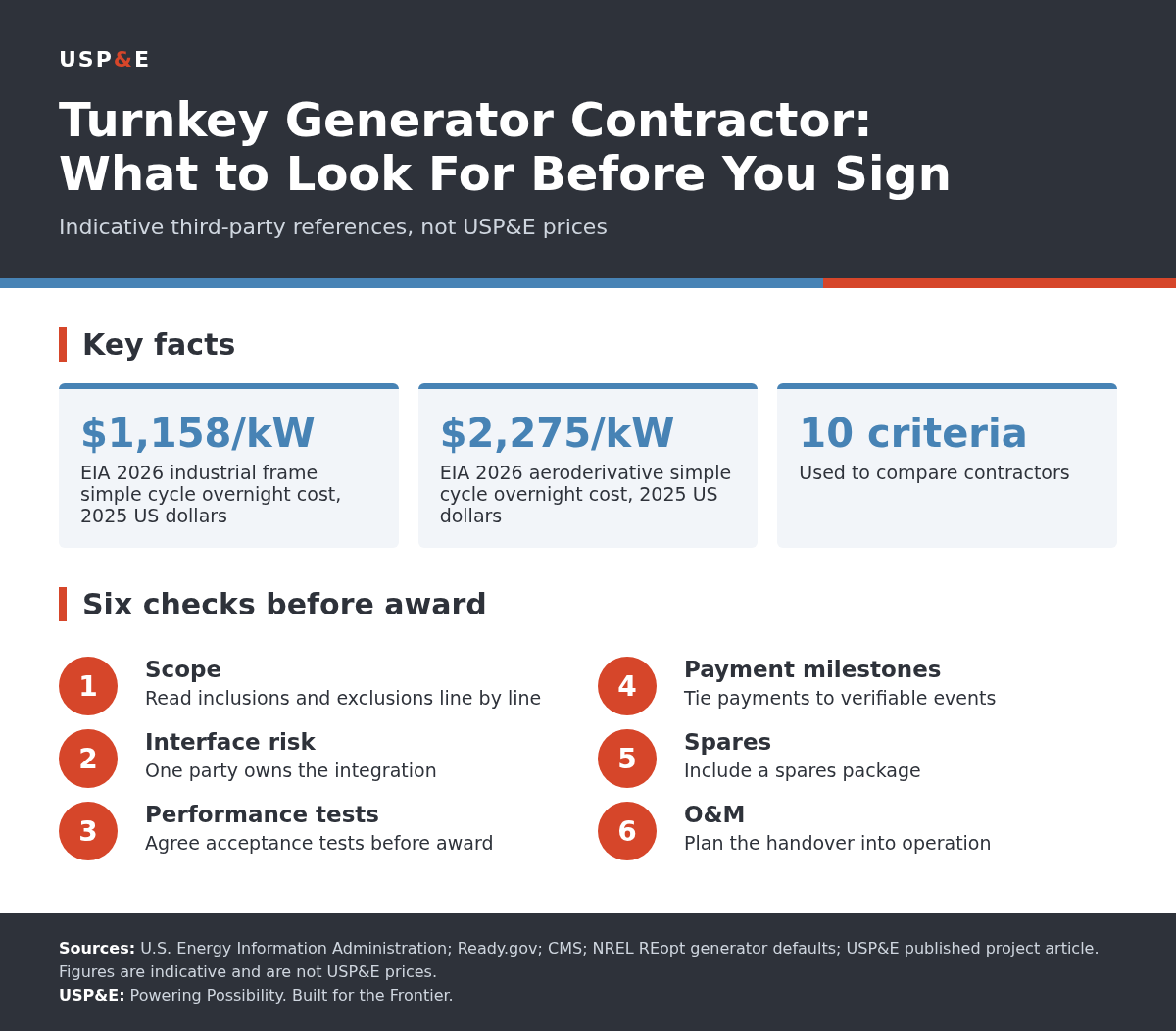
For scale, the U.S. Energy Information Administration’s Assumptions to the Annual Energy Outlook 2026 puts the total overnight cost of a new industrial frame simple cycle plant at about $1,158 per kW, and a new aeroderivative simple cycle plant at about $2,275 per kW, in 2025 US dollars. The EIA also publishes capital cost and performance characteristics for generating technologies. These are large United States plant costs, shown only as a scale comparison.
For smaller engine plants, the National Renewable Energy Laboratory’s REopt model, in its published generator cost defaults, uses about $650 to $880 per kW for installed diesel generator plant, with fixed operating cost of about $10 to $20 per kW per year plus fuel. Those are model defaults, not quotations.
|
Turnkey generator contractor budget layer |
What it covers |
Risk if ignored |
|
Equipment |
Sets, switchgear, tanks, controls |
Price may exclude auxiliaries |
|
Installation |
Civil, mechanical and electrical works |
Poor access raises cost |
|
Engineering and management |
Design, procurement, supervision |
Thin management causes delay |
|
Commissioning |
Tests, synchronisation, training |
Skipped tests hide faults |
|
Contingency |
Allowance for unknowns |
Too little leads to variations |
Fuel Type Comparison
|
Fuel Type |
CapEx Range |
OpEx Range |
Typical Lead Time |
Best Application |
|
Diesel engine plant |
About $650 to $880/kW installed (NREL REopt defaults) |
About $10 to $20/kW per year fixed, plus fuel (NREL REopt defaults) |
Varies with size and package |
Backup, prime and remote power |
|
Natural gas engine plant |
Fuel often cheaper where pipeline gas is reliable |
Varies with package |
Sites with firm gas supply |
|
|
New industrial frame turbine plant |
About $1,158/kW installed (EIA 2026, 2025 US dollars) |
About $7.18/kW per year plus $4.17/MWh (EIA 2026) |
More than five years for large new units in tight markets |
Large utility or industrial plants |
|
New aeroderivative turbine plant |
About $2,275/kW installed (EIA 2026, 2025 US dollars) |
About $9.99/kW per year plus $5.97/MWh (EIA 2026) |
18 to 36 months for smaller new turbines is a published market range |
Fast-ramping larger plants |
Sources: NREL REopt generator defaults; U.S. Energy Information Administration, Assumptions to the Annual Energy Outlook 2026, Table 3. Blank cells could not be verified from a comparable official source. These are not USP&E prices, and the turbine figures describe much larger United States plants.
New vs Used Equipment Under a Turnkey Generator Contractor
A turnkey generator contractor can build with new or used equipment, and the choice affects schedule and cost. New equipment brings warranty and a clean history, though lead times for large units can be long. Used equipment can be available sooner and can reduce capital cost, but only if it has been inspected, tested and refurbished where needed. The contractor should state which route is proposed and what warranty applies to each item.
Where used equipment is proposed, the owner should insist on a documented inspection, a records audit and a performance test before acceptance. Title must be clear. USP&E explains the process in its guide to how to buy a used gas turbine and sets out the warning signs in its guide to how to spot a power plant broker scam. Buyers can also browse the MW generators category.
USP&E is an independent seller and is not affiliated with any engine, turbine or generator manufacturer named by buyers during a project. Those names are trademarks of their respective owners.
Spares planning belongs in the turnkey scope. A plant that is handed over with no spares will be down for weeks after a minor fault. USP&E explains the approach in its guide to power plant critical spares strategy.
Emissions and Permits Within a Turnkey Generator Contractor Scope
Permitting is a major risk and should be written into the contract. In the United States, the U.S. Environmental Protection Agency regulates stationary engines under its stationary engines programme. Other countries set their own limits. A turnkey generator contractor should confirm who obtains each permit, who pays for studies, and what happens if approval is delayed.
Access to the grid and to fuel are also permit-like risks. The World Bank tracks the share of people with access to electricity, and many project sites sit in places where connection and fuel supply are difficult. The contractor’s plan for fuel logistics and grid connection should be part of the proposal, not left for later.
Case Studies: Turnkey Generator Contractor Lessons from Real Projects
USP&E only publishes approved case studies, and it does not name clients without permission. USP&E has delivered projects in 45+ countries, including power plant EPC projects and operations and maintenance work, and approved examples are collected on the case studies page. No outcome specific to a turnkey generator contractor is claimed here beyond what is published.
The lessons below reflect common practice, not a named project:
- Owners who define performance tests before award avoid disputes at handover.
- Owners who clarify exclusions in a lump sum avoid a flood of variations.
- Owners who require a spares package at handover avoid long outages after a minor fault.
- Owners who choose a contractor with O&M capability get a smoother transition into operation.
How to Choose a Turnkey Generator Contractor: 10 Criteria
- Track record. Ask for approved references on projects of similar size, fuel and location. USP&E has delivered 150+ power projects in 45+ countries since 2002.
- Single point responsibility. Confirm that one party owns interface risk between equipment, civil and electrical works.
- Scope clarity. Check inclusions and exclusions line by line. A low price with a vague scope is not a bargain.
- Engineering depth. Ask who will do the load studies, protection design and layout, and how they will be reviewed.
- Procurement strength. Check access to new and used equipment, inspection routines and title verification.
- Commissioning plan. Require a written plan for tests, synchronisation and performance acceptance.
- Safety and quality systems. Look for recognised systems such as ISO 9001:2015 and ISO 45001:2018, and ask for site safety records.
- Permitting and logistics. Confirm who obtains each permit and how fuel and equipment will reach the site.
- O&M capability. A contractor who can operate the plant reduces handover risk. USP&E offers O&M with 95%+ O&M availability as an official company figure.
- Contract clarity. Delivery date, damages, payment milestones, warranty and acceptance tests should be in writing.
FAQ: Turnkey Generator Contractor
What is a turnkey generator contractor?
A turnkey generator contractor designs, supplies, installs, tests and hands over a working power plant under one contract. The owner receives a plant ready to run. The contractor carries the integration risk between equipment, civil and electrical works, which is the main reason owners choose a turnkey route.
Is a turnkey contract always lump sum?
No. Lump sum is the most common structure, because it gives price certainty. Other structures include target cost and EPCM arrangements, which allocate risk differently. Whatever the structure, the owner should understand who carries which risk and what the scope excludes before signing with a turnkey generator contractor.
What performance tests should I require?
Require tests for output, fuel consumption, voltage and frequency stability, load acceptance, protection operation and emissions where relevant. Agree the test procedure, the acceptance criteria and the remedy for failure before contract award. Tests should run at site conditions and be witnessed by the owner or an independent engineer.
How do I compare turnkey bids?
Compare scope line by line, not only price. Check exclusions, equipment makes, test requirements, delay damages, warranty and spares. A low bid with a vague scope often costs more after variations. Ask each turnkey generator contractor to explain how their price covers interface risk.
Can a turnkey generator contractor use used equipment?
Yes, if inspection, testing and title are documented. Used equipment can shorten schedules and reduce capital cost. Require a records audit, a performance test and clear warranty terms. Ensure the contractor states which items are new and which are used.
Why does O&M matter for a turnkey contract?
A contractor with operations and maintenance capability understands how the plant will be run, so designs for maintainability and hands over a plant that operators can support. It also gives the owner a single party to call if a fault appears after handover.
What does USP&E need to quote?
USP&E needs the site location, the load, the fuel, the voltage and frequency, and when you need power. With these inputs, USP&E can describe how a turnkey generator contractor scope would work for your project and what information is still needed.
Key Takeaways: Turnkey Generator Contractor
- A turnkey generator contractor owns the integration risk from design to handover.
- Check scope, exclusions and performance tests before comparing price.
- Make permits, fuel logistics and grid connection part of the contract.
- Require spares and a documented handover.
- Choose a contractor with engineering, EPC and O&M depth, not a trader alone.
A well defined contract turns a complex build into a solvable one. When you are ready to plan, USP&E’s engineers can help you assess your needs as a turnkey generator contractor would, define the scope and bring the plant to power.
Ready to Power Your Project? Talk to USP&E’s Engineers.
Whether you are in early feasibility or ready to mobilise on a power station, EPC, or O&M project, USP&E’s engineers can help. With 150+ power projects delivered in 45+ countries since 2002, our engineers remove the technical and commercial risk from your project, with speed and without excuses.
Contact USP&E Today Request a Fast Quote
USP&E: Powering Possibility. Built for the Frontier. ISO 9001:2015 | ISO 45001:2018 | 150+ power projects in 45+ countries | 25,000 MW contracted since 2002 | 24+ years