

Power Plant Critical Spares Strategy: The Remote Site Stocking Guide
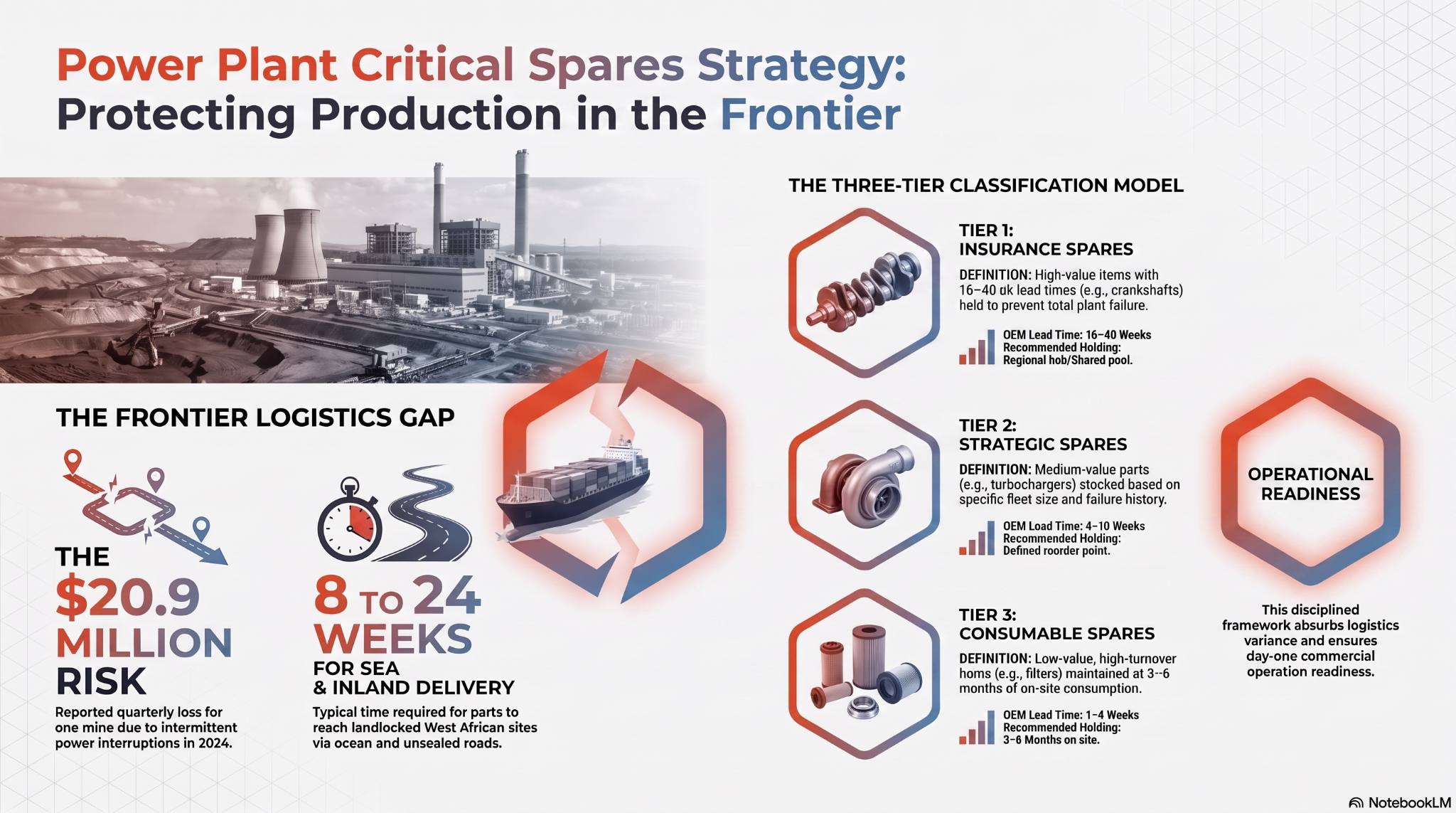
When a turbocharger fails on a 6 MW engine at a gold mine in western Mali, the plant does not lose 6 MW. It loses the mill. In 2024, Allied Gold reported that intermittent power interruptions in Cote d’Ivoire cost it roughly 8,625 ounces of gold production in a single quarter, a shortfall valued at approximately USD 20.9 million at the gold price of the time. The engine component that triggers an event like that is rarely exotic and rarely expensive. It is usually a part that costs a few thousand dollars, sits on a shelf in Europe or the United States, and takes eleven weeks to reach site.
That gap between the cost of the part and the cost of its absence is the entire argument for a disciplined power plant critical spares strategy. In frontier markets, where the nearest OEM depot may be three countries away and customs clearance can consume more calendar time than manufacturing, spares planning is not a warehouse function. It is a production protection function, and it belongs in the same risk register as fuel supply and grid stability.
Your plant is the hero of this story. The mill has to turn, the tariff has to be met, and the availability guarantee has to hold. USP&E Global has spent 25 years operating power stations in exactly these conditions, across 150 projects in more than 35 countries, with 350 engineers and offices in the USA, UAE, South Africa, and Mali. What follows is the framework our operations teams use to decide what to hold, how much of it, and where to hold it.
The Reliability Challenge at Remote Power Stations: What the Data Shows
Remote generation exists because the grid does not reach, or does not hold. That single fact shapes every spares decision that follows, because there is no import capacity to lean on when a unit trips.
The scale of the underlying reliability gap is well documented. According to the International Energy Agency, around 600 million people in sub-Saharan Africa still lacked access to electricity as of 2024, roughly 47 percent of the population, and the region now accounts for approximately eight out of every ten people worldwide without a connection. The World Bank energy and mining data portal tracks the same trend in installed capacity terms: South Africa and North Africa together hold over 65 percent of the continent’s installed electrical capacity while representing under 20 percent of its population.
|
Reliability Context for Remote Power Station Spares Planning |
Figure |
Year |
Source |
|
People in sub-Saharan Africa without electricity access |
Approximately 600 million |
2024 |
IEA |
|
Share of sub-Saharan African population without access |
Approximately 47 percent |
2024 |
IEA |
|
Share of global unelectrified population in sub-Saharan Africa |
Approximately 80 percent |
2024 |
IEA |
|
Investment required for universal access in sub-Saharan Africa |
Approximately USD 150 billion |
2025 estimate |
IEA |
|
Share of continental installed capacity in South Africa and North Africa |
Over 65 percent |
2025 |
IEA World Energy Investment |
For a mine, an industrial plant, or an independent power producer operating beyond the reach of a dependable grid, these numbers translate into a specific operational condition: the on site power station is the only source of supply, and every hour it is unavailable is an hour of lost production. The African Development Bank energy portfolio and the International Finance Corporation both treat demonstrable operational reliability as a precondition for financing generation assets in these markets, which means a documented spares plan increasingly carries weight with lenders as well as with plant managers.
The compounding factor is logistics. A part manufactured in Germany reaches a landlocked West African mine site through a sequence of ocean freight, port clearance, inland trucking, and final delivery over unsealed road. Each stage adds variance, and variance is what a power plant critical spares strategy exists to absorb.
Key Drivers of Power Plant Critical Spares Strategy in Frontier Markets: Why Now Is the Critical Window
Five drivers are pushing spares discipline from an operational nicety to a contractual and financial requirement.
- Extended and volatile OEM lead times. Global supply chains for rotating equipment have not returned to pre-2020 rhythms. Long lead castings, turbocharger cartridges, alternator rewinds, and control system boards routinely quote in months rather than weeks. Where a part once arrived in six weeks, a nine to sixteen week window is now common, and that shift alone invalidates stocking rules written before 2020.
- The critical minerals expansion across West and Central Africa. Gold, lithium, bauxite, copper, and manganese projects in Mali, Burkina Faso, Guinea, Liberia, and the Democratic Republic of Congo are commissioning at scale, almost all of them off grid or grid insecure. Each new mine adds a power station whose availability is directly coupled to commodity revenue.
- Availability guarantees moving into contract. Mining and industrial offtakers increasingly require contractual availability, commonly 90 to 95 percent for continuous duty thermal plant, backed by liquidated damages. An operator cannot underwrite that number without controlling parts access, which makes spares a commercial exposure rather than a maintenance preference.
- Emergency procurement economics. Parts bought under outage pressure carry a premium. Expedited air freight, weekend clearance, and OEM emergency pricing typically add substantially to the planned purchase cost of the same item, and the reactive repair itself costs multiples of the same work performed on schedule. Holding cost is knowable. Emergency cost is not.
- Bankability and lender scrutiny. Development finance institutions reviewing independent power producer projects now expect a written spares plan, defined stock levels, and a named storage location before financial close. A spares list assembled after commissioning is a red flag in due diligence.
|
Part Class |
Typical OEM Lead Time |
Air Freight to Remote West Africa |
Sea Freight and Inland Delivery |
Recommended Holding Position |
|
Filters, belts, gaskets, lube oil |
1 to 4 weeks |
5 to 10 days |
8 to 14 weeks |
On site, 3 to 6 months of consumption |
|
Injectors, fuel pumps, sensors, relays |
4 to 10 weeks |
7 to 14 days |
10 to 16 weeks |
On site, defined minimum and reorder point |
|
Turbocharger cartridge, cylinder head, piston assembly |
8 to 20 weeks |
10 to 21 days |
12 to 20 weeks |
On site or regional hub, one set minimum |
|
Alternator rotor, main bearings, crankshaft |
16 to 40 weeks |
14 to 28 days, oversize |
16 to 24 weeks |
Regional hub or shared pool |
|
Step up transformer, switchgear panel |
40 to 100 weeks |
Not practical |
20 to 30 weeks |
Pre order or shared pool, never post failure |
Lead time ranges above reflect general frontier market planning experience and should be re confirmed against current OEM quotations for the specific fleet before they are written into a stocking plan.
Building the Power Plant Critical Spares List: A Technical and Commercial Framework
A power plant critical spares strategy is not a shopping list. It is a set of explicit risk decisions, one per component, documented so that anyone auditing the plant can see why an item is held and why another is not.
Three definitions matter before the framework makes sense. O&M means operations and maintenance, the contracted running of the plant after construction ends. EOH means equivalent operating hours, the run time measure that governs service intervals on turbines and engines. CMMS means computerised maintenance management system, the software that links asset records to inventory and work orders. Without a CMMS, stock levels drift within a year of commissioning.
The Three Tier Classification Model
Every component on a remote power station belongs in one of three tiers, and the tier determines the stocking rule.
|
Power Plant Critical Spares Strategy Tier |
Definition |
Stocking Rule |
Typical Value Profile |
Example Components |
|
Tier 1, Insurance |
Failure trips the unit or the plant; lead time exceeds 6 months |
Hold one minimum regardless of cost, or secure a shared pool agreement |
High value, near zero turnover |
Alternator rotor, crankshaft, step up transformer, turbine hot section set |
|
Tier 2, Strategic |
Failure derates or stops one unit; lead time 2 to 6 months |
Hold to a calculated minimum based on fleet size and failure history |
Medium value, low turnover |
Turbocharger cartridge, cylinder head, fuel injection pump, control card |
|
Tier 3, Consumable |
Routine wear and scheduled replacement |
Hold 3 to 6 months of consumption with defined reorder points |
Low value, high turnover |
Filters, gaskets, belts, hoses, lube oil, coolant additive |
The discipline lives in Tier 1. The rule USP&E applies is straightforward: if the component’s failure causes a full unit trip and its replacement lead time exceeds six months, one unit is held or contractually secured, and the decision is made before the failure rather than after it. A plant that orders a step up transformer after it fails will wait a year or more while carrying full outage cost throughout.
The Power Plant Critical Spares List by Technology
Fleet composition changes the list materially. Reciprocating engines are parts intensive and forgiving of partial capacity. Gas turbines are parts light in day to day terms but carry very high value life limited components at defined EOH intervals.
|
Technology |
Tier 1 Insurance Spares |
Tier 2 Strategic Spares |
Tier 3 Consumables |
|
HFO reciprocating engine |
Crankshaft, alternator rotor, engine block spare unit |
Cylinder heads, turbocharger cartridges, piston and liner sets, fuel pumps, purifier bowl |
Fuel and lube filters, separator plates, gaskets, valve seats, treatment chemicals |
|
Diesel reciprocating engine |
Alternator rotor, main bearing set |
Cylinder heads, turbocharger, injectors, water pump, governor actuator |
Filters, belts, hoses, coolant, lube oil |
|
Natural gas reciprocating engine |
Alternator rotor, crankshaft |
Spark plugs in bulk, ignition coils, turbocharger, detonation sensors, cylinder heads |
Air and oil filters, gaskets, lube oil, spark plug consumables |
|
Aeroderivative gas turbine |
Hot section set, gas generator swap unit, main gearbox |
Combustion liners, fuel nozzles, igniters, variable geometry actuators, control cards |
Inlet air filters, lube oil, seals, borescope consumables |
|
Balance of plant, all fuels |
Step up transformer, main breaker |
HT and LT cabling spares, cooling fans, pump motors, PLC modules, battery banks |
Instrument fittings, terminal blocks, lamps, fuses, filters |
USP&E maintains this discipline across the fleets it operates, including the HFO generator sets and natural gas turbines in its inventory and under management, with equipment specific stocking rules developed during power plant engineering rather than improvised after handover. Mobile aeroderivative units such as the GE TM2500 shift the calculation again, because the gas generator itself can be swapped as a module, which changes what needs to sit on the shelf.
Setting Generator Spare Parts Stock Levels
Generator spare parts stock levels should scale with three variables: the number of identical units in the fleet, the criticality of continuous supply, and the realistic replenishment window from the chosen supply route. Fleet standardisation is the single most powerful lever available, because eight identical engines share one spares pool while eight different engines require eight.
|
Plant Configuration |
Identical Units |
Indicative Spares Holding as Percentage of Equipment Value |
Minimum Consumable Cover |
Tier 1 Position |
|
Single unit, critical load |
1 |
5 to 8 percent |
6 months on site |
Full insurance set on site |
|
Small fleet, 5 to 15 MW |
2 to 4 |
4 to 6 percent |
4 to 6 months on site |
One insurance set on site |
|
Mid fleet, 15 to 60 MW |
5 to 10 |
3 to 5 percent |
3 to 6 months on site |
One insurance set per engine model |
|
Large fleet, 60 MW and above |
10 and above |
2 to 4 percent |
3 months on site plus hub buffer |
Shared pool plus regional hub |
|
Multi site portfolio |
Across sites |
2 to 3 percent |
3 months on site |
Regional hub with rotable pool |
Percentages above are planning ranges, not guarantees, and should be validated against the actual fleet bill of materials and failure history before budgeting. Two further cost realities belong in the same conversation. First, the annual carrying cost of held inventory, covering capital, warehousing, insurance, and obsolescence, is commonly planned in the region of 20 to 30 percent of inventory value. Second, obsolete or surplus stock accumulates quickly, and periodic audits that reconcile inventory records against the live asset register are what prevent a storeroom full of parts for equipment that was retired two years ago.
Fuel Type Comparison for Frontier Market Power Projects
|
Fuel Type |
CapEx per MW Installed |
OpEx Profile |
Lead Time to Commercial Operation |
Best Application |
|
Diesel reciprocating |
USD 400,000 to 800,000 |
High fuel cost, moderate parts cost |
8 to 16 weeks for containerised units |
Fast track, bridging power, standby, small mines |
|
HFO reciprocating |
USD 800,000 to 1,500,000 |
Lowest fuel cost, highest parts and treatment cost |
9 to 14 months, never fast track |
Continuous base load, large mines, industrial |
|
Natural gas reciprocating |
USD 700,000 to 1,200,000 |
Low fuel cost where gas is piped, moderate parts cost |
6 to 12 months plus gas connection |
Gas adjacent industry, utility base load |
|
Mobile aeroderivative turbine |
USD 700,000 to 1,300,000 |
Fuel sensitive, high value life limited parts |
12 to 24 weeks for mobile units |
Utility peaking, emergency capacity, data centres |
|
Solar plus storage hybrid |
USD 900,000 to 1,600,000 |
Very low OpEx, minimal rotating spares |
9 to 18 months |
Fuel cost reduction layered onto thermal base |
CapEx ranges are honest planning ranges for frontier market delivery including balance of plant, civil works, and fuel infrastructure, and they vary materially with site access, ambient conditions, and local content requirements. HFO deserves a specific warning that USP&E gives every client: HFO power stations are never fast track. Engineering, balance of plant manufacturing, civil works, and class four pipe welding place a realistic floor of nine to fourteen months on delivery, and any party promising a commissioned HFO plant in ninety days should be treated with extreme caution.
Mobilising Spares: Fast Track Versus Standard Sequencing
|
Spares Mobilisation Activity |
Standard Sequence |
Fast Track Sequence with Pre Positioning |
|
Fleet bill of materials and criticality ranking |
Weeks 1 to 6 |
Completed during EPC engineering phase |
|
Tier 1 and Tier 2 procurement and manufacture |
Weeks 6 to 30 |
Ordered alongside prime movers, arrives with plant |
|
Consumable stock build to reorder points |
Weeks 20 to 34 |
Shipped in the same consignment as the units |
|
Warehouse, bin locations, CMMS load |
Weeks 26 to 38 |
Configured before first fire |
|
Full stocking position achieved |
Month 9 to 12 after handover |
Day one of commercial operation |
The difference between those two columns is roughly a year of exposure, and it is decided during engineering, not during operations. This is why USP&E integrates spares planning into EPC construction scope rather than treating it as a post commissioning task, and why our operations and maintenance contracts specify the stocking position as a deliverable. Consumption data flowing from SmartPower into the maintenance management system is what keeps those levels honest over a multi year term.
Case Studies: Proven Power Plant Critical Spares Strategy Results in West Africa and Similar Markets
Mali, over 100 MW, HFO and diesel reciprocating, O&M turnaround. USP&E was appointed to recover a mining power plant comprising 15 CAT CM32 engines that had been left in critical condition by the previous operator. The scope included forensic root cause analysis across the fleet, engine rebuilds, turbocharger upgrades, cooling water and fuel quality remediation, the installation of three new zero hour CM32 engines, and a rebuilt spare parts management regime. By 2024 the plant had reached 95 percent availability, and maintenance cost per engine had been reduced by 66 percent against the previous operator’s performance. Fleet standardisation on a single engine model was central to making the spares pool affordable at that availability level.
Burkina Faso, Perkoa Zinc Mine, Caterpillar 3516B and MaK 6CM32, emergency rebuild and spares supply. USP&E mobilised within days to stabilise an ageing power station that was threatening mining continuity, completing major overhauls, scheduled services, and life extension work backed by a one year warranty, with spare parts supply forming a defined element of the award. The mobilisation speed was possible because parts and people were already positioned in the region rather than sourced from scratch.
Sierra Leone and Togo, diesel and HFO plant, long term O&M. USP&E has designed, built, and operated diesel and HFO power stations in Sierra Leone since 2009 and operates generation assets in Togo, in both cases for clients whose production depends entirely on on site supply. Across its portfolio USP&E manages over 260 MW under long term O&M agreements and has delivered over USD 250 million in fuel and operating savings to clients, holding ISO 9001:2015 and ISO 45001:2018 certification with zero lawsuits in 25 years of operation.
These outcomes are documented further in the USP&E project portfolio and client references. The common thread across all three is unremarkable: the parts were already there.
How to Select an O&M Partner for Power Plant Critical Spares Strategy: 10 Critical Criteria
- Ask for the written spares plan before contract signature. A credible partner produces a document that classifies every component as insurance, strategic, or consumable, names the storage location for each class, and states maximum replenishment lead times. Any provider who cannot produce this before signing is not ready to execute the scope.
- Confirm who owns the inventory. Spare parts ownership can sit with the buyer, the contractor, or be jointly held, and each structure has different consequences at contract end. Establish in writing what happens to unconsumed stock on expiry or termination.
- Verify a physical regional presence. Pre positioning is meaningless without a warehouse, a workshop, and a customs relationship inside the region. Ask which specific facility holds your Tier 1 parts and how long delivery from that facility to your site actually takes.
- Test technology specific depth. An operator experienced on HFO reciprocating engines will not automatically deliver equivalent results on an aeroderivative gas turbine. Ask for OEM specific evidence for each technology in your fleet, supported by project records rather than marketing claims.
- Require a CMMS, not a spreadsheet. Generator spare parts stock levels drift within months without software that links consumption to reorder points and asset records. Ask to see the system, the reports it produces, and who is accountable for reviewing them.
- Interrogate the availability guarantee. A contractual availability number is only as credible as the parts access behind it. Ask what the guarantee excludes, what remedies apply, and how the stocking position underwrites the commitment.
- Check customs and import competence. In frontier markets, clearance frequently takes longer than manufacturing. Ask specifically about bonded warehousing, duty exemptions available to power projects, and documented clearance times in your jurisdiction.
- Push for fleet standardisation advice. A partner who recommends standardising on fewer engine models is protecting your spares budget. A partner indifferent to fleet mix will leave you funding parallel inventories.
- Confirm compliance posture. Verify Foreign Corrupt Practices Act and Office of Foreign Assets Control compliance, along with ISO 9001 quality and ISO 45001 safety certification. Parts sourcing crosses borders, and sanctions exposure sits in the supply chain.
- Insist on local capability transfer. The most durable spares programme is one your own team can run. Ask what training, documentation, and handover the partner commits to, so that plant reliability outlives the contract.
Frequently Asked Questions: Power Plant Critical Spares Strategy and Stock Levels
What spare parts should a remote power station hold?
A remote power station should hold three categories of parts. Consumables such as fuel and lube filters, gaskets, belts, and treatment chemicals should cover three to six months of consumption on site. Strategic spares such as turbocharger cartridges, cylinder heads, injection pumps, and control cards should be held to a calculated minimum based on fleet size and failure history. Insurance spares such as alternator rotors, crankshafts, and step up transformers should be held as one unit minimum, or secured through a shared pool, whenever failure trips the plant and lead time exceeds six months.
How much should a power plant spend on spare parts inventory?
Indicative holding for a remote thermal power station falls between roughly 2 and 8 percent of equipment value, with single unit critical load plants at the top of that range and large standardised fleets at the bottom. Annual carrying cost on that inventory, covering capital, storage, insurance, and obsolescence, is commonly planned at 20 to 30 percent of inventory value. Those figures should always be validated against the specific fleet bill of materials before budgeting.
What is the difference between insurance spares and strategic spares?
Insurance spares are components whose failure causes a complete plant or unit trip and whose replacement lead time is so long, typically over six months, that the part must be on hand before it is needed. Strategic spares reduce or interrupt output from a single unit and carry lead times of roughly two to six months, so they are stocked to a calculated minimum rather than automatically held. The distinction matters because insurance spares are justified by outage risk while strategic spares are justified by consumption probability.
How long does it take to get spare parts to a remote power plant in Africa?
Common consumables and wear parts typically quote at one to four weeks from the supplier, while critical long lead items can run three to six months or longer. Delivery time then sits on top of that. Air freight to a remote West African site typically takes five to twenty one days depending on part size and clearance, while sea freight with inland trucking runs eight to twenty four weeks. This is precisely why pre positioning, not expediting, is the reliable answer.
Does an LTSA or O&M contract include spare parts?
A properly structured long term service agreement or O&M contract specifies the minimum critical spare parts inventory to be held on site or at a defined regional hub, the maximum lead time from order to delivery for each part class, and the ownership structure of the inventory. If the contract is silent on these three points, the availability guarantee it contains is not underwritten. Spare parts inventory management is also available as a standalone service where the plant is operated in house.
How do you set generator spare parts stock levels?
Generator spare parts stock levels are set from three inputs: the number of identical units in the fleet, the criticality of continuous supply, and the realistic replenishment window from the chosen supply route. Fleet standardisation is the strongest lever, because identical units share one spares pool while mixed fleets require parallel inventories. Reorder points should then be driven from actual consumption data held in a maintenance management system, and reviewed at least annually against the live asset register to remove obsolete stock.
Can a power plant critical spares strategy be added after commissioning?
Yes, but it costs more and exposes the plant to roughly a year of avoidable risk. When spares are procured alongside the prime movers during the EPC phase, the full stocking position exists on day one of commercial operation. When the exercise begins after handover, the bill of materials, procurement, manufacture, and warehouse setup typically place the plant nine to twelve months away from a defensible position, and every failure inside that window is handled by emergency purchase at premium cost.
Summary: Key Takeaways for Power Plant Critical Spares Strategy Decision Makers
- A power plant critical spares strategy protects production, not just equipment. The cost of a missing part is measured in lost output, not in the price of the part.
- Classify every component into three tiers. Insurance spares are held whenever failure trips the plant and lead time exceeds six months, strategic spares are stocked to a calculated minimum, and consumables cover three to six months of use.
- Indicative holding runs 2 to 8 percent of equipment value depending on fleet size and standardisation, with annual carrying cost commonly planned at 20 to 30 percent of inventory value.
- Fleet standardisation is the single most effective cost lever available. Identical units share one spares pool; mixed fleets fund several.
- Lead time, not price, drives the stocking decision. Consumables quote in weeks, insurance spares in months to years, and delivery into remote sites adds weeks again.
- Plan spares during engineering, not after handover. Pre positioning delivers a full stocking position on day one instead of nine to twelve months later.
- Put the stocking position in the contract. A written spares plan with named locations, defined stock levels, and stated lead times is what makes an availability guarantee real, and it is now expected in lender due diligence as well.
USP&E Global has built its power plant critical spares strategy discipline across 150 projects in more than 35 countries over 25 years, with 350 engineers, over 260 MW under long term O&M management, ISO 9001:2015 and ISO 45001:2018 certification, and zero lawsuits. Your plant is the hero. We are the guide who has already made these decisions on sites like yours.
Ready to Power Your Project? Talk to USP&E’s Engineers Free.
USP&E Global offers a complimentary 4-hour engineering consultation for qualified power station, EPC, and O&M projects. Whether you are in early feasibility or ready to mobilize, our team of 350+ engineers across 35+ countries is ready to guide your project to success with speed and without excuses.
USP&E Global. Powering Possibility. Built for the Frontier.
ISO 9001:2015 | ISO 45001:2018 | 150+ Projects | 35+ Countries | Zero Lawsuits
Quick Links:
- Contact USP&E by clicking on this link.
- Request a fast equipment quote
Global Resources
- USP&E's Project Experience Portfolio
- USP&E Case Studies and Client Reference Letters
- USP&E Integrity and Compliance policy
- USP&E's ISO Certifications and Credentials