

How to Buy a Used Gas Turbine: The Complete Inspection, NDA and Deposit Process
Knowing how to buy a used gas turbine correctly is the difference between a project that comes online on time and within budget, and one that stalls in legal disputes over undisclosed asset condition, missing documentation, or a vendor who disappeared after cashing a deposit. The global secondary market for used gas turbines and engine-driven power stations is large, fragmented, and largely unregulated. There are no mandatory disclosure standards, no universal inspection protocols, and no governing body that polices sellers. Buyers are entirely responsible for their own due diligence.
USP&E Global has been buying, selling, inspecting, and deploying used gas turbines and engine-driven power stations for 25 years across more than 35 countries. In that time, USP&E has developed and refined a procurement process that protects buyers, qualifies sellers, satisfies OFAC and FCPA compliance requirements, and consistently delivers projects that perform as represented. This article is the definitive step-by-step guide to how to buy a used gas turbine, covering the NDA, the Know Your Customer (KYC) verification process, the physical inspection, the USD 20,000 inspection facilitation fee, the 20 percent reservation deposit, and every step from initial enquiry to asset delivery.
Whether you are a mining company energy manager, an IPP developer, a utility procurement officer, or a government ministry sourcing emergency generation capacity, this guide gives you the exact framework USP&E applies to every used gas turbine and power station transaction in its global portfolio.
Section 2: Why the Used Gas Turbine Market Requires a Structured Purchase Process
The global secondary market for power generation equipment is estimated to represent several billion US dollars annually. The U.S. Energy Information Administration tracks over 1,100 GW of installed gas turbine capacity across the United States alone, much of which turns over through asset sales, decommissioning, and project restructuring every year. Globally, the volume is far larger. In frontier and emerging markets, second-hand gas turbines and reciprocating engines represent the fastest route to installed generation capacity for projects where new equipment manufacturing lead times of 12 to 24 months are commercially unacceptable.
The challenge for buyers is that the secondary market is entirely opaque. Sellers range from credentialled international EPC contractors with full documentation packages, to brokers who have never set foot on the asset they are offering, to outright fraudsters who collect deposits on equipment they do not own. Without a structured purchase process, buyers have no reliable way to distinguish between these categories.
The World Bank’s Regulatory Indicators for Sustainable Energy (RISE) programme has identified procurement transparency as one of the critical barriers to energy access in developing economies. When governments and utilities in West Africa, the Middle East, and Southeast Asia purchase used generation equipment through unvetted brokers without inspection protocols, the result is frequently equipment that is misrepresented, incomplete, or incapable of sustained operation at the rated output. This directly undermines energy access targets and wastes capital that frontier economies can rarely afford to lose.
USP&E’s structured purchase process eliminates these risks through a sequence of mandatory steps that every buyer must complete before USP&E releases detailed asset information, facilitates an inspection, or accepts a deposit. This process is not bureaucracy. It is the foundation of every successful used gas turbine transaction USP&E has completed in 25 years of operation.
Section 3: The Complete Used Gas Turbine Inspection Checklist
Before any transaction proceeds to a term sheet or deposit, the physical condition of the asset must be independently verified. USP&E facilitates third-party inspections by internationally accredited inspection bodies including SGS, TUV Rheinland, Bureau Veritas, and equivalent organisations. The following table is the standard inspection checklist USP&E applies to every how to buy a used gas turbine engagement, regardless of asset type, age, or geography.
Table 1: Used Gas Turbine and Power Station Inspection Checklist
|
Inspection Category |
Key Items to Verify |
Red Flags That Should Stop a Purchase |
|
Engine Hours and Starts |
Original hours from factory, hours since last major overhaul, number of starts on record |
Missing or incomplete logbooks, inconsistent hour counts, unusually high start cycles relative to run hours |
|
Borescope Inspection |
Combustion liner condition, turbine blade tip clearance, compressor blade erosion, hot section deposits |
Blade tip rubs, excessive hot section cracking, compressor fouling that cannot be washed, foreign object damage |
|
Vibration Analysis |
Baseline vibration signature at all operating speeds, bearing condition, rotor balance |
Vibration levels above OEM limits, unexplained spikes at critical speeds, evidence of historic bearing failures |
|
Oil and Fluid Analysis |
Lube oil sampling for metal content, fuel system integrity, coolant contamination check |
High iron or copper content in oil samples (indicates internal wear), coolant in lube oil, fuel dilution |
|
Electrical and Controls |
Control system software version, generator insulation resistance, exciter condition, protection relay settings |
Obsolete or unsupported control software, low insulation resistance on generator windings, damaged relay panels |
|
Mechanical and Auxiliaries |
Inlet filter and exhaust system condition, fuel system completeness, auxiliary skid integrity, coupling condition |
Missing auxiliary components, corroded fuel trains, cracked exhaust ducting, coupling wear beyond OEM limits |
|
Documentation Package |
OEM certificates, as-built drawings, service history, spare parts list, previous test reports |
No documentation available, third-party reports only, refusal to share service records, no nameplate data |
|
Scope of Supply |
Confirm exactly what is included: prime mover only, or with alternator, control panel, and auxiliaries |
Verbal scope that does not match physical site inventory, items listed but not on site, missing alternator |
Borescope Inspection: The Non-Negotiable Technical Standard
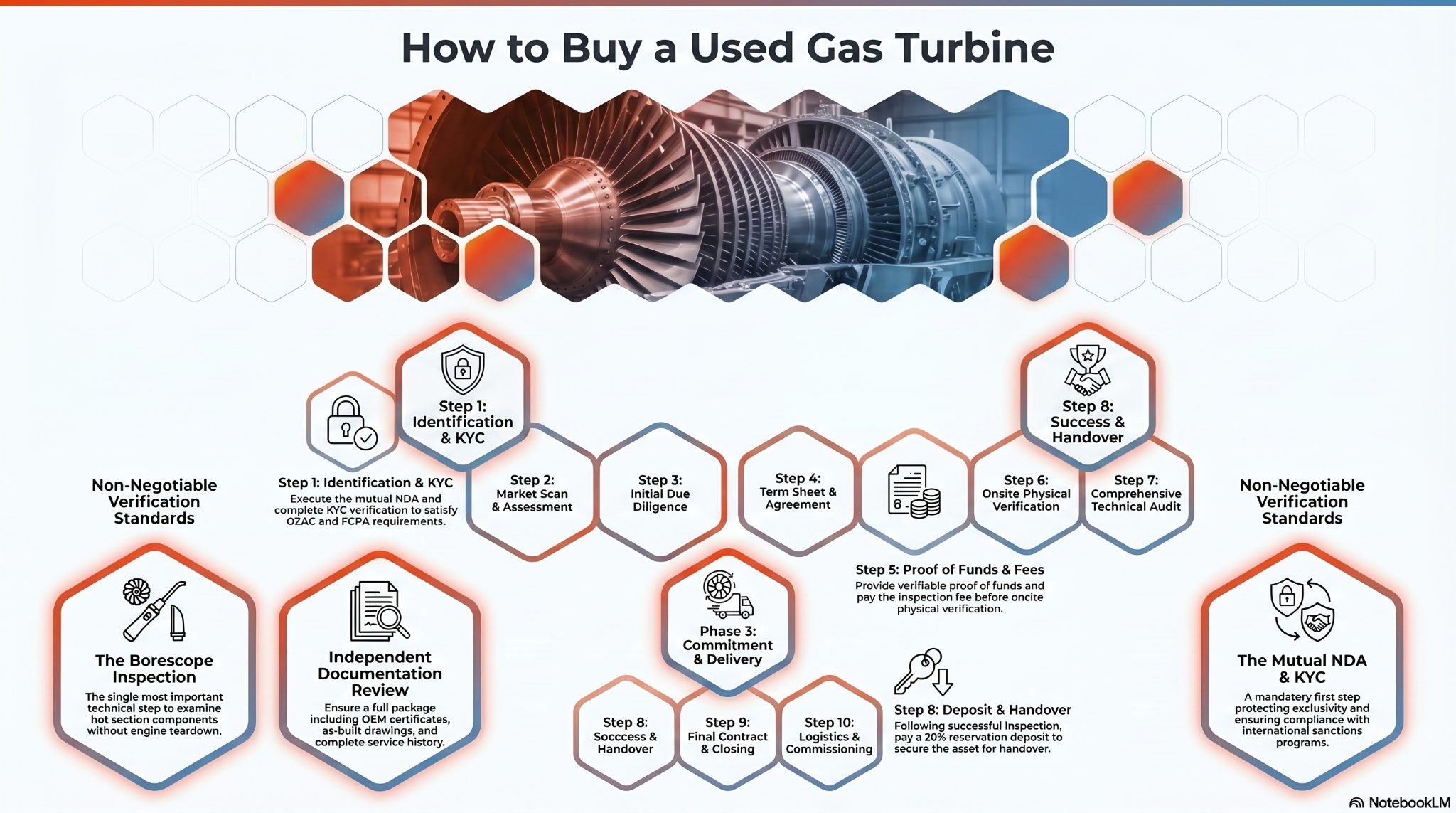
A borescope inspection is the single most important technical verification step in any used gas turbine purchase. A borescope inserts a fibre optic camera through inspection ports in the turbine casing to examine the condition of the combustion section, first and second-stage turbine blades, compressor blades, and hot section components without requiring a full engine teardown. The cost of a borescope is typically USD 5,000 to 15,000. The cost of purchasing a gas turbine with undisclosed hot section damage and then discovering the condition during a first commissioning test can run to millions of dollars in repairs and project delays.
USP&E has conducted and facilitated borescope inspections across dozens of gas turbine models including GE Frame 5, Frame 6, Frame 7, LM2500, LM6000, and TM2500, Solar Turbines Centaur, Taurus, and Mars, Siemens SGT-400 and SGT-700, and Rolls-Royce Avon and RB211 series. Our GE TM2500 mobile gas turbine page provides model-specific technical information for one of the most frequently transacted assets in the USP&E portfolio.
Documentation: What a Complete Package Looks Like
A used gas turbine purchase without a full documentation package is a purchase made blind. The minimum acceptable documentation set for a credible used gas turbine transaction includes: OEM factory acceptance test records and as-built drawings; a complete service and overhaul history with dates, scope, and the identity of the service organisation; the most recent borescope report and vibration analysis; the nameplate data and serial number verification; spare parts lists specific to the asset; and, for packaged power stations, the single-line electrical diagram and process and instrumentation diagrams (P&IDs). Sellers who cannot or will not provide this documentation package are selling an unknown quantity. Buyers who accept that risk without a deep discount and a comprehensive inspection do so at their own commercial peril.
Section 4: The NDA and KYC Process — Why Every Buyer Must Complete This Before Proceeding
USP&E does not disclose asset locations, detailed technical specifications, or ownership details to any party that has not first executed its mutual Non-Disclosure Agreement. This is not a negotiating position. It is a compliance and commercial protection requirement that USP&E has maintained consistently for 25 years. Understanding why this process exists is essential for any buyer learning how to buy a used gas turbine through a credentialled international vendor.
Why the NDA Protects Both Buyer and Seller
USP&E owns over 100 MW of gas turbines and generators outright and holds exclusivity agreements on a further 500 MW. These exclusivity arrangements with asset owners, banks, and financial institutions are commercially sensitive and legally binding. Disclosing asset locations and ownership details to unverified parties creates the risk of circumvention, where a buyer bypasses USP&E to approach the asset owner directly. The NDA prevents this, protects USP&E’s commercial relationships, and ensures that the buyer is working within a legally structured transaction framework. Review the USP&E master brochure and credentials for further background on USP&E’s asset ownership and exclusivity model.
OFAC and FCPA Compliance: The Legal Framework Behind the NDA
As a United States-registered company, USP&E is subject to the Office of Foreign Assets Control (OFAC) sanctions programmes, enforceable by the U.S. Department of the Treasury, and the Foreign Corrupt Practices Act (FCPA). USP&E is legally prohibited from facilitating any transaction where the final destination of an asset is a sanctioned country, including Iran, Russia, North Korea, Cuba, and others on the OFAC Specially Designated Nationals list. USP&E is also prohibited from participating in any transaction where commissions or fees are paid to politically connected individuals as a condition of a government-related contract award.
The KYC requirements in the NDA process are the mechanism through which USP&E verifies that none of these prohibited conditions apply to a transaction. Buyers who are unwilling to complete the KYC process signal to USP&E that the transaction may involve sanctioned parties, undisclosed end destinations, or politically connected intermediaries. In those cases, USP&E terminates the engagement. This is not a commercial decision. It is a legal one.
Broker Commissions in the NDA
USP&E’s standard NDA includes a blank commission field, allowing broker partners to register their agreed commission percentage before the transaction proceeds. USP&E pays 3 to 5 percent commission to introducing brokers on full-price transactions, and by mutual agreement can pay a minimum of 1 percent where a buyer-required discount reduces the sale price. This commission structure is designed to flatten the broker chain by giving introducing parties the confidence to bring USP&E directly in front of the end buyer, maximising the probability of a successful transaction. See USP&E’s project experience and commercial track record for evidence of this approach in practice.
Section 5: The USP&E Step-by-Step Used Gas Turbine Purchase Process
The following table documents the complete 10-step sequence that USP&E applies to every used gas turbine and power station purchase. This is the operational answer to how to buy a used gas turbine through a credentialled, OFAC-compliant, internationally experienced vendor. Each step is mandatory and sequential. No step can be skipped or reordered.
Table 2: USP&E 10-Step Used Gas Turbine Purchase Process
|
Step |
Process Stage |
What Happens |
USP&E Requirement |
|
1 |
Identify Asset |
Browse USP&E inventory at uspeglobal.com. Click Fast Quote on any listing that fits your power, fuel, and frequency requirements. |
Fast Quote submission via website |
|
2 |
Sign the NDA |
USP&E sends its mutual NDA with KYC provisions and commission language. All parties (buyer, brokers, end user) must sign before any asset location, detailed specs, or ownership information is disclosed. |
Signed NDA from all parties |
|
3 |
KYC Verification |
Passport copies for all company representatives. Company registration documents for the buyer and any broker entities. Site coordinates to confirm the project is not in a sanctioned territory. |
Passports, company registration, project coordinates |
|
4 |
Term Sheet |
USP&E issues a term sheet covering: asset pricing (ex-works or FOB), scope of supply, inspection terms, reservation deposit amount (20%), and refundability conditions. |
Signed term sheet from buyer |
|
5 |
Proof of Funds |
Buyer provides verifiable proof of funding: bank comfort letter, confirmed LC, or equivalent. USP&E does not disclose exact asset location until this step is complete. |
Bank letter or proof of funding document |
|
6 |
Inspection Fee |
USD 20,000 non-refundable inspection facilitation fee is invoiced and paid. USP&E senior engineers are present at all inspections. SGS or TUV third-party inspectors are the buyer’s choice and are at the buyer’s cost. |
USD 20,000 inspection fee paid in advance |
|
7 |
Physical Inspection |
Asset location is disclosed. Inspection is conducted by buyer’s chosen third party (SGS, TUV, or equivalent) with USP&E present. Borescope, vibration analysis, oil sampling, and full documentation review completed. |
Inspection report signed by all parties |
|
8 |
Reservation Deposit |
Upon successful inspection, buyer pays 20% reservation deposit. This is refundable only if the asset is found to be materially not as represented during inspection. The deposit is applied to the purchase price on contract signature. |
20% deposit to USP&E bank account |
|
9 |
Sales Contract |
Full purchase and sale agreement is executed. Payment terms, delivery terms, warranty provisions, and any O&M or LTSA annexures are finalised and signed by all parties. |
Signed purchase and sale agreement |
|
10 |
Delivery and Handover |
Balance of purchase price is paid. Asset is released for shipping. USP&E coordinates logistics to the nearest port. Delivery terms confirmed as ex-works or FOB as per the contract. |
Balance payment, then asset released |
The USD 20,000 Inspection Fee: Why It Exists and What It Covers
USP&E charges a non-negotiable USD 20,000 inspection facilitation fee payable before any physical inspection proceeds. This fee covers USP&E’s direct costs of deploying senior sales and logistics engineers to the inspection site, coordinating with the asset owner or custodian, preparing the technical review materials, and managing the inspection process from arrival to final report sign-off. USP&E personnel are present at every inspection. There are no remote-only inspections facilitated by USP&E.
The inspection fee also serves as a commercial qualification mechanism. In the years before USP&E introduced this fee, it conducted inspections weekly for parties who had no funding, no real project, and no genuine purchase intent. The inspection fee eliminated that category of enquiry entirely. Every buyer who pays the fee has demonstrated sufficient project seriousness to proceed. If the asset is found by the buyer’s third-party inspector to be materially not as represented by USP&E, the full USD 20,000 is refunded. If the buyer proceeds to purchase, 50 percent of the inspection fee (USD 10,000) is applied as a discount against the purchase price.
The 20 Percent Reservation Deposit
Following a successful inspection, USP&E requires a 20 percent reservation deposit against the agreed purchase price. This deposit is refundable only in the event that the asset is found during inspection to be materially not as represented. Once the inspection is deemed satisfactory by the buyer’s third-party inspector, the deposit becomes non-refundable and is applied in full against the purchase price on contract execution. USP&E places multi-million-dollar deposits of its own on assets it reserves for clients, sometimes 12 to 24 months ahead of delivery. The 20 percent buyer deposit mirrors this commitment and ensures that both parties are commercially aligned before the transaction proceeds to full contract. View our full inventory of available power station assets to identify assets suitable for your project.
Section 6: Common Mistakes Buyers Make When Purchasing a Used Gas Turbine
After 25 years of facilitating used gas turbine purchases across 35+ countries, USP&E has observed the same category of buyer mistakes appearing repeatedly. Understanding these errors is as important as understanding the correct process.
- Accepting a verbal or email scope of supply without physical verification. What a seller lists in a proposal and what is physically on site are frequently different. Always insist on a site inspection with a documented scope of supply sign-off.
- Paying a deposit before signing an NDA and completing KYC. Any seller who accepts a deposit from a buyer who has not completed KYC verification is either not OFAC-compliant or is not the genuine owner of the asset.
- Relying on the seller’s inspection report rather than commissioning an independent third-party inspection. A seller-supplied report is not independent. SGS, TUV Rheinland, Bureau Veritas, or equivalent accredited bodies must conduct the inspection on behalf of the buyer.
- Purchasing a gas turbine without a complete documentation package. A used gas turbine without service history, OEM certificates, and as-built drawings is an asset of unknown condition. It cannot be financed, insured, or warranted.
- Engaging with brokers who cannot introduce the buyer directly to the asset owner. If a broker cannot arrange a direct introduction between the buyer and the asset owner or custodian (under NDA), they do not have genuine access to the asset.
- Ignoring fuel and frequency specifications. A gas turbine rated for 60 Hz natural gas operation cannot simply be converted to 50 Hz HFO operation. Frequency and fuel specification must be confirmed before any purchase commitment is made.
- Assuming the purchase price is the project cost. The equipment cost is typically 30 to 50 percent of the total installed project cost. Shipping, balance of plant, civil works, electrical interconnection, and commissioning costs must be modelled before any equipment purchase decision is made.
Section 7: Frequently Asked Questions About How to Buy a Used Gas Turbine
How do I know if a used gas turbine seller is legitimate?
A legitimate used gas turbine vendor will require you to sign an NDA before disclosing asset locations or ownership details, will provide a complete documentation package including service history and OEM certificates, will facilitate a third-party inspection by SGS, TUV, or Bureau Veritas, and will have a verifiable track record of completed transactions. USP&E has completed 150+ projects in 35+ countries and has zero lawsuits in 25 years. Verify any vendor by searching their company registration, checking client references, and asking for a portfolio of completed projects.
What documents should I ask for before buying a used gas turbine?
The minimum documentation package for a credible used gas turbine purchase includes: OEM factory acceptance test certificate and as-built drawings, a full service and overhaul history with dates and service organisation details, the most recent borescope report and vibration analysis, nameplate data and serial number verification, spare parts lists, and (for packaged power stations) single-line electrical diagrams and P&IDs. Any vendor unwilling to provide these documents upon execution of a mutual NDA should be disqualified from the transaction.
How much does it cost to inspect a used gas turbine before buying?
Third-party inspection costs for a used gas turbine vary by asset size and inspection scope. A borescope inspection typically costs USD 5,000 to 15,000. A full SGS or TUV Rheinland mechanical and electrical inspection for a packaged power station costs USD 10,000 to 25,000. USP&E charges an additional USD 20,000 inspection facilitation fee to cover the cost of its senior engineers attending and managing the inspection. If the asset proceeds to purchase, USD 10,000 of this fee is applied as a discount against the purchase price.
What is a 20 percent reservation deposit on a used gas turbine purchase?
A 20 percent reservation deposit is a payment made by the buyer to the seller after a successful physical inspection, securing the asset against competing buyers while the full purchase and sale agreement is finalised. USP&E requires this deposit after inspection sign-off. The deposit is fully refundable if the inspection reveals that the asset is materially not as represented. Once the inspection is accepted by the buyer, the deposit becomes non-refundable and is applied in full to the purchase price at contract execution.
Can I buy a used gas turbine without signing an NDA?
Not through USP&E. The NDA is a mandatory first step in every transaction, without exception. It protects USP&E’s exclusivity agreements with asset owners, satisfies OFAC and FCPA compliance requirements, and establishes the legal framework within which the transaction proceeds. Any vendor offering to sell you a gas turbine without requiring an NDA is either not the genuine owner of the asset or is not operating within an OFAC-compliant framework. Neither condition is acceptable for a legitimate power station procurement.
How long does the used gas turbine purchase process take from first enquiry to delivery?
The timeline from first enquiry to asset delivery depends on asset availability, inspection scheduling, and financing readiness. USP&E’s 10-step process typically takes 30 to 90 days from NDA execution to contract signature for a straightforward equipment-only transaction. Delivery timelines depend on shipping logistics, port access, and the buyer’s project site readiness. For buyers with proof of funds in place and a clear project scope, USP&E has completed transactions from first contact to asset release in under 60 days.
What happens if the gas turbine fails inspection?
If USP&E’s asset is found by the buyer’s independent third-party inspector to be materially not as represented in the term sheet and supporting documentation, USP&E will refund the full USD 20,000 inspection facilitation fee in full. The buyer is under no obligation to proceed with the purchase. USP&E has never once had a transaction in 25 years where an asset was found to be fundamentally misrepresented, because every asset USP&E offers for sale is documented, inspected, and verified before it enters the active sales portfolio.
Section 8: Summary — Key Takeaways for Used Gas Turbine Buyers
For procurement officers, project developers, IPP developers, and mining company energy managers researching how to buy a used gas turbine, the following summary captures the critical decision points from this guide:
- Always sign a mutual NDA and complete KYC before any asset information is disclosed. This protects both parties and satisfies OFAC and FCPA compliance requirements.
- Commission an independent borescope, vibration analysis, and documentation review through an accredited third-party inspector such as SGS, TUV Rheinland, or Bureau Veritas. Never rely solely on a seller-provided inspection report.
- Budget USD 20,000 to 40,000 for inspection costs before committing to a purchase. The cost of discovering undisclosed asset condition after purchase is orders of magnitude higher.
- Provide proof of funding early in the process. Sellers with genuine assets in high demand will not hold inventory for buyers who cannot demonstrate financial capacity.
- Understand that the equipment price is 30 to 50 percent of the total installed project cost. Shipping, balance of plant, civil works, and commissioning costs must be modelled before purchase.
- Work with a vendor who has a verifiable 25-year track record, zero lawsuits, ISO certification, and completed projects in the regions where you are operating.
When you need to know exactly how to buy a used gas turbine and get it right the first time, USP&E is the guide that has walked this road across 35+ countries and 150+ projects, without a single lawsuit filed in 25 years of operation.
Ready to Buy a Used Gas Turbine? Talk to USP&E’s Engineers Free.
USP&E Global offers a complimentary 4-hour engineering consultation for qualified power station, EPC, and O&M projects. Whether you are evaluating a used gas turbine purchase, need guidance on inspection, or are ready to initiate the NDA process, our team of 350+ engineers across 35+ countries is ready to guide your transaction to a successful outcome with speed and without excuses.
USP&E Global — Powering Possibility. Built for the Frontier.
ISO 9001:2015 | ISO 45001:2018 | 150+ Projects | 35+ Countries | Zero Lawsuits
Quick Links:
- Contact USP&E by clicking on this link.
- Request a fast equipment quote
Global Resources
- USP&E's Project Experience Portfolio
- USP&E Case Studies and Client Reference Letters
- USP&E Integrity and Compliance policy
- USP&E's ISO Certifications and Credentials