

How to Spot a Power Plant Broker Scam: Red Flags Every Buyer Should Know Before You Sign Anything
If you are procuring a gas turbine, HFO power station, or diesel generating set for a serious industrial or utility project, understanding how to spot a power plant broker scam is not optional. It is a non-negotiable project survival skill. Every year, legitimate mining companies, IPP developers, and government utilities in Africa, the Middle East, and Southeast Asia lose millions of dollars, months of critical project time, and operational credibility to fraudulent or unqualified power equipment brokers. Some lose everything.
USP&E Global has operated in 35+ countries for more than 25 years. In that time, our team of 350+ engineers and commercial professionals has encountered virtually every form of fraud, misrepresentation, and bad-faith dealing in the power equipment market. We have never filed or received a lawsuit. We have completed 150+ projects, deployed gigawatts of generation capacity, and built an OFAC and FCPA-compliant procurement process precisely because the alternative, buying from the wrong seller, is too costly to risk.
This guide is written for project developers, energy managers, and procurement officers who want to understand how to spot a power plant broker scam before money leaves their account, before an NDA is signed under false pretenses, and before a project timeline is destroyed by a seller who never had the equipment in the first place.
The Scale of Power Equipment Fraud: What the Data Shows
Power equipment fraud is a multi-billion-dollar global problem concentrated in the secondary market for gas turbines, HFO engines, diesel generating sets, and containerized power plants. The U.S. Department of Justice and the U.S. Department of the Treasury’s Office of Foreign Assets Control (OFAC) publish regular enforcement actions related to illegal equipment exports and procurement fraud. According to the U.S. Department of Justice FCPA Resource Guide, procurement fraud in infrastructure projects is among the most reported categories of international commercial crime.
The U.S. Energy Information Administration estimates that over $300 billion in energy infrastructure investment is executed annually across developing markets alone. The World Bank’s energy sector procurement guidelines document that procurement irregularities represent a significant share of infrastructure project failures in emerging economies. USAID’s Power Africa initiative cites procurement fraud as one of the top five causes of delayed power sector development across sub-Saharan Africa, including in Nigeria, Ghana, Tanzania, and the Democratic Republic of Congo.
Table 1: Common Power Equipment Fraud Scenarios by Region and Project Type
| Region | Fraud Type | Estimated Loss Range | Warning Signal |
| West Africa (Nigeria, Ghana, Mali) | Fictitious equipment listing with stolen spec sheets | $500K to $5M | No inspection fee process, no NDA requirement, no term sheet |
| East Africa (Kenya, Tanzania, Uganda) | Deposit theft via fake power station sale | $200K to $2M | Refuses to disclose asset location before deposit |
| Middle East (Iraq, Yemen, Libya) | Equipment misrepresentation: hours, condition, scope | $1M to $15M | No borescope, no service history, no KYC documentation |
| South and Southeast Asia (Myanmar, Indonesia) | Broker chain with no direct owner access | $500K to $8M | 4+ layers of brokers, no proof of ownership offered |
| North America and Europe (secondary market) | Sanctioned-country diversion schemes | $2M to $50M+ | Refuses to confirm project coordinates or end buyer |
| Latin America (Ecuador, Colombia, Peru) | Fraudulent LOI and fake proof of funds | $300K to $3M | Insists on quote before NDA, claims urgency without funding proof |
Key Drivers of Power Plant Broker Scams: Why They Are Increasing in 2025 and 2026
Understanding how to spot a power plant broker scam requires understanding why the problem is growing. Three structural forces are accelerating fraud in the global power equipment market.
First, the demand surge across Africa, the Middle East, and data center markets globally has created enormous pressure on procurement timelines. Mining companies expanding in Mali, Burkina Faso, and the Democratic Republic of Congo, utilities in Liberia, Togo, and Guinea, and data center operators in the USA and the Gulf are all competing for a limited pool of available gas turbines, HFO engines, and containerized power plants. Scammers exploit this urgency.
Second, the rise of online inventory listings has made it trivially easy for fraudulent actors to copy legitimate spec sheets, photographs, and technical data from credible EPC companies and repost them as their own inventory. USP&E has documented dozens of cases where our own inventory photographs and datasheets were stolen and used to solicit fraudulent deposits.
Third, broker chain complexity obscures accountability. A project developer in Mozambique negotiating with a broker in London who is relying on a sub-broker in Dubai who claims access to a GE LM6000 in Texas has no practical ability to verify ownership without a structured qualification process. This opacity is the operating environment for most power equipment scams.
The African Development Bank’s energy sector reports consistently identify procurement fraud and misrepresentation as critical barriers to electrification across the continent. The International Finance Corporation’s power sector guidance recommends formal KYC and asset verification protocols for all secondary market power equipment transactions, specifically because of the fraud risk in this market segment.
The 12 Red Flags That Tell You How to Spot a Power Plant Broker Scam
These are the specific warning signs that USP&E’s commercial team uses to qualify and screen power equipment transactions. Every flag listed below has been observed in real transactions over 25 years of operation across 35+ countries.
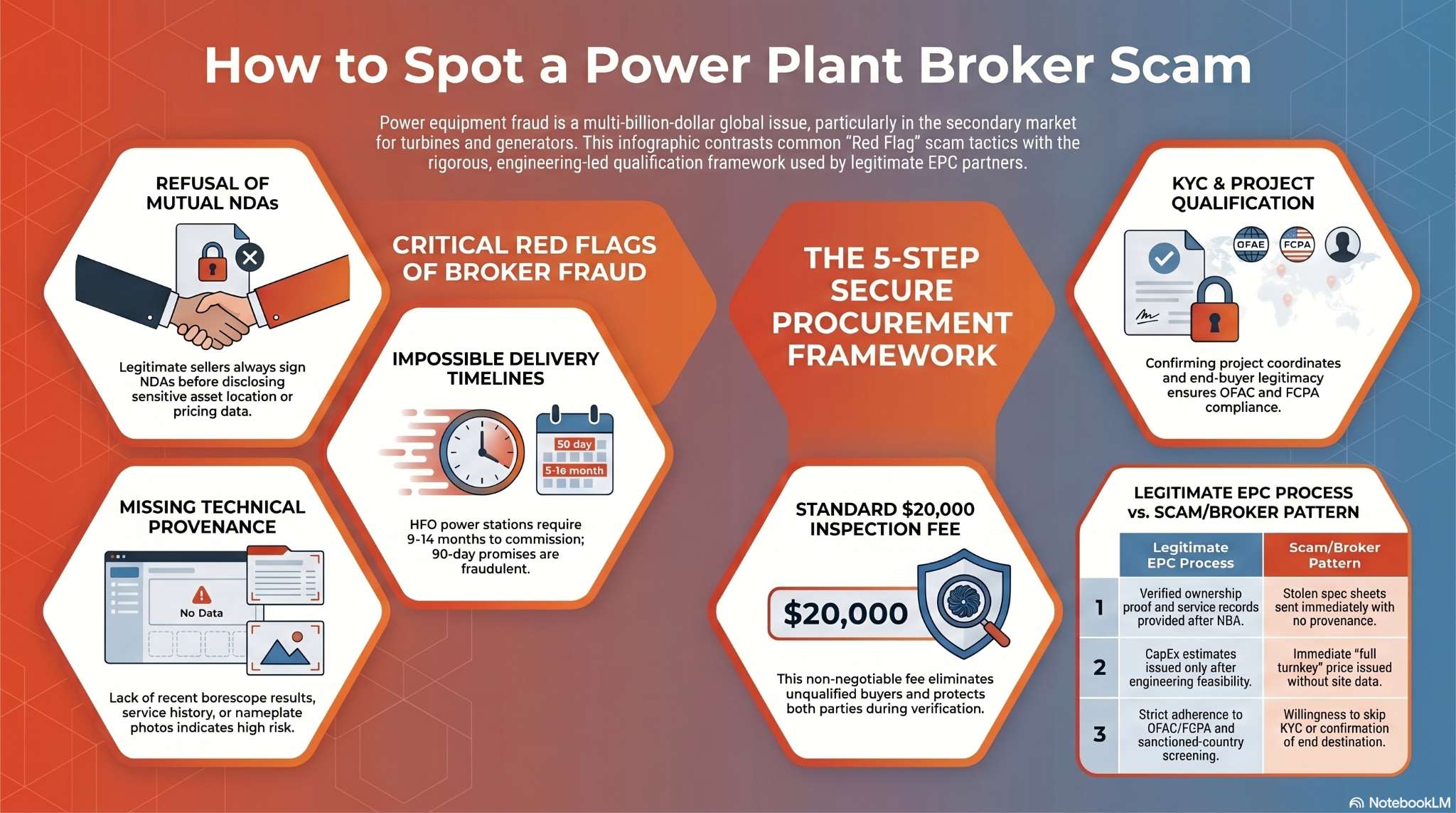
Red Flag 1: Refuses to Sign a Mutual NDA
A legitimate power equipment seller, whether an OEM, an owner, or an EPC, will always agree to a mutual non-disclosure and non-circumvention agreement before detailed discussions proceed. Any seller who declines to sign an NDA, insists on your NDA only, or dismisses the concept entirely is either hiding asset ownership details or attempting to retain the option to circumvent you later. USP&E requires a signed NDA before disclosing asset location, condition details, or pricing beyond what is publicly listed.
Red Flag 2: Cannot Provide Proof of Ownership or Exclusivity
Ask directly: do you own this asset outright, do you have an exclusivity agreement with the owner, or are you a sub-broker in a chain? A credible seller will answer this immediately and provide documentation. USP&E owns over 50 MW of equipment outright and holds formal exclusivity agreements on over 500 MW more. Sellers who deflect this question, claim ownership verbally without documentation, or promise to get back to you are almost certainly operating without any legitimate claim to the asset.
Red Flag 3: Refuses to Disclose the Asset Location Before Inspection
Before any formal inspection can be arranged, a legitimate seller will require a signed NDA, passport copies, a signed term sheet, and proof of funds. After those conditions are met, the asset location should be disclosed clearly. Any seller who refuses to name even the country or region of the asset, or insists the location cannot be disclosed under any conditions, is likely listing equipment they do not have access to or cannot legally export from the jurisdiction in question.
Red Flag 4: No Inspection Fee Process or Below-Market Inspection Terms
USP&E charges a $20,000 participation fee for inspections. This is non-negotiable and exists specifically to eliminate time-wasters and unqualified buyers. Fraudulent sellers often do the opposite: they offer free inspections with no process, and then use the inspection visit to pressure buyers into immediate deposits, or worse, to collect passport and banking information under false pretenses. If an inspection process has no structured commercial terms, treat it as a warning sign, not a benefit.
Red Flag 5: Pushes for a Quote or Proposal Before KYC Is Complete
USP&E will not issue a formal proposal before the project location is confirmed as non-sanctioned, the end buyer is identified, and the basic commercial qualification process is complete. Sellers who eagerly send detailed proposals and pricing without asking about your project location, timeline, funding, or end buyer profile are almost certainly non-compliant brokers attempting to collect information they can use to pitch the same asset to multiple buyers simultaneously.
Red Flag 6: Refuses to Confirm the Project is Not in a Sanctioned Country
Under the U.S. Foreign Corrupt Practices Act (FCPA) and the OFAC sanctions framework, any power equipment transaction that involves Iran, Russia, North Korea, or other designated countries is illegal. USP&E immediately terminates any discussion where a buyer refuses to confirm the project coordinates or end destination. Sellers who are willing to proceed without this confirmation are either ignorant of US law or actively involved in sanctions evasion, and either situation creates catastrophic legal risk for the buyer.
Red Flag 7: No Borescope, Service History, or Technical Documentation
A used gas turbine or HFO engine without a recent borescope inspection, a documented service and overhaul history, a clear record of original hours and hours since rebuild, and nameplate photographs is an asset you cannot evaluate. Sellers who claim documentation is unavailable, lost, or will be provided later are presenting an asset of unknown condition and unknown risk. No serious transaction should proceed without this documentation package.
Red Flag 8: Offers Unrealistic Fast-Track Timelines for Complex Power Stations
HFO power stations cannot be installed in 60 to 90 days. This is physically and technically impossible. A project requiring class-four pipefitting, civil works, 10,000 to 30,000 man-hours of assembly, custom balance of plant, and grid interconnection engineering requires 9 to 14 months from deposit to commissioning at an absolute minimum. Sellers who claim otherwise are either fraudulent, technically incompetent, or both. USP&E has installed HFO plants faster than most competitors in the industry. We will never promise a timeline that violates engineering reality.
Red Flag 9: Accepts Gold, Cryptocurrency Only, or Unusual Payment Methods
USP&E accepts USD, Euros, and Bitcoin. Any seller who insists on gold, commodity swap arrangements, or exotic payment structures is almost certainly involved in fraud, money laundering, or sanctions evasion. When a prospective buyer suggests paying in gold, USP&E’s position is simple: if you own gold, you can sell it on the open market and send us USD like every other legitimate client in the world. The same logic applies to sellers offering to receive payment through unusually complex or indirect channels.
Red Flag 10: Claims to Have Every Asset You Need, Immediately Available
Legitimate power equipment inventories are finite and change constantly. USP&E maintains over 50 MW of owned inventory and exclusivity on over 500 MW, with direct owner relationships covering another 2,000+ MW. We know what is available and can confirm availability against real listing pages. Brokers who claim to have any gas turbine you need, at any megawatt rating, in any configuration, available immediately, are almost certainly working from copied spec sheets with no actual asset access.
Red Flag 11: Broker Chain with No Willingness to Flatten to End Buyer
In legitimate power equipment transactions, all parties are protected through commissions agreements embedded in NDAs. USP&E pays 3 to 5% brokerage commission and has a standard process for structuring multi-party introductions so that every broker is protected without compromising the transaction. Deals where a broker chain insists on remaining opaque, refuses to introduce the end buyer, and cannot guarantee USP&E will not be circumvented are structurally unable to close and should be declined.
Red Flag 12: Politically Connected Individuals with Unusual Commission Demands
Any transaction in which politically connected family members, government officials, or their representatives are party to undisclosed commissions, facilitation payments, or kick-back arrangements is a violation of the FCPA and equivalent anti-bribery laws in the UK, EU, and South Africa. USP&E immediately closes any deal where politically connected individuals are identified in the commission structure. This has cost us short-term revenue on individual transactions. It has also meant 25 years of zero lawsuits and zero regulatory enforcement actions.
The USP&E Qualification Framework: How a Legitimate EPC Transacts
The most reliable way to protect your project from power equipment fraud is to work through a structured qualification process with an OFAC and FCPA-compliant EPC. USP&E’s process has been refined across 150+ projects in 35+ countries and is designed to protect both parties.
Review the complete USP&E project portfolio and experience to understand the depth and geographic range of our delivery track record.
Table 2: USP&E’s 5-Step Qualification Process vs. Common Scam Process Characteristics
| Step | Legitimate EPC Process (USP&E) | Scam / Fraudulent Broker Pattern | Buyer Protection It Provides |
| 1 | Mutual NDA with commissions language signed by all parties | No NDA required, or buyer’s NDA only accepted | Ensures confidentiality, non-circumvention, and commission protection for all parties |
| 2 | Project qualification: location, end buyer, fuel spec, timing, proof of funds | Immediate quote issued without any project details | Confirms project legitimacy, OFAC compliance, and technical suitability |
| 3 | Asset verification: ownership proof, borescope, service history, nameplate photos | Spec sheets sent immediately with no provenance documentation | Confirms the asset exists, is available, and is in the represented condition |
| 4 | Signed term sheet with inspection T&Cs and $20K inspection fee | Free inspection offered with no commercial structure | Protects buyer from misrepresentation; fee applied to purchase if successful |
| 5 | Engineering feasibility and CapEx estimate before LSTK commitment | Immediate full turnkey price issued without site data | Prevents budget disasters caused by unknown balance-of-plant requirements |
Real-World Outcomes: What Happens When Buyers Skip Due Diligence
USP&E has been contacted by dozens of project developers over the years who lost significant sums to fraudulent brokers before finding us. The patterns are consistent. The following examples are composites drawn from real inquiry patterns, with identifying details changed to protect the parties involved.
A mining energy manager in West Africa received a detailed proposal for a 22 MW HFO power station at a price 35% below market. The seller claimed to own the asset outright and promised delivery in 90 days. The buyer paid a $500,000 deposit and received a boilerplate engineering report. The seller then disappeared. There was no NDA, no term sheet, no proof of ownership, and no inspection process. The project was delayed 18 months.
A utility developer in the Middle East engaged with a broker chain across four layers of intermediaries for a GE LM2500 gas turbine. The turbine was represented as low-hours, recently overhauled, and available for immediate delivery. No borescope was available. No service records could be produced. When a physical inspection was finally arranged without a term sheet or inspection fee, the turbine was found to be a different model, in significantly worse condition, in a different country than represented. Legal costs to recover the deposit exceeded $200,000 and took three years.
USP&E’s published client case studies and references document real project outcomes across mining, utility, and industrial sectors in Mali, Sierra Leone, Liberia, Togo, South Africa, Saudi Arabia, and Iraq, among others. Each case study shows what a legitimate EPC transaction looks like from first contact to commissioning.
10 Criteria for Selecting a Legitimate Power Equipment Seller or EPC
When evaluating a power equipment seller or EPC partner, a procurement officer should apply the following criteria. Each one maps directly to a known failure mode in the fraudulent broker market.
- Verified ownership or exclusivity on every asset listed, with documentation available upon NDA execution.
- A structured NDA process with mutual non-circumvention and commissions protection for all parties.
- An OFAC and FCPA compliance framework that requires project coordinates and KYC documentation before any quote is issued.
- A published inspection process with clear commercial terms and a structured fee that protects both parties.
- A qualified in-house engineering team capable of performing feasibility studies, conceptual design, and detailed engineering, not just asset brokerage.
- ISO 9001:2015 and ISO 45001:2018 certification as a baseline quality and safety management credential.
- A documented project portfolio with named client references and measurable outcomes across multiple countries and fuel types.
- A transparent broker chain policy that pays commissions under signed agreement and requires introduction to end buyers for project qualification.
- A realistic commissioning timeline presented for every technology type, including honest disclosure that HFO power stations require 9 to 14 months, not 90 days.
- A verifiable track record with no material legal disputes, regulatory enforcement actions, or unsatisfied judgments over at least 10 years of operation..
Frequently Asked Questions: How to Spot a Power Plant Broker Scam
How do I know if a gas turbine seller is legitimate or a scammer?
A legitimate gas turbine seller will require a mutual NDA before sharing detailed information, demand KYC documentation and proof of funds before issuing a formal proposal, provide borescope results, service histories, and ownership documentation on request, and have a verifiable track record of completed projects with named client references. If the seller pushes you for a deposit before completing any of these steps, walk away immediately.
What is the most common type of power plant broker scam?
The most common scam involves a broker with no legitimate asset access copying a spec sheet and photograph from a real listing, representing the asset as available, and requesting a deposit to secure it. Once the deposit is paid, the broker either disappears or claims the asset was sold to another buyer. The second most common scam involves misrepresentation of asset condition, specifically claiming low hours and recent overhaul on equipment that is actually in poor condition or does not match the specification.
Why does USP&E charge $20,000 for inspections if the asset is real?
The inspection fee exists to qualify serious buyers and protect all parties. Before the inspection fee was implemented, USP&E conducted inspections for any party who asked, and many were fraudulent or unfunded inquiries designed to gather competitive intelligence or waste time. Since implementing the fee, the quality of inspection requests has increased dramatically. The fee is refundable in full if the asset is found not to be as represented, and 50% is applied to the purchase price if the buyer proceeds.
How do I verify that a power equipment broker actually owns the asset they are selling?
Request a signed declaration of ownership or exclusivity, certified company registration documents, and clear chain-of-title documentation for the asset. Ask to speak directly to the legal owner or their authorized representative. Request photographs of the asset showing current condition, nameplate data, and visible serial numbers that you can cross-reference with manufacturer records. Any seller who cannot provide this within a reasonable timeframe after NDA execution does not have the ownership or access they are claiming.
What should I do if I suspect a power plant broker scam is already in progress?
Stop all financial transfers immediately. Do not execute any wire transfer, letter of credit, or deposit until you have verified the seller’s identity, ownership status, and asset condition independently. Engage an independent inspection body such as SGS or Bureau Veritas to conduct an unannounced verification if the asset location has been disclosed. Report suspected fraud to the relevant authorities in your jurisdiction and, if the transaction involves US persons or US-origin equipment, consider reporting to the U.S. Department of Justice or OFAC.
Is it possible to buy a legitimate used gas turbine or HFO power station through a broker?
Yes, and many of the best deals in the secondary power equipment market involve brokers who provide genuine value through market access, engineering support, and transaction structuring. The key is to work with brokers who operate transparently: disclose their relationship to the owner, sign commissions agreements that protect your interests, and work within a KYC and compliance framework. USP&E has paid millions in broker commissions over 25 years to partners who bring qualified, funded, and legitimate projects to us.
What are the legal risks of buying power equipment from a scammer without knowing it?
Beyond the direct financial loss, buyers who unknowingly transact with fraudulent sellers may face legal exposure under OFAC regulations if equipment was diverted from a sanctioned country, customs and import violations if documentation was falsified, contractual liability to their own downstream clients or project funders, and reputational damage that affects future financing and regulatory relationships. In some jurisdictions, buyer’s representatives who failed to conduct basic due diligence may face personal liability.
Summary: Key Takeaways for Buyers Who Need to Know How to Spot a Power Plant Broker Scam
Understanding how to spot a power plant broker scam before it damages your project is achievable with a consistent due diligence framework. The 12 red flags documented in this article are drawn from 25 years of real-world transactions across 35+ countries.
- How to spot a power plant broker scam starts with one question: will the seller sign a mutual NDA with commissions protection before any discussions proceed? If not, stop immediately.
- Any seller who refuses to disclose the project destination, refuses KYC documentation, or refuses to confirm OFAC compliance is a sanctions evasion risk, not just a commercial risk.
- HFO power stations cannot be installed in 90 days. Any seller who promises otherwise is either fraudulent or technically incompetent.
- Proof of ownership, borescope results, service histories, and nameplate documentation are non-negotiable prerequisites for any secondary market power equipment transaction.
- A structured inspection process with a formal inspection fee and refund policy is a sign of a legitimate operator, not an obstacle.
- Working with an ISO 9001:2015 and ISO 45001:2018 certified EPC with a documented project portfolio and zero lawsuits over 25 years is the most reliable protection against power equipment fraud.
- How to spot a power plant broker scam ultimately comes down to process: sellers who resist structure, resist documentation, and resist transparency are telling you everything you need to know.
USP&E Global has been operating transparently in the world’s most challenging power markets since 2002. Our operations and maintenance and EPC construction teams operate across Africa, the Middle East, and the Americas under a compliance framework built for exactly the environments where fraud thrives.
Ready to Power Your Project? Talk to USP&E’s Engineers Free.
USP&E Global offers a complimentary 4-hour engineering consultation for qualified power station, EPC, and O&M projects. Whether you are in early feasibility or ready to mobilize, our team of 350+ engineers across 35+ countries is ready to guide your project to success with speed and without excuses.
USP&E Global – Powering Possibility. Built for the Frontier.
ISO 9001:2015 | ISO 45001:2018 | 150+ Projects | 35+ Countries | Zero Lawsuits
Quick Links:
- Contact USP&E by clicking on this link.
- Request a fast equipment quote
Global Resources
- USP&E's Project Experience Portfolio
- USP&E Case Studies and Client Reference Letters
- USP&E Integrity and Compliance policy
- USP&E's ISO Certifications and Credentials