

Business Continuity Power: How Standby Generation Protects Revenue and Operations
Business continuity power is the standby and backup supply that keeps a business running when the grid fails. For some operations an outage is an inconvenience. For others it is a loss of data, product, safety or revenue within minutes. Data centres, hospitals, factories, airports, schools and emergency services all depend on it. This guide explains how to plan business continuity power, how to size and test it, what to budget and how to choose equipment and a supplier.
USP&E has delivered 150+ power projects in 45+ countries since 2002, with 25,000 MW contracted since 2002. USP&E holds ISO 9001:2015 and ISO 45001:2018 certification and works across equipment supply, EPC (Engineering, Procurement and Construction) and O&M (Operations and Maintenance). USP&E is more than a broker: it removes technical and commercial risk for buyers through engineering, inspection, EPC and O&M. Supply comes from USP&E’s own inventory plus equipment sourced from OEMs, IPPs, banks and asset owners. The advice below is an engineering view of business continuity power, and it does not replace local codes or the facility’s own risk assessment.
What Is Business Continuity Power and Who Needs It?
Business continuity power covers the equipment and plans that keep critical operations running through a loss of utility supply. It normally includes one or more generating sets, an automatic transfer switch, uninterruptible power supplies for sensitive loads, a fuel system, and a testing routine. The aim is to restore supply in seconds and sustain it for as long as the outage lasts.
The need is wider than many owners expect. Ready.gov, the United States government’s preparedness site, explains in its guide to power outages that outages can disrupt communications, water and transportation, close shops, banks and fuel stations, cause food spoilage and prevent the use of medical devices. Any business that depends on those services shares the risk.
Some sectors carry more risk than others. The International Energy Agency’s analysis of energy demand from AI notes that data centres rely on backup generators and UPS batteries to reach the extremely high reliability they must meet. In health care, CMS, the United States federal health care regulator, takes an all-hazards approach to power outages in its emergency preparedness programme.
|
Business continuity power sector |
What an outage risks |
Typical protection |
|
Data centres |
Data loss and service failure |
UPS plus standby sets, redundancy |
|
Health care |
Patient safety |
Life safety loads on standby power |
|
Manufacturing |
Scrap and lost production |
Standby sets for critical lines |
|
Education |
Safety systems and learning |
Standby power for life safety loads |
|
Emergency services |
Response capability |
Standby sets with fuel autonomy |
Planning Business Continuity Power: Risk, Load and Autonomy
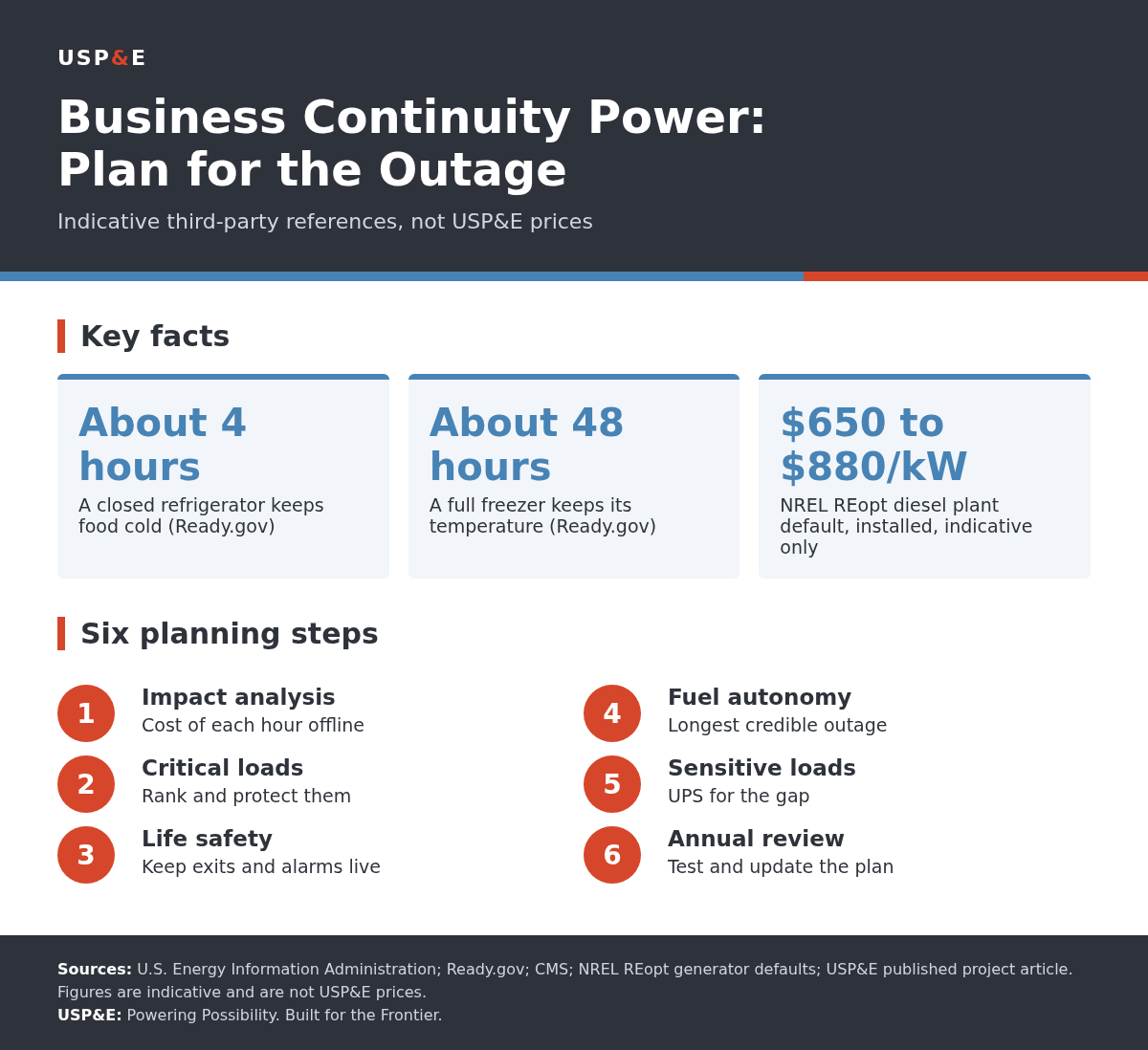
Begin with a business impact analysis. List every function, how long it can be down and what an hour of downtime costs. That ranking decides what must be on backup power, what can be shed and how long supply must last. It also shows whether a UPS alone is enough, or whether engine sets are needed for longer outages.
Then build the load list. For each critical circuit record running power, starting power, voltage and the maximum time without supply. Motors and chillers draw high currents when they start, so the standby set must be sized for starts. Redundancy follows: a single set is a single point of failure, so many businesses install two or more sets arranged to keep critical load if one fails.
Autonomy is the last piece. Fuel storage must cover the longest credible outage, with margin for delayed deliveries. The U.S. Energy Information Administration explains how the grid links generation, transmission and distribution in its guide to electricity in the United States. A regional event can affect fuel supply as well as electricity, so on-site storage is the safety margin. USP&E’s guide to standby generator reliability covers testing and fuel care.
Quick planning steps for business continuity power
- Run a business impact analysis and rank functions by tolerance for downtime.
- Build a load list with running and starting power.
- Choose redundancy so one failure does not lose critical load.
- Size fuel storage for the longest credible outage plus margin.
- Set a test routine, including on-load tests.
Testing and Maintaining Business Continuity Power
Untested backup power is a hope, not a plan. Run each set regularly, test the transfer switch and run the plant on load at least once a year. Check batteries, chargers, coolant, filters and fuel quality. Keep records of every run. Train staff on what to do when the grid fails, and rehearse it.
Maintenance contracts and spares matter. A critical set that waits two weeks for a part is not critical. USP&E explains the approach in its guide to power plant critical spares strategy. For health care and other life safety sites, USP&E’s guide to diesel generators for hospitals and prisons covers load ranking and redundancy in more detail.
|
Business continuity power test |
Frequency |
What it proves |
|
Start and short run |
Monthly |
Sets start and transfer |
|
Battery and charger test |
Monthly |
Starting power available |
|
Fuel sample and water drain |
Quarterly |
Fuel is fit for use |
|
On-load test |
Annual |
Rated output and cooling |
|
Failure drill |
Annual |
Staff respond correctly |
Business Continuity Power and the Wider Plan
Business continuity power is one part of a wider continuity plan. Generators keep the lights on, but staff also need access, communications, water and fuel. A plan should cover how people reach the site, how they are told what to do and how long the business can operate on its own supplies. Suppliers and customers should be part of the plan, because a site that runs while its partners do not may gain little.
Review the plan after every test and every event. Equipment ages, loads change and staff move on. A set sized for last year’s load may not carry this year’s. Schedule an annual review that checks the load list, the fuel autonomy, the test records and the spares. Business continuity power that is reviewed regularly stays aligned with the business, while power that is installed once and forgotten drifts away from what the business now needs.
Document the plan in plain language. A manager who is away should still be able to follow it. Include contact numbers, fuel supplier details, the location of keys and isolators, and the order in which loads are restored after an outage. Print copies and keep them on site, because digital copies may not be reachable during an outage.
Training closes the gap between a plan and an outcome. Run a short exercise each year in which staff respond to a simulated outage, then note what worked and what did not. Small problems found in an exercise, such as a missing key or an out of date phone number, cost almost nothing to fix, whereas the same problems found during a real outage can be very costly.
Business Continuity Power Cost: What to Budget
USP&E does not publish business continuity power prices, because they depend on load, redundancy, fuel autonomy and market timing. The figures below are indicative third-party references, not USP&E prices. A budget should include the sets, transfer and distribution equipment, UPS where needed, fuel storage, building works, commissioning and the long-term cost of testing and maintenance. The cost of an outage should sit beside it. When an hour of downtime is expensive, a more robust design usually pays for itself.
For scale, the National Renewable Energy Laboratory’s REopt model, in its published generator cost defaults, uses about $650 to $880 per kW for installed diesel generator plant, with fixed operating cost of about $10 to $20 per kW per year plus fuel. Those are model defaults for United States conditions, not quotations, and a real project may differ.
|
Business continuity power cost layer |
What it covers |
Risk if ignored |
|
Generating sets |
Engines, alternators, enclosures |
A weak rating fails in a long outage |
|
Transfer and distribution |
Switches, boards, cabling |
Slow or failed changeover |
|
UPS and batteries |
Sensitive loads and bridging |
Interruptions before sets start |
|
Fuel system |
Tanks, pumps, filtration |
Short autonomy |
|
Testing and training |
Runs, records, drills |
Untested systems may fail |
Fuel Type Comparison
|
Fuel Type |
CapEx Range |
OpEx Range |
Typical Lead Time |
Best Application |
|
Diesel generating sets |
About $650 to $880/kW installed (NREL REopt defaults) |
About $10 to $20/kW per year fixed, plus fuel (NREL REopt defaults) |
Varies with size and package |
Backup, prime and remote power |
|
Natural gas engines |
Fuel often cheaper where pipeline gas is reliable |
Varies with package |
Sites with firm gas supply |
|
|
New industrial frame turbine plant |
About $1,158/kW installed (EIA 2026, 2025 US dollars) |
About $7.18/kW per year plus $4.17/MWh (EIA 2026) |
More than five years for large new units in tight markets |
Large utility or industrial plants |
|
New aeroderivative turbine plant |
About $2,275/kW installed (EIA 2026, 2025 US dollars) |
About $9.99/kW per year plus $5.97/MWh (EIA 2026) |
18 to 36 months for smaller new turbines is a published market range |
Fast-ramping larger plants |
Sources: NREL REopt generator defaults; U.S. Energy Information Administration, Assumptions to the Annual Energy Outlook 2026, Table 3. Blank cells could not be verified from a comparable official source. These are not USP&E prices, and the turbine figures describe much larger United States plants.
New vs Used Equipment for Business Continuity Power
Many owners choose new sets for critical duty because of warranty and a clean record. Used sets can serve secondary sites, temporary cover or budget-limited projects if the records are clear. Ask for engine hours, service history, the last overhaul and alternator tests, and require a load test at the stated rating and proof of ownership or a written right to sell before any deposit. USP&E explains how to inspect and buy in its guide to used diesel generators for sale, and buyers can browse the diesel generators category.
USP&E is an independent seller and is not affiliated with any engine, turbine or generator manufacturer named by buyers during a project. Those names are trademarks of their respective owners.
Case Studies: Business Continuity Power in Real Projects
USP&E only publishes approved case studies, and it does not name clients without permission. USP&E has delivered projects in 45+ countries, including power plant EPC projects and operations and maintenance work, and approved examples are collected on the case studies page. No outcome specific to business continuity power is claimed here beyond what is published.
The lessons below reflect common practice, not a named project:
- Businesses that rank functions by downtime tolerance avoid paying to back up loads that can be shed.
- Businesses that add redundancy keep critical supply when one set is down.
- Businesses that test on load find faults while there is no emergency.
- Businesses that store fuel for the longest credible outage avoid depending on deliveries.
How to Choose Business Continuity Power and a Supplier: 10 Criteria
- Business impact analysis. Rank functions by tolerance for downtime and cost of an hour lost.
- Load list. Record running and starting power for each critical circuit.
- Redundancy. Choose an arrangement that keeps critical load after one failure.
- Transfer design. Specify automatic transfer with safe bypass for testing.
- Fuel autonomy. Size storage for the longest credible outage plus margin.
- Testing plan. Agree monthly runs and an annual on-load test.
- Inspection and title. For used units, require a records audit, a load test and proof of ownership or a written right to sell before any deposit.
- Spares and service. Hold critical spares and agree response times.
- EPC and O&M depth. A supplier that can install, commission and maintain the plant reduces handover risk. USP&E offers O&M with 95%+ O&M availability as an official company figure.
- Contract clarity. Delivery date, tests, payment milestones, warranty and training should be in writing.
FAQ: Business Continuity Power
What is business continuity power?
Business continuity power is the standby and backup supply that keeps critical operations running when the grid fails. It usually includes generating sets, an automatic transfer switch, UPS for sensitive loads, a fuel system and a testing routine. Its aim is to restore supply in seconds and sustain it for the whole outage.
How do I decide what to put on backup power?
Run a business impact analysis. List each function, how long it can be down and what downtime costs. Rank them, then put life safety and critical functions on backup power and shed the rest. That ranking drives sizing, redundancy and fuel storage for business continuity power.
Is a UPS enough?
A UPS bridges short interruptions and protects sensitive loads, but its batteries last minutes. For longer outages you need generating sets. Most critical sites use both: a UPS to cover the seconds before sets start, and sets to carry load for hours or days. Business continuity power plans should state which role each part plays.
Why use more than one generator?
One set is a single point of failure. Two or more sets, arranged so the loss of one still leaves enough capacity for critical load, give better security and allow maintenance without leaving the site exposed. Redundancy needs well designed paralleling controls and protection.
How often should I test standby power?
Run a short start test monthly, check batteries and chargers at the same time and carry out an on-load test once a year. Follow the maker’s schedule and local codes, and record every test. Regular testing is the foundation of business continuity power.
How much fuel should I store?
Store enough for the longest credible outage plus a margin for delayed deliveries. A regional event can disrupt fuel supply as well as electricity. Test and rotate stored fuel regularly so that it is fit to run when needed, and keep delivery contacts current.
What does USP&E need to quote?
USP&E needs the site location, the critical load list, the voltage and frequency, the redundancy required, the fuel available and the date you need power. With these inputs, USP&E can recommend a business continuity power design and a delivery plan.
Key Takeaways: Business Continuity Power
- Business continuity power starts with a ranking of functions by tolerance for downtime.
- Size for motor starts, add redundancy and store fuel for the longest credible outage.
- Test regularly, including on load, and rehearse failure drills.
- Inspect any used units, verify title and load test before paying a deposit.
- Choose a supplier with engineering, EPC and O&M depth, not a trader alone.
Protecting operations is a solvable problem with the right partner. When you are ready to plan, USP&E’s engineers can help you size business continuity power, plan the fuel and testing, and bring the plant to power.
Ready to Power Your Project? Talk to USP&E’s Engineers.
Whether you are in early feasibility or ready to mobilise on a power station, EPC, or O&M project, USP&E’s engineers can help. With 150+ power projects delivered in 45+ countries since 2002, our engineers remove the technical and commercial risk from your project, with speed and without excuses.
Contact USP&E Today Request a Fast Quote
USP&E: Powering Possibility. Built for the Frontier. ISO 9001:2015 | ISO 45001:2018 | 150+ power projects in 45+ countries | 25,000 MW contracted since 2002 | 24+ years