

Standby Generator Reliability: Will Your Backup Power Start When the Storm Hits?
Standby generator reliability is the gap between owning a generator and having power. Hurricanes, tornadoes, transformer failures, heavy winds, droughts and power station faults can cut utility supply for days or even weeks. Businesses, hospitals, data rooms and homes then depend on a machine that may have sat idle for months. Many standby sets fail the first time they are asked to run. This guide explains what drives standby generator reliability, how to test and maintain a set, what to budget, and how to choose equipment and a supplier that give you real confidence.
USP&E has delivered 150+ power projects in 45+ countries since 2002, with 25,000 MW contracted since 2002. USP&E holds ISO 9001:2015 and ISO 45001:2018 certification and works across equipment supply, EPC (Engineering, Procurement and Construction) and O&M (Operations and Maintenance). USP&E is more than a broker: it removes technical and commercial risk for buyers through engineering, inspection, EPC and O&M. Supply comes from USP&E’s own inventory plus equipment sourced from OEMs, IPPs, banks and asset owners. The advice below draws on that engineering and operations experience.
What Is Standby Generator Reliability?
Standby generator reliability is the probability that a backup set starts, takes load and keeps running for as long as it is needed. It is not a single number on a datasheet. It is the result of design, installation, maintenance, fuel quality, testing and operator readiness. A well built set can still fail if its battery is flat, its fuel is old or its transfer switch has seized.
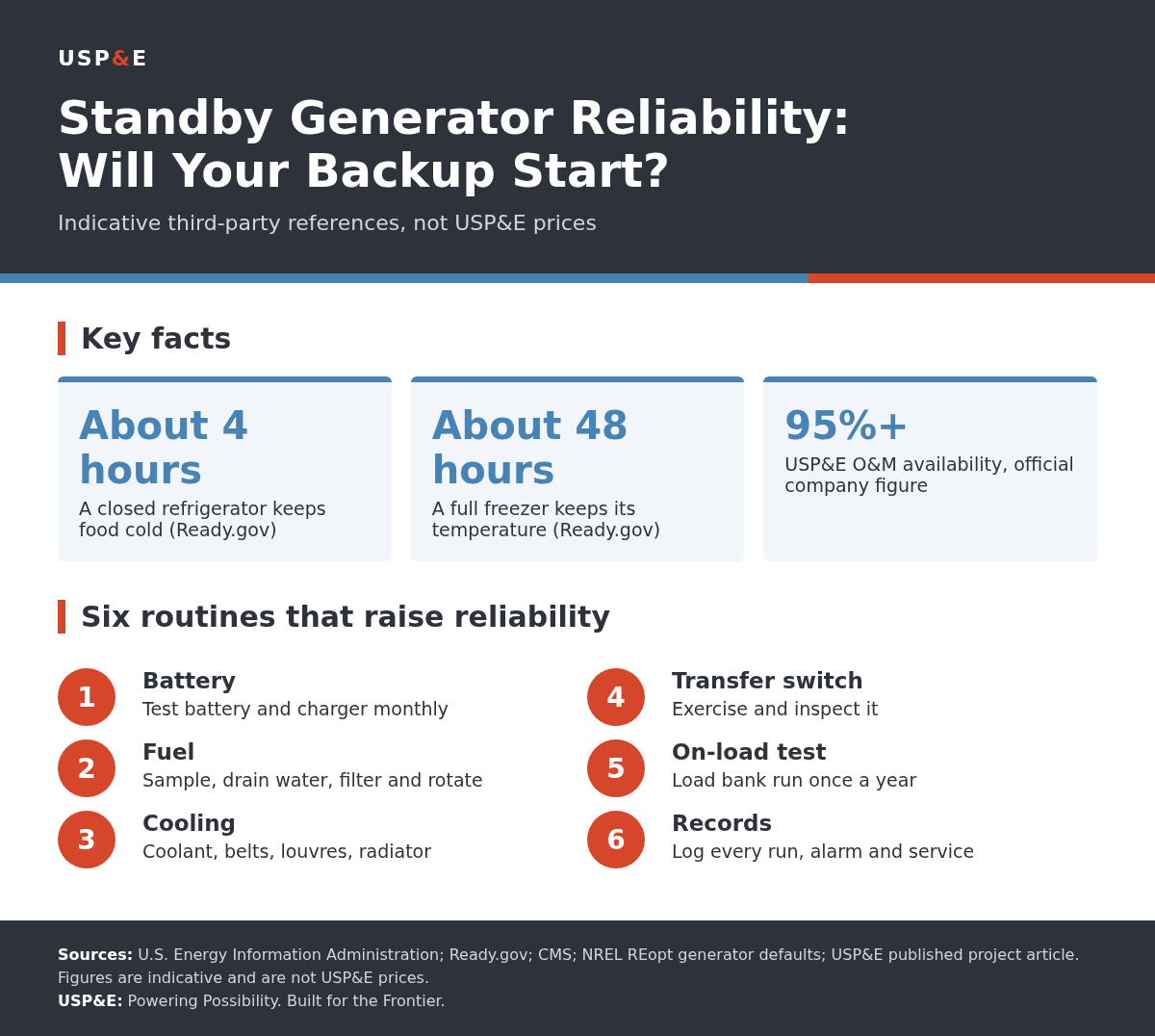
The need is real. Ready.gov, the United States government’s preparedness site, explains in its guide to power outages that extended outages can disrupt communications, water and transportation, close shops and banks, and prevent the use of medical devices. It also notes that a closed refrigerator keeps food cold for about four hours, and a full freezer for about 48 hours. Those limits show how quickly an outage turns into a loss, and why standby generator reliability matters.
The U.S. Energy Information Administration describes how the grid links generation, transmission and distribution in its guide to electricity in the United States. A fault in any link can interrupt supply to a wide area. Standby sets are the owner’s own protection against that risk, and their reliability decides whether the protection works. In health care, CMS, the United States federal health care regulator, takes an all-hazards approach to power outages in its emergency preparedness programme, which shows how seriously regulators treat the issue.
|
Standby generator reliability factor |
Typical failure |
Control |
|
Starting battery |
Flat or sulphated battery |
Charger, regular test, replacement schedule |
|
Fuel |
Old, contaminated or low fuel |
Fuel testing, polishing, rotation |
|
Cooling |
Low coolant, blocked radiator |
Checks and scheduled service |
|
Transfer switch |
Seized or mis-set switch |
Exercise and inspection |
|
Controls |
Alarm left in the wrong mode |
Checks and remote monitoring |
The Main Causes of Standby Generator Failure
Studies of standby failures usually point to a short list of causes, and most of them are about maintenance, not engine design. Starting batteries top the list in many fleets. A battery that holds charge in the shop may fail in a cold plant room. Chargers fail quietly, so a set can look healthy while its battery slowly dies.
Fuel is the next cause. Diesel ages, absorbs water and grows microbial contamination in tanks. After months in storage, it can clog filters and stop an engine under load. The U.S. Energy Information Administration’s explainer on diesel fuel shows how diesel is produced and distributed, and why quality can vary. Owners should test stored fuel, drain water from tanks and filter or replace fuel on a schedule.
Cooling and ventilation come third. A set needs air to burn fuel and cool the engine. A blocked louvre, a failed fan belt or low coolant can cause a shutdown within minutes of starting. Wet or flooded plant rooms cause electrical faults. And controls left in the wrong mode after a test can leave a set that will not start automatically.
The fourth cause is the transfer switch. If it does not operate, the generator may run perfectly and still supply nothing. Switches should be exercised and inspected, and tested with the building on load, at intervals set by the maker and local codes.
Quick checks to improve standby generator reliability
- Test the starting battery and charger every month.
- Sample stored fuel, drain water and filter or rotate it on schedule.
- Check coolant, belts, louvres and the radiator.
- Exercise the transfer switch, and run the set on load at least once a year.
- Confirm controls are in automatic mode after every test.
Testing and Maintenance Routines for Standby Generator Reliability
A good routine has several layers. Weekly or monthly, a short no-load or light-load run proves that the set starts and that alarms are clear. Running a diesel engine with no load for long periods is not ideal, so tests should include load where possible. Annually, an on-load test, often with a load bank, proves that the set can carry its rated output and that cooling, fuel and controls hold up for several hours.
A load bank is a device that applies an artificial electrical load. It lets owners test a set at its rating without disturbing the building. It also helps clear carbon from engines that have run lightly. Where a facility cannot afford to shed its real load for a test, a load bank is the practical solution.
Records matter. Log every run, every alarm, every fuel top-up and every service. Records show trends such as rising oil use, longer starting times or falling battery voltage, and they prove compliance to regulators and insurers. USP&E’s operations and maintenance team applies the same discipline to larger plants, with 95%+ O&M availability as an official company figure.
|
Standby generator reliability routine |
Frequency |
What it proves |
|
Visual check and alarm review |
Weekly |
No leaks, alarms clear |
|
Start and run test |
Monthly |
Set starts and transfers |
|
Battery and charger test |
Monthly |
Starting power available |
|
Fuel sample and water drain |
Quarterly |
Fuel fit for use |
|
On-load test with load bank |
Annual |
Rated output and cooling |
Standby Generator Reliability Cost: What to Budget
USP&E does not publish standby generator reliability prices, because they depend on set size, enclosure, controls and market timing. The figures below are indicative third-party references, not USP&E prices. Cost has three parts: the set and its installation, the cost of testing and maintenance, and the cost of failure. The last is often the largest. A hospital, data room or cold store that loses power can lose far more than the price of the generator.
For scale, the National Renewable Energy Laboratory’s REopt model, in its published generator cost defaults, uses about $650 to $880 per kW for installed diesel generator plant, with fixed operating cost of about $10 to $20 per kW per year plus fuel. Those are model defaults for United States conditions, not quotations. They suggest that annual running and maintenance cost is a small share of installed cost, which makes a proper maintenance budget good value.
|
Standby generator reliability cost layer |
What it covers |
Risk if ignored |
|
Equipment and installation |
Set, switch, fuel system, plant room |
A poor install undermines a good set |
|
Maintenance |
Service, parts, fuel care |
Skipped service raises failure risk |
|
Testing |
Monthly runs and annual load test |
Faults stay hidden |
|
Monitoring |
Alarms and remote reporting |
Slow response to faults |
|
Cost of failure |
Lost production, spoilage, safety |
Usually larger than the above |
Fuel Type Comparison
|
Fuel Type |
CapEx Range |
OpEx Range |
Typical Lead Time |
Best Application |
|
Diesel standby set |
About $650 to $880/kW installed (NREL REopt defaults) |
About $10 to $20/kW per year fixed, plus fuel (NREL REopt defaults) |
Varies with size and package |
Most commercial and industrial standby |
|
Natural gas standby set |
Fuel often cheaper where supply survives outages |
Varies with package |
Sites with firm gas supply |
|
|
Dual fuel set |
Varies with package |
Sites needing fuel flexibility |
||
|
Battery system |
Varies with size |
Short bridging and clean transfer |
Sources: NREL REopt generator defaults. Blank cells could not be verified from a comparable official source. These are not USP&E prices.
Safety, Emissions and Rapid-Deployment Backup
Reliability and safety go together. Ready.gov’s generator safety guidance says generators and fuel should be used outdoors, at least 20 feet from windows, doors and attached garages, with working carbon monoxide detectors installed. Keep sets dry, let them cool before refuelling and follow the maker’s instructions. For fixed installations, a transfer switch prevents back-feeding the grid.
Emissions rules apply as well. The U.S. Environmental Protection Agency regulates stationary engines under its stationary engines programme, and the rules treat emergency use differently from routine use in many cases. Confirm the status of each unit and how many hours it may run for testing.
Rapid-deployment mobile units add a second layer of cover. A trailer-mounted or containerised set held in reserve, or available on call, can replace a failed fixed set or serve a site with no fixed backup. USP&E sets out the logistics risks in its guide to fuel theft at a remote power plant, which also apply to reserve fuel stores.
New vs Used Equipment for Standby Generator Reliability
New sets bring warranty and a known starting point. Used sets can offer good value if the records are clear. A used set that has sat idle needs particular care, since seals, hoses and batteries age even when the engine does not run. Ask for engine hours, service history, the last overhaul and alternator tests. Require a load test at the stated rating and proof of ownership or a written right to sell before any deposit.
USP&E explains how to inspect and buy in its guide to used diesel generators for sale, and buyers can browse the diesel generators category. USP&E also compares engine and alternator families in its guide to industrial generator brands.
USP&E is an independent seller and is not affiliated with any engine or generator manufacturer named by buyers during a project. Those names are trademarks of their respective owners.
Case Studies: Standby Generator Reliability in Real Projects
USP&E only publishes approved case studies, and it does not name clients without permission. USP&E has delivered projects in 45+ countries, including power plant EPC projects and operations and maintenance work, and approved examples are collected on the case studies page. No outcome specific to standby generator reliability is claimed here beyond what is published.
The lessons below reflect common practice, not a named project:
- Owners who test batteries monthly find weak ones before an outage does.
- Owners who sample and rotate fuel avoid blocked filters under load.
- Owners who run a load bank test annually prove rated output and cooling.
- Owners who hold critical spares restore service sooner after a fault.
How to Choose Standby Generator Reliability Features and a Supplier: 10 Criteria
- Duty rating. Confirm the quoted output is the standby, prime or continuous figure you need, and under which standard.
- Starting system. Check battery capacity, charger quality and cold-start capability for the site.
- Fuel system. Design storage for the longest credible outage, with filtration, water drain and a rotation plan.
- Cooling and ventilation. Confirm airflow, louvres and radiator capacity at the site’s worst ambient temperature.
- Transfer arrangements. Specify a quality transfer switch, with bypass for safe testing.
- Controls and monitoring. Require clear alarms, remote reporting and a record of every run.
- Inspection and title. For used units, require a records audit, a load test and proof of ownership or a written right to sell before any deposit.
- Spares and service. Hold critical spares, including filters and batteries, and agree service response times. See USP&E’s power plant critical spares strategy.
- EPC and O&M depth. A supplier that can install, commission and maintain the plant reduces handover risk.
- Contract clarity. Delivery date, tests, payment milestones, warranty and training should be in writing.
FAQ: Standby Generator Reliability
What is standby generator reliability?
Standby generator reliability is the chance that a backup set starts, takes load and keeps running for as long as an outage lasts. It depends on design, installation, maintenance, fuel quality, testing and operator readiness, not only on the engine. A well built set can still fail if basic checks are skipped.
Why do standby generators fail to start?
The most common causes are flat or weak starting batteries, old or contaminated fuel, cooling or ventilation faults, a seized transfer switch and controls left in the wrong mode. Most are maintenance problems rather than design faults. Regular testing and records are the strongest defence for standby generator reliability.
How often should I test a standby generator?
Run a short start test monthly, and check the battery and charger at the same time. Test fuel quality quarterly, and carry out an on-load test, often with a load bank, once a year. Follow the maker’s schedule and your local codes, and record every test.
What is a load bank test?
A load bank applies an artificial electrical load to a generator so it can be tested at its rated output without disturbing the building. It proves that the engine, alternator, cooling and fuel system hold up under full load. It also helps clear carbon from engines that have run lightly.
How long does stored diesel last?
Diesel can degrade, absorb water and grow microbial contamination in storage, so shelf life depends on tank condition and care. Test samples regularly, drain water and filter or replace fuel on a schedule. Good fuel care is a core part of standby generator reliability.
Should I buy a used standby generator?
You can, if the records are clear and the unit is tested. Ask for engine hours, service history, the last overhaul and alternator tests. Require a load test at the stated rating and proof of ownership or a written right to sell before you pay any deposit.
What does USP&E need to quote?
USP&E needs the site location, the critical load, the voltage and frequency, the fuel available, the longest outage to cover and the date you need power. With these inputs, USP&E can recommend equipment and a plan to raise standby generator reliability.
Key Takeaways: Standby Generator Reliability
- Standby generator reliability depends on batteries, fuel, cooling, transfer switches and testing, more than on engine design.
- Test monthly, run on load annually and keep records of every run.
- Care for fuel, because old diesel is a leading cause of failure under load.
- Inspect used units, verify title and load test before paying a deposit.
- Choose a supplier with engineering, EPC and O&M depth, not a trader alone.
Reliable backup power is a solvable problem when the routine is clear. When you are ready to improve it, USP&E’s engineers can help you assess standby generator reliability, plan testing and spares, and bring the plant to power.
Ready to Power Your Project? Talk to USP&E’s Engineers.
Whether you are in early feasibility or ready to mobilise on a power station, EPC, or O&M project, USP&E’s engineers can help. With 150+ power projects delivered in 45+ countries since 2002, our engineers remove the technical and commercial risk from your project, with speed and without excuses.
Contact USP&E Today Request a Fast Quote
USP&E: Powering Possibility. Built for the Frontier. ISO 9001:2015 | ISO 45001:2018 | 150+ power projects in 45+ countries | 25,000 MW contracted since 2002 | 24+ years