

How to Stop Fuel Theft at a Remote Power Plant: The Complete Fuel Management and Reconciliation Guide
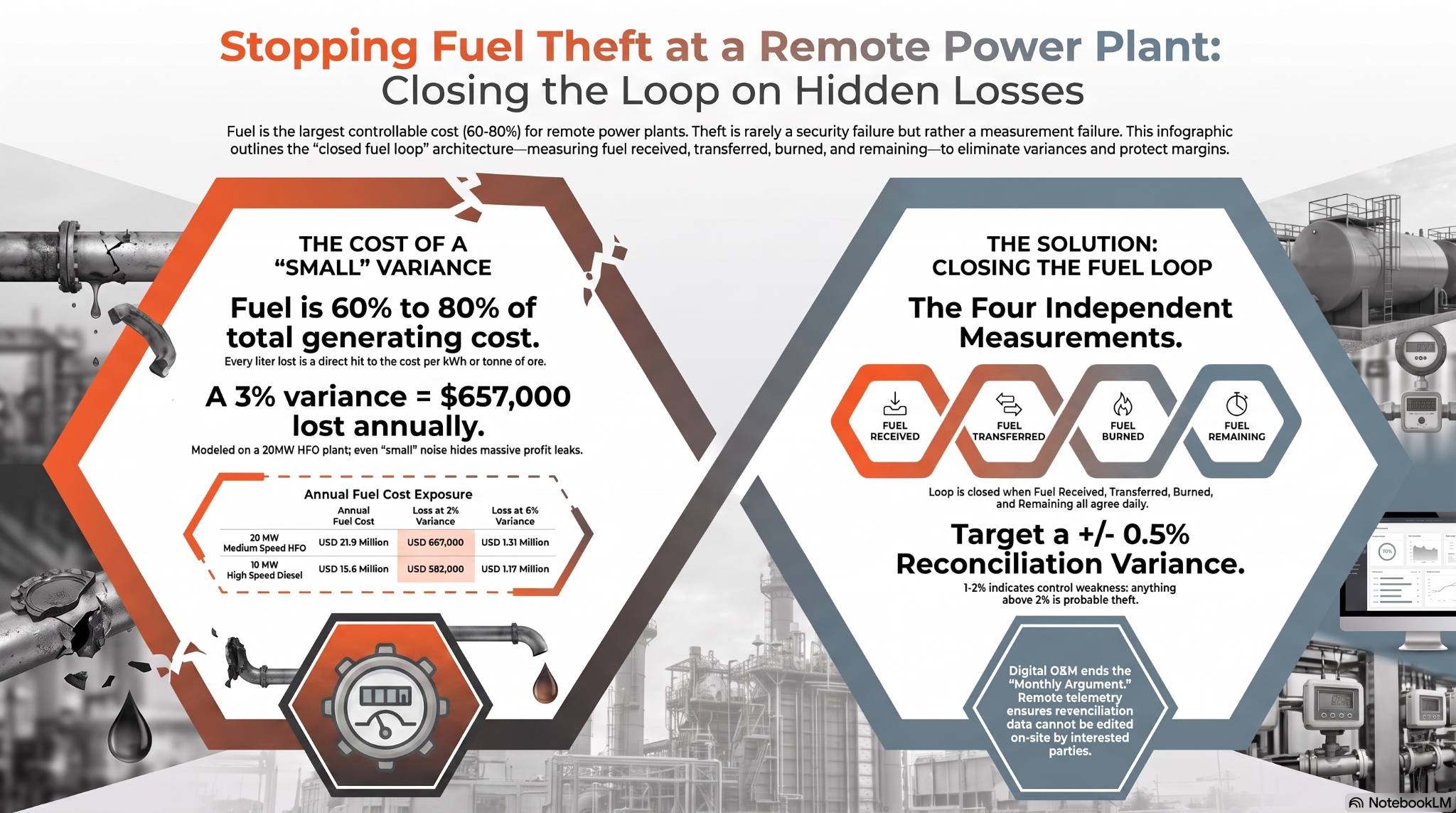
Fuel is the single largest controllable cost on almost every off grid power station in Africa, the Middle East and South Asia, and it is the easiest cost to lose without anyone noticing. On a 20 MW heavy fuel oil plant burning roughly 31 million litres a year, an unexplained variance of just 3 percent is more than 900,000 litres. At delivered inland prices, that is over half a million dollars leaving site annually with no invoice, no incident report and no line item. This is why fuel theft at a remote power plant is not a security problem. It is a metering, measurement and accountability problem that happens to have a security symptom.
Most mine energy managers and independent power producers discover the loss late, usually when a generation report and a fuel purchase ledger stop agreeing and nobody can say why. By then the trail is cold, the dip books are unreliable and the operator on shift has already left the country.
Your plant does not need more guards. It needs a closed fuel loop: measured in, measured burned, measured remaining, reconciled daily against a known specific fuel consumption curve, with variance escalated the same week it appears. USP&E Global has designed, built and operated diesel, HFO and gas fired power stations in frontier markets for 25 years, across 150+ projects in 35+ countries, with 350+ engineers and 260+ MW currently under operations and maintenance management. This guide sets out the fuel control architecture our teams deploy on remote sites, the reconciliation tolerances that separate normal measurement error from genuine loss, and the contractual terms that make fuel accountability someone’s job rather than everyone’s assumption.
The True Cost of Fuel Theft at a Remote Power Plant: What the Data Shows
Fuel theft at a remote power plant is expensive because fuel dominates the operating cost stack. For a thermal plant running base load in a market with no grid alternative, fuel typically represents 60 to 80 percent of total generating cost, with operations, maintenance, spares and overhaul provisions sharing the remainder. Every litre lost is therefore a direct hit to the cost per kWh, and in mining applications a direct hit to the cost per tonne.
The exposure is structural rather than incidental. According to the International Energy Agency, more than 600 million people in Africa still live without access to electricity, and industrial operators across the continent consequently self generate at scale. World Bank energy data shows the same pattern across the wider frontier market set: where the grid is absent or unreliable, liquid fuel becomes the primary energy carrier, trucked hundreds of kilometres to sites with limited supervision and high staff turnover. The African Development Bank has repeatedly identified this dependence as a competitiveness constraint for African industry.
Industry estimates place diesel at roughly 20 to 40 percent of an open pit mine’s total operating cost, and fuel management vendors report that unaccounted fuel commonly runs between 2 and 6 percent of fuel spend at sites relying on manual dip readings and paper logs. Those figures are third party estimates rather than audited data, so the more useful exercise is arithmetic on your own plant. The table below models the annual exposure at stated assumptions.
Table 1: Modelled Annual Fuel Loss Exposure at a Remote Power Plant
| Plant Configuration | Annual Fuel Burn (Illustrative) | Annual Fuel Cost at Stated Price | Loss at 3% Variance | Loss at 6% Variance |
| 10 MW high speed diesel, 75% capacity factor, 0.27 L/kWh | 17.7 million litres | USD 19.5 million at 1.10/litre | USD 585,000 | USD 1.17 million |
| 20 MW medium speed HFO, 85% capacity factor, 0.21 L/kWh | 31.3 million litres | USD 21.9 million at 0.70/litre | USD 657,000 | USD 1.31 million |
| 5 MW containerised diesel, 60% capacity factor, 0.29 L/kWh | 7.6 million litres | USD 8.4 million at 1.10/litre | USD 252,000 | USD 504,000 |
| 40 MW gas turbine on distillate backup, 15% run hours, 0.33 L/kWh | 17.3 million litres | USD 19.0 million at 1.10/litre | USD 570,000 | USD 1.14 million |
The point of the table is not the precision of any single row. It is that a variance small enough to hide inside measurement noise is large enough to fund a fuel control system many times over in its first year.
Key Drivers of Fuel Theft at a Remote Power Plant: Why Now Is the Critical Window
Five forces have made fuel accountability urgent rather than administrative across frontier power operations.
- Fuel prices have re priced the incentive. Delivered diesel at remote inland sites in West and Central Africa routinely lands well above coastal pump prices once haulage, losses and duties are loaded. Higher landed value raises the return on every stolen litre and attracts organised rather than opportunistic theft. A control regime designed when fuel was cheap is under specified now.
- Mining expansion has multiplied exposed sites. Gold, lithium, copper and bauxite development across Mali, Burkina Faso, Guinea, the Democratic Republic of Congo, Tanzania and Mozambique has put new captive power stations into locations with thin institutional oversight, long supply chains and contractor heavy workforces.
- Lender and audit scrutiny has tightened. Development finance institutions including the International Finance Corporation increasingly expect documented fuel handling, storage and environmental controls as a condition of disbursement. Fuel that cannot be reconciled is a finding, not just a loss.
- Regulatory frameworks now require records that also deter theft. In the United States, facilities storing bulk oil above threshold volumes must maintain a Spill Prevention, Control and Countermeasure plan under 40 CFR 112, including periodic container integrity testing and inspection records retained for at least three years, per the S. Environmental Protection Agency. Frontier market projects financed to international standards are increasingly held to equivalent documentation, and a disciplined tank register is simultaneously an environmental control and a theft control.
- Digital O&M has closed the detection gap. Mass flow metering, automatic tank gauging and remote telemetry now cost a fraction of the loss they prevent, and they convert fuel accountability from a monthly argument into a daily exception report.
Fuel theft at a remote power plant is rarely a single dramatic event. It is a set of small, repeatable extraction routes, each with a matching control. The table below maps them.
Table 2: How Fuel Theft at a Remote Power Plant Occurs and Which Control Stops It
| Loss Vector | How fuel theft at a remote power plant occurs | Primary Detection Control | Accountable Function |
| Short delivery | Tanker delivers less than the bill of lading states, often via partial pre discharge en route | Sealed compartments, seal number log, calibrated receipt metering, temperature corrected volume at 15 degrees C | Fuel receiving officer |
| Density and water manipulation | Product diluted or water bottoms counted as fuel volume | Density testing on receipt, water paste or interface probe, sampling and retained samples per delivery | Laboratory or shift chemist |
| Tank tapping and unauthorised valve draws | Draw off below liquid level, sludge lines, redundant drain valves | Automatic tank gauging with alarmed level rate of change, valve locking and single point fill, no gravity draws | Plant manager |
| Unmetered day tank transfers | Fuel moved from bulk to day tank or to site vehicles without record | Positive displacement or Coriolis metering on every transfer path, reconciliation of transfer totals | Control room operator |
| Phantom generation | Run hours or load overstated so the burn appears legitimate | Engine hour counters cross checked against kWh export meters and specific fuel consumption curves | Performance engineer |
| Paper record substitution | Dip books amended after the fact, missing delivery notes | Digital capture at source, immutable logs, remote replication off site daily | O&M contract manager |
EPC and O&M Solutions That Stop Fuel Theft at a Remote Power Plant: A Technical and Commercial Overview
A fuel loop is closed when four numbers can be produced independently and made to agree: fuel received, fuel transferred, fuel burned and fuel remaining. Everything below exists to produce those four numbers reliably at a site where the nearest calibration laboratory may be a thousand kilometres away.
Receipt control. One nominated fill point, lockable dry break coupling, calibrated inline meter with temperature compensation, sealed tanker compartments logged by seal number, density and water checks on every load, and retained samples held for the contract period. Volumes recorded at reference temperature, not ambient, since a 20 degree temperature difference materially changes apparent volume on a 40,000 litre delivery.
Storage control. Bunded bulk tanks with certified strapping charts, automatic tank gauging using radar or servo level measurement, water interface detection, high level and rate of change alarms, and physical elimination of every draw point below liquid level that is not metered. Tank integrity inspection on a published schedule, which serves environmental compliance and closes the quiet leak that looks like theft.
Consumption control. Metering on engine supply and return lines, or mass flow metering where return line compensation is unreliable. Burn is then compared against the unit’s specific fuel consumption curve at measured load. When a machine that should consume 0.27 litres per kWh reports 0.31, either it needs maintenance or fuel is leaving elsewhere, and both answers matter.
Reconciliation and escalation. Daily reconciliation, weekly variance review, monthly signed statement. Variance thresholds agreed in advance so escalation is automatic rather than political. This is where remote power plant monitoring earns its cost: telemetry replicated off site means the reconciliation cannot be edited by anyone with an interest in the outcome.
Design stage decisions. The cheapest fuel control is the one engineered into the plant before concrete is poured. Fill point location, tank farm layout, meter placement, cable routing for level instrumentation and camera sightlines are all power plant engineering decisions, not retrofit decisions. Retrofitting metering into a live HFO plant with heated and traced fuel lines is expensive and disruptive. Designing it in adds a small fraction of a percent to project CapEx.
Indicative CapEx for a full fuel control package on a 10 to 30 MW remote plant, covering receipt metering, automatic tank gauging, per unit consumption metering, telemetry and integration, generally falls in the low hundreds of thousands of US dollars, with annual OpEx for calibration, maintenance and monitoring a modest fraction of that. Against a modelled six figure annual loss, payback is typically measured in months. These ranges are indicative and must be confirmed by engineering against a specific site scope.
Table 3: Fuel Control Implementation Timeline, Fast Track Versus Standard
| Phase | Fast Track Retrofit | Standard Retrofit | Designed In at EPC Stage |
| Site fuel audit and baseline reconciliation | 1 to 2 weeks | 3 to 4 weeks | Included in conceptual design |
| Instrument specification and procurement | 4 to 8 weeks | 10 to 16 weeks | Within main procurement package |
| Installation and calibration | 2 to 4 weeks, staged around load | 4 to 8 weeks | Within construction programme |
| Telemetry, integration and reporting setup | 2 to 3 weeks | 4 to 6 weeks | Within commissioning |
| Operator training and procedure rollout | 1 to 2 weeks | 2 to 4 weeks | Within operator readiness |
| Total to first reliable reconciliation | 10 to 19 weeks | 23 to 38 weeks | No separate programme |
Fuel Type Comparison for Remote Power Plant Fuel Security
Fuel choice changes the theft profile as much as it changes the cost profile. Highly saleable, easily decanted fuels carry the greatest exposure. Piped gas carries almost none.
Table 4: Fuel Type Comparison for Remote Power Plant Projects and Theft Exposure
| Fuel Type | CapEx | OpEx | Lead Time | Theft Exposure | Best Application |
| Diesel, high speed gensets | Lowest | Highest fuel cost per kWh | 4 to 12 weeks | Highest, directly saleable and easily decanted | Fast track, standby, bridging power, short mine life |
| Heavy fuel oil, medium speed engines | High | Lowest liquid fuel cost per kWh | 9 to 14 months | Moderate, needs heating and handling so resale is harder | Base load 10 MW and above, long mine life, utility supply |
| Natural gas, reciprocating or turbine | Moderate to high | Lowest where pipeline gas exists | 6 to 18 months depending on gas infrastructure | Very low, metered and not decantable | Sites with pipeline gas, LNG or associated gas access |
| Solar hybrid with thermal backup | High upfront, lower lifetime | Lowest marginal cost per kWh generated | 6 to 12 months | Reduces exposure by cutting litres consumed | Mining and remote industrial with strong irradiation |
| Mobile gas turbines on gas or distillate | Moderate | Depends on fuel and run hours | 8 to 16 weeks | Low on gas, moderate on distillate | Emergency, grid support, phased permanent build |
The strategic insight is that reducing consumption reduces exposure. Every litre a hybrid power system displaces is a litre that cannot be stolen, which is why fuel security belongs in the technology selection conversation and not only in the security plan. Where liquid fuel is unavoidable, the diesel and HFO generating equipment selected should be matched to a fuel control architecture from day one.
Case Studies: Reducing Fuel Theft at a Remote Power Plant in Frontier Markets
USP&E has operated liquid fuelled plants in some of the most logistically difficult environments in the world, and fuel accountability has been central to every one of those contracts.
Mali, gold mining O&M. USP&E has designed, built and operated diesel and HFO power stations in Mali since 2006 and currently employs more than 120 engineers and technicians in country supporting mining sector clients. On these contracts, daily fuel reconciliation against per unit specific fuel consumption is a standard deliverable, with variance reported to the client’s energy manager rather than held inside the operating team. Client identities, installed capacities and specific savings figures on these contracts require internal confirmation before publication.
Sierra Leone, mining and commercial O&M. USP&E has delivered diesel and HFO power station EPC and O&M in Sierra Leone since 2009 for mining and hospitality sector clients. Sites in this market combined high delivered fuel cost with long inland haulage, which made receipt side controls, sealed deliveries and density verification the highest value interventions rather than perimeter security.
Togo, gas and diesel generation. USP&E currently operates more than 50 MW in Togo with an in country team, alongside a wider platform of 260+ MW under management. Where pipeline gas is available, metered gas supply removes the decanting risk entirely and shifts the accountability question from volume security to metering accuracy and calibration discipline.
Across the portfolio, USP&E has documented more than USD 250 million in fuel and operating savings for clients, and one gas turbine engagement produced a documented 66 percent cost reduction. Further verified detail is available via project experience and client references.
How to Select an O&M Partner That Can Stop Fuel Theft at a Remote Power Plant: 10 Critical Criteria
Fuel accountability is a contract design problem as much as an engineering one. Use these criteria when evaluating an EPC and O&M partner for a remote site.
- Ask who owns the fuel number. A credible partner names a single accountable role for daily reconciliation and will accept that obligation in the contract. If fuel accountability is described as shared, it is unowned.
- Require a defined variance tolerance. Ask what percentage variance the partner treats as normal and at what threshold escalation is automatic. Vague answers here predict vague answers later.
- Test their specific fuel consumption discipline. A partner who cannot state expected litres per kWh for the proposed units at your load profile and ambient conditions cannot detect a burn anomaly, because they have no baseline to compare against.
- Inspect the instrumentation philosophy, not the brand list. Ask where meters sit, how return lines are handled, how tank gauging is calibrated and how often. Instrument placement determines whether the loop actually closes.
- Demand off site data replication. Reconciliation data that lives only on site can be edited on site. Daily replication to an independent server is a control, not a convenience.
- Check frontier logistics capability. Calibration equipment, spare instrumentation and qualified technicians must reach your site within a defined response window. In practice this means in country presence, not a regional office promise.
- Verify local workforce depth and training. Fuel controls are executed by operators. A partner with an established local team, documented procedures and recurring training will hold the discipline. A fly in team will not.
- Confirm compliance credentials. ISO 9001:2015 quality management and ISO 45001:2018 occupational health and safety certification indicate that documented procedure is normal practice rather than an exception.
- Interrogate the reporting format before signing. Ask to see a redacted monthly fuel reconciliation statement from a live contract. If none exists in presentable form, the discipline probably does not exist either.
- Align commercial incentives. Availability guarantees, guaranteed heat rate or litres per kWh performance bands, and a long term service agreement structure put the partner’s margin on the same side of the ledger as your fuel budget.
Frequently Asked Questions: Fuel Theft at a Remote Power Plant
How do you stop fuel theft at a remote power plant?
You stop fuel theft at a remote power plant by closing the fuel loop rather than by adding guards. That means calibrated temperature compensated metering at receipt, automatic tank gauging with alarmed rate of change detection in storage, consumption metering on each generating unit, and daily reconciliation of fuel received, transferred, burned and remaining against a known specific fuel consumption curve. Variance thresholds should be agreed in advance and escalated automatically. Physical security matters, but it only works once the measurement system can tell you that something is missing within 24 hours rather than 30 days.
What is a normal fuel reconciliation variance for a power plant?
With calibrated metering, temperature compensated volumes and automatic tank gauging, a well run remote power plant should reconcile to within roughly plus or minus 0.5 percent of throughput. Sustained variance of 1 to 2 percent generally indicates a control or calibration weakness rather than theft. Variance consistently above 2 percent should be treated as probable loss and investigated formally. These tolerance bands reflect operating practice and should be confirmed by engineering against your specific instrumentation and fuel type.
How much money does fuel theft cost a mining power plant each year?
The loss scales directly with fuel spend. A 20 MW heavy fuel oil plant burning approximately 31 million litres annually spends in the region of USD 22 million on fuel at 0.70 per litre, so a 3 percent unexplained variance costs roughly USD 657,000 per year. On a diesel plant at higher unit fuel cost, the same percentage variance costs proportionally more. Because a full fuel control package on a plant of this size typically costs a fraction of one year of that loss, payback is usually measured in months.
What is generator fuel reconciliation and how often should it be done?
Generator fuel reconciliation is the daily comparison of four independently measured quantities: fuel received, fuel transferred between tanks, fuel consumed by each generating unit, and fuel physically remaining in storage. Reconciliation should be performed daily, reviewed weekly for trend, and issued monthly as a signed statement to the asset owner. Monthly only reconciliation is the most common failure mode on remote sites, because a 30 day gap makes it impossible to attribute a variance to a shift, a delivery or a machine.
Can a fuel management system detect theft that dip readings miss?
Yes. Manual dip readings are taken infrequently, are subject to reading error and tank geometry assumptions, and are recorded by the same people they are meant to check. A power plant fuel management system combining automatic tank gauging, inline metering and off site data replication captures level changes continuously, flags abnormal rate of change outside transfer windows, and produces records that cannot be retrospectively amended on site. That combination detects small persistent losses that dip books structurally cannot.
Does switching to gas or solar hybrid reduce fuel theft exposure?
Substantially, yes. Pipeline natural gas cannot be decanted or resold from a remote site, so metered gas supply effectively eliminates volumetric theft and shifts the risk to metering accuracy. A solar hybrid configuration reduces exposure differently, by cutting the number of litres consumed and stored, and every displaced litre is a litre that cannot be stolen. Where liquid fuel remains necessary, heavy fuel oil carries lower theft exposure than diesel because it requires heating and specialised handling, which limits its informal resale market.
Should fuel accountability be written into the O&M contract?
Yes, and it should be specific. A strong O&M contract names the accountable role for daily reconciliation, defines the variance tolerance and escalation threshold, specifies the reporting format and frequency, requires off site data replication, and ties a portion of commercial performance to guaranteed fuel consumption or heat rate bands within a long term service agreement. Without those clauses, fuel accountability defaults to whoever is holding the dip book, which is the condition that allows losses to persist.
Summary: Key Takeaways on Fuel Theft at a Remote Power Plant
- Fuel theft at a remote power plant is a measurement failure before it is a security failure. If you cannot reconcile daily, you cannot detect loss in time to act on it.
- Fuel typically represents 60 to 80 percent of generating cost on a remote thermal plant, so a 3 percent variance on a 20 MW HFO station equates to roughly USD 657,000 per year at the assumptions modelled above.
- Close the loop on four numbers: fuel received, fuel transferred, fuel burned and fuel remaining, each measured independently and reconciled every day.
- Target reconciliation within plus or minus 0.5 percent of throughput. Treat 1 to 2 percent as a control weakness and anything above 2 percent as probable loss requiring formal investigation.
- Temperature compensated volumes, density and water checks, sealed deliveries, single point fill and elimination of unmetered draw points address the majority of loss vectors on receipt and in storage.
- Fuel choice changes exposure. Diesel carries the highest theft risk, HFO is moderate, pipeline gas is minimal, and hybrid configurations reduce risk by reducing litres consumed.
- Contract the outcome. Named accountability, defined variance tolerances, off site data replication and performance bands turn fuel discipline into an obligation rather than an aspiration.
- Engineer controls at design stage. Retrofitting fuel metering into a live plant costs several times what it costs to build it in, which is why stopping fuel theft at a remote power plant starts on the drawing board.
Ready to Power Your Project? Talk to USP&E’s Engineers Free.
USP&E Global offers a complimentary 4-hour engineering consultation for qualified power station, EPC, and O&M projects. Whether you are in early feasibility or ready to mobilize, our team of 350+ engineers across 35+ countries is ready to guide your project to success with speed and without excuses.
USP&E Global. Powering Possibility. Built for the Frontier.
ISO 9001:2015 | ISO 45001:2018 | 150+ Projects | 35+ Countries | Zero Lawsuits
Quick Links:
- Contact USP&E by clicking on this link.
- Request a fast equipment quote
Global Resources
- USP&E's Project Experience Portfolio
- USP&E Case Studies and Client Reference Letters
- USP&E Integrity and Compliance policy
- USP&E's ISO Certifications and Credentials