

Hospital Backup Power: How to Keep Critical Facilities Running Through an Outage
Hospital backup power is not a convenience. It keeps ventilators, theatres, laboratories, cold storage and communications running when the grid fails. Prisons and other secure facilities have a similar duty, because lives and security depend on lighting, doors, alarms and water. A failure in hospital backup power can harm patients within minutes. This guide explains how hospital backup power systems are designed, how to specify diesel generation for them, what to budget, and how to choose a supplier who can deliver a system that works the first time.
USP&E has delivered 150+ power projects in 45+ countries since 2002, with 25,000 MW contracted since 2002. USP&E holds ISO 9001:2015 and ISO 45001:2018 certification and works across equipment supply, EPC (Engineering, Procurement and Construction) and O&M (Operations and Maintenance). USP&E is more than a broker: it removes technical and commercial risk for buyers through engineering, inspection, EPC and O&M. Supply comes from USP&E’s own inventory plus equipment sourced from OEMs, IPPs, banks and asset owners. The advice below reflects that engineering view, and it does not replace the requirements of local codes or the facility’s own regulators.
What Is Hospital Backup Power and Why Does It Matter?
Hospital backup power is the standby electrical system that takes over when the utility supply fails. It normally includes one or more generating sets, an automatic transfer switch, distribution boards that feed the critical loads, a fuel system and a monitoring and testing routine. The aim is to restore supply within seconds, and to keep it running for as long as the outage lasts.
The risks are well understood. Ready.gov, the United States government’s preparedness site, notes in its guide to power outages that outages can prevent the use of medical devices, cause food spoilage and water contamination, and disrupt communications and transportation. A hospital concentrates every one of those risks in a single building. Cold storage for medicines, life support and diagnostic imaging all depend on power.
Regulators take the same view. CMS, the United States federal health care regulator, runs an emergency preparedness programme that takes an all-hazards approach to events including hurricanes, fires, earthquakes and power outages. Its aim is to help providers respond in a timely and organised way. Power is the thread that runs through every plan, and hospital backup power is how the plan is carried out.
|
Hospital backup power element |
Role |
What to check |
|
Generating sets |
Supply power during an outage |
Duty rating, starting time, redundancy |
|
Automatic transfer switch |
Moves load to the generator |
Transfer time, testing, bypass |
|
Critical distribution |
Feeds life safety and priority loads |
Load priority and separation |
|
Fuel system |
Stores and supplies fuel |
Autonomy, filtration, delivery plan |
|
Monitoring and testing |
Proves readiness |
Test schedule, alarms, records |
Designing Hospital Backup Power: Load, Redundancy and Autonomy
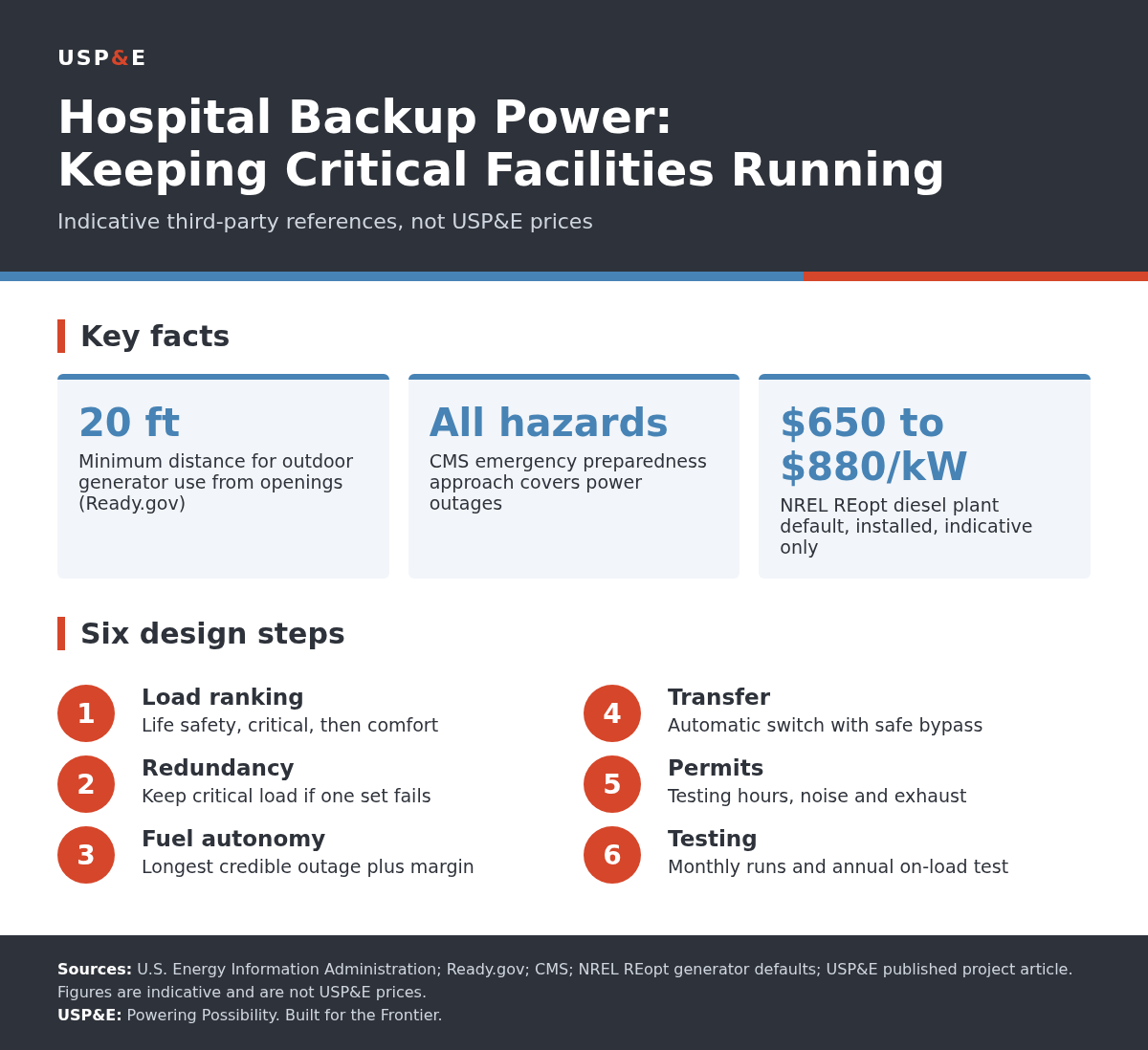
Design starts with the load. List the circuits that must stay on, in order of priority. Life safety loads such as lighting, alarms and medical gas come first. Critical clinical loads such as theatres, intensive care and imaging follow. Comfort loads such as general air conditioning come last, and can be shed if capacity is short. For each circuit, record the running power, the starting power and the maximum time it can go without supply.
Redundancy is the next decision. A single large set is a single point of failure. Two or more sets, arranged so that the loss of one still leaves enough capacity for the critical loads, give much better security. Parallel operation needs designed controls and protection, but it allows load to be shared and maintenance to be done without leaving the hospital exposed. Many owners aim for an arrangement that continues to serve the critical load after the failure of any one set.
Autonomy means how long the system can run without refuelling. Fuel storage must cover the longest credible outage, plus a margin for delayed deliveries. The U.S. Energy Information Administration’s guide to electricity in the United States explains how the grid links generation, transmission and distribution, and why faults can leave wide areas without supply. In a regional event, fuel deliveries may be delayed, so the hospital’s own storage is its safety margin.
Quick design steps for hospital backup power
- Rank loads by priority and record running and starting power.
- Choose redundancy so that the loss of one set still serves critical load.
- Size fuel storage for the longest credible outage plus a margin.
- Design transfer arrangements and bypass for safe testing.
- Set a regular test schedule, including on-load tests.
Prisons and Other Secure Facilities
Secure facilities share the hospital’s need for dependable supply, with some extra demands. Lighting, perimeter alarms, door control, communications and water pumping must work through an outage. A power failure that unlocks doors or switches off cameras creates a security risk as well as a comfort problem. Kitchens and laundries are usually lower priority and can be shed.
The design logic is the same as for a hospital. Rank the loads, choose redundancy, store enough fuel and test regularly. The difference is that access for service crews is controlled, so maintenance plans need to be agreed with the operator in advance, and spares should be held on site.
|
Hospital backup power equivalent in a secure facility |
Priority |
Note |
|
Perimeter lighting and alarms |
Highest |
Security depends on it |
|
Door control and communications |
Highest |
Staff safety and control |
|
Water pumping and cold storage |
High |
Health and supply |
|
Kitchens and laundries |
Medium |
Can be restored after critical load |
|
General comfort cooling |
Low |
First to shed in a long outage |
Hospital Backup Power Cost: What to Budget
USP&E does not publish hospital backup power prices, because they depend on size, redundancy, enclosure, fuel system and market timing. The figures below are indicative third-party references, not USP&E prices. Cost has several layers: the sets, the transfer and distribution equipment, the fuel system, the building works and the long-term cost of testing and maintenance.
For scale, the National Renewable Energy Laboratory’s REopt model, in its published generator cost defaults, uses about $650 to $880 per kW for installed diesel generator plant, with fixed operating cost of about $10 to $20 per kW per year plus fuel. Those are model defaults for United States conditions, not quotations, and a hospital system with redundancy and strict standards may cost more.
Testing and maintenance are real costs and should be in the budget from the start. A system that is not tested may not start. Monthly tests, annual on-load tests and regular fuel quality checks are normal practice. Budget also for staff training, because the people who respond on the night need to know the system.
|
Hospital backup power cost layer |
What it covers |
Risk if ignored |
|
Generating sets |
Engines, alternators, enclosures |
A weak rating fails under long running |
|
Transfer and distribution |
Switches, boards, cabling |
Poor design delays restoration |
|
Fuel system |
Tanks, pumps, filtration |
Short autonomy ends the supply |
|
Building works |
Plant room, ventilation, exhaust |
Heat and noise problems |
|
Testing and training |
Test runs, records, drills |
Untested systems may not start |
Fuel Type Comparison
|
Fuel Type |
CapEx Range |
OpEx Range |
Typical Lead Time |
Best Application |
|
Diesel generating sets |
About $650 to $880/kW installed (NREL REopt defaults) |
About $10 to $20/kW per year fixed, plus fuel (NREL REopt defaults) |
Varies with size and package |
Most hospital standby systems |
|
Natural gas generating sets |
Fuel often cheaper where supply is firm |
Varies with package |
Sites with gas supply that survives outages |
|
|
Battery systems |
Varies with size |
Short bridging and clean transfer |
||
|
Dual fuel sets |
Varies with package |
Sites needing fuel flexibility |
Sources: NREL REopt generator defaults. Blank cells could not be verified from a comparable official source. These are not USP&E prices.
Emissions, Testing and Permits for Hospital Backup Power
Emergency engines are regulated, and the rules can affect how often a set may be tested. In the United States, the U.S. Environmental Protection Agency regulates stationary engines under its stationary engines programme, and sets national limits for pollutants such as criteria air pollutants. Rules differ by country and by the engine’s use, and emergency engines are often treated differently from engines that run for routine supply.
Confirm early what testing hours the permit allows, what emissions equipment is needed and whether noise limits apply. A hospital often sits in a dense urban area, so noise and exhaust routing need careful design. These issues are easy to solve in the design stage and hard to fix after installation.
New vs Used Equipment for Hospital Backup Power
Hospital owners often prefer new equipment for the warranty and the clean record, and that is a reasonable position. Used equipment is sometimes considered for temporary cover, for secondary sites or for budget reasons. Where it is, ask for engine hours, service history, the last overhaul and alternator tests. Require a load test at the stated rating and proof of ownership or a written right to sell before any deposit.
USP&E explains how to inspect and buy in its guide to used diesel generators for sale, and buyers can browse the diesel generators category and the natural gas generators category.
USP&E is an independent seller and is not affiliated with any engine or generator manufacturer named by buyers during a project. Those names are trademarks of their respective owners.
Spares matter. A hospital cannot wait weeks for a part. USP&E explains the approach in its guide to power plant critical spares strategy.
Case Studies: Hospital Backup Power and Critical Facility Projects
USP&E only publishes approved case studies, and it does not name clients without permission. USP&E has delivered projects in 45+ countries, including power plant EPC projects and operations and maintenance work, and approved examples are collected on the case studies page. No outcome specific to hospital backup power is claimed here beyond what is published.
The lessons below reflect common practice, not a named project:
- Facilities that rank loads before sizing avoid paying to back up loads that can be shed.
- Facilities that use redundant sets keep critical supply when one set is under maintenance.
- Facilities that test on load find faults while there is no emergency.
- Facilities that store fuel for the longest credible outage avoid depending on deliveries.
How to Choose Hospital Backup Power Equipment and a Supplier: 10 Criteria
- Load ranking. Start with a ranked list of life safety, critical and comfort loads, with running and starting power.
- Redundancy. Choose an arrangement that keeps critical load after the failure of any one set.
- Starting and transfer time. Confirm how quickly the system restores supply, and how it behaves during transfer.
- Fuel autonomy. Size storage for the longest credible outage, and plan deliveries and filtration.
- Paralleling and protection. Where sets run together, controls and protection should be designed as a system.
- Emissions, noise and permits. Check testing hours, exhaust and noise limits for an urban site.
- Inspection and title. For any used units, require a records audit, a load test and proof of ownership or a written right to sell before any deposit.
- Spares and service. Hold critical spares and agree response times with the service provider.
- EPC and O&M depth. A supplier that can install, commission and maintain the system reduces handover risk. USP&E offers O&M with 95%+ O&M availability as an official company figure.
- Contract clarity. Delivery date, tests, payment milestones, warranty and training should be in writing.
FAQ: Hospital Backup Power
What is hospital backup power?
Hospital backup power is the standby electrical system that takes over when the grid fails. It normally includes generating sets, an automatic transfer switch, critical distribution, a fuel system and a testing routine. It keeps life safety and clinical loads running, including theatres, intensive care, laboratories and cold storage for medicines.
How long should hospital backup power run without refuelling?
Long enough to cover the longest credible outage, plus a margin for delayed deliveries. The right figure depends on local risk, regulations and the facility’s role. Fuel storage should be sized by risk assessment, and fuel should be tested and rotated regularly so it is fit to run when needed.
Why use more than one generator?
One large set is a single point of failure. Two or more sets, arranged so that the loss of one still leaves enough capacity for critical load, give better security and allow maintenance without leaving the building exposed. Redundancy needs well designed paralleling controls and protection in hospital backup power systems.
How often should backup generators be tested?
Regular tests are normal practice, including short monthly runs and longer on-load tests at intervals set by local codes and the facility’s regulator. Tests prove that the engine starts, the transfer switch operates and the fuel system works. Record every test, and fix faults promptly.
Are diesel sets still the standard choice?
Diesel remains the most common choice for hospital backup power, because it starts quickly, stores fuel simply and handles sudden load well. Gas sets and batteries are used in some designs, often alongside diesel. The choice depends on fuel supply, permits, space and the facility’s priorities.
Can used equipment be used for hospital backup power?
It can be considered for temporary cover or secondary sites, if records are clear and the unit is tested. Ask for engine hours, service history and a load test, and require proof of ownership or a written right to sell. Many hospitals prefer new equipment for warranty reasons.
What does USP&E need to quote?
USP&E needs the site location, the critical load list, the voltage and frequency, the redundancy you require, the fuel available and the date you need power. With these inputs, USP&E can recommend a hospital backup power design and a delivery plan.
Key Takeaways: Hospital Backup Power
- Hospital backup power starts with a ranked list of loads and a clear view of redundancy.
- Size fuel storage for the longest credible outage, and test the system on load.
- Check emissions, testing hours and noise limits at the design stage.
- Inspect any used units, verify title and load test before paying a deposit.
- Choose a supplier with engineering, EPC and O&M depth, not a trader alone.
A well designed system is a solvable problem with the right partner. When you are ready to plan, USP&E’s engineers can help you define hospital backup power, size the redundancy and fuel, and bring the plant to power.
Ready to Power Your Project? Talk to USP&E’s Engineers.
Whether you are in early feasibility or ready to mobilise on a power station, EPC, or O&M project, USP&E’s engineers can help. With 150+ power projects delivered in 45+ countries since 2002, our engineers remove the technical and commercial risk from your project, with speed and without excuses.
Contact USP&E Today Request a Fast Quote
USP&E: Powering Possibility. Built for the Frontier. ISO 9001:2015 | ISO 45001:2018 | 150+ power projects in 45+ countries | 25,000 MW contracted since 2002 | 24+ years