

Voltage and Frequency by Country: The Global Reference Table for Power Station Projects
Selecting the wrong generator frequency is one of the most expensive mistakes a power project can make. A 60Hz gas turbine landed at a 50Hz site cannot simply be switched on, and the retrofit adds time and cost to the project. Voltage and Frequency by Country is therefore the first technical filter applied to any equipment shortlist, ahead of capacity, fuel type, or price. USP&E has designed, built, and operated power stations across 45+ countries, and projects start by confirming the grid standard at site. The table below is the working reference our sales engineers use, published so your team can use it too.
Voltage and frequency by country is the first filter for any equipment shortlist, because a machine built for the wrong grid standard cannot simply be switched on. The reference table below lists nominal values for every country and territory, and this page keeps it intact. It then adds guidance on regional patterns, equipment choices, site verification and procurement risk, so that voltage and frequency by country becomes a practical design input.
Why Voltage and Frequency by Country Determines Your Power Station Design
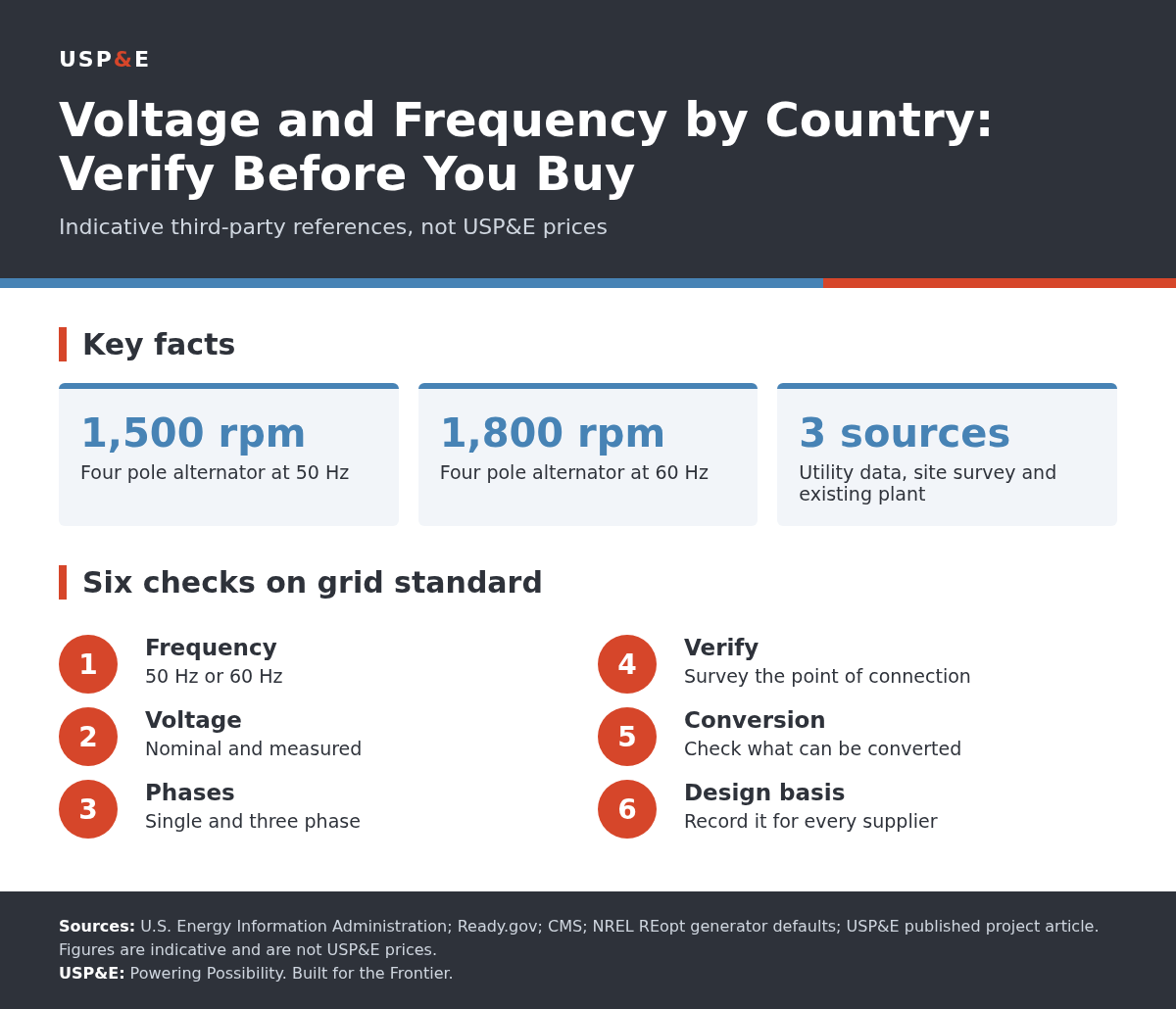
Frequency governs the rotational speed of the prime mover. A four pole alternator turns at 1,500 RPM for 50Hz and 1,800 RPM for 60Hz, which changes rated output, cooling duty, and the specification of every downstream item. Voltage determines transformer selection, switchgear ratings, cable sizing, and grid interconnection design.
Approximately 80 percent of the world operates at 50Hz. The 60Hz group is concentrated in North America, much of Central and South America, Saudi Arabia, South Korea, the Philippines, and parts of West Africa including Liberia. Frontier markets add a further complication: published national standards frequently differ from what is measured at a remote mine site, where private grids, legacy plant, and voltage drop over long feeders are common. The International Energy Agency identifies unreliable supply as a primary constraint on African industrial productivity, and World Bank energy data shows the same pattern across low access markets.
| Market Group | Voltage and Frequency by Country | Common Generator Setup |
| Western and Southern Africa | 220V to 230V, 50Hz | 1,500 RPM diesel or HFO gensets, 11kV or 33kV step up |
| Liberia and Guyana | 120V to 240V, 60Hz | 1,800 RPM units, scarce secondary market supply |
| Gulf and Middle East | 220V to 240V, 50Hz, Saudi Arabia at 60Hz | Gas turbines and gas reciprocating sets |
| North America | 120V to 240V, 60Hz | 1,800 RPM gas turbines and gas engines for data centres |
| Southern Africa mining | 230V, 50Hz | Hybrid diesel, HFO, and solar configurations |
50Hz and 60Hz: What Frequency Conversion Actually Involves
Conversion is possible, but not uniform across equipment types. Many 1,500 and 1,800 RPM reciprocating gensets convert between 50Hz and 60Hz with governor, alternator, and derating changes, and mobile aeroderivative units such as the GE TM2500 switch relatively quickly. Heavy frame industrial gas turbines often require gearbox or generator changes that make conversion uneconomic against buying correctly rated equipment.
Derating is the point most budgets miss. Converting a 60Hz machine to 50Hz service reduces available output, so a plant sized on nameplate figures arrives undersized. USP&E therefore treats fuel specification, ambient conditions, elevation, and grid standard as a single design input during power plant engineering.
Global Voltage and Frequency by Country Reference Table
Figures below are nominal single phase supply values and should be confirmed against the local utility or a site survey before procurement. Japan is the notable split market, running 50Hz in the east and 60Hz in the west.
| Country or Territory | Nominal Voltage | Frequency |
| Afghanistan | 220V | 50Hz |
| Albania | 230V | 50Hz |
| Algeria | 230V | 50Hz |
| American Samoa | 120V | 60Hz |
| Andorra | 230V | 50Hz |
| Angola | 220V | 50Hz |
| Anguilla | 110V | 60Hz |
| Antigua | 230V | 60Hz |
| Argentina | 220V | 50Hz |
| Armenia | 230V | 50Hz |
| Aruba | 127V | 60Hz |
| Australia | 240V | 50Hz |
| Austria | 230V | 50Hz |
| Azerbaijan | 220V | 50Hz |
| Azores | 230V | 50Hz |
| Bahamas | 120V | 60Hz |
| Bahrain | 230V | 50Hz |
| Balearic Islands | 230V | 50Hz |
| Bangladesh | 220V | 50Hz |
| Barbados | 115V | 50Hz |
| Belarus | 230V | 50Hz |
| Belgium | 230V | 50Hz |
| Belize | 110/220V | 60Hz |
| Benin | 220V | 50Hz |
| Bermuda | 120V | 60Hz |
| Bhutan | 230V | 50Hz |
| Bolivia | 230V | 50Hz |
| Bosnia | 230V | 50Hz |
| Botswana | 230V | 50Hz |
| Brazil | 110/220V | 60Hz |
| Brunei | 240V | 50Hz |
| Bulgaria | 230V | 50Hz |
| Burkina Faso | 220V | 50Hz |
| Burundi | 220V | 50Hz |
| Cambodia | 230V | 50Hz |
| Cameroon | 220V | 50Hz |
| Canada | 120V | 60Hz |
| Canary Islands | 230V | 50Hz |
| Cape Verde | 230V | 50Hz |
| Cayman Islands | 120V | 60Hz |
| Central African Republic | 220V | 50Hz |
| Chad | 220V | 50Hz |
| Channel Islands | 230V | 50Hz |
| Chile | 220V | 50Hz |
| China | 220V | 50Hz |
| Colombia | 110V | 60Hz |
| Comoros | 220V | 50Hz |
| Congo, Democratic Republic (DRC) | 220V | 50Hz |
| Cook Islands | 240V | 50Hz |
| Costa Rica | 120V | 60Hz |
| Cote d’Ivoire | 220V | 50Hz |
| Croatia | 230V | 50Hz |
| Cuba | 110/220V | 60Hz |
| Cyprus | 230V | 50Hz |
| Czech Republic | 230V | 50Hz |
| Denmark | 230V | 50Hz |
| Djibouti | 220V | 50Hz |
| Dominica | 230V | 50Hz |
| Dominican Republic | 110V | 60Hz |
| East Timor | 220V | 50Hz |
| Ecuador | 127V | 60Hz |
| Egypt | 220V | 50Hz |
| El Salvador | 115V | 60Hz |
| Equatorial Guinea | 220V | 50Hz |
| Eritrea | 230V | 50Hz |
| Estonia | 230V | 50Hz |
| Eswatini (Swaziland) | 230V | 50Hz |
| Ethiopia | 220V | 50Hz |
| Faeroe Islands | 230V | 50Hz |
| Falkland Islands | 240V | 50Hz |
| Fiji | 240V | 50Hz |
| Finland | 230V | 50Hz |
| France | 230V | 50Hz |
| French Guiana | 220V | 50Hz |
| Gabon | 220V | 50Hz |
| Gambia | 230V | 50Hz |
| Gaza | 230V | 50Hz |
| Germany | 230V | 50Hz |
| Ghana | 230V | 50Hz |
| Gibraltar | 230V | 50Hz |
| Greece | 230V | 50Hz |
| Greenland | 230V | 50Hz |
| Grenada | 230V | 50Hz |
| Guadeloupe | 230V | 50Hz |
| Guam | 110V | 60Hz |
| Guatemala | 120V | 60Hz |
| Guinea | 220V | 50Hz |
| Guinea-Bissau | 220V | 50Hz |
| Guyana | 240V | 60Hz |
| Haiti | 110V | 60Hz |
| Honduras | 110V | 60Hz |
| Hong Kong | 220V | 50Hz |
| Hungary | 230V | 50Hz |
| Iceland | 230V | 50Hz |
| India | 240V | 50Hz |
| Indonesia | 230V | 50Hz |
| Iran | 230V | 50Hz |
| Iraq | 230V | 50Hz |
| Ireland | 230V | 50Hz |
| Isle of Man | 230V | 50Hz |
| Israel | 230V | 50Hz |
| Italy | 230V | 50Hz |
| Jamaica | 110V | 50Hz |
| Japan | 100V | 50/60Hz |
| Jordan | 230V | 50Hz |
| Kazakhstan | 220V | 50Hz |
| Kenya | 240V | 50Hz |
| Kiribati | 240V | 50Hz |
| Korea, South | 220V | 60Hz |
| Kuwait | 240V | 50Hz |
| Kyrgyzstan | 220V | 50Hz |
| Laos | 230V | 50Hz |
| Latvia | 230V | 50Hz |
| Lebanon | 230V | 50Hz |
| Lesotho | 220V | 50Hz |
| Liberia | 120V | 60Hz |
| Libya | 127/230V | 50Hz |
| Liechtenstein | 230V | 50Hz |
| Lithuania | 230V | 50Hz |
| Luxembourg | 230V | 50Hz |
| Macau | 220V | 50Hz |
| Macedonia | 230V | 50Hz |
| Madagascar | 127/220V | 50Hz |
| Madeira | 230V | 50Hz |
| Malawi | 230V | 50Hz |
| Malaysia | 240V | 50Hz |
| Maldives | 230V | 50Hz |
| Mali | 220V | 50Hz |
| Malta | 230V | 50Hz |
| Martinique | 220V | 50Hz |
| Mauritania | 220V | 50Hz |
| Mauritius | 230V | 50Hz |
| Mexico | 127V | 60Hz |
| Micronesia | 120V | 60Hz |
| Moldova | 230V | 50Hz |
| Monaco | 230V | 50Hz |
| Mongolia | 230V | 50Hz |
| Montserrat Islands | 230V | 60Hz |
| Morocco | 220V | 50Hz |
| Mozambique | 220V | 50Hz |
| Myanmar (Burma) | 230V | 50Hz |
| Namibia | 220V | 50Hz |
| Nauru | 240V | 50Hz |
| Nepal | 230V | 50Hz |
| Netherlands | 230V | 50Hz |
| Netherlands Antilles | 127/220V | 50Hz |
| New Caledonia | 220V | 50Hz |
| New Zealand | 230V | 50Hz |
| Nicaragua | 120V | 60Hz |
| Niger | 220V | 50Hz |
| Nigeria | 240V | 50Hz |
| Norway | 230V | 50Hz |
| Okinawa | 100V | 60Hz |
| Oman | 240V | 50Hz |
| Pakistan | 230V | 50Hz |
| Palmyra Atoll | 120V | 60Hz |
| Panama | 110V | 60Hz |
| Papua New Guinea | 240V | 50Hz |
| Paraguay | 220V | 50Hz |
| Peru | 220V | 60Hz |
| Philippines | 220V | 60Hz |
| Poland | 230V | 50Hz |
| Portugal | 230V | 50Hz |
| Puerto Rico | 120V | 60Hz |
| Qatar | 240V | 50Hz |
| Reunion Island | 230V | 50Hz |
| Romania | 230V | 50Hz |
| Russian Federation | 230V | 50Hz |
| Rwanda | 230V | 50Hz |
| Saudi Arabia | 127/220V | 60Hz |
| Senegal | 230V | 50Hz |
| Serbia and Montenegro | 230V | 50Hz |
| Seychelles | 240V | 50Hz |
| Sierra Leone | 230V | 50Hz |
| Singapore | 230V | 50Hz |
| Slovakia | 230V | 50Hz |
| Slovenia | 230V | 50Hz |
| Somalia | 220V | 50Hz |
| South Africa | 230V | 50Hz |
| Spain | 230V | 50Hz |
| Sri Lanka | 230V | 50Hz |
| St. Kitts and Nevis | 230V | 60Hz |
| St. Lucia | 240V | 50Hz |
| St. Vincent | 230V | 50Hz |
| Sudan | 230V | 50Hz |
| Suriname | 127V | 60Hz |
| Sweden | 230V | 50Hz |
| Switzerland | 230V | 50Hz |
| Syria | 220V | 50Hz |
| Tahiti | 110/220V | 60Hz |
| Taiwan | 110V | 60Hz |
| Tajikistan | 220V | 50Hz |
| Tanzania | 230V | 50Hz |
| Thailand | 220V | 50Hz |
| Togo | 220V | 50Hz |
| Tonga | 240V | 50Hz |
| Trinidad and Tobago | 115V | 60Hz |
| Tunisia | 230V | 50Hz |
| Turkey | 230V | 50Hz |
| Turkmenistan | 220V | 50Hz |
| Uganda | 240V | 50Hz |
| Ukraine | 230V | 50Hz |
| United Arab Emirates | 220V | 50Hz |
| United Kingdom | 230V | 50Hz |
| United States | 120/240V | 60Hz |
| Uruguay | 220V | 50Hz |
| Uzbekistan | 220V | 50Hz |
| Venezuela | 120V | 60Hz |
| Vietnam | 220V | 50Hz |
| Virgin Islands | 110V | 60Hz |
| Western Samoa | 230V | 50Hz |
| Yemen | 230V | 50Hz |
| Zambia | 230V | 50Hz |
| Zimbabwe | 220V | 50Hz |
USP&E does not supply equipment, spare parts, or services into sanctioned jurisdictions, including Iran and Russia. Entries above are published for technical reference only, and all enquiries are screened against OFAC and FCPA requirements before a proposal is issued. To find the amps drawn at each voltage for a given load, use our conversion formulas.
Reading Voltage and Frequency by Country Regionally
A few regional patterns help when you scan the table. Most of Europe, Africa, Asia and Oceania use 50 Hz with nominal voltages between 220 and 240 volts. North America, much of Central America and several other countries use 60 Hz at lower voltages. A small number of countries use both, with Japan the most familiar example.
The table gives nominal supply values for single phase. Industrial sites often use three phase systems at higher voltages, and those values depend on the utility and the site. Treat the table as a first screen and confirm details with the utility, a site survey or the existing plant nameplates.
|
Voltage and frequency by country region |
Typical frequency |
Note |
|
Europe |
50 Hz |
Nominal 230 V single phase |
|
Most of Africa |
50 Hz |
Check each country, as values range from 220 V to 240 V |
|
Middle East |
Mostly 50 Hz |
Saudi Arabia is a notable 60 Hz market |
|
North America |
60 Hz |
Nominal 120 V single phase, higher for industry |
|
South America |
Mixed |
Check each country, as both standards occur |
|
Japan |
50 Hz and 60 Hz |
Split by region |
The U.S. Energy Information Administration explains how supply is delivered to users in its guide to delivery of electricity to consumers, and its electricity overview gives wider context.
Keep a copy of the table and your verified values together, so that voltage and frequency by country is recorded once and used by every discipline on the project.
Voltage and Frequency by Country and Equipment Choice
The grid standard drives the choice of equipment. A set built for the wrong frequency can be modified in some cases, but the change adds cost and time. Recognising which equipment is easy to convert and which is hard helps buyers avoid mistakes.
|
Voltage and frequency by country equipment |
Conversion difficulty |
Comment |
|
Diesel and gas engine sets |
Often possible |
Governor, alternator and derate changes |
|
Mobile aeroderivative units |
Often quicker |
Maker advice is needed for each model |
|
Heavy frame turbines |
Often uneconomic |
Gearbox or generator changes may be needed |
|
Transformers |
Depends on design |
Check volts per hertz rating |
|
Motors and drives |
Depends on design |
Check speed and cooling |
Ask for the rating at the site frequency and ambient conditions. USP&E’s guide to 60 Hz to 50 Hz voltage conversion explains equipment effects in detail, and USP&E’s power plant engineering service covers the wider design, and the diesel generator inventory and natural gas generator inventory pages show the types of plant that can be matched to a standard.
Verifying Voltage and Frequency by Country at Site
Published national values often differ from what is measured at a remote site. Private grids, legacy plant and voltage drop on long feeders can all change the real conditions. Verification protects the project, because a wrong assumption affects every downstream item.
|
Voltage and frequency by country check |
Source |
Output |
|
Utility data |
Utility interconnection documents |
Nominal voltage, frequency and fault level |
|
Site survey |
Measurements at the point of connection |
Actual voltage and frequency range |
|
Existing plant |
Nameplates and drawings |
Equipment ratings and standards |
|
Load study |
Meter data and engineering review |
Real load and power factor |
Write the verified values into the project specification, and share them with every supplier. A short design basis document avoids disputes later. The Environmental Protection Agency also publishes rules on stationary engines, which can affect equipment choice in some markets. USP&E’s guide to electricity around the world gives more background.
Repeat the verification when the project scope changes. A new site, a new feeder or a new utility connection may bring a different voltage and frequency by country or region, and the design basis should be updated each time.
Voltage and Frequency by Country and Procurement Risk
The grid standard also affects supply. In markets with a common standard, there may be more equipment available at shorter lead times. In markets with a less common standard, buyers may find fewer options and longer waits. Confirm the standard early so that you can plan procurement with real information.
Check that every supplier quotes at the right frequency and voltage, and ask for the rating in writing. Compare options on the same basis, and include testing, transport and installation. Ask also for the support available in the country, including spares and service.
USP&E is an independent seller and is not affiliated with any equipment manufacturer. Where equipment from a manufacturer is discussed, that name is a trademark of its owner, and only the manufacturer can give binding statements about its products. Use the table to screen the standard, and use a written specification to buy.
|
Voltage and frequency by country procurement item |
What to confirm |
Why it matters |
|
Rated output |
Output at site frequency and ambient |
Avoids undersized plant |
|
Voltage options |
Alternator and transformer voltages |
Avoids extra equipment |
|
Support |
Spares and service in the country |
Reduces outage time |
|
Compliance |
Import, emissions and safety rules |
Avoids delay at the border |
The EIA gives helpful units and calculators when quotations use different units, and its guide to how electricity is generated is a good primer for non specialist team members.
Using Voltage and Frequency by Country in Early Project Planning
The earliest planning stage is the cheapest time to confirm the standard. A feasibility study should state the voltage and frequency, the source of the information, and the date it was checked. If the project involves several countries, build a register that lists the standard for each site, so that equipment can be compared across the portfolio.
Think about the whole electrical system. The generator voltage must match the transformer, the switchgear and the grid connection, or else the design needs a step up or step down transformer. Frequency must match the grid for synchronised operation, and an island system needs agreement with the loads it serves. Where a site has a mix of 50 Hz and 60 Hz loads, a frequency converter or separate supplies may be needed.
Plan also for future change. A country may update its grid, or a mine may connect to a utility after years on its own supply. Choosing a generator voltage and frequency that suits the likely long term standard avoids replacement later. Ask the utility about plans, and record the answer.
Finally, build the standard into the contract documents. State frequency, voltage, phases and tolerances in the specification, and require suppliers to confirm compliance in writing. A clear specification at the start is cheaper than a correction at commissioning.
USP&E is an independent seller and is not affiliated with any engine, turbine or generator manufacturer named by buyers during a project. Those names are trademarks of their respective owners.
Case Studies: Voltage and Frequency by Country in Real Projects
USP&E only publishes approved case studies, and it does not name clients without permission. USP&E has delivered projects in 45+ countries, including power plant EPC projects and operations and maintenance work, and approved examples are collected on the case studies page. No outcome specific to voltage and frequency by country is claimed here beyond what is published.
The lessons below reflect common practice, not a named project:
- Teams that verify the grid standard at site avoid ordering equipment for the wrong frequency.
- Buyers who ask for ratings at the site frequency compare offers fairly.
- Projects that write a design basis early avoid disputes between suppliers.
- Planners who check support in the country avoid long outages after handover.
Voltage and Frequency by Country: 10 Criteria for Getting It Right
- Confirm frequency. Establish whether the site uses 50 Hz or 60 Hz.
- Confirm voltage. Record nominal and measured voltage at the point of connection.
- Check the phases. Confirm single phase and three phase supply arrangements.
- Verify on site. Measure the real values and compare with the published table.
- Check existing plant. Read the nameplates of equipment already on site.
- Assess conversion. Decide whether conversion is practical and economic.
- Ask for ratings. Request output at site frequency and ambient conditions.
- Write a design basis. Record the standard in the project specification.
- Check support. Confirm spares and service are available in the country.
- Review compliance. Check local rules on equipment, emissions and import.
FAQ: Voltage and Frequency by Country
What is the difference between 50 Hz and 60 Hz power?
Frequency is the number of times per second the current changes direction. A four pole alternator runs at 1,500 rpm for 50 Hz and 1,800 rpm for 60 Hz. Equipment built for one frequency can run hot or inefficiently on the other.
Which countries use 60 Hz?
North America, much of Central America, Saudi Arabia, South Korea, the Philippines and parts of West Africa, including Liberia, use 60 Hz. Most of Europe, Africa, Asia and Oceania use 50 Hz. Check the table above, because some countries differ.
Can a 60 Hz generator run at 50 Hz?
Some reciprocating and mobile aeroderivative sets can be converted with governor, alternator and control changes, usually with a derate. Heavy frame turbines are often uneconomic to convert. Ask the maker for written advice on the exact model before you decide to proceed.
Is the table enough to specify equipment?
No. The table gives nominal single phase values, which are a first screen. Industrial sites often use higher voltages and private systems. Confirm the real values with the utility or a site survey, and write them into the specification before you order.
Why does grid standard affect cost?
The standard decides which equipment can be used without modification. A set that matches the standard is usually quicker to deploy. A set that needs conversion adds engineering, testing and time, and may lose output, so compare the whole cost of each option.
How do I verify the standard at a remote site?
Use utility data, measurements at the point of connection and the nameplates of existing plant. Record the voltage range, frequency range and fault level. Share the results with every supplier so that all offers use the same basis and the same assumptions.
How can USP&E help with grid standards?
USP&E’s engineers can review your site data, confirm the standard and match equipment to it. Send the country, voltage, frequency, load and fuel, and USP&E will recommend a suitable plant and help plan delivery, installation and operation for your project.
Key Takeaways: Voltage and Frequency by Country
- Voltage and frequency by country is the first filter in equipment selection.
- Use the table as a screen, and verify the real values at site.
- Conversion is easier for some equipment than for others.
- Write the standard into a design basis for suppliers.
- Check support and compliance in the country before ordering.
Checking voltage and frequency by country early protects the schedule and the budget. When you are ready to select plant for your grid standard, USP&E’s engineers can help you choose it and bring it to power.
Ready to Power Your Project? Talk to USP&E’s Engineers.
Whether you are in early feasibility or ready to mobilise on a power station, EPC, or O&M project, USP&E’s engineers can help. With 150+ power projects delivered in 45+ countries since 2002, our engineers remove the technical and commercial risk from your project, with speed and without excuses.
Contact USP&E Today Request a Fast Quote
USP&E: Powering Possibility. Built for the Frontier. ISO 9001:2015 | ISO 45001:2018 | 150+ power projects in 45+ countries | 25,000 MW contracted since 2002 | 24+ years