

Mobile Emergency Power Generation: How to Prepare for Disaster Recovery Power
Mobile emergency power generation is what keeps a hospital, a water plant or a relief camp running when the grid goes dark. After a storm, flood, earthquake or major fault, the first hours decide how much damage follows. A well planned mobile emergency power generation fleet can restore critical load in hours, while a poorly planned one sits in a yard or runs out of fuel on day two. This guide explains how mobile emergency power generation works, how to size and specify it, what to budget, and how to choose a supplier who can deliver when it counts.
USP&E has delivered 150+ power projects in 45+ countries since 2002, with 25,000 MW contracted since 2002. USP&E holds ISO 9001:2015 and ISO 45001:2018 certification and works across equipment supply, EPC (Engineering, Procurement and Construction) and O&M (Operations and Maintenance). USP&E is more than a broker: it removes technical and commercial risk for buyers through engineering, inspection, EPC and O&M. Supply comes from USP&E’s own inventory plus equipment sourced from OEMs, IPPs, banks and asset owners. Its engineers apply that experience to emergency power, where speed and reliability matter equally.
What Is Mobile Emergency Power Generation?
Mobile emergency power generation means generating sets that can be moved to where power is needed and connected quickly. The sets may be trailer-mounted, skid-mounted or built into 20 ft or 40 ft containers. Most use diesel engines, because diesel is easy to store and transport and the engines handle sudden load. Some use natural gas where pipeline gas survives the event. The key feature is mobility: the unit arrives with cooling, controls, fuel and cabling already fitted, so it can run within hours of reaching the site.
Disasters make the case for it. Ready.gov, the United States government’s preparedness site, explains in its guide to power outages that extended outages can disrupt communications, water and transportation. They can close shops, banks and fuel stations, cause food spoilage and water contamination, and prevent the use of medical devices. These effects spread through a community quickly, which is why mobile emergency power generation is planned in advance by hospitals, utilities and governments.
Mobile emergency power generation differs from a permanent standby set in one respect: the site is not fixed. A fleet may serve a hospital one week and a pumping station the next. That demands standard connection points, clear labelling, and a stock of cables, distribution boards and fuel containers that match the fleet.
|
Mobile emergency power generation format |
Typical use |
Strength |
Watch point |
|
Trailer-mounted set |
Field hospitals, shelters, pumping |
Towable and quick to connect |
Needs a clear access route |
|
Skid-mounted set in an enclosure |
Fixed temporary sites |
Robust and easy to refuel |
Needs a crane or forklift |
|
Containerised plant |
Camps, plant backup, relief hubs |
Complete package with fuel and controls |
Logistics and a flat pad |
|
Distribution and cabling kit |
Connection to loads |
Speeds up energising |
Wrong cable ratings cause faults |
Planning Mobile Emergency Power Generation Before the Event
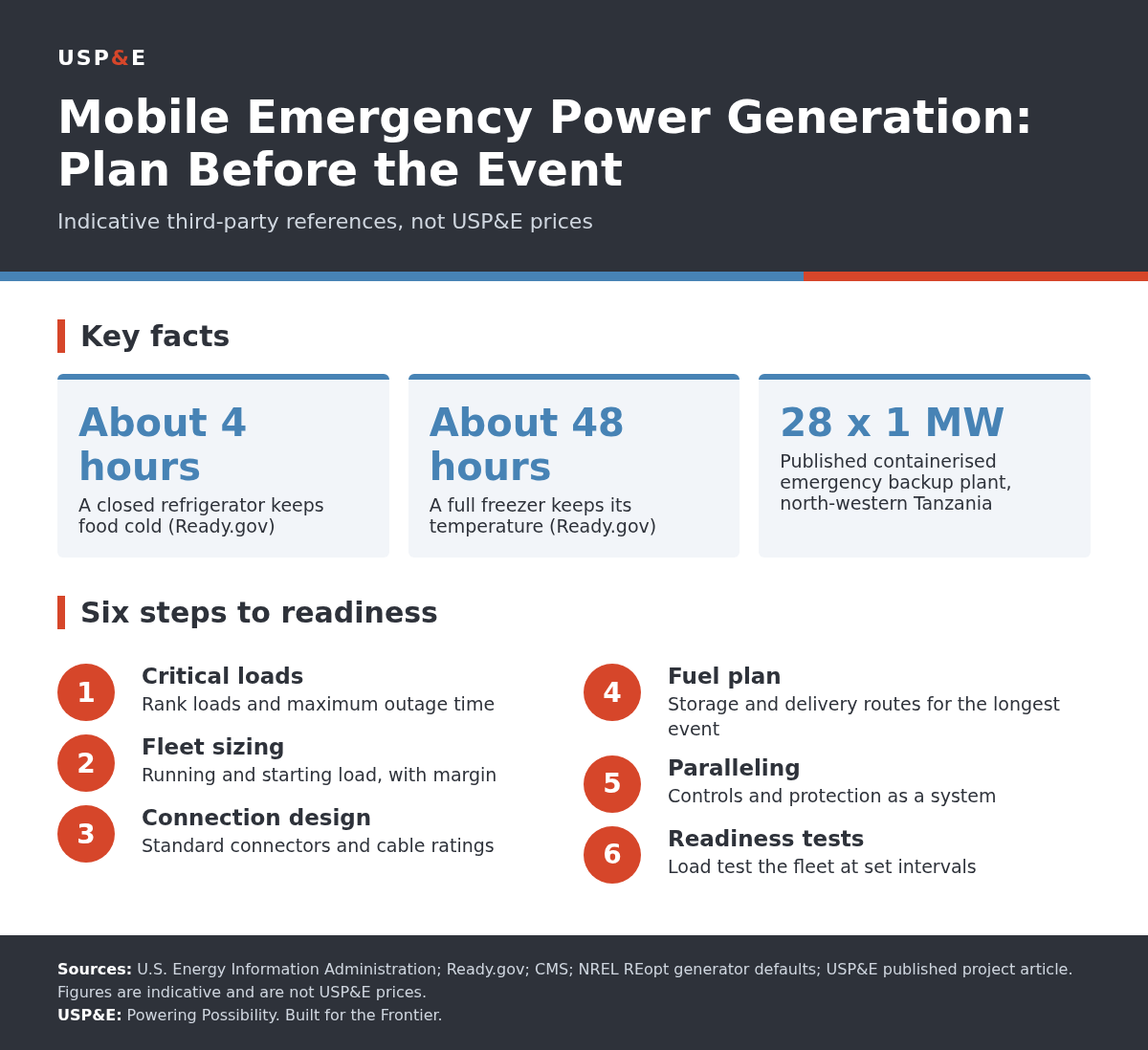
The right time to buy mobile emergency power generation is before it is needed. A plan starts with a list of critical loads and their order of priority. Hospitals, water treatment, communications, fuel distribution and emergency coordination centres usually come first. For each load the plan should record the power, the voltage, the connection point and the maximum time it can go without supply.
The next step is to size the fleet. Add the running load, then the starting load of the largest motor on each circuit. Apply a margin for heat and altitude. Decide how many units are needed and whether they will run in parallel. Parallel operation gives redundancy, because one set can fail without losing the whole supply, but it needs controls and protection designed as a system.
Fuel logistics decide whether mobile emergency power generation succeeds. A fleet running at moderate load burns fuel continuously. The plan must say who delivers fuel, from where, and by which route when roads are damaged. The U.S. Energy Information Administration’s explainer on diesel fuel shows how fuel is produced and distributed, and why supply can tighten after a major event. USP&E sets out the operating risks in its guide to fuel theft at a remote power plant, which applies equally to emergency fuel stores.
Health care shows why the planning must be formal. CMS, the United States federal health care regulator, runs an emergency preparedness programme that takes an all-hazards approach to events such as hurricanes, fires, earthquakes and power outages. Its aim is to help providers respond in a timely, organised and effective way. Power is the common thread across every one of those hazards.
At national level, the U.S. Energy Information Administration describes the structure of the grid in its guide to electricity in the United States. The grid links generation, transmission and distribution, so a fault in one part can leave a wide area without supply, and that is the gap emergency fleets fill.
|
Mobile emergency power generation planning step |
Output |
Owner |
|
Critical load survey |
Ranked list of loads with power and voltage |
Facility or utility engineer |
|
Fleet sizing |
Number and rating of sets, with margin |
Engineering lead |
|
Fuel plan |
Storage, supplier and delivery routes |
Logistics lead |
|
Connection design |
Standard connectors, cables and labels |
Electrical lead |
|
Readiness testing |
Load tests and records |
Maintenance lead |
Quick planning steps for mobile emergency power generation
- List critical loads in order of priority, with power, voltage and maximum outage time.
- Size the fleet for running and starting loads, with margin for heat and altitude.
- Fix connection points and standardise cables and labelling.
- Plan fuel supply, storage and delivery routes for the longest credible event.
- Test the fleet under load at set intervals, not only at start-up.
Mobile Emergency Power Generation Cost: What to Budget
USP&E does not publish mobile emergency power generation prices, because they depend on size, package, fuel system and market timing. The figures below are indicative third-party references, not USP&E prices. Cost has four layers: the generating sets, the connection and distribution kit, the fuel system, and the cost of keeping the fleet ready. Readiness cost is often overlooked. It covers storage, scheduled testing, battery replacement, fuel rotation and operator training.
For scale, the National Renewable Energy Laboratory’s REopt model, in its published generator cost defaults, uses about $650 to $880 per kW for installed diesel generator plant, with fixed operating cost of about $10 to $20 per kW per year plus fuel. Those are model defaults for United States conditions, not quotations, and a mobile fleet may cost more or less depending on package and logistics.
Renting can make sense for a one-off need, and owning can make sense for an organisation that expects repeated events. A hospital group or a utility will often own a core fleet and rent more when an event is large. Whichever route is chosen, the contract should state delivery time, the duty rating, who supplies fuel and who is responsible for operators.
|
Mobile emergency power generation cost layer |
What it covers |
Risk if ignored |
|
Generating sets |
Engine, alternator, enclosure or container |
A weak duty rating fails under long running |
|
Distribution and cabling |
Boards, cables, protection and connectors |
Wrong ratings cause trips and fires |
|
Fuel system |
Tanks, pumps, filtration and delivery plan |
An empty tank stops the plant |
|
Readiness |
Testing, storage, fuel rotation, training |
An untested fleet may not start |
|
Logistics |
Transport, lifting and access routes |
A set that cannot reach the site has no value |
Fuel Type Comparison
|
Fuel Type |
CapEx Range |
OpEx Range |
Typical Lead Time |
Best Application |
|
Diesel, mobile or containerised set |
About $650 to $880/kW installed (NREL REopt defaults) |
About $10 to $20/kW per year fixed, plus fuel (NREL REopt defaults) |
Varies with package and market |
First response and long duty |
|
Natural gas set |
Fuel can be cheaper where pipeline supply survives |
Varies with package |
Sites with firm gas supply after the event |
|
|
Dual fuel set |
Varies with package |
Sites where fuel supply is uncertain |
||
|
Battery system |
Varies with size |
Short bridging and silent operation |
Sources: NREL REopt generator defaults. Blank cells could not be verified from a comparable official source. These are not USP&E prices.
New vs Used Mobile Emergency Power Generation Equipment
Emergency fleets can be built from new or used sets. New sets bring warranty and a known starting point. Used sets can be available sooner and can offer good value, but they need careful inspection. When you review used equipment for mobile emergency power generation, ask for engine hours, service records, the last major overhaul and alternator test results. Require a load test at the stated rating and proof of ownership or a written right to sell before any deposit.
A set that has stood idle for years needs particular attention. Fuel can degrade, seals can dry out and batteries can fail. Ask for evidence that the set has been exercised and tested. USP&E explains how to check used units in its guide to used diesel generators for sale, and buyers can review the diesel generators and MW generators categories.
USP&E is an independent seller and is not affiliated with any engine or generator manufacturer named by buyers during a project. Those names are trademarks of their respective owners.
Emissions and permits also matter. The U.S. Environmental Protection Agency regulates stationary engines under its stationary engines programme. Emergency use is treated differently from routine use in many rules, so confirm the status of each unit for the jurisdiction where it will run.
Case Studies: Mobile Emergency Power Generation in Real Projects
USP&E only publishes approved case studies, and it does not name clients without permission. One published example of engineered emergency power is the backup plant at a gold project in north-western Tanzania, described in USP&E’s project article. The plant comprises 28 containerised 1 MW generator sets, six 72,000-litre bulk fuel tanks, three pump skids and 28 day tanks, for 28 MW of emergency backup. It was delivered as a complete engineered system, not as a loose line of sets. No availability or performance outcome beyond those published facts is claimed here.
USP&E has delivered projects in 45+ countries, including power plant EPC projects and operations and maintenance work, and further approved examples sit on the case studies page.
The lessons below reflect common practice, not a second named project:
- Fleets that size fuel storage to the longest credible event avoid running dry on day two.
- Fleets that standardise connectors and cable ratings connect faster under pressure.
- Fleets that run a monthly load test find faults before an emergency does.
- Fleets that hold a spares kit return to service sooner after a failure.
How to Choose Mobile Emergency Power Generation and a Supplier: 10 Criteria
- Critical load list. Start with a ranked list of loads and the maximum outage time each can tolerate. Equipment follows the list, not the other way round.
- Duty rating. Confirm whether output is standby, prime or continuous. Emergencies can last weeks, so a short standby rating may not be enough.
- Fuel plan. Size storage for the longest credible event and plan delivery routes when roads are damaged.
- Connection design. Standardise connectors, cable ratings and labelling so crews can energise loads quickly and safely.
- Paralleling and protection. If sets run together, the controls, breakers and protection settings must be designed as a system.
- Logistics. Ask how units will move from storage to site, including trailers, cranes and road access.
- Inspection and title. For used units, require a records audit, a load test and proof of ownership or a written right to sell before any deposit.
- Spares and service. Hold a recommended spares list, filters and batteries, and agree who services the fleet during an event.
- EPC and O&M depth. A supplier that can install, commission and operate the plant reduces handover risk. USP&E offers O&M with 95%+ O&M availability as an official company figure.
- Contract clarity. Delivery time, tests, payment milestones, warranty and operator responsibility should be in writing.
FAQ: Mobile Emergency Power Generation
What is mobile emergency power generation?
Mobile emergency power generation means generating sets, usually diesel, mounted on trailers, skids or in containers so they can be moved to a site and connected quickly. It supplies critical loads such as hospitals, water plants and relief camps when the grid fails, and it arrives with cooling, controls and fuel already fitted.
How fast can mobile emergency power generation be deployed?
Deployment time depends on distance, road access, fleet readiness and the connection design. A tested fleet with standard connectors can often be energised within hours of arrival. An untested fleet with poor fuel logistics can take days. Planning, rehearsal and clear connection points are what make mobile emergency power generation fast.
How do I size a fleet for disaster response?
List critical loads in priority order, add running load and the starting load of the largest motors, then apply a margin for heat and altitude. Decide how many sets are needed and whether they will run in parallel. Size fuel for the longest event you plan to cover.
Should I rent or buy emergency generators?
Buy a core fleet if you expect repeated events, and rent extra capacity for large ones. Renting suits a one-off need. Owning gives control over readiness and testing. Whichever route you choose for mobile emergency power generation, agree delivery time, duty rating, fuel supply and operator responsibility in the contract.
How much fuel do I need?
Enough for the longest credible outage, plus a margin for delayed deliveries. A fleet at moderate load burns fuel continuously, so storage, pumps and delivery routes are part of the plant design. Rotate stored fuel and test it regularly, because old fuel can cause starting and running faults.
Is it safe to run a generator after a storm?
It is safe if you follow the rules. Ready.gov advises using generators outdoors, at least 20 feet from windows, doors and attached garages, with carbon monoxide detectors installed. Keep sets dry, let them cool before refuelling, and use a transfer switch so power cannot back-feed the grid.
What does USP&E need to quote?
USP&E needs the site location, the critical loads, the voltage and frequency, the fuel available and the date you need power. It also helps to know how long the event could last. With these inputs, USP&E can recommend a mobile emergency power generation fleet and a delivery plan.
Key Takeaways: Mobile Emergency Power Generation
- Plan mobile emergency power generation before the event, starting with a ranked list of critical loads.
- Size fuel storage and delivery routes for the longest credible outage.
- Standardise connectors and cable ratings, and test the fleet under load at regular intervals.
- Inspect used units, verify title and load test before paying a deposit.
- Choose a supplier with engineering, EPC and O&M depth, not a trader alone.
Readiness is a solvable problem when the plan is clear. When you are ready to prepare, USP&E’s engineers can help you size mobile emergency power generation, plan the fuel and connections, and bring the plant to power.
Ready to Power Your Project? Talk to USP&E’s Engineers.
Whether you are in early feasibility or ready to mobilise on a power station, EPC, or O&M project, USP&E’s engineers can help. With 150+ power projects delivered in 45+ countries since 2002, our engineers remove the technical and commercial risk from your project, with speed and without excuses.
Contact USP&E Today Request a Fast Quote
USP&E: Powering Possibility. Built for the Frontier. ISO 9001:2015 | ISO 45001:2018 | 150+ power projects in 45+ countries | 25,000 MW contracted since 2002 | 24+ years