

Turbine Lifecycle Cost: How to Calculate the Full Cost of Owning a Gas Turbine
Turbine lifecycle cost is the total cost of owning a gas turbine over its working life, not just the price on the quotation. The purchase price is only the start. Fuel, operations, routine maintenance, major overhauls, spares, emissions compliance and downtime often add up to more than the equipment itself. A buyer who compares quotes on price alone can pick the wrong machine. This guide shows how to calculate turbine lifecycle cost, which inputs matter, what third-party references say and how to build a fair comparison.
USP&E has delivered 150+ power projects in 45+ countries since 2002, with 25,000 MW contracted since 2002. USP&E holds ISO 9001:2015 and ISO 45001:2018 certification and works across equipment supply, EPC (Engineering, Procurement and Construction) and O&M (Operations and Maintenance). USP&E is more than a broker: it removes technical and commercial risk for buyers through engineering, inspection, EPC and O&M. Supply comes from USP&E’s own inventory plus equipment sourced from OEMs, IPPs, banks and asset owners. The method below is general. USP&E does not publish prices, and the references used are third-party figures for scale only.
What Is Turbine Lifecycle Cost and Which Costs Does It Include?
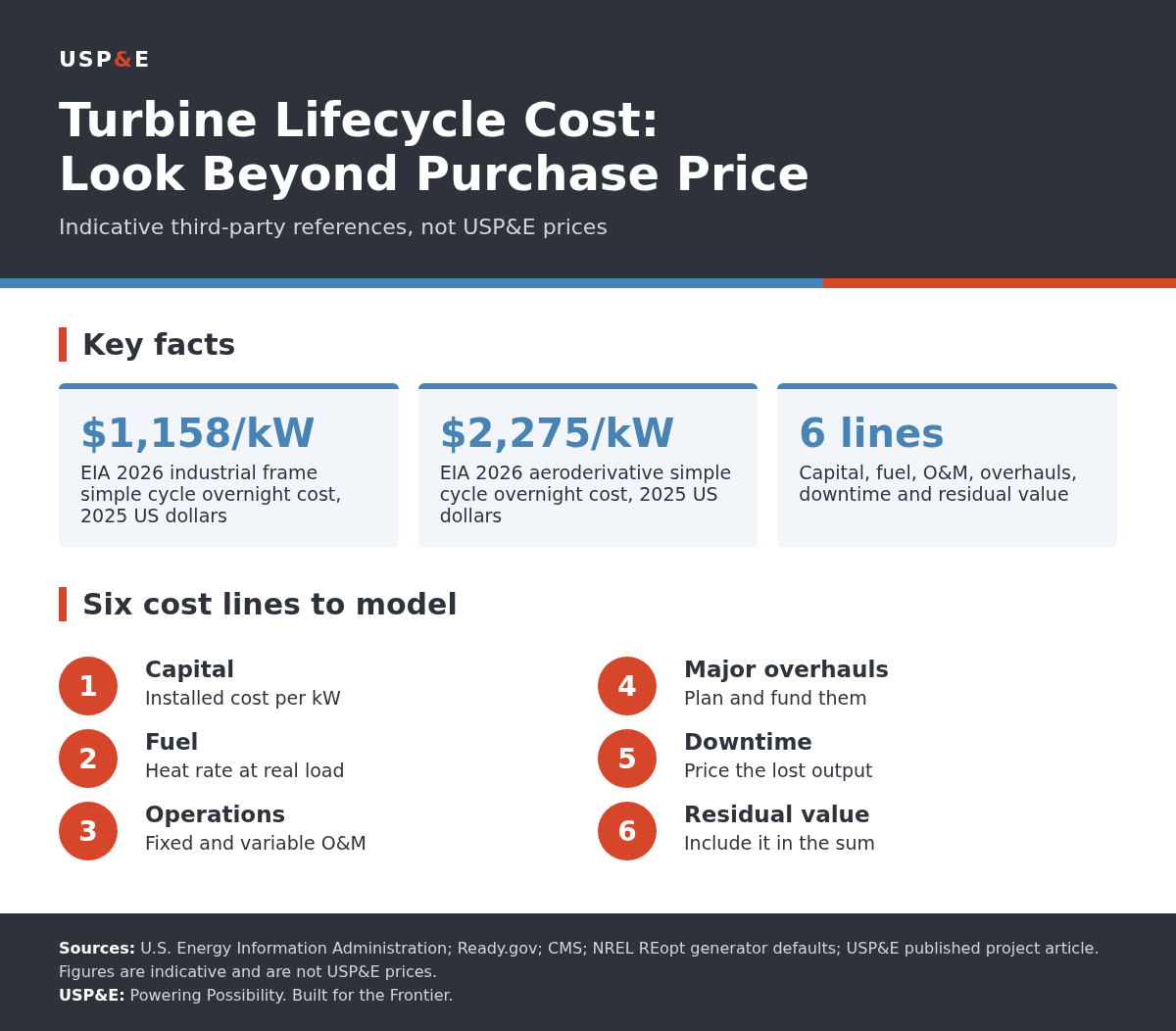
Turbine lifecycle cost is the sum of every cost of owning and running a turbine, usually discounted to present value. It can be written simply: lifecycle cost equals capital cost, plus the present value of fuel, plus the present value of operations and maintenance, plus the present value of major overhauls and spares, plus the cost of downtime and compliance, less any residual value at the end of life.
Capital cost includes the turbine, generator, auxiliaries, civil and electrical works, installation and commissioning. The U.S. Energy Information Administration publishes capital cost and performance characteristics for generating technologies, which show how installed cost varies by plant type. Those figures describe large United States plants and are useful for scale, not as quotations.
Fuel is usually the largest running cost. The EIA explains the role of gas in power generation in its guide to natural gas use, and the way thermal plants convert fuel to power in its guide to how electricity is generated. Fuel cost per kilowatt-hour depends on the heat rate of the machine and the fuel price, so efficiency has a direct effect on turbine lifecycle cost.
|
Turbine lifecycle cost component |
What it covers |
What drives it |
|
Capital cost |
Equipment, installation, commissioning |
Size, type, site and market |
|
Fuel |
Gas or liquid fuel over running hours |
Heat rate, price, utilisation |
|
Operations |
Operators, monitoring, consumables |
Staffing model and site |
|
Maintenance |
Inspections, overhauls, spares |
Running hours and starts |
|
Downtime and compliance |
Lost output, emissions equipment |
Reliability and permits |
Calculating Turbine Lifecycle Cost Step by Step
Start by defining the duty. How many hours a year will the turbine run, how many starts will it see and at what load? Peaking plants run few hours with many starts, and baseload plants run most hours with few starts. The balance between starts and hours changes maintenance cost sharply, because turbine hot parts wear with both.
Next, build the annual cost lines. Fuel equals annual energy output times heat rate times fuel price. Fixed operating cost covers staff and routine items regardless of output. Variable operating cost scales with output or running hours. Major maintenance follows the maker’s inspection intervals, which are set by equivalent operating hours. Long term service agreements can fix part of this cost for a period. USP&E explains how they work in its guide to what an LTSA is for a gas turbine.
Then discount. Costs that occur later are worth less today, so each year’s cost is discounted at a rate that reflects the owner’s cost of capital. Sum the discounted costs, subtract the discounted residual value and divide by discounted energy to get a cost per kilowatt-hour. USP&E sets out the approach in its guide to what LCOE is. Always test the result against changes in fuel price, load factor and discount rate.
Quick steps for turbine lifecycle cost
- Define running hours, starts and load for the duty.
- List capital, fuel, fixed and variable operating, and maintenance costs.
- Add major overhauls and spares at the maker’s intervals.
- Discount all costs to present value and subtract residual value.
- Test the result against fuel price, load factor and discount rate.
Comparing Options Using Turbine Lifecycle Cost
A fair comparison uses the same duty, the same site conditions and the same cost basis for every option. A used turbine may have a lower capital cost and a higher heat rate. A new aeroderivative may have a higher capital cost and better part-load efficiency. Which is cheaper over life depends on the running hours.
Delivery time also belongs in the comparison. Utility Dive reported in March 2026 on EPRI analysis in its article on five year waits and rising costs, which put waits for large new turbines at more than five years and for smaller units at 18 to 36 months. A cheaper option that arrives years later may cost more once the cost of delay is counted. USP&E covers procurement trade-offs in its gas turbine procurement guide.
|
Turbine lifecycle cost comparison factor |
Why it matters |
How to test |
|
Heat rate |
Sets fuel cost per kilowatt-hour |
Compare at site load, not only at full load |
|
Starts per year |
Drives maintenance cost |
Ask for the maker’s start-based intervals |
|
Availability |
Sets lost output |
Request reliability data |
|
Delivery time |
Sets cost of delay |
Add delay cost to each option |
|
Emissions equipment |
Adds cost and permit risk |
Confirm the permit route early |
Common Mistakes in Turbine Lifecycle Cost Models
Several mistakes recur in turbine lifecycle cost models. The first is using the nameplate heat rate instead of the heat rate at the real operating load, which understates fuel cost. The second is ignoring starts, which understates maintenance cost for peaking duty. The third is leaving out major overhauls and spares, which are lumpy and large. The fourth is ignoring downtime, which turns a cheap machine into an expensive one if it is unreliable.
The fifth mistake is using a single point estimate. Fuel price, load factor and discount rate are uncertain, so a good turbine lifecycle cost model shows a range. Run low, base and high cases, and look for options that stay competitive across all three. If one option wins only in the base case, it is a fragile choice. A robust model also records its sources, so that every input can be checked and updated when the market moves.
Turbine Lifecycle Cost: What Third-Party References Show
USP&E does not publish turbine lifecycle cost figures or prices, because they depend on model, site, duty and market timing. The figures below are indicative third-party references, not USP&E prices. The EIA reference points are for large United States plants and are shown only to illustrate how capital and operating cost lines are structured. Emissions compliance also adds cost in many markets. The U.S. Environmental Protection Agency publishes information on criteria air pollutants, which shows the pollutants that permits usually address.
For scale, the National Renewable Energy Laboratory’s REopt model, in its published generator cost defaults, uses about $650 to $880 per kW for installed diesel generator plant, with fixed operating cost of about $10 to $20 per kW per year plus fuel. Those are model defaults for United States conditions, not quotations, and a real project may differ.
|
Turbine lifecycle cost line |
Reference point |
Note |
|
Capital cost, industrial frame simple cycle |
About $1,158/kW (EIA 2026, 2025 US dollars) |
Large United States plant |
|
Capital cost, aeroderivative simple cycle |
About $2,275/kW (EIA 2026, 2025 US dollars) |
Large United States plant |
|
Fixed operating cost |
About $7.18 to $9.99/kW per year (EIA 2026) |
By plant type |
|
Variable operating cost |
About $4.17 to $5.97/MWh (EIA 2026) |
By plant type |
|
Fuel, overhauls, downtime |
Site specific |
Must be modelled for each project |
Fuel Type Comparison
|
Fuel Type |
CapEx Range |
OpEx Range |
Typical Lead Time |
Best Application |
|
Diesel generating sets |
About $650 to $880/kW installed (NREL REopt defaults) |
About $10 to $20/kW per year fixed, plus fuel (NREL REopt defaults) |
Varies with size and package |
Backup, prime and remote power |
|
Natural gas engines |
Fuel often cheaper where pipeline gas is reliable |
Varies with package |
Sites with firm gas supply |
|
|
New industrial frame turbine plant |
About $1,158/kW installed (EIA 2026, 2025 US dollars) |
About $7.18/kW per year plus $4.17/MWh (EIA 2026) |
More than five years for large new units in tight markets |
Large utility or industrial plants |
|
New aeroderivative turbine plant |
About $2,275/kW installed (EIA 2026, 2025 US dollars) |
About $9.99/kW per year plus $5.97/MWh (EIA 2026) |
18 to 36 months for smaller new turbines is a published market range |
Fast-ramping larger plants |
Sources: NREL REopt generator defaults; U.S. Energy Information Administration, Assumptions to the Annual Energy Outlook 2026, Table 3. Blank cells could not be verified from a comparable official source. These are not USP&E prices, and the turbine figures describe much larger United States plants.
New vs Used Turbines in a Turbine Lifecycle Cost Comparison
A used turbine can lower capital cost and shorten delivery, but its remaining life, heat rate and maintenance status decide whether it lowers turbine lifecycle cost. Ask for operating hours and starts, borescope and inspection records, the last major overhaul and performance test data, and require proof of ownership or a written right to sell before any deposit. Compare the cost of any refurbishment against the cost of a new unit. USP&E explains the process in its guide to used gas turbines for sale, and sets out critical spares in its guide to power plant critical spares strategy.
USP&E is an independent seller and is not affiliated with any engine, turbine or generator manufacturer named by buyers during a project. Those names are trademarks of their respective owners.
Case Studies: Turbine Lifecycle Cost in Real Projects
USP&E only publishes approved case studies, and it does not name clients without permission. USP&E has delivered projects in 45+ countries, including power plant EPC projects and operations and maintenance work, and approved examples are collected on the case studies page. No outcome specific to turbine lifecycle cost is claimed here beyond what is published.
The lessons below reflect common practice, not a named project:
- Owners who count starts as well as hours predict maintenance cost more accurately.
- Owners who add delay cost to each option avoid choosing a cheap but late machine.
- Owners who test results against fuel price and utilisation avoid false confidence.
- Owners who agree a long term service plan early reduce cost uncertainty.
How to Choose Turbine Lifecycle Cost and a Supplier: 10 Criteria
- Duty definition. Define running hours, starts and load before comparing options.
- Heat rate at site. Compare efficiency at site load and conditions, not only at full load.
- Maintenance intervals. Ask for the maker’s inspection schedule by hours and starts.
- Service agreement. Compare long term service terms and what they fix.
- Delivery time. Add the cost of delay to each option.
- Emissions compliance. Confirm equipment and permit costs early.
- Inspection and title. For used units, require a records audit, a performance test and proof of ownership or a written right to sell before any deposit.
- Spares. Plan a critical spares list and its cost.
- EPC and O&M depth. A supplier that can install, commission and operate the plant reduces handover risk. USP&E offers O&M with 95%+ O&M availability as an official company figure.
- Contract clarity. Delivery date, tests, payment milestones and warranty should be in writing.
FAQ: Turbine Lifecycle Cost
What is turbine lifecycle cost?
Turbine lifecycle cost is the total cost of owning and running a turbine over its working life, discounted to present value. It includes capital cost, fuel, operations, maintenance, major overhauls, spares, downtime and compliance, less any residual value. It is a fairer basis for comparison than price alone.
Which cost is usually the largest?
Fuel is usually the largest running cost for a turbine that runs many hours, and it depends on heat rate and fuel price. For a peaking turbine that runs few hours, capital cost and maintenance can dominate. Turbine lifecycle cost shows which applies to your duty.
Why do starts matter for maintenance?
Hot parts wear with both running hours and starts, because thermal cycling causes stress. A peaking turbine with many starts can need inspections sooner than its hours suggest. Ask the maker for start-based intervals and include them in your turbine lifecycle cost model.
How do I treat future costs?
Discount them. Costs that occur later are worth less today, so each year’s cost is discounted at a rate that reflects your cost of capital. Sum the discounted costs, subtract the discounted residual value and divide by discounted energy to get a cost per kilowatt-hour.
Does a used turbine always cost less over its life?
No. A used turbine can have lower capital cost but a higher heat rate or sooner overhauls. Its remaining life and maintenance status decide the result. Ask for records and test data, and compare turbine lifecycle cost, not only purchase price.
Should delivery time be part of the calculation?
Yes. Utility Dive reported on EPRI analysis that put waits for large new turbines at more than five years and for smaller units at 18 to 36 months. A cheaper machine that arrives years later may cost more once the cost of delay is counted.
What does USP&E need to quote?
USP&E needs the site location, the duty and running hours, the fuel, the voltage and frequency and the date you need power. With these inputs, USP&E can help you build a turbine lifecycle cost comparison and recommend suitable options for your site and duty.
Key Takeaways: Turbine Lifecycle Cost
- Turbine lifecycle cost counts every cost of ownership, not only the purchase price.
- Define duty, hours and starts first, because they drive fuel and maintenance cost.
- Discount future costs and test the result against fuel price and utilisation.
- Add delivery delay and compliance cost to each option.
- Choose a supplier with engineering, EPC and O&M depth, not a trader alone.
A clear cost model turns a difficult choice into a solvable one. When you are ready to compare options, USP&E’s engineers can help you calculate turbine lifecycle cost for your project and bring the plant to power.
Ready to Power Your Project? Talk to USP&E’s Engineers.
Whether you are in early feasibility or ready to mobilise on a power station, EPC, or O&M project, USP&E’s engineers can help. With 150+ power projects delivered in 45+ countries since 2002, our engineers remove the technical and commercial risk from your project, with speed and without excuses.
Contact USP&E Today Request a Fast Quote
USP&E: Powering Possibility. Built for the Frontier. ISO 9001:2015 | ISO 45001:2018 | 150+ power projects in 45+ countries | 25,000 MW contracted since 2002 | 24+ years