

Used Gas Turbines for Sale: How to Buy the Right Unit Without Costly Surprises
Buyers searching for used gas turbines for sale face a hard market. Demand from data centres, utilities and industrial sites has stretched factory lead times, and many projects cannot wait years for a new unit. The secondary market of used, refurbished and mobile units has become a practical route to power. That route carries real risk. Records can be incomplete, hours can be misreported and the purchase price rarely reflects the full installed cost.
This guide is written for IPP (Independent Power Producer) developers, data centre operators, mine energy managers and utility procurement teams. It explains how to assess used gas turbines for sale, what drives total installed cost, how new, used and refurbished units compare, and how to choose a supplier you can trust. You should finish it knowing which questions to ask and which answers should worry you.
USP&E has delivered 150+ power projects in 45+ countries since 2002, with 25,000 MW contracted since 2002. USP&E holds ISO 9001:2015 and ISO 45001:2018 certification. USP&E is more than a broker: it removes technical and commercial risk for buyers through engineering, inspection, EPC (Engineering, Procurement and Construction) and O&M (Operations and Maintenance). Supply comes from USP&E’s own inventory plus equipment sourced from OEMs, IPPs, banks and asset owners.
If you already know the size and fuel you need, browse current inventory of gas turbines for sale. If you are still defining the project, read on.
What Are Used Gas Turbines for Sale? Specifications and Ratings
Used gas turbines for sale are power generation packages that have already operated and are offered again on the secondary market. Each one converts fuel into electricity through a rotating turbine and a coupled generator. The category covers units removed from service, refurbished units with overhauled hot sections and trailer-mounted mobile units.
Most used gas turbines for sale fall into three families. Aeroderivative units are derived from aircraft engines. They are compact, start quickly and suit peaking, bridge power and mobile duty. Industrial or heavy-duty frame units are larger and heavier, and they suit base load and combined cycle plants. Small industrial units sit below both and often serve oil and gas sites, mines and campuses.
Before you compare prices of used gas turbines for sale, compare ratings. A nameplate rating is measured at ISO conditions: 15 degrees Celsius, sea level and 60% relative humidity. Real sites are hotter, higher or both, and output falls as a result. USP&E explains this effect in its guide to gas turbine derating for heat, altitude and site conditions.
Key specifications to request for used gas turbines for sale
|
Specification |
Why it matters |
What to ask the seller |
|
ISO rating (MW) |
Baseline output before site derating |
Rated output and the test that confirmed it |
|
Heat rate |
Sets fuel cost for the life of the unit |
Latest performance test data, with date |
|
Fuel capability |
Gas only, dual fuel or liquid fuel |
Fuel specification sheet and nozzle configuration |
|
Frequency (50 Hz or 60 Hz) |
Must match your grid or load |
Generator frequency and any conversion history |
|
Operating hours and starts |
Drives remaining life and overhaul timing |
Hour meter records and start counts |
|
Emissions controls |
Determines permit compliance |
Combustor type and emissions test results |
|
Package scope |
Defines what is and is not included |
Full scope list: enclosure, controls, auxiliaries |
Emissions rules depend on the country. In the United States, the U.S. Environmental Protection Agency sets Clean Air Act standards for engines and combustion turbines. Check local rules before you commit to any of the used gas turbines for sale on your shortlist.
Used Gas Turbines for Sale Price and Total Installed Cost: What Buyers Should Budget
The equipment price is only one part of what you will spend. Buyers who budget for the turbine alone are usually surprised later. A realistic budget covers the full installed cost, from purchase to commercial operation.
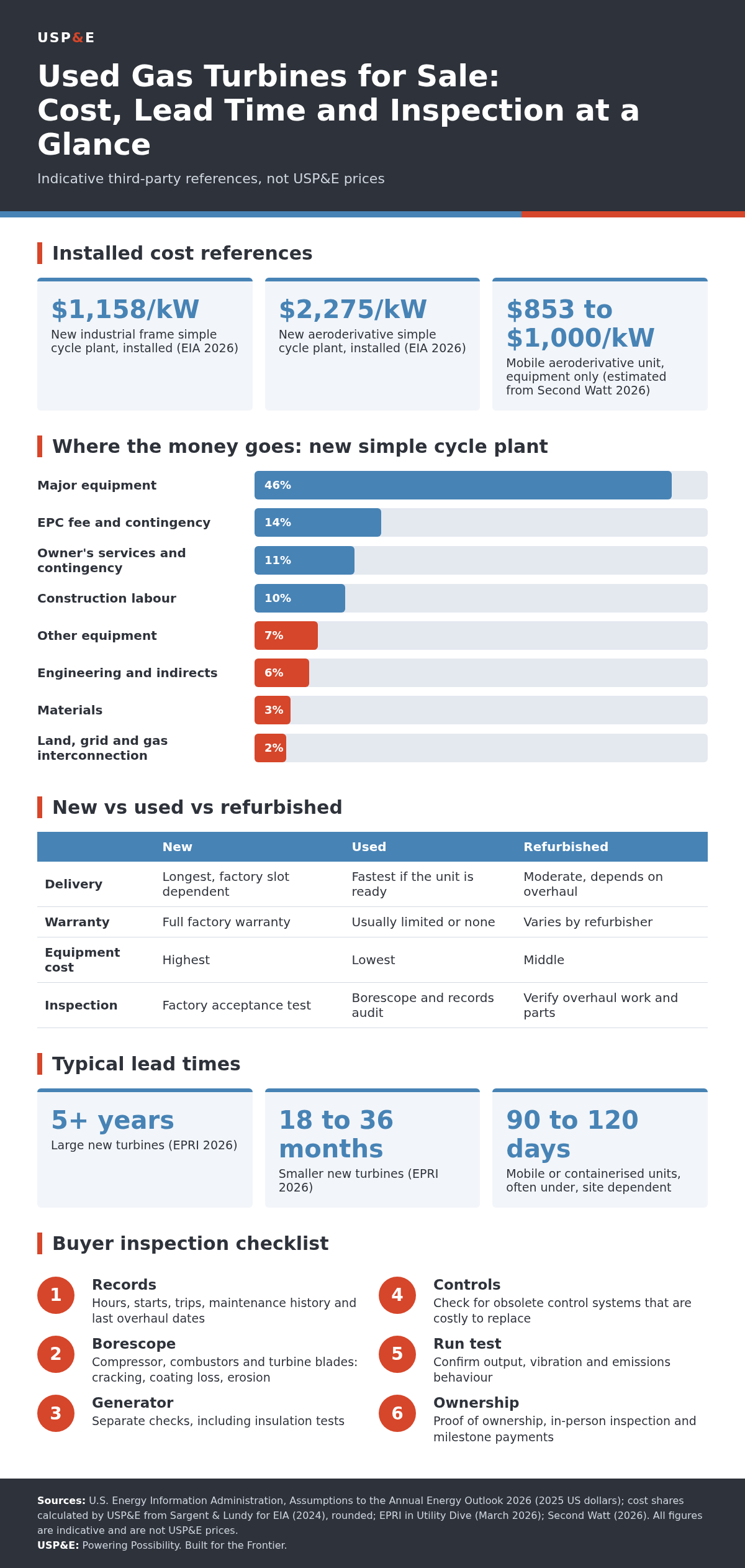
USP&E does not publish unit prices, because they depend on model, hours, condition, scope and market timing. The figures below are indicative third-party market references, not USP&E prices. The U.S. Energy Information Administration’s Assumptions to the Annual Energy Outlook 2026 (April 2026) puts the total overnight cost of a new industrial frame simple cycle plant at about $1,158 per kW. A new aeroderivative simple cycle plant comes in at about $2,275 per kW, in 2025 US dollars. These are installed plant costs in the United States, not equipment prices.
Turbine prices have also moved quickly. The Electric Power Research Institute (EPRI), writing in Utility Dive in March 2026, reported that average gas turbine prices rose from roughly $2,000 per kW to $3,000 per kW in six months.
Prices for used gas turbines for sale vary widely by model, hours and condition. The Turbine-Trader.com buyers’ guide (2026) lists indicative asking ranges from about $1 million to $4 million for small used aeroderivative units, up to about $8 million to $20 million for the largest. Market data from Second Watt (2026) shows low-hour mobile units asking about $558 to $712 per kW before the current demand surge.
Cost elements beyond the price of used gas turbines for sale
|
Cost element |
What it covers |
Typical risk if ignored |
|
Equipment purchase |
Turbine, generator and package as offered |
Scope gaps hidden in the sale contract |
|
Inspection and due diligence |
Borescope, records review, factory or site test |
Buying a unit with hidden damage |
|
BOP (Balance of Plant) |
Fuel system, cooling, electrical, controls, buildings |
Unplanned work that delays commissioning |
|
Shipping and logistics |
Crating, ocean freight, inland transport, customs |
Damage in transit or port delays |
|
Installation |
Foundations, mechanical and electrical erection |
Rework from poor site preparation |
|
Grid connection |
Substation, switchgear, protection, studies |
Months of delay waiting for approvals |
|
Commissioning |
Testing, tuning, performance runs |
Output below contract figures |
|
Spares and service |
Initial spares and an LTSA (Long-Term Service Agreement) |
Long outages waiting for parts |
Each line needs a number before you sign for any of the used gas turbines for sale you are considering. A public reference case shows how the split can look. The table below is derived from the Sargent & Lundy study for the U.S. Energy Information Administration, Capital Cost and Performance Characteristics for Utility-Scale Electric Power Generating Technologies (January 2024). It covers a new 211 MW simple cycle plant with four aeroderivative units, at a total of $1,606 per kW in 2023 US dollars.
Indicative installed cost split for a new simple cycle plant
|
Cost component |
Share of total capital cost |
What it includes |
|
Major equipment |
46% |
Gas turbines and emissions catalysts |
|
Other equipment |
7% |
Pumps, tanks, switchgear and transformers |
|
Construction labour |
10% |
Civil, structural and erection work |
|
Materials |
3% |
Construction materials, freight and consumables |
|
Engineering and construction indirects |
6% |
Engineering, management, start-up and commissioning |
|
EPC fee and contingency |
14% |
Contractor fee (6%) and contingency (8%) |
|
Owner’s services and contingency |
11% |
Development, permitting, owner’s engineering and contingency |
|
Land and grid and gas interconnection |
2% |
Land, transmission line and gas pipeline connection |
Source: shares calculated by USP&E from Table 3-1 of the Sargent & Lundy report for EIA (2024). The figures are indicative only. Shares are rounded and exclude interest during construction. In that reference case, the turbines and catalysts make up less than half of the total. Real projects in remote or frontier sites often carry higher logistics and BOP costs.
Fuel supply also matters. The International Energy Agency tracks natural gas markets and supply, and the EIA assumptions above also give operating cost and heat rate figures. Both help you test fuel and market assumptions.
New vs Used Gas Turbines for Sale: Inspection, Hours, and Warranty
New, used and refurbished units each solve a different problem. The right choice depends on your schedule, budget, risk appetite and duty cycle. A new unit gives you a full factory warranty and known history, but it carries the longest wait. Used gas turbines for sale can be delivered far sooner but need rigorous inspection. A refurbished gas turbine sits between the two, with a known overhaul scope and, in some cases, a warranty on refurbished components.
Comparing new units with used gas turbines for sale
|
Used gas turbines for sale compared |
New |
Used |
Refurbished |
|
Delivery |
Longest, factory slot dependent |
Fastest if unit is ready |
Moderate, depends on overhaul scope |
|
History |
None, fully known |
Must be verified from records |
Overhaul records available |
|
Warranty |
Full factory warranty |
Usually limited or none |
Varies by refurbisher and scope |
|
Equipment cost |
Highest |
Lowest |
Middle |
|
Inspection need |
Factory acceptance test |
Full borescope and records audit |
Verify overhaul work and parts |
|
Best fit |
Long-term base load |
Bridge, peaking, fast-track |
Base load or peaking with lower risk |
How to inspect used gas turbines for sale
Inspection is where buyers of used gas turbines for sale protect themselves. Start with records. You need operating hours, starts, trips, maintenance history and the dates of the last hot section and major overhaul. Missing records are a warning sign, not a detail.
Next, inspect the hardware. A borescope inspection lets engineers see compressor blades, combustors and turbine blades without a teardown. Look for cracking, coating loss, erosion and foreign object damage. Check the generator separately, including insulation tests. Review the control system, because obsolete controls can be costly to replace.
Finally, test the unit if possible. A run test or factory test confirms output, vibration and emissions behaviour. USP&E sets out the full process in its guide on how to buy a used gas turbine.
Fraud is a real risk in the market for used gas turbines for sale. Some sellers offer units they do not control, and long chains of intermediaries make that harder to spot. Insist on proof of ownership or a written right to sell, an inspection in person and payment terms tied to milestones.
Warranty and refurbishment
A refurbished gas turbine is only as good as the work done on it. Ask who performed the overhaul, which parts were replaced and whether original or approved replacement parts were used. Ask what warranty applies and who stands behind it. USP&E offers power generation asset refurbishment for buyers who want a known condition before installation.
Fuel Type Comparison
Used gas turbines for sale are one option among several. The table below compares common fuel and technology routes. CapEx (capital expenditure) and OpEx (operating expenditure) figures are indicative third-party references for new plants in the United States. Blank cells could not be verified from a credible public source.
|
Fuel Type |
CapEx Range |
OpEx Range |
Typical Lead Time |
Best Application |
|
Natural gas, mobile aeroderivative turbine |
About $853 to $1,000/kW, equipment only (estimated from Second Watt 2026); new stationary aeroderivative plant about $2,275/kW installed (EIA 2026) |
About $9.99/kW per year fixed plus $5.97/MWh variable (EIA 2026, aeroderivative plant) |
Often under 90 to 120 days, site dependent |
Bridge power, emergency and fast-track supply |
|
Natural gas, used or refurbished frame turbine |
Utility and industrial base load |
|||
|
Natural gas, new turbine |
About $1,158/kW for an industrial frame simple cycle plant (EIA 2026) |
About $7.18/kW per year fixed plus $4.17/MWh variable (EIA 2026) |
More than five years for large units, 18 to 36 months for smaller units (EPRI 2026) |
Long-term base load and combined cycle |
|
Diesel, containerised gensets |
About $650 to $880/kW installed (NREL REopt defaults) |
About $10 to $20/kW per year fixed, plus fuel (NREL REopt defaults) |
Often under 90 to 120 days, site dependent |
Standby, remote sites, short-term supply |
|
HFO (Heavy Fuel Oil), engine power station |
About $800 to $1,000/kW, medium speed engines (IDB Invest, 2010 US dollars) |
Typically 9 to 14 months from deposit |
Remote base load where gas is unavailable |
Sources: U.S. Energy Information Administration, Assumptions to the Annual Energy Outlook 2026, Table 3 (April 2026, 2025 US dollars, new U.S. plants). Lead times for new units: EPRI in Utility Dive, March 2026 (linked above). Mobile turbine CapEx: estimated from Second Watt (2026) asking and transaction data per kW. Diesel: NREL REopt model default values (REopt generator defaults, checked 2026). HFO: IDB Invest, Liquid and Gaseous Fossil Fuel Power Plant Guidelines, citing 2010 cost data, so treat it as an older reference. All figures are indicative and are not USP&E prices.
A mobile gas turbine suits buyers who need power quickly. USP&E explains how they work in its guide to what a mobile gas turbine is.
Case Studies: Used Gas Turbines for Sale in Real Projects
Real projects show how buying decisions play out on site. USP&E only publishes case studies that have been approved for release, and the USP&E case studies page lists those available.
A typical project built around used gas turbines for sale starts with a site and load review, then moves to unit selection, records review and inspection of candidate units. USP&E then plans dismantling, shipping, installation and commissioning under its power plant EPC projects scope, drawing on 24+ years of delivery since 2002.
Where power is needed quickly, a typical fast-track scope pairs a mobile gas turbine with fuel supply, grid or load connection and a short commissioning plan, while the permanent plant is engineered in parallel.
The lessons below reflect common practice in the secondary turbine market. They are not outcomes from a specific project.
- Projects that inspect used gas turbines for sale before paying a deposit avoid most of the costly surprises.
- Projects that study the grid connection early avoid long commissioning delays.
- Projects that agree spares and service before delivery reduce outage risk in year one.
How to Choose a Supplier of Used Gas Turbines for Sale: 10 Criteria
The right supplier matters as much as the right unit. Use these ten criteria to compare offers for used gas turbines for sale on equal terms.
- Proof of ownership or control. The supplier should show that it owns the unit or holds a written right to sell it. Ask for documents before you pay any deposit.
- Complete maintenance records. The supplier should provide hours, starts, trips and overhaul history. Gaps in the records should lower the price or end the discussion.
- Independent inspection access. The supplier should allow your engineers to inspect the unit in person. A borescope inspection should be standard, not an extra favour.
- Clear package scope. The offer should list every item included, from controls to auxiliaries. Anything not listed should be treated as excluded.
- Engineering depth. The supplier should have engineers who understand derating, BOP and grid connection. A trader alone cannot answer these questions.
- Installation and EPC capability. A supplier with EPC experience can carry the unit from purchase to power. Ask how many power projects it has delivered and where.
- O&M support after handover. Ask who will operate and maintain the unit. USP&E provides power plant operations and maintenance for buyers who want one accountable partner.
- Logistics experience. Gas turbines are heavy and sensitive. The supplier should have shipped similar units and handled customs in your country.
- Compliance and ethics. The supplier should screen every deal for sanctions and anti-corruption risk. Ask for its written compliance policy.
- Certifications and safety record. Look for quality and safety certification such as ISO 9001 and ISO 45001. USP&E holds ISO 9001:2015 and ISO 45001:2018 certification.
FAQ: Used Gas Turbines for Sale
Where can I find used gas turbines for sale that are ready to ship?
Start with suppliers that publish inventory, allow inspection in person and show proof of ownership or a written right to sell. You can browse current inventory on the USP&E gas turbines category page. Ask for records and inspection access before you discuss price or pay any deposit.
Is a used gas turbine a safe purchase?
A used gas turbine can be a safe purchase if it passes a full records review and a borescope inspection. Risk comes from unverified history, not from age alone. Tie every payment to inspection results and delivery milestones, and confirm who stands behind any warranty before you sign.
How much do used gas turbines for sale cost?
Costs depend on model, hours, condition and scope. Turbine-Trader.com (2026) lists indicative used aeroderivative asking prices of about $1 million to $20 million per unit. The purchase price is only part of the installed cost, which also covers BOP, shipping, installation, grid connection and commissioning.
How fast can a used unit be delivered and running?
A mobile gas turbine or a containerised package can often be fast-tracked in under 90 to 120 days, depending on site conditions. Larger installed units take longer. EPRI reported in 2026 that new large gas turbines take more than five years from order, which is why buyers look at used units.
What is the difference between a used and a refurbished gas turbine?
A used unit is offered in its current condition after service. A refurbished gas turbine has had components overhauled or replaced to a defined scope. Refurbished units usually cost more but carry less unknown risk, so ask who did the work and what warranty applies to it.
Will a used gas turbine produce its nameplate output on my site?
Usually not. Nameplate output is measured at ISO conditions of 15 degrees Celsius, sea level and 60% relative humidity, and heat, altitude and humidity reduce it. An engineer should calculate the site rating for your location before you buy, so the unit matches your load.
Can USP&E install and operate the unit after purchase?
Yes. USP&E provides EPC and O&M services for power stations and has delivered 150+ power projects in 45+ countries since 2002. One partner across inspection, installation, commissioning and operation reduces handover risk and keeps responsibility for performance in one place.
Key Takeaways: Used Gas Turbines for Sale
- The secondary market is a practical route to power when factory slots are scarce, but it rewards careful buyers.
- Budget for the full installed cost of used gas turbines for sale, not the equipment price alone.
- Verify ownership, records and condition before you pay a deposit.
- Match the unit to your site conditions, fuel and duty cycle.
- Choose a supplier with engineering, EPC and O&M depth, not a trader alone.
- Rising electricity demand from data centres is a key driver of this market, as the International Energy Agency sets out in its Energy and AI report.
Buying the right unit is a solvable problem with the right partner beside you. When you are ready to compare used gas turbines for sale, USP&E’s engineers can help you assess units, plan installation and bring your project to power.
Ready to Power Your Project? Talk to USP&E’s Engineers.
Whether you are in early feasibility or ready to mobilise on a power station, EPC, or O&M project, USP&E’s engineers can help. With 150+ power projects delivered in 45+ countries since 2002, our engineers remove the technical and commercial risk from your project, with speed and without excuses.
Contact USP&E Today Request a Fast Quote
USP&E: Powering Possibility. Built for the Frontier. ISO 9001:2015 | ISO 45001:2018 | 150+ power projects in 45+ countries | 25,000 MW contracted since 2002 | 24+ years