

GE LM2500 Gas Turbine and LM6000 Gas Turbine: Specs, Comparison and EPC Guide
The GE LM2500 gas turbine and the LM6000 gas turbine (often written “LM 6000 gas turbine”) are the two most widely used aeroderivative gas turbines for fast, flexible power. GE Vernova rates the LM2500 family at about 37 MW in simple cycle and the LM6000 at about 57 MW. For plant configuration, see how a natural gas turbine generator fits a simple or combined cycle plant. Both can reach full power in about five minutes and burn natural gas or liquid fuels. This guide sets out the published GE specifications side by side, explains when each machine fits, and shows how USP&E delivers both as complete power stations through EPC and O&M. USP&E has delivered 150+ power projects in 45+ countries over 24+ years, with 25,000 MW contracted since 2002.
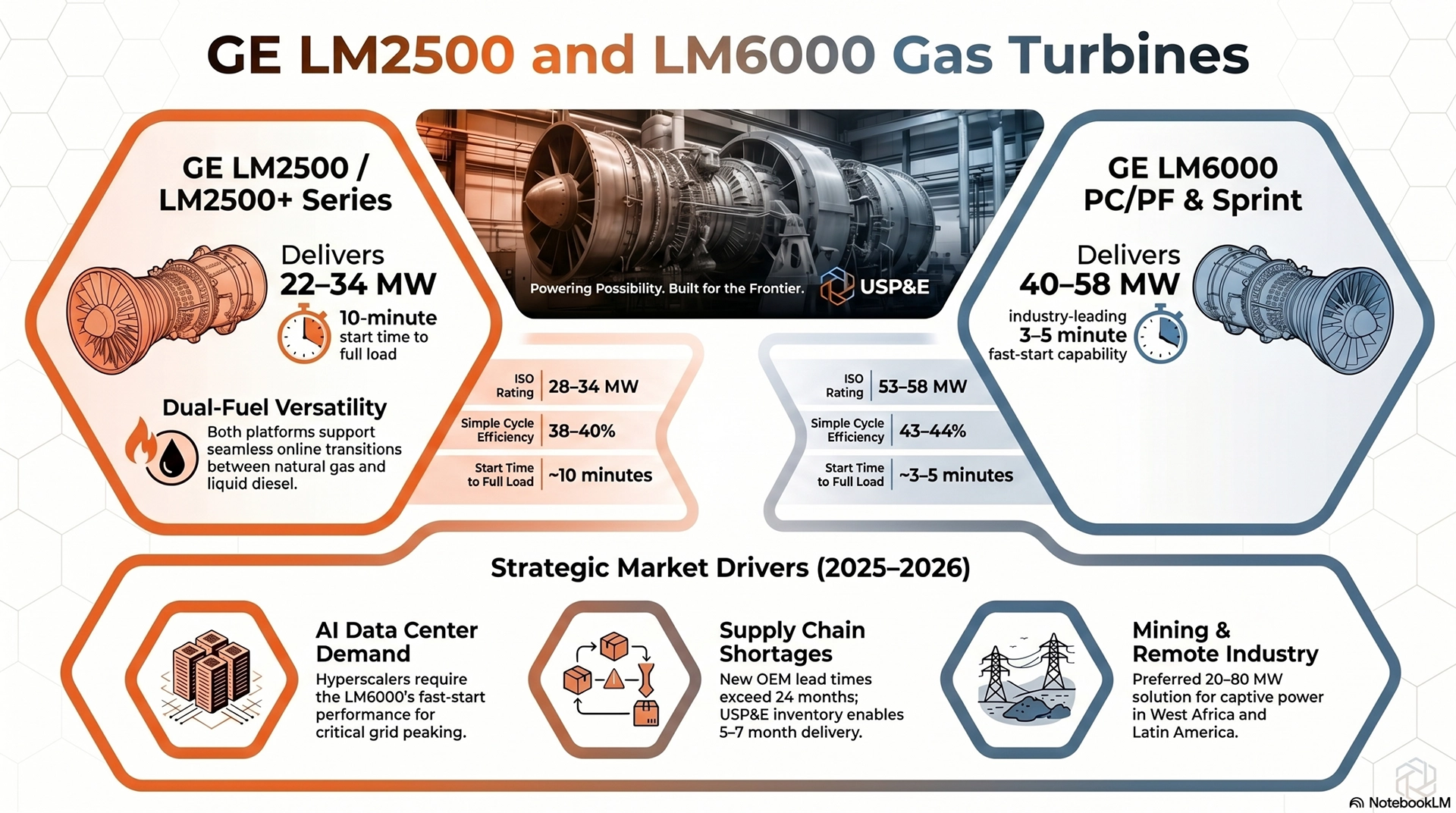
LM2500 vs LM6000 at a Glance
| Headline figure (GE Vernova) | LM2500 family | LM6000 |
|---|---|---|
| Simple cycle output | ~37 MW | ~57 MW |
| Simple cycle efficiency | ~40% | 41% |
| Start time | 5 minutes | 5 minutes |
| Hydrogen capability | Up to 75% H2 | 100% H2 capable |
| Fleet experience | ~140 million operating hours | ~60 million operating hours, 1,500+ units sold |
| Reliability | >99.8% | >99% reliability, >98% availability |
| Fast-install package | LM2500XPRESS: installed in under 30 days, up to 95% factory assembled | LM6000VELOX: up to 40% shorter installation and commissioning |
| Parent aircraft engine | GE CF6-6 | GE CF6-80C2 |
Sources: GE Vernova LM2500 and LM6000 product pages; Wikipedia for the parent engines. Ratings are ISO, natural gas, simple cycle. Actual output varies with site ambient conditions, altitude, fuel and package.
GE LM2500: Specs and Typical Duty
The GE LM2500 is GE Vernova's widely used aeroderivative gas turbine for fast, flexible power. Typical published simple-cycle output for the family is about 37 MW at ISO conditions on natural gas, with a five-minute start. Current LM2500XPRESS packages are rated 34.5 MW (+G4 DLE UPT) and 36.3 MW (+G5 DLE UPT) net. GE lists fuel flexibility up to 75% hydrogen and derives the machine from the CF6-6 aircraft engine. These are typical published figures; actual output varies with site ambient conditions, altitude, fuel and package. USP&E is an independent EPC and O&M contractor that also sources new, used and refurbished units; it is not the OEM and is not a broker.
LM6000: Specs and Typical Duty
The LM6000 is GE Vernova's larger aeroderivative, often written "LM 6000", used for peaking, combined heat and power, and 50 MW-class blocks. Typical published simple-cycle output is about 57 MW at ISO conditions on natural gas, with about 41% efficiency and a five-minute start. Current LM6000VELOX packages are rated 51.1 MW (PC Sprint) and 56.9 MW (PF+ Sprint) net. GE describes the LM6000 as 100% hydrogen capable and derives it from the CF6-80C2 aircraft engine. GE has sold more than 1,500 LM6000 units, with about 60 million operating hours. These are typical published figures; actual output varies with site ambient conditions, altitude, fuel and package. USP&E is not the OEM and is not a broker.
GE LM2500 Gas Turbine and LM6000 Gas Turbine Specifications (LM 2500 / LM 6000)
The table below uses GE Vernova’s current published packages: LM2500XPRESS+G4 and +G5 DLE UPT, and LM6000VELOX PC and PF+ Sprint. Older LM2500 (base, +, +G4 SAC) and LM6000 (PA, PC, PD, PF) units remain in service and on the secondary market. Their ratings differ, so always check the nameplate and the OEM performance curve for the specific unit. The same LM2500 core powers the trailer-mounted TM2500 gas turbine used for mobile and emergency power.
| Specification (ISO, natural gas, simple cycle) | LM2500XPRESS+G4 DLE UPT | LM2500XPRESS+G5 DLE UPT | LM6000VELOX PC Sprint | LM6000VELOX PF+ Sprint |
|---|---|---|---|---|
| Net output (MW) | 34.5 | 36.3 | 51.1 | 56.9 |
| Net heat rate (Btu/kWh, LHV) | 8,669 | 8,751 | 8,595 | 8,328 |
| Net heat rate (kJ/kWh, LHV) | 9,146 | 9,233 | 9,068 | 8,800 |
| Net efficiency (%, LHV) | 39.4% | 39.0% | 39.7% | 41.0% |
| Package dimensions (m) | 28.5 x 3.04 | 28.5 x 3.04 | 20.43 x 4.1 | 20.43 x 4.1 |
| Package height (m) | 8.2 | 8.2 | 14.38 | 14.38 |
| Largest lift (kg) | 72,000 | 72,000 | 71,000 (generator) | 71,000 (generator) |
| Frequency | 50 / 60 Hz | 50 / 60 Hz | 50 / 60 Hz | 50 / 60 Hz |
Source: GE Vernova product pages for the LM2500 and LM6000, accessed 21 Oct 2026. Ratings include inlet and exhaust losses and exclude balance of plant. Baker Hughes publishes its own industrial ratings for related models: PGT25+/LM2500+G4 at 34 MW, PGT25+/LM2500+G5 at 38.3 MW and LM6000PF+ at 53.8 MW.
LM 6000 Gas Turbine vs LM2500: Which Aeroderivative Fits Your Project?
Block size and plant layout
The biggest difference is unit size. An LM6000 delivers roughly 51 to 57 MW per unit in GE’s current packages, against roughly 34 to 37 MW for the LM2500XPRESS. Choosing between them means trading the number of units against redundancy. For example, a 100 MW requirement needs two LM6000 units or three LM2500 units, and N+1 redundancy changes that count again.
Efficiency and fuel cost
The LM6000PF+ Sprint has the best published heat rate of the four packages (8,328 Btu/kWh), so it burns less fuel per MWh at full load. The LM2500 family is close behind. In a plant with several smaller units it can also hold better part-load efficiency, because units can be switched off rather than turned down.
Speed to power
Both turbines reach full power in about five minutes. GE’s LM2500XPRESS is designed for installation in under 30 days, with up to 95% factory assembly and about 80% fewer electrical interconnects than a traditional plant. The LM6000VELOX cuts LM6000 installation and commissioning by up to 40%. Either way, permitting, the gas supply and the grid connection usually decide the overall schedule.
Fuel flexibility and hydrogen
GE lists natural gas, diesel, aviation fuel, naphtha, LPG, ethane, ethanol and biodiesel for the LM2500, which can burn up to 75% hydrogen. For the LM6000, GE lists natural gas, LPG, isopentane, ethanol, diesel and coke oven gas, with 100% hydrogen capability. Dual-fuel gas and diesel operation is available on both.
Typical applications
Operators choose the LM2500 for distributed generation, island and mining grids, oil and gas, marine and mechanical drive. It is also the core of GE’s TM2500 trailer-mounted unit. The LM6000 is the usual choice for utility peaking, combined heat and power, and larger blocks where a 50 MW-class unit keeps the number of units down.
Need units now? See USP&E’s GE gas turbines for sale, our guide on how to buy a used gas turbine, and the GE TM2500 mobile gas turbine guide.
LM-Class Aeroderivatives and Data Centre Power
Large data centre campuses need firm power in 50 to several hundred MW blocks, often before a utility connection is available. Aeroderivatives suit this load because they start in minutes, follow load quickly and come in factory-built packages. The LM2500 and LM6000 are the reference points most developers start from. Read more in our guide to gas turbine power plants for data centers.
OEM manufacturing queues for new aeroderivative units are long. For US developers planning new campuses, USP&E also offers the New USP&E FX-45 45MW Modular Gas Turbine for the Hyperscale Data Center sector in the USA, with delivery slots for 2028–2030. USP&E engineers the plant around it, as it does for LM2500 and LM6000 projects. Speak to our team about FX-45 slot availability.
Browse USP&E power generation inventory
The Global Race for Fast, Reliable Aeroderivative Power
This guide is written for data center developers, mine energy managers, IPP sponsors, utility procurement officers, and defense operators who must select, specify, deploy, and maintain GE aeroderivative gas turbines under real world conditions. It covers availability, technical specifications, fuel flexibility, fast track timelines, proven case studies, and the ten criteria every buyer should evaluate before awarding an EPC contract.
The Global Demand for GE LM2500 and LM6000 Gas Turbines: What the Data Shows
Global electricity demand is forecast to grow by more than 30 percent by 2035, with hyperscale data center load alone projected to double by 2030 according to the International Energy Agency Electricity 2024 Report. Natural gas fired generation remains the fastest, most scalable way to meet that demand while grid operators wait for long cycle nuclear and transmission build outs. Aeroderivative gas turbines, and specifically the GE LM2500 and LM6000 Gas Turbines platforms, sit at the center of this response. Their combination of fast start, high simple cycle efficiency, and dual fuel capability makes them the preferred prime mover for peaking, grid support, data center baseload, and fast track industrial power.
Table 1. Technical Specification Benchmarks for the GE LM2500 and LM6000 Gas Turbines Family
| Aeroderivative Platform | ISO Power Output | Simple Cycle Efficiency | Heat Rate (Btu/kWh) | Time to Full Load | Fuel Flexibility |
| LM2500 | 22 MW | 36 percent | 9,700 | 10 minutes | Natural Gas or Distillate |
| LM2500+ | 30 MW | 38 percent | 9,200 | 10 minutes | Natural Gas or Distillate |
| LM2500+G4 | 34 MW | 39 percent | 9,000 | 10 minutes | Natural Gas or Distillate |
| LM6000PC | 43 MW | 41 percent | 8,900 | 10 minutes | Natural Gas or Distillate |
| LM6000PF Sprint | 47 MW | 41 percent | 8,800 | 10 minutes | Natural Gas or Distillate |
| LM6000PG / PH | 52 MW | 42 percent | 8,700 | 10 minutes | Natural Gas or Distillate |
Source: GE Vernova product literature, aggregated for comparative reference. Actual performance varies with ambient temperature, site elevation, fuel composition, and package configuration.
According to the U.S. Energy Information Administration, natural gas now fuels more than 43 percent of U.S. electricity generation, and aeroderivatives dominate the fast dispatch segment of that fleet. The African Development Bank Energy and Power portfolio estimates that sub Saharan Africa alone requires more than 160 GW of new generating capacity by 2035, with mobile and fast install aeroderivatives expected to cover a growing share of that build out. For frontier market utilities and private off takers, the GE LM2500 and LM6000 Gas Turbines platform is often the only technology that can meet both the capacity and timeline requirements.
Key Drivers of GE LM2500 and LM6000 Gas Turbines Deployment in 2026
Five converging market forces are pushing procurement officers toward the GE LM2500 and LM6000 Gas Turbines platform in 2026. Each of these drivers compresses project timelines and raises the cost of the wrong EPC decision.
- AI and data center load growth. S. hyperscale AI and data center campuses are requesting 200 MW to 1,000 MW of on site generation with 12 to 24 month commissioning deadlines. Simple cycle LM6000 packages are the only proven technology that can meet that schedule at scale.
- Grid instability and peaking demand. Utilities from ERCOT in Texas to Eskom in South Africa are deploying fast start aeroderivatives to cover intermittency from solar and wind build outs. An LM6000 can reach full load in under ten minutes, making it ideal for frequency regulation and grid support.
- Frontier market electrification. West African, Middle Eastern, and Southeast Asian governments are accelerating IPP reforms. USP&E supports clients in Mali, Togo, Liberia, Saudi Arabia, Iraq, and Ukraine, where fast track aeroderivative deployments are often the only viable solution for reliable base and peak power.
- LNG to power and natural gas expansion. New LNG import terminals from Senegal to Mozambique are creating a wave of gas fired generation opportunities. LM2500 and LM6000 units are proven in both LNG mechanical drive and utility scale power generation duty.
- Dual fuel resilience. Every LM2500 and LM6000 frame can switch between pipeline natural gas and liquid distillate, protecting project economics against fuel supply disruption. This resilience is critical for mine sites, conflict zones, and island grids.
The International Renewable Energy Agency highlights how hybrid systems increasingly pair aeroderivative gas turbines with solar and battery storage to lower fuel cost per kilowatt hour. USP&E’s hybrid power systems practice integrates exactly that architecture, using GE LM2500 and LM6000 Gas Turbines as the reliable base load anchor for solar plus battery hybrids serving mining, utility, and data center clients.
EPC and O&M Solutions for GE LM2500 and LM6000 Gas Turbines: Technical and Commercial Overview
Procuring a gas turbine is the easy part. Engineering, procuring, constructing, commissioning, and operating a complete power station around it is where 80 percent of project risk lives. USP&E is an integrated EPC and O&M contractor that also sources new, used and refurbished gas turbines and reciprocating engines for its clients. Our power plant engineering, EPC construction, and operations and maintenance teams deliver the full lifecycle under one ISO certified umbrella.
Fast Track vs Standard EPC Timelines for GE LM2500 and LM6000 Gas Turbines
Table 2. Delivery Model, Scope, and Timeline for GE LM2500 and LM6000 Gas Turbines EPC Projects
| Delivery Model | Typical Scope | Commissioning Lead Time | Best Application |
| Emergency Rental (TM2500) | Trailer mounted, grid connected | 30 to 90 days | Utility emergency, disaster response, mining crash power |
| Fast Track EPC (LM2500XPRESS or LM6000VELOX) | Factory packaged turnkey power plant | 9 to 14 months | Data center, mining, IPP peaking |
| Standard Simple Cycle EPC | Full balance of plant, site specific civil works | 14 to 22 months | Utility and industrial base load |
| Combined Cycle EPC | Simple cycle turbines plus HRSG plus steam turbine | 24 to 36 months | High efficiency base load IPP |
| Long Term Service Agreement (LTSA and O&M) | Spares pooling, overhauls, SmartPower monitoring | Continuous operations | Every deployed unit |
Fuel flexibility is central to the platform’s value proposition. Both the LM2500 and LM6000 frames run on pipeline natural gas, LNG regasified supply, and liquid distillate, and select variants accept treated associated gas and ethane rich mixtures. Mine sites and island grids particularly benefit from dual fuel because it eliminates single source fuel risk and stabilises long term OpEx.
Capital expenditure benchmarks, honestly stated, range from approximately USD 800 per kilowatt for an ex works LM2500 package up to USD 1,800 per kilowatt for a fully installed LM6000 simple cycle power station with complete balance of plant, grid interconnection, fuel farm, and civil works in a frontier market. Operating expenditure is dominated by fuel, and the platform’s 41 to 42 percent simple cycle efficiency combined with roughly 8,700 Btu/kWh heat rate makes it among the most efficient aeroderivatives in service today.
Fuel Type Comparison for GE LM2500 and LM6000 Gas Turbines Power Projects
Table 3. Indicative Fuel, CapEx, OpEx, and Application Comparison for GE LM2500 and LM6000 Gas Turbines
| Fuel Type | Indicative CapEx (USD per kW) | Indicative OpEx (USD per MWh) | Fast Track Lead Time | Best Application |
| Pipeline Natural Gas | 800 to 1,400 | 35 to 65 | 9 to 14 months | Data center, utility base load |
| LNG Regasified Supply | 1,000 to 1,600 | 55 to 95 | 12 to 18 months | Coastal IPP, island grids |
| Liquid Distillate (Diesel) | 800 to 1,300 | 150 to 220 | 9 to 12 months | Emergency power, remote mining |
| Hybrid Gas plus Solar plus BESS | 1,500 to 2,400 | 25 to 55 | 14 to 20 months | Mining camps, off grid utilities |
Indicative ranges only. Final CapEx and OpEx must be confirmed through a USP&E conceptual feasibility study.
Operations and maintenance considerations are equally important. The LM2500 and LM6000 platforms both run on a hot section inspection at roughly 25,000 hours and a major overhaul at approximately 50,000 hours. USP&E provides long-term service agreements that include spare parts pooling, SmartPower remote monitoring, borescope inspections, and guaranteed availability terms. Our SmartPower AI platform fuses sensor data, predictive analytics, and field engineer workflows to reduce unplanned downtime and fuel burn across the managed fleet.
Case Studies: Proven GE LM2500 and LM6000 Gas Turbines Results Across Three Continents
USP&E has deployed, operated, and maintained GE aeroderivative gas turbines in some of the toughest environments on the planet. Three representative projects illustrate the operational range.
Libya, TM2500 Emergency Power. USP&E was engaged as EPC contractor with GE Distributed Power for the potential supply of 12 TM2500 plus mobile gas turbines for Tripoli area emergency power. Confirmed in a written letter of support from GE Power and Water, this deployment demonstrated USP&E’s ability to structure ex works supply, remote commissioning, and local O&M under conflict zone conditions. The reference confirms the company’s standing as a recognised EPC partner inside the GE aeroderivative ecosystem.
Togo, Natural Gas Turbine IPP. USP&E built and now operates a natural gas turbine power station for a natural gas turbine IPP in Togo, with our team on site and centralised engineering support from our Mali and Johannesburg offices. The project proved out USP&E’s ability to drop an aeroderivative package into a low infrastructure market and deliver grid quality power within budget and on schedule.
Americas Portfolio: Guyana, Colombia, Mexico, and the United States. USP&E’s regional portfolio across the Americas covers multiple gas turbine projects serving data centers, oil and gas operations, and utility customers. The published case record at USP&E’s Americas EPC and O&M article demonstrates deep experience with LM2500 family and LM6000 family deployment for natural gas and dual fuel applications, and reinforces our data center gas turbine authority position.
Full project listings and verified client references are published at our project portfolio and client references pages. A complementary case study, which documented approximately USD 10 million in buyer savings on a Siemens turbine procurement, is available at the Siemens gas turbine savings case study and illustrates the same diligence USP&E brings to every GE aeroderivative transaction.
How to Select the Right EPC Partner for GE LM2500 and LM6000 Gas Turbines: 10 Critical Criteria
Selecting an EPC and O&M partner for an aeroderivative power project is one of the highest stakes decisions a procurement officer makes. The following ten criteria separate frontier grade contractors from asset brokers and resellers.
- Verified GE ecosystem standing. Does the contractor have written letters of support from GE Vernova or legacy GE Power and Water for aeroderivative supply, installation, and remote commissioning? USP&E holds such references on file.
- Access to verified gas turbine supply. A credible partner must be able to locate real, available units and check their documentation and history. USP&E sources new, used and refurbished gas turbines for its clients.
- In house engineering depth. EPC success depends on engineering teams covering mechanical, electrical, civil, instrumentation, controls, and commissioning disciplines under one roof.
- Frontier and conflict zone operating experience. The partner should have executed projects in the hardest jurisdictions, including Mali, Liberia, Togo, Sierra Leone, Iraq, Saudi Arabia, Libya, and Ukraine.
- ISO certification and safety record. Insist on ISO 9001:2015 for quality and ISO 45001:2018 for occupational health and safety, plus a documented project track record across 24+ years of trading.
- OFAC and FCPA compliance culture. An FCPA and OFAC compliant partner protects the project from sanctions exposure, bribery risk, and politically connected counterparties that can destroy bankability.
- Fast track delivery capability. Factory packaged LM2500XPRESS and LM6000VELOX solutions should be part of the partner’s standard offering, not a one off exception. USP&E routinely mobilises these platforms for fast track clients.
- Long term service agreement depth. The right O&M contractor offers guaranteed availability, spare parts pooling, and remote monitoring through platforms like SmartPower. USP&E currently manages more than 260 MW under active O&M.
- Feasibility and conceptual engineering capacity. The partner should be able to deliver a bankable conceptual or feasibility study in 30 to 120 days, not hand the client a generic equipment quote dressed up as a proposal.
- Global fuel flexibility expertise. Natural gas, LNG, distillate, associated gas, hybrid solar plus battery: the partner must have integrated every one of them into live projects.
LM2500 and LM6000 Gas Turbine FAQs
What is the difference between the LM2500 and LM6000 gas turbine?
The main difference is size. GE Vernova rates the LM2500 family at about 37 MW in simple cycle and the LM6000 at about 57 MW. Both are GE aeroderivatives with five-minute starts. The LM6000 has the better published heat rate. The LM2500 has the larger fleet, with about 140 million operating hours, and suits smaller or distributed plants.
How many MW is an LM6000 gas turbine?
GE Vernova’s current LM6000VELOX packages are rated at 51.1 MW (PC Sprint) and 56.9 MW (PF+ Sprint) net, at ISO conditions on natural gas in simple cycle. Older LM6000 PA, PC and PD units are rated lower. Site temperature, altitude and fuel reduce real output, so check the OEM performance curve for each unit.
Is the LM 6000 gas turbine the same as the GE LM6000?
Yes. “LM 6000” is a common way of writing the GE LM6000, the aeroderivative gas turbine derived from the CF6-80C2 aircraft engine. The same applies to “LM 2500” for the LM2500. GE Vernova’s current LM 6000 gas turbine packages, the LM6000VELOX PC and PF+ Sprint, are rated at 51.1 MW and 56.9 MW net at ISO conditions.
What is the LM6000?
The LM6000 is GE Vernova's 50 MW-class aeroderivative gas turbine, derived from the CF6-80C2 aircraft engine. Typical published simple-cycle output is about 57 MW at ISO conditions on natural gas, with a five-minute start. Current LM6000VELOX packages are rated 51.1 MW and 56.9 MW net. Actual output varies with site conditions. USP&E is not the OEM.
How many MW is an LM2500 gas turbine?
GE Vernova rates the current LM2500XPRESS+G4 DLE UPT at 34.5 MW and the +G5 at 36.3 MW net, at ISO conditions on natural gas. Its headline figure for the family is about 37 MW. Earlier LM2500 base and LM2500+ units produce less, so confirm the exact model, configuration and nameplate before you compare quotes.
What aircraft engines are the LM2500 and LM6000 derived from?
The LM2500 is derived from the GE CF6-6 aircraft engine. The LM6000 is derived from the GE CF6-80C2 turbofan. GE adapted each for industrial and marine use, adding an expanded turbine section that turns thrust into shaft power, deck or skid mounting, and power generation controls. That aviation heritage explains their low weight and fast starts.
How fast can an LM6000 or LM2500 start?
GE Vernova quotes a five-minute start for both. The LM2500 goes from cold iron to base load in about five minutes and can start and stop several times a day. GE cites a nominal ramp rate of around 50 MW per minute for aeroderivatives like the LM6000, far faster than typical medium-speed reciprocating engines.
What fuels can the LM2500 and LM6000 burn?
According to GE Vernova, the LM2500 runs on natural gas, diesel, aviation fuel, naphtha, LPG, ethane, ethanol and biodiesel. The LM6000 runs on natural gas, LPG, isopentane, ethanol, diesel and coke oven gas. Both offer dual-fuel gas and diesel configurations, and the LM6000 can switch fuels without interrupting power output.
Are the LM2500 and LM6000 hydrogen capable?
Yes, within limits GE publishes. GE Vernova describes the LM6000 as 100% hydrogen capable and the LM2500 as capable of up to 75% hydrogen. The LM2500 fleet has about two million operating hours on fuels containing 5% to 95% hydrogen by volume. Combustor type, fuel supply and permits decide what a specific project can run.
How much does an LM6000 or LM2500 cost?
No single price applies. Cost depends on whether the unit is new, used or overhauled, its operating hours and maintenance records, its package scope, frequency, emissions equipment and delivery location. Balance of plant, the gas supply and the grid connection often cost as much as the turbine itself. USP&E prices each unit and project against a defined scope.
Which is better for a data centre, the LM2500 or LM6000?
It depends on campus load and redundancy. LM6000 units mean fewer, larger blocks for big campuses. LM2500 units allow finer N+1 steps and easier phased growth. For US hyperscale developers, USP&E also offers the New USP&E FX-45 45MW Modular Gas Turbine for the Hyperscale Data Center sector in the USA, with 2028–2030 delivery slots.
Does USP&E supply and maintain LM2500 and LM6000 units?
Yes. USP&E sources new, used and refurbished aeroderivative gas turbines and lists available units on our natural gas turbine inventory page. We engineer, build, commission and operate complete power stations under EPC and O&M contracts. USP&E has delivered 150+ power projects in 45+ countries over 24+ years, with 25k MW contracted since 2002.
What is the GE TM2500 gas turbine?
The GE TM2500 is a trailer-mounted aeroderivative gas turbine built around the LM2500 core. It is designed for fast delivery and installation as mobile or emergency power, and can be moved when the need ends.
How does the TM2500 compare with the LM 6000 gas turbine?
The TM2500 is a mobile package for fast, temporary or bridging power. The LM 6000 gas turbine is a larger aeroderivative usually installed as a fixed plant for peaking, combined cycle or data centre power. See the GE TM2500 guide for mobile use cases.
Is the LM 6000 a good fit for data centre power?
It can be, where a campus needs firm, fast-starting gas power in blocks the LM 6000 suits. USP&E assesses load profile, gas supply and grid connection for each project.
Summary: Key Takeaways for GE LM2500 and LM6000 Gas Turbines Decision Makers
- The GE LM2500 and LM6000 are the world’s most deployed aeroderivative gas turbines: the LM2500 family has about 140 million operating hours, and GE has sold more than 1,500 LM6000 units with about 60 million operating hours (GE Vernova). Compare GE gas turbine generator packages currently listed by USP&E.
- Simple cycle efficiency ranges from 36 to 42 percent, heat rates from 8,700 to 9,700 Btu/kWh, and both frames offer dual fuel resilience between natural gas and distillate.
- Fast track delivery models such as LM2500XPRESS and LM6000VELOX enable 9 to 14 month commissioning for data center, mining, and IPP projects.
- Capital expenditure ranges from roughly USD 800 per kilowatt ex works to USD 1,800 per kilowatt fully installed in a frontier market.
- USP&E is an EPC partner for GE LM2500 and LM6000 gas turbines, with ISO 9001:2015 and ISO 45001:2018 certifications, 150+ power projects in 45+ countries and 24+ years of frontier market delivery.
- The right partner must demonstrate GE ecosystem standing, FCPA and OFAC compliance, ISO certification, and proven long term service agreement capability.
- Speak to our engineers about the right solution for your project.
Ready to Power Your Project? Talk to USP&E’s Engineers.
Speak to our engineers about the right solution for your project. Whether you are in early feasibility or ready to mobilise, our engineering team, with 150+ power projects in 45+ countries behind it, is ready to guide your project to success with speed and without excuses.
Quick Links:
- Contact USP&E by clicking on this link.
- Request a fast equipment quote
Global Resources
- USP&E's Project Experience Portfolio
- USP&E Case Studies and Client Reference Letters
- USP&E Integrity and Compliance policy
- USP&E's ISO Certifications and Credentials