

Gas Turbine Derating: How Heat and Altitude Cut Real Site Output
A gas turbine rated at 30 MW on a supplier data sheet may deliver 22 MW on your site. Nothing is wrong with the machine. The number on the data sheet was measured at conditions your project will never see, and gas turbine derating is the engineering correction that closes the gap between that number and reality. Buyers who skip the correction size the plant to the wrong figure, sign a power purchase agreement they cannot meet, and discover the shortfall during commissioning when it is expensive to fix.
Your project is the hero of this story. A mine at 1,400 metres in Mali, a cement works at 48 degrees Celsius in Iraq, a data centre campus in west Texas, each has a real load to serve and a real date to meet. USP&E Global operates as the guide. Over 25 years we have engineered, built and operated more than 150 power projects across 35 plus countries, and site rated output is the first calculation our engineers run on every one of them, before a single unit is quoted.
This guide explains what causes derating, how large the effect typically is, how it is corrected, and what to demand from any supplier offering gas turbines for sale before you commit capital.
What Gas Turbine Derating Is and What the Data Shows
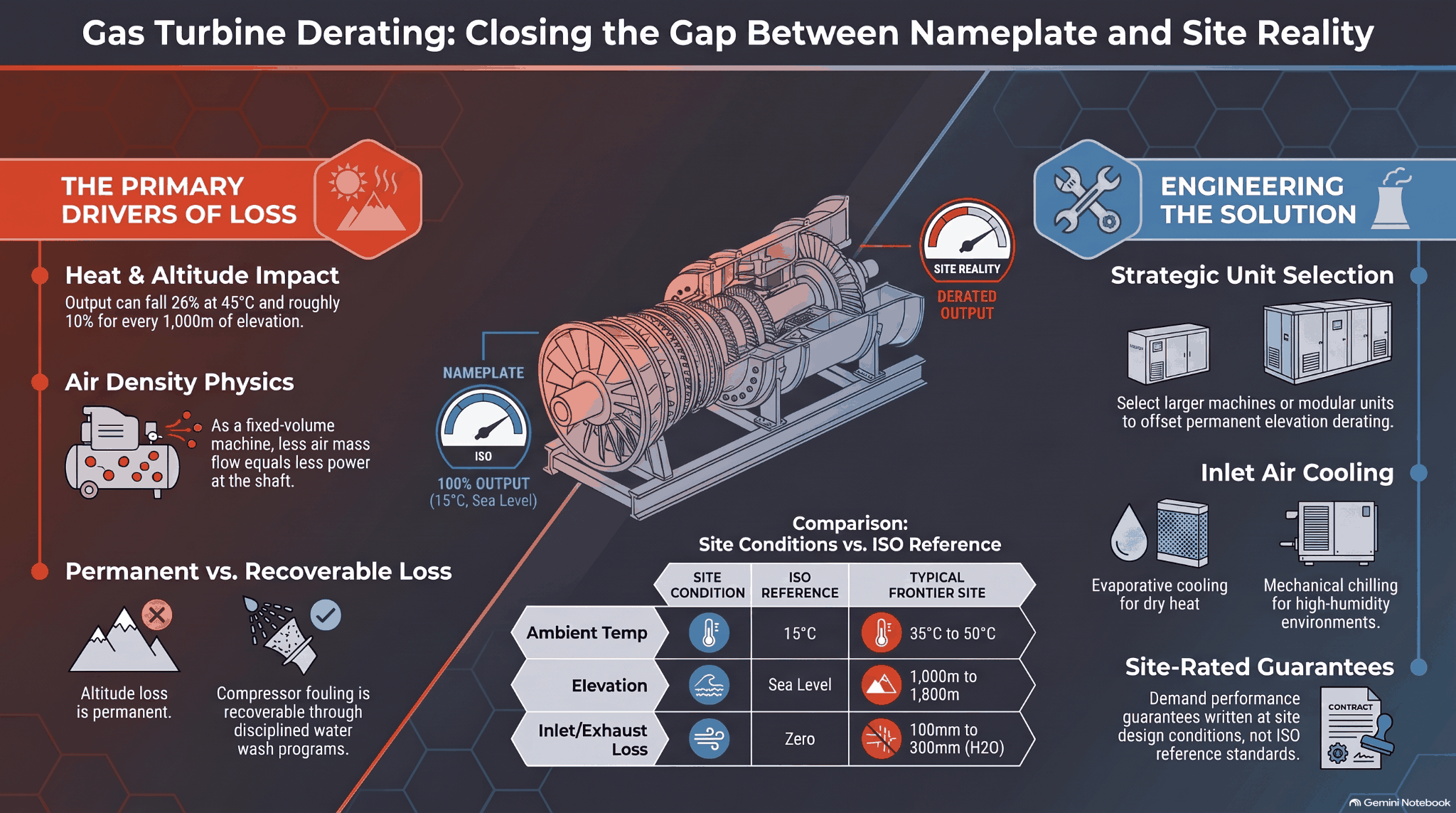
Gas turbine derating is the reduction in usable electrical output that occurs when a machine operates at conditions different from its reference rating. Manufacturers publish output at ISO reference conditions defined in ISO 3977-2: an ambient temperature of 15 degrees Celsius, sea level ambient pressure of 101.325 kPa, 60 percent relative humidity, and zero inlet and exhaust pressure losses.
Almost no real installation matches that. A gas turbine is a fixed volume machine. It draws a constant volumetric flow of air, so the mass of air it ingests falls whenever air density falls. Hot air is less dense. Air at altitude is less dense. Humid air is less dense than dry air at the same temperature and pressure. Less mass flow through the compressor means less power at the shaft.
|
Site Condition |
ISO Reference |
Typical Frontier Site |
Direction of Gas Turbine Derating |
|
Ambient temperature |
15 degrees Celsius |
35 to 50 degrees Celsius |
Output falls |
|
Site elevation |
Sea level |
0 to 1,800 metres |
Output falls with elevation |
|
Ambient pressure |
101.325 kPa |
82 to 101 kPa |
Output falls with pressure |
|
Relative humidity |
60 percent |
10 to 95 percent |
Minor effect, varies |
|
Inlet and exhaust losses |
Zero |
100 to 300 mm water column |
Output falls |
The altitude correction is the most predictable of these. Output scales approximately with the ratio of site ambient pressure to ISO ambient pressure, so a site at roughly 1,000 metres, where ambient pressure sits near 90 kPa, gives up in the region of 10 percent of ISO output on pressure alone. Temperature is the larger and less linear effect.
Published manufacturer comparison data illustrates the scale, showing an aeroderivative gas turbine losing close to 26 percent of net output at 45 degrees Celsius relative to ISO reference conditions. Inlet and exhaust ducting, filtration and silencing add further loss, commonly in the region of 2 percent and higher where inlet conditioning equipment is fitted. Regional demand data published by the International Energy Agency and country level capacity data from the World Bank show that the fastest growing thermal generation markets are concentrated in exactly the hot and high locations where these corrections bite hardest.
Key Drivers of Gas Turbine Derating: Why the Correction Cannot Be Deferred
Five mechanisms drive the difference between nameplate and site rated output. Each is engineered around differently, and each carries a different cost.
- Ambient temperature. This is the dominant variable on most frontier sites. As inlet air temperature rises above 15 degrees Celsius, air density and therefore compressor mass flow fall, and both output and thermal efficiency decline. The magnitude is machine specific and must be taken from the manufacturer’s performance curves rather than a rule of thumb, because aeroderivative and heavy frame machines behave differently. Aeroderivative units are generally more temperature sensitive than heavy frame units.
- Site elevation. Ambient pressure falls with altitude, and output falls with it in close to direct proportion. Unlike temperature, altitude is constant, permanent and cannot be engineered away. It can only be designed for by selecting a larger machine or more units. Renewable and thermal capacity datasets published by IRENA show how much of the world’s new industrial generation is being built at elevation, where this correction is permanent.
- Inlet and exhaust pressure losses. Filtration, silencers, ducting, evaporative coolers and heat recovery equipment all impose pressure drop. Every millimetre of water column costs output. Heavy dust filtration, which is mandatory on Sahelian mining sites, imposes higher loss than a benign coastal installation.
- Relative humidity. Water vapour is less dense than dry air, so high humidity reduces output modestly. The effect is small next to temperature and altitude but is not zero, and it matters for contractual performance testing in coastal and delta locations.
- Compressor fouling and degradation. Dust, salt and hydrocarbon aerosols deposit on compressor blading and progressively reduce mass flow and efficiency. This is recoverable degradation, addressed by online and offline water washing, and it is the reason a plant that met its guarantee at commissioning can fall short two years later without any hardware fault.
|
Gas Turbine Derating Driver |
Typical Magnitude |
Recoverable |
Primary Mitigation |
|
Ambient temperature above ISO |
Large, machine specific |
No |
Inlet cooling, unit oversizing |
|
Site elevation |
Roughly proportional to pressure ratio |
No |
Unit selection, added units |
|
Inlet and exhaust losses |
Approximately 2 percent and above |
Partly |
Low loss filtration design |
|
Relative humidity |
Small |
No |
Design margin |
|
Compressor fouling |
Progressive over run hours |
Yes |
Water wash programme |
Government and development finance capacity planning documents, including the energy sector work published by the African Development Bank, consistently assume site corrected capacity rather than nameplate. Lenders do the same. A financial model built on ISO output will not survive independent engineer review.
Engineering Around Gas Turbine Derating: Technical and Commercial Options
There are only four honest responses to gas turbine derating, and a competent power plant engineering team will price all of them before recommending one.
The first is to select a larger machine or add units. This is the simplest answer and often the cheapest on a lifetime basis for sites at high elevation, where the loss is permanent. Modular selection also improves part load efficiency and allows maintenance without full plant shutdown.
The second is inlet air cooling. Evaporative coolers and fogging systems reduce inlet temperature toward the wet bulb temperature and recover a useful portion of hot day output. They work well in hot dry climates such as the Sahel and inland Middle East and poorly in humid coastal conditions where the wet bulb depression is small. Mechanical chilling recovers more output across a wider range of humidity but consumes parasitic power and adds capital cost and maintenance scope.
The third is to design the plant around the actual load profile rather than the peak nameplate. Many industrial and mining loads peak at night when ambient temperature is lowest, which means the worst case derating and the worst case load do not always coincide. Establishing that requires real load data, not assumptions.
The fourth is to accept the derated figure and write the contract around it. This is the option most often skipped and the one that prevents disputes. Guarantees should be stated at site design conditions, with correction curves annexed, not at ISO.
Indicative capital cost for simple cycle gas turbine plant runs in a broad range, and honest ranges are more useful than false precision. Mobile and packaged units generally sit lower on engineering and civil scope, while installed heavy frame and combined cycle stations sit higher once balance of plant is included. Operating cost is dominated by fuel, and because derating reduces efficiency as well as output, a poorly corrected design raises cost per MWh for the life of the asset.
|
Delivery Route |
Typical Schedule to First Power |
Engineering Effort |
Best Fit |
|
Mobile packaged gas turbine |
Approximately 3 to 6 months |
Low to moderate |
Bridge power, urgent grid support |
|
Used and surplus units from inventory |
Approximately 6 to 12 months |
Moderate |
Fast-track industrial and mining loads |
|
New build simple cycle |
Approximately 18 to 30 months |
High |
Utility scale, long horizon projects |
|
New build combined cycle |
Approximately 30 to 48 months |
Very high |
Baseload where lifecycle cost dominates |
Fuel Type Comparison for Gas Turbine and Engine Power Projects
|
Fuel Type |
CapEx |
OpEx |
Lead Time |
Best Application |
|
Natural gas turbine |
Moderate |
Low to moderate |
Moderate |
Pipeline gas or LNG available, large blocks |
|
Diesel or distillate turbine |
Moderate |
High |
Short |
Bridge power, standby, dual fuel backup |
|
HFO reciprocating engine |
High |
Low |
Long |
Baseload where no gas exists |
|
Diesel reciprocating engine |
Low |
High |
Very short |
Small remote loads, standby duty |
|
Thermal plus solar hybrid |
Moderate to high |
Reduced fuel burn |
Moderate |
Daytime mining and industrial loads |
Selecting from an existing pool of gas turbines for sale shortens the schedule materially, because the manufacturing queue is already behind you. It does not remove the derating obligation. A used unit is corrected for site conditions exactly as a new one is, and any seller unwilling to state site rated output should be treated with caution.
Case Studies: Gas Turbine Derating and Site Rated Output in Practice
In Turkey, USP&E delivered 100 MW of prime power for Grup Impeks using four Pratt and Whitney FT8 MobilePac gas turbine packages. The requirement was inspection, testing, loading, shipping and installation in under 90 days, and the units were delivered ahead of schedule. Fast-track programmes of this kind concentrate risk in exactly the place derating errors surface, because there is no schedule float to redesign around a shortfall discovered late.
In Saudi Arabia, USP&E supported the City of NEOM construction programme with gas turbine supply. NEOM’s utilities entity ENOWA has publicly signalled requirements measured in tens of gigawatts before 2030. Tabuk Province design conditions are hot and, in places, elevated, which makes the difference between ISO and site rated output a material planning number rather than an engineering footnote.
Across USP&E’s West African portfolio, including HFO and diesel stations built for mining and utility clients in Mali, Guinea and Sierra Leone, site correction has been part of the standard scope since the first project. Full details of delivered capacity and client outcomes are set out in the USP&E project portfolio and in documented client references.
How to Select an EPC Partner Who Engineers Gas Turbine Derating Properly
- Ask for site rated output in writing, at design ambient and elevation. Any proposal quoting ISO output alone has not been engineered. This single question separates engineering firms from equipment resellers.
- Require the manufacturer’s correction curves as an annex. Rules of thumb are not acceptable for a bankable project. Temperature correction is machine specific and the curves are the only defensible basis.
- Confirm inlet and exhaust loss assumptions. Ask what pressure drop the filtration and silencing package imposes and whether that loss is already reflected in the quoted site output.
- Test whether guarantees are written at site conditions. A performance guarantee stated at ISO is unenforceable in practice, because the plant will never operate there.
- Check the load profile analysis. A partner who has asked for your hourly load data is engineering. A partner who has not is guessing.
- Evaluate inlet cooling advice sceptically. Evaporative cooling is excellent in dry heat and weak in humid heat. A partner recommending it without a wet bulb analysis is selling hardware, not solutions.
- Confirm in-house engineering headcount. USP&E carries 350 plus engineers and staff. Ask any bidder how many engineers are employed directly rather than subcontracted.
- Verify the same firm can operate what it builds. An operations and maintenance capability aligns design incentives with lifetime performance, including the water wash programme that protects against recoverable degradation.
- Check certification and record. ISO 9001:2015 and ISO 45001:2018 are the baseline for lender and insurer acceptance. USP&E has completed 150 plus projects across 35 plus countries with zero lawsuits in 25 years.
- Confirm compliance posture. FCPA and OFAC compliance protects your project and your reputation, particularly where equipment crosses multiple jurisdictions.
Frequently Asked Questions: Gas Turbine Derating
What is gas turbine derating?
Gas turbine derating is the reduction in usable output that occurs when a turbine operates at site conditions different from its ISO reference rating of 15 degrees Celsius, sea level pressure and 60 percent relative humidity. Because a gas turbine ingests a fixed volume of air, any reduction in air density reduces mass flow and therefore power. Heat, altitude, humidity and inlet pressure losses all reduce density. The corrected figure, not the nameplate, is what the plant will actually deliver.
How much output does a gas turbine lose at high ambient temperature?
The loss is machine specific and must be taken from manufacturer performance curves. Published comparative data shows aeroderivative gas turbines losing close to 26 percent of net output at 45 degrees Celsius relative to ISO conditions, with thermal efficiency also falling. Heavy frame machines are generally less temperature sensitive than aeroderivatives. No single percentage per degree applies across all models, which is why correction curves are mandatory for any bankable design.
How does altitude affect gas turbine output?
Output falls approximately in proportion to the ratio of site ambient pressure to ISO ambient pressure. A site at around 1,000 metres, where ambient pressure is near 90 kPa, gives up roughly 10 percent of ISO output on elevation alone, before any temperature correction is applied. Altitude derating is permanent and cannot be engineered away. It is addressed by selecting a larger machine or adding units.
Can inlet air cooling recover output lost to derating?
Partly, and only in the right climate. Evaporative cooling and fogging reduce inlet temperature toward the wet bulb temperature and work well in hot dry conditions such as the Sahel and inland Middle East. In humid coastal conditions the wet bulb depression is small and the recovery is limited. Mechanical chilling works across a wider range but consumes parasitic power and adds capital and maintenance cost.
Do reciprocating engines suffer the same derating as gas turbines?
Not to the same degree. Published comparative data shows reciprocating engine output falling by a much smaller margin than aeroderivative gas turbine output at high ambient temperature. This is one reason engine driven plant is often preferred for hot climate baseload where gas turbine derating would otherwise force significant oversizing. The correct choice depends on fuel availability, load profile and required block size.
Does gas turbine derating apply to used and surplus units?
Yes. A used gas turbine is corrected for site conditions in exactly the same way as a new one. Buying from existing inventory shortens the delivery schedule because the manufacturing queue is already behind you, but it does not change the physics. Any seller offering gas turbines for sale who cannot state site rated output at your design conditions should be treated with caution.
Should a performance guarantee be written at ISO or site conditions?
At site conditions, with correction curves annexed. A guarantee stated at ISO reference conditions is effectively unenforceable, because the plant will never operate at 15 degrees Celsius and sea level pressure with zero inlet losses. Independent engineers acting for lenders will insist on site referenced guarantees before financial close.
Summary: Key Takeaways on Gas Turbine Derating
- Gas turbine derating is the correction between ISO nameplate output and what a machine actually delivers at your site. It is engineering, not a discount.
- ISO reference conditions are 15 degrees Celsius, 101.325 kPa at sea level, 60 percent relative humidity and zero inlet and exhaust losses. Almost no real site matches them.
- Ambient temperature is usually the dominant driver, and aeroderivative machines are generally more temperature sensitive than heavy frame machines.
- Altitude derating scales roughly with ambient pressure ratio, is permanent, and can only be answered by machine selection or additional units.
- Inlet and exhaust pressure losses commonly cost around 2 percent and above, and heavy dust filtration on mining sites costs more.
- Compressor fouling is recoverable degradation and is managed through a disciplined water wash programme under a competent O&M contract.
- Demand site rated output in writing, correction curves as an annex, and performance guarantees written at design conditions. This applies equally to new equipment and to gas turbines for sale from existing inventory.
Ready to Power Your Project? Talk to USP&E’s Engineers Free.
USP&E Global offers a complimentary 4-hour engineering consultation for qualified power station, EPC, and O&M projects. Whether you are in early feasibility or ready to mobilize, our team of 350+ engineers across 35+ countries is ready to guide your project to success with speed and without excuses.
USP&E Global. Powering Possibility. Built for the Frontier.
ISO 9001:2015 | ISO 45001:2018 | 150+ Projects | 35+ Countries | Zero Lawsuits
Quick Links:
- Contact USP&E by clicking on this link.
- Request a fast equipment quote
Global Resources
- USP&E's Project Experience Portfolio
- USP&E Case Studies and Client Reference Letters
- USP&E Integrity and Compliance policy
- USP&E's ISO Certifications and Credentials