

Balance of Plant in Power Generation: The Hidden 60 Percent of Every Power Station EPC Project
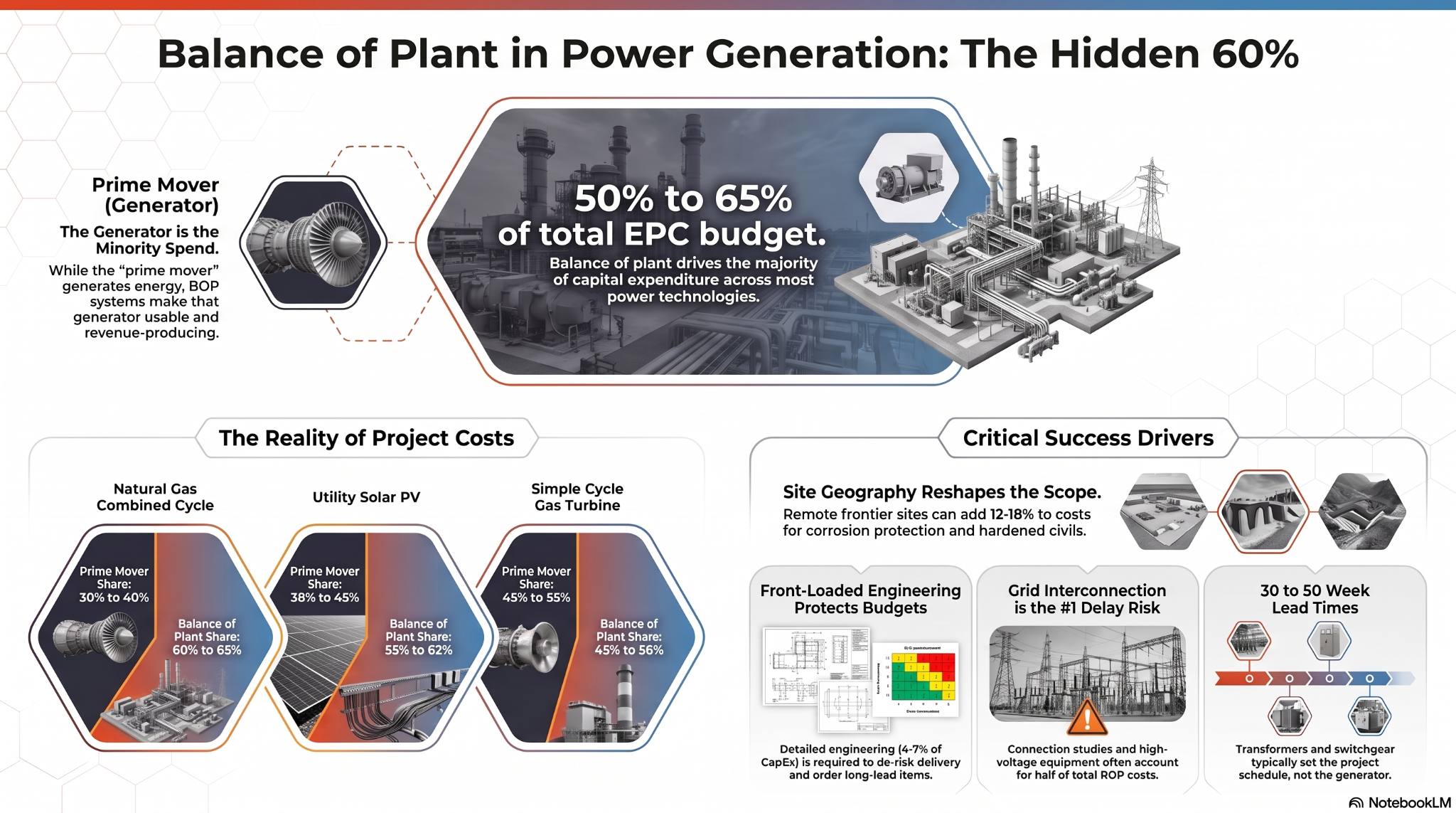
Most buyers price a power station by its engines or turbines. That is the single most expensive mistake in energy procurement. On a natural gas combined cycle project, the prime mover accounts for as little as 35 percent of installed cost, while balance of plant in power generation drives the remaining 50 to 65 percent of the budget, the schedule, and the risk. When a project runs late or over budget, the cause is almost never the turbine. It is the switchgear that arrived out of specification, the transformer with a 40 week lead time, the grid interconnection study that no one commissioned, or the civil works that flooded in the first rainy season. Your project is the hero of this story. USP&E has spent 25 years as the guide that keeps the hidden 60 percent from sinking it, delivering 150+ projects across 35+ countries without a single lawsuit.
What Balance of Plant in Power Generation Actually Means
Balance of plant in power generation refers to every system, component, and construction activity required to turn a bare generating unit into a functioning, grid connected, revenue producing power station. The prime mover, whether a gas turbine, an HFO engine, a diesel genset, or a solar array, generates the energy. Balance of plant, commonly abbreviated BOP, is everything else. It is the electrical infrastructure, the fuel handling, the cooling, the civil works, the control systems, and the grid interconnection that make the generator usable.
The term matters because it exposes the true scope of a power project. A turbine sitting on a truck is not a power station. It becomes one only when balance of plant equipment surrounds it, connects it, protects it, and ties it to a load. Industry cost studies confirm the scale of this reality. For natural gas combined cycle plants, BOP represents roughly 65 percent of total project cost, covering the heat recovery steam generator, steam turbine, condenser, cooling systems, and all connecting electrical infrastructure. For simpler combustion turbine plants without a steam cycle, BOP still accounts for around 50 percent. For utility solar, balance of plant can reach 60 percent or more of capital expenditure while the modules themselves make up the smaller share. Authoritative energy bodies such as the International Energy Agency and the U.S. Energy Information Administration track these installed cost structures across technologies, and the pattern holds worldwide: the generator is the minority of the spend.
The Core Definitions Every Buyer Should Know
- BOP (Balance of Plant): All auxiliary systems beyond the prime mover needed to produce and deliver power.
- EPC (Engineering, Procurement, Construction): The turnkey delivery model under which a single contractor engineers, buys, and builds the entire plant, BOP included.
- O&M (Operations and Maintenance): The long term service model that keeps the plant, and its balance of plant systems, running at guaranteed availability.
- CapEx and OpEx: Capital expenditure is the one time build cost. Operating expenditure is the recurring cost of fuel, parts, and labour over the plant life.
The table below breaks the balance of plant into its major subsystems, so buyers can see exactly where the hidden 60 percent lives.
|
Balance of Plant Subsystem |
What It Covers |
Why It Matters |
|
Electrical infrastructure |
Transformers, switchgear, protection, cabling |
Usually the largest single BOP line item |
|
Grid interconnection |
Connection studies, relays, high voltage tie in |
The top schedule and delay risk |
|
Fuel system |
Storage, treatment, delivery, metering |
Engineered to each site fuel specification |
|
Cooling and exhaust |
Radiators, condensers, stacks, HRSG |
Sized to ambient temperature and duty cycle |
|
Control and SCADA |
Instrumentation, automation, monitoring |
Enables safe operation and O&M performance |
|
Civil works |
Foundations, roads, drainage, buildings |
Dictated entirely by site geography |
The Data: How Balance of Plant Costs Break Down by Technology
The direct answer is that balance of plant is the largest single cost bucket in almost every thermal and renewable power project. The table below shows how the prime mover share and the BOP share shift by technology, based on published installed cost studies and USP&E field experience.
|
Power Station Type |
Prime Mover Share of Cost |
Balance of Plant Share |
Primary BOP Cost Drivers |
|
Natural gas combined cycle |
30 to 40 percent |
60 to 65 percent |
HRSG, steam turbine, condenser, cooling, grid tie |
|
Simple cycle gas turbine |
45 to 55 percent |
45 to 50 percent |
Transformers, switchgear, fuel gas system, civils |
|
HFO reciprocating engine |
35 to 45 percent |
55 to 65 percent |
Fuel treatment, exhaust, class four piping, civils |
|
Diesel genset (containerised) |
55 to 70 percent |
30 to 45 percent |
Cabling, switchgear, fuel farm, foundations |
|
Utility solar PV |
38 to 45 percent |
55 to 62 percent |
Substation, inverters, racking, roads, collection |
These ranges reflect fully installed EPC scope. Site conditions move any specific project inside or outside the bands. A flat site next to an existing substation carries far lower balance of plant cost than a remote frontier site that needs 22 kilometres of new access road, hardened civils for dust and heat, and a dedicated high voltage substation. The World Bank energy data platform and IRENA both document how logistics, terrain, and grid distance drive installed cost variation across regions, which is exactly where balance of plant scope expands or contracts.
Key Drivers of Balance of Plant in Power Generation: Why It Decides Project Success
The reason balance of plant in power generation makes or breaks a project comes down to a handful of drivers that buyers routinely underestimate. Understanding them is the difference between a plant that energises on schedule and one that stalls for a year.
- Grid interconnection is the top delay risk. Interconnection equipment, protection relays, and the connection studies behind them are among the most technically complex and delay prone parts of any EPC project. On some projects, grid connection alone can approach half of total balance of plant cost. It cannot be rushed and it cannot be skipped.
- Long lead electrical equipment sets the schedule. High voltage transformers, medium voltage switchgear, and specialised protection systems can carry lead times of 30 to 50 weeks. The turbine may be in stock, but the plant cannot commission until the last transformer arrives, is installed, and is tested.
- Fuel systems are unique to every site. HFO plants require heated storage, centrifuging, treatment, and heavy class four welded piping that can consume 10,000 to 30,000 man hours. Natural gas plants require compression and metering. Each fuel system is engineered to the specific fuel specification and cannot be copied from another site.
- Civil works are dictated by geography. Foundations, grading, drainage, and access roads depend entirely on soil, seismicity, flood risk, and remoteness. Frontier sites in the Sahel or coastal West Africa often add 12 to 18 percent to balance of plant cost for corrosion protection and hardened construction.
- Ambient and local content rules reshape scope. High ambient temperatures force larger cooling and derated ratings. Local content requirements dictate which portions of balance of plant must be sourced or built in country.
The table below shows why front loaded engineering protects the balance of plant budget.
|
Engineering Path |
Typical Upfront Cost |
Effect on BOP Budget |
Effect on Schedule |
|
No conceptual engineering |
0 USD |
Overruns of 20 percent or more common |
Delays of 6 to 12 months typical |
|
Conceptual design study |
150,000 to 350,000 USD |
BOP scoped and priced early |
Long lead items ordered on time |
|
Full detailed engineering |
4 to 7 percent of CapEx |
BOP fully specified and de-risked |
Bankable, predictable delivery |
EPC and O&M Solutions: Engineering the Balance of Plant Correctly
The direct answer to controlling balance of plant is a single accountable EPC and O&M contractor who engineers the whole plant as one system rather than a broker who ships a generator and disappears. USP&E delivers both under one roof, which is how balance of plant risk is actually managed rather than merely quoted.
A legitimate EPC scope includes the prime mover, full balance of plant, transformers, switchgear, grid interconnection equipment, the fuel system, civil works, cabling, control systems, commissioning, training, and performance testing. It typically excludes land, permitting fees, local taxes, and fuel supply unless specifically scoped. Buyers who compare only prime mover prices are comparing a fraction of the real project. USP&E power plant engineering teams begin every project by defining balance of plant scope precisely, because a plant is never 100 percent complete off the shelf. Every site carries unique grid, fuel, and ambient conditions that dictate custom balance of plant.
Fast track delivery is possible, but only within physical limits. Containerised diesel and some mobile gas turbine solutions can energise quickly because much of their balance of plant is pre engineered. HFO stations cannot. Even when engines are in stock, HFO balance of plant requires engineering, manufacturing, civil works, and heavy welding that push commissioning to 9 to 14 months from deposit. USP&E states this honestly, because pretending otherwise is how deposits get lost. Our operations and maintenance teams then keep balance of plant systems, from switchgear to cooling, running under fixed availability guarantees, and our HFO authority page documents how this integrated model performs in the field.
Fuel Type Comparison for Power Station Balance of Plant
| Fuel Type | CapEx per kW Installed | OpEx Level | Lead Time | Best Application |
| Diesel genset | 600 to 900 USD | High fuel cost | Under 90 days | Fast track, standby, remote |
| Natural gas turbine | 700 to 1,200 USD | Low to moderate | 4 to 9 months | Baseload, data centres, utilities |
| HFO reciprocating | 900 to 1,500 USD | Moderate fuel cost | 9 to 14 months | Mining baseload, grid support |
| Solar plus diesel hybrid | 1,400 to 2,200 USD | Low fuel cost | 6 to 12 months | Remote mines, fuel reduction |
Full detailed bankable engineering typically costs 4 to 7 percent of total project CapEx, and it is a non negotiable precursor to any firm installed cost figure. Fully installed EPC projects generally fall between 900 and 1,500 USD per kW, driven by fuel type, site conditions, and balance of plant scope rather than prime mover price alone.
Case Studies: Proven Balance of Plant Results in Frontier Markets
USP&E has engineered and delivered balance of plant across some of the most demanding markets on earth, where getting the auxiliary systems right is the entire challenge. These examples reflect the integrated EPC and O&M approach documented in the USP&E project experience portfolio.
In Mali, USP&E has designed, built, and operated diesel and HFO power stations since 2006 for major gold mining clients, with a resident team of engineers and technicians managing the fuel systems, cooling, and civil infrastructure that define balance of plant performance in high ambient, high dust conditions. Reliable baseload for a producing mine depends far more on that balance of plant discipline than on the engines alone.
In Togo, USP&E operates over 50 MW of natural gas turbine driven generation, where the grid interconnection, gas handling, and electrical balance of plant were engineered to utility grade standards for continuous duty. Across USP&E case studies, integrated EPC and O&M delivery has produced measurable lifecycle savings, including a documented 66 percent cost reduction case and more than 250 million USD in cumulative fuel and operating savings for clients. Detailed outcomes are catalogued in the USP&E client references. Specific project MW figures, named client attributions, and savings percentages should be verified against current internal records before publishing.
How to Select an EPC Partner Who Masters Balance of Plant: 10 Critical Criteria
Choosing a partner to deliver balance of plant in power generation is a procurement decision that determines whether your plant runs or sits idle. Evaluate every candidate against these criteria.
- In house engineering capability. The partner must engineer balance of plant, not just supply a generator. Ask to see their power plant engineering team and process.
- Turnkey EPC and O&M under one roof. A single accountable party for both build and operation prevents the finger pointing that stalls plants when balance of plant systems fail.
- Honest lead times. A credible partner tells you HFO is not fast track and explains why. Anyone promising a full HFO plant in 90 days is misleading you.
- Transparent scope definition. The quote should itemise the full balance of plant, not just the prime mover. Vague scope is a red flag.
- Grid interconnection expertise. Confirm the partner has delivered interconnection studies and equipment, the single biggest delay risk.
- Fuel system experience with your fuel. HFO, natural gas, and diesel each demand different balance of plant. Match the partner to your fuel specification.
- Frontier logistics track record. Remote sites punish weak supply chains. Verify boots on the ground experience in comparable geographies.
- Compliance discipline. ISO 9001:2015 and ISO 45001:2018 certification, plus FCPA and OFAC compliance, protect your project and your reputation.
- Proven O&M availability guarantees. Ask whether the partner will stand behind availability with a long term service agreement covering balance of plant.
- Verifiable references. Twenty five years of delivery with zero lawsuits, across 35+ countries, is the kind of proof that separates guides from brokers.
Frequently Asked Questions: Balance of Plant in Power Generation
What is balance of plant in power generation?
Balance of plant in power generation is every system beyond the prime mover that is required to turn a generating unit into a working power station. It includes transformers, switchgear, grid interconnection, fuel handling, cooling, control systems, cabling, and civil works. On most thermal and solar projects it represents 50 to 65 percent of total installed cost. The generator alone is never a power station.
What percentage of a power plant is balance of plant?
Balance of plant typically accounts for 50 to 65 percent of total power plant cost. For natural gas combined cycle plants it reaches roughly 65 percent, for simple cycle gas turbines around 50 percent, and for utility solar it can exceed 60 percent of capital expenditure. The exact share depends on site conditions, grid distance, and fuel type. This is why pricing a project on the turbine alone is misleading.
What is included in balance of plant?
Balance of plant includes the electrical systems (transformers, switchgear, protection, cabling), the grid interconnection equipment, the fuel system (storage, treatment, and delivery), the cooling and exhaust systems, the control and SCADA systems, and all civil works such as foundations, roads, and drainage. It also covers commissioning, testing, and integration. Every one of these is engineered specifically to the site.
Why does balance of plant cause project delays?
Balance of plant causes delays because its components carry the longest lead times and the most complex engineering. High voltage transformers and switchgear can take 30 to 50 weeks to deliver, and grid interconnection studies and equipment are technically demanding and delay prone. If these are not engineered and ordered early, the plant cannot commission even when the turbine is on site. Front loaded engineering is the proven fix.
How much does balance of plant cost for a power station?
Balance of plant cost varies widely by technology and site, but it is consistently the largest cost bucket in the project. Fully installed EPC projects generally range from 900 to 1,500 USD per kW, with balance of plant driving most of that figure. Remote frontier sites can exceed 1,600 USD per kW due to hardened civils, logistics, and expedited engineering. A firm number requires a site specific engineering study.
Can balance of plant be fast tracked?
Some balance of plant can be fast tracked, but only where it is pre engineered, such as containerised diesel or certain mobile gas turbine packages. HFO and combined cycle balance of plant cannot be rushed, because they require site specific engineering, manufacturing, civil works, and heavy welding. Any vendor promising a complete HFO plant in under three months is not being honest about balance of plant reality.
Who is responsible for balance of plant in an EPC contract?
Under a turnkey EPC contract, the EPC contractor is responsible for engineering, procuring, installing, and commissioning the full balance of plant as part of a single accountable delivery. The best outcomes come when the same partner also holds the O&M contract, so balance of plant is designed for maintainability and backed by an availability guarantee. This single point of accountability is what protects the buyer.
Summary: Key Takeaways for Balance of Plant Decision-Makers
- Balance of plant in power generation is 50 to 65 percent of total project cost, not a minor add on to the generator price.
- The prime mover is the minority of the spend on almost every thermal and solar project. Pricing a plant on the turbine alone is the most common and costly procurement error.
- Grid interconnection and long lead electrical equipment are the top schedule risks in balance of plant, and both must be engineered and ordered early.
- Fuel systems and civil works are unique to every site and cannot be copied from another project.
- Front loaded engineering, at 4 to 7 percent of CapEx for full detailed design, protects the balance of plant budget and schedule.
- A single accountable EPC and O&M partner is the proven way to control balance of plant in power generation, backed by USP&E delivery of 150+ projects across 35+ countries with zero lawsuits.
Ready to Power Your Project? Talk to USP&E’s Engineers Free.
USP&E Global offers a complimentary 4-hour engineering consultation for qualified power station, EPC, and O&M projects. Whether you are in early feasibility or ready to mobilize, our team of 350+ engineers across 35+ countries is ready to guide your project to success with speed and without excuses.
USP&E Global, Powering Possibility. Built for the Frontier.
ISO 9001:2015 | ISO 45001:2018 | 150+ Projects | 45+ Countries | Zero Lawsuits
Quick Links:
- Contact USP&E by clicking on this link.
- Request a fast equipment quote
Global Resources
- USP&E's Project Experience Portfolio
- USP&E Case Studies and Client Reference Letters
- USP&E Integrity and Compliance policy
- USP&E's ISO Certifications and Credentials