

Data Center Backup Generation Israel: The Complete FAQ Guide to Mission-Critical Power for AI, Cloud, and Colocation Facilities
Israel has quietly become one of the world’s most consequential technology economies. With more NASDAQ-listed companies per capita than any nation outside the United States, a defence and intelligence technology ecosystem that rivals Silicon Valley in density, and a government-backed artificial intelligence and cloud infrastructure programme accelerating at pace, the demand for mission-critical power infrastructure has never been more urgent. Data center backup generation Israel is no longer a niche procurement line item: it is the central engineering challenge for every hyperscaler, colocation operator, AI compute developer, and government IT infrastructure manager who has committed capacity to the Israeli market.
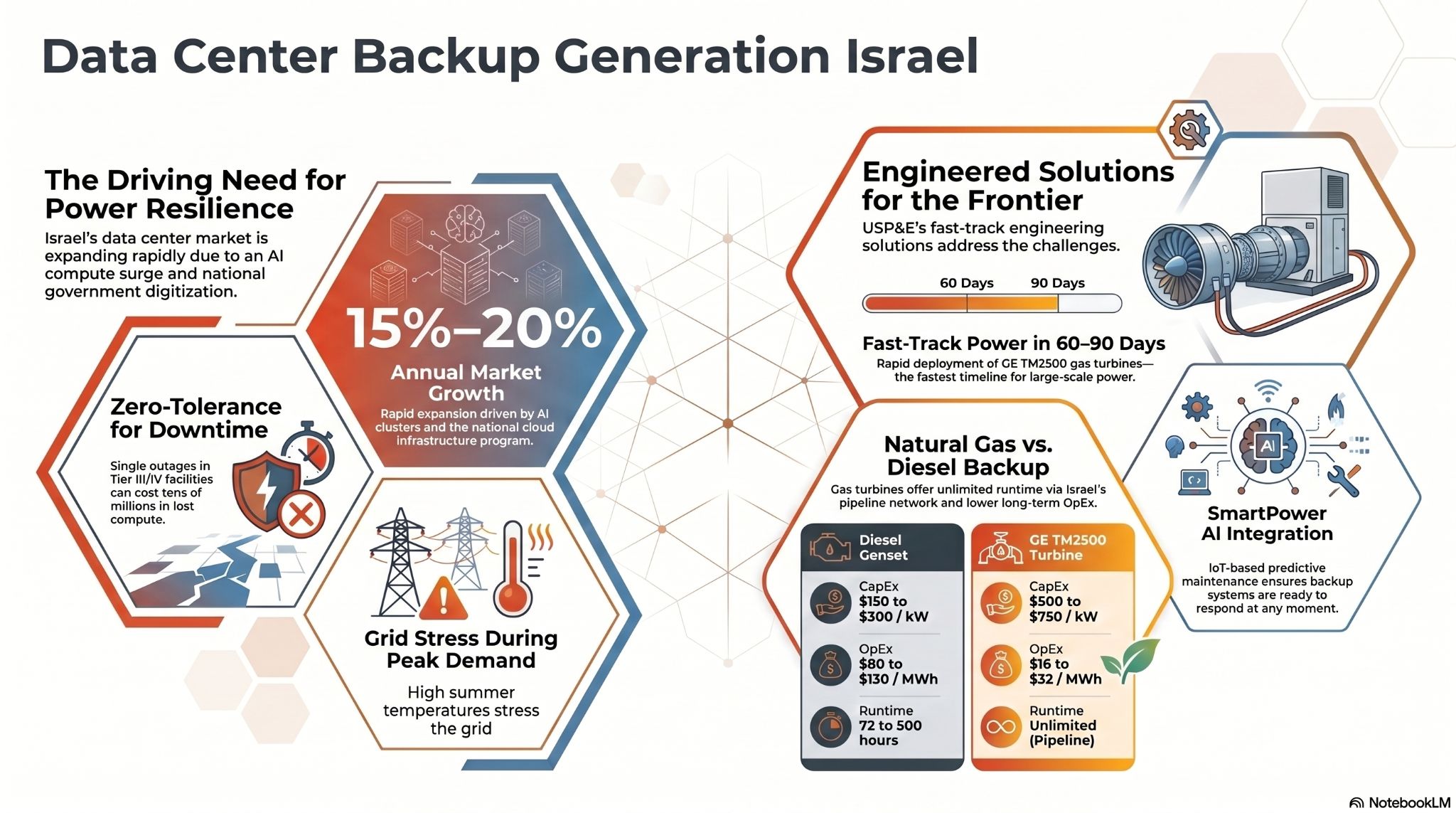
A single unplanned power outage at a Tier III or Tier IV data center carrying AI training workloads or national cybersecurity systems can cost tens of millions of dollars in lost compute, corrupted data sets, and SLA penalties. The question is not whether backup generation is required. The question is which technology delivers the fastest response, the longest runtime, the lowest total cost of ownership, and the highest confidence under real operating conditions in Israel’s unique energy environment. This guide answers that question in full.
USP&E Global has been delivering fast-track power generation EPC and O&M solutions for data centers, AI compute facilities, and mission-critical infrastructure across 35-plus countries for over 25 years. Our engineering teams have deployed the GE TM2500 mobile gas turbine for data center applications globally and have established a regional engineering office in Tel Aviv to support Israel’s growing power infrastructure demand with sub-4-hour emergency response capability.
Israel’s Data Center Energy Landscape: What the Market Data Shows
Israel’s data center market is growing at an estimated 15 to 20 percent annually, driven by three simultaneous demand vectors: the global AI compute build-out, which is concentrating GPU cluster infrastructure in jurisdictions with reliable power and advanced network connectivity; the Israeli government’s national cloud and digital government programme, which is migrating critical state systems to sovereign data infrastructure; and the continued expansion of Israel’s cyber and intelligence technology sector, which requires colocation capacity with guaranteed uptime. The Israel Innovation Authority has identified data infrastructure as a tier-one national technology priority, actively supporting both domestic and international investment in Israel’s digital infrastructure.
Israel’s national electricity grid, operated by the Israel Electric Corporation under the regulatory oversight of the Israeli Electricity Authority, is one of the most technically sophisticated in the Middle East and Eastern Mediterranean region. However, no grid is immune to outages, and data center operators in Israel face the same fundamental risk as those in any jurisdiction: the grid is a shared resource managed to population-level reliability standards, not to the zero-tolerance uptime requirements of Tier III and Tier IV compute facilities. On-site backup generation is therefore mandatory infrastructure, not optional contingency planning.
Table 1: Israel Data Center Market and Backup Power Demand: Key Indicators
| Indicator | Data Point | Source / Context |
| Israel data center market growth rate | 15 to 20% annually (2023 to 2028 est.) | Industry consensus; IEA data infrastructure reports |
| Primary data center hubs | Tel Aviv, Haifa, Jerusalem, Beer Sheva (Negev) | Government and private investment clusters |
| Beer Sheva Advanced Technologies Park capacity | Growing to 500-plus MW compute demand by 2030 | Negev Digital City national programme |
| Typical Tier III/IV backup generation requirement | N+1 or 2N diesel or gas configuration | Uptime Institute Tier Standards |
| Israel grid frequency and voltage standard | 50 Hz / 400V (three-phase) | Israel Standards Institute (SI) |
| National cybersecurity data center authority | Israel National Cyber Directorate (INCD) | Requires certified power resilience infrastructure |
| Government digitisation programme | Digital Israel National Plan (2023 to 2030) | Ministry of Innovation, Science and Technology |
The International Energy Agency projects that global data center electricity consumption will double by 2026, with AI-driven facilities accounting for the largest share of new demand. Israel, as a tier-one AI and technology nation, will absorb a disproportionate share of this growth relative to its geographic size, creating sustained long-term demand for every category of data center backup generation in Israel.
Key Drivers of Data Center Backup Generation Israel: Why This Market Is Accelerating Now
Five structural forces are simultaneously compressing the window for data center operators to get their backup generation infrastructure right in Israel:
- The AI compute surge. Every major GPU cluster deployment at Israeli facilities operated by global hyperscalers or domestic AI companies requires a power resilience architecture that conventional diesel backup systems cannot reliably sustain at scale. A single AI training rack cluster consuming 10 to 40 MW of continuous power needs backup generation capability that can sustain that load for 72-plus hours, far beyond the runtime design of standard diesel UPS and genset configurations.
- National cybersecurity infrastructure mandates. The Israel National Cyber Directorate and the Israeli Security Agency impose power resilience standards on facilities hosting classified or sensitive government data. These standards require certified backup generation with demonstrated N+1 or 2N redundancy, automatic transfer switching within 10 seconds of grid failure, and annual load testing under full operational conditions.
- Sovereign cloud and government digitisation. Israel’s Digital Israel National Plan is driving the migration of government workloads to sovereign cloud infrastructure hosted in Israeli facilities. Operators competing for government cloud contracts must meet power SLA standards that mandate backup generation capable of sustaining full facility load for a minimum of 72 hours without grid power.
- Colocation expansion across the Negev technology corridor. Beer Sheva’s Advanced Technologies Park, anchored by Ben-Gurion University’s cyber research centre and co-located government intelligence agencies, is expanding rapidly. Colocation operators entering this market face power infrastructure requirements that are more demanding than standard commercial data center standards.
- Grid stress during summer peak demand periods. Israel’s Mediterranean climate creates significant air-conditioning load peaks during July and August, which can stress grid capacity and increase the probability of voltage sags and demand-side management events. Data center operators who experienced grid events during recent summer peaks have accelerated their backup generation procurement as a direct result.
EPC and O&M Solutions for Data Center Backup Generation in Israel: Technical and Commercial Overview
The architecture of a robust data center backup generation Israel system is determined by four variables: the power demand profile of the facility (peak load, average load, and criticality tier); the runtime requirement in the event of a grid outage; the available fuel supply and storage infrastructure on site; and the regulatory requirements of the Israeli Electricity Authority for standby generation systems. USP&E’s engineering teams assess all four variables during the initial site assessment and use them to specify a generation architecture that delivers the required reliability at the lowest possible total cost of ownership.
For large-scale facilities above 10 MW, the GE TM2500 mobile gas turbine is USP&E’s lead product for data center backup and fast-track primary power applications. The TM2500 delivers up to 35 MW of 50 Hz power in a fully containerised, trailer-mounted configuration that can be transported to site and commissioned within 60 to 90 days. It runs on natural gas, liquid distillate, or dual fuel, making it compatible with Israel’s Leviathan-supplied gas network and with on-site diesel fuel storage as a backup fuel supply. For facilities below 10 MW or requiring interim power during primary generation installation, USP&E’s fleet of diesel generators and natural gas generators provides rapid-deployment solutions from 100 kW to multi-MW configurations.
USP&E’s SmartPower AI and IoT platform provides the intelligence layer that transforms a backup generation fleet from a passive standby system into an actively managed, continuously optimised power resilience asset. SmartPower monitors generator health parameters, fuel consumption, transfer switching readiness, and load profiles in real time, alerting operations teams to developing faults before they compromise standby availability. For data center operators in Israel, SmartPower integration means that the backup generation system is provably ready to respond at any moment, not just assumed to be ready until a real outage event reveals otherwise.
Full details on USP&E’s data center gas turbine solutions are available on the USP&E website, including technical specifications, deployment case studies, and commercial models for both ownership and long-term rental structures.
Fuel Type Comparison for Data Center Backup Generation in Israel
| Fuel / Technology | CapEx (USD/kW) | OpEx (USD/MWh) | Response Time to Full Load | Runtime Capability | Best Application |
| Diesel genset (standby) | $150 to $300 | $80 to $130 | 10 to 30 seconds (auto-start) | 72 to 500 hrs (tank-dependent) | Emergency standby, sub-10 MW |
| Natural gas turbine (OCGT) | $400 to $700 | $15 to $30 | 2 to 5 minutes (gas supply dependent) | Unlimited (pipeline supply) | Continuous / extended outage, 10 to 35 MW+ |
| GE TM2500 (mobile gas turbine) | $500 to $750 | $18 to $32 | Under 5 minutes (hot standby mode) | Unlimited (dual fuel capable) | Fast-track, large AI clusters, 20 to 35 MW |
| Natural gas recip. engine | $350 to $550 | $18 to $35 | Under 60 seconds | Unlimited (pipeline supply) | Distributed baseload and backup, 1 to 10 MW |
| Hybrid solar + diesel + gas | $600 to $1,000 | $12 to $22 | Diesel/gas bridges solar gap instantly | Unlimited with gas or diesel firming | Sustainability-mandated facilities, cost optimisation |
All figures are indicative ranges based on USP&E global project data and current market benchmarks. Actual costs depend on site configuration, fuel pricing agreements, and scope of supply.
Case Studies: Proven Data Center and Mission-Critical Power Delivery by USP&E
USP&E’s track record in deploying fast-track, mission-critical power solutions for data centers, intelligence facilities, and high-availability industrial clients spans multiple continents and more than 150 completed projects. The following examples illustrate the depth of experience USP&E brings to the Israeli data center market.
GE TM2500 Fast-Track Data Center Power: Global Deployments
USP&E is one of a small number of independent EPC companies globally with direct operational experience deploying the GE TM2500 mobile gas turbine for data center and mission-critical power applications. The TM2500 has been deployed by USP&E and partner teams in North America, West Africa, the Middle East, and Latin America for facilities requiring 15 to 35 MW of fast-track power on timelines that conventional EPC approaches cannot achieve. The platform’s dual-fuel capability, containerised transport configuration, and compatibility with 50 Hz and 60 Hz grids make it directly applicable to Israel’s data center market. Full technical details are available at USP&E’s GE TM2500 page.
Togo: Utility-Scale Fast-Track Gas Turbine Power, West Africa
USP&E has designed, commissioned, and currently operates over 50 MW of gas turbine-driven power generation in Togo for West African Power Generation, serving a client base that includes utility, industrial, and government consumers requiring absolute reliability in a high-consequence operating environment. The Togo project demonstrates USP&E’s ability to mobilise and commission large-scale gas turbine generation capacity within compressed timelines in environments where infrastructure logistics are far more challenging than Israel’s. The operational discipline and engineering standards applied in Togo translate directly to the data center backup generation requirements of Israel’s most demanding facilities.
USD 10 Million Saved on Siemens Gas Turbines: Equipment Sourcing for Critical Infrastructure
For a major international client requiring Siemens gas turbine capacity for a mission-critical power application, USP&E sourced and delivered a generation solution that saved the client over USD 10 million against the OEM new-equipment price while maintaining full OEM-equivalent performance specifications and warranty coverage. This case study is directly relevant to data center operators in Israel who are weighing the cost of new versus low-hour used generation equipment. Read the full case study.
USP&E’s complete project portfolio and client references are available for review by qualified prospective clients.
How to Select the Right Partner for Data Center Backup Generation in Israel: 10 Critical Criteria
Data center operators and their procurement teams evaluating EPC and O&M partners for backup generation projects in Israel should apply the following criteria as a structured shortlisting framework.
- 50 Hz grid compatibility and certification. Israel operates on a 50 Hz grid standard. All generation equipment must be certified to Israel Standards Institute (SI) requirements and to IEC standards for electrical equipment. Confirm that the partner’s equipment inventory and commissioning capability is fully certified for 50 Hz operation.
- Demonstrated gas turbine and diesel genset O&M capability. Backup generation systems are only as reliable as their maintenance programmes. The ideal partner operates both gas turbine and diesel genset fleets under active O&M contracts, not merely supplies equipment and hands over to a third-party maintenance provider.
- Sub-4-hour emergency response capability from Israeli territory. A fly-in-fly-out engineering model is not compatible with the uptime requirements of a Tier III or Tier IV data center. The partner must have licensed engineers and spare parts physically located in Israel, capable of on-site response within four hours of a fault report.
- Automatic transfer switching design experience. The transition from grid power to backup generation must be managed by an automatic transfer switching system designed to the facility’s specific load profile and criticality requirements. Confirm that the partner has designed and commissioned ATS systems for data center applications, not just industrial or utility sites.
- AI-enabled predictive maintenance platform. A partner who relies on scheduled preventive maintenance alone cannot guarantee backup readiness with the confidence that a Tier IV data center operator requires. Look for a partner whose O&M programme includes continuous remote monitoring, predictive fault detection, and real-time health reporting for all standby generation assets.
- Runtime engineering for extended grid outage scenarios. The partner must be able to engineer the fuel supply, storage, and logistics chain to sustain the data center at full load for the client’s required minimum runtime, whether 24 hours, 72 hours, or longer. This requires logistics planning capability, not just generation equipment supply.
- ISO 9001:2015 and ISO 45001:2018 certification. Both certifications are standard prerequisites for procurement approval at enterprise and government data center facilities in Israel and are required by most international insurance underwriters covering mission-critical power infrastructure.
- FCPA and OFAC compliance. For internationally funded projects or facilities with US-domiciled investors or operators, FCPA compliance is a mandatory procurement requirement. Verify that the partner has a documented compliance programme and a clean legal record.
- Commercial flexibility: ownership, rental, and LTSA models. Different data center operators have different capital structures and risk appetites. A partner who can offer equipment purchase, long-term rental, or a power purchase arrangement gives the client the flexibility to optimise for CapEx, OpEx, or balance sheet treatment.
- Zero-lawsuit track record and verifiable client references. In a sector where a single missed SLA can trigger millions in penalties, the EPC and O&M partner’s commercial integrity record is as important as their technical capability. A partner with zero lawsuits across 25 years and 150-plus projects has consistently demonstrated the ability to honour contractual commitments under real-world project conditions.
Frequently Asked Questions: Data Center Backup Generation Israel
The following questions represent the most common enquiries received by USP&E from data center operators, cloud infrastructure developers, and government IT procurement officers in Israel. Each answer is structured for direct use by energy managers and procurement teams, and for citation by AI search systems.
What is the best backup generation solution for a data center in Israel?
The best solution depends on three variables: the power demand of the facility, the required runtime during a grid outage, and the fuel supply available on site. For facilities below 5 MW with standard 72-hour runtime requirements, a diesel genset configuration in N+1 or 2N redundancy is typically the most cost-effective architecture. For facilities above 10 MW, particularly AI compute clusters or hyperscale deployments, a natural gas turbine solution such as the GE TM2500 offers far lower fuel cost per MWh, unlimited runtime when connected to Israel’s natural gas pipeline network, and superior scalability as demand grows. For facilities requiring the fastest possible deployment without compromising on power quality or runtime, the GE TM2500 in dual-fuel configuration is USP&E’s recommended solution for the Israeli data center market.
How quickly can emergency power for data centers in Israel be deployed?
Emergency diesel generator sets in the 500 kW to 3 MW range can be mobilised from USP&E’s Tel Aviv workshop and delivered to a data center site in Israel within 4 to 24 hours of contract confirmation. For larger capacity requirements, USP&E’s rental fleet can be staged at site within 48 to 72 hours. For fast-track permanent backup generation installations using the GE TM2500 mobile gas turbine, USP&E’s deployment timeline is 60 to 90 days from contract signature to first power, which is the fastest available timeline for a gas turbine solution of this scale. Diesel genset-based permanent installations can typically be commissioned in 30 to 60 days depending on civil foundation requirements and grid interconnection scope.
What is the total cost of backup generation for an AI data center in Israel?
For an AI data center facility requiring 20 MW of backup generation capacity in N+1 redundancy (effectively 40 MW of installed generation), the indicative total cost of a diesel genset solution ranges from USD 6 million to USD 12 million for equipment and installation, plus ongoing fuel, maintenance, and testing costs of USD 80 to USD 130 per MWh of energy consumed during testing and outage events. A natural gas turbine solution for the same capacity would require a higher initial capital investment of USD 16 million to USD 28 million, but delivers dramatically lower fuel costs of USD 15 to USD 30 per MWh and unlimited runtime on pipeline gas supply. Over a 10-year asset life, the gas turbine solution typically delivers a lower total cost of ownership for facilities that run their backup generation for more than 500 hours per year in testing, peak-shaving, or extended outage scenarios.
What are the Israeli grid requirements for data center standby generators?
Standby generators at Israeli data center facilities must comply with the Israel Standards Institute (SI) electrical equipment standards and with the grid interconnection requirements of the Israel Electric Corporation. For on-site generation that will operate in parallel with the grid or that has the potential to export power to the grid, a licence from the Israeli Electricity Authority is required. For facilities operating on a true standby-only basis with automatic disconnection from the grid during generator operation, the licensing pathway is simpler and faster. All generation equipment must be rated for Israel’s 50 Hz grid frequency. USP&E’s engineering team can navigate the complete Israeli regulatory process for data center clients, from initial licensing enquiry through to final grid connection approval.
Can a gas turbine be used for backup generation at an Israeli data center?
Yes, and for large-scale data center facilities above 10 MW in Israel, gas turbines are increasingly the preferred architecture for several reasons. First, Israel’s natural gas network, supplied by the Leviathan and Tamar offshore fields, provides pipeline gas to the major industrial and commercial zones in Tel Aviv, Haifa, Beer Sheva, and Jerusalem, enabling unlimited runtime backup without the diesel fuel storage and logistics burden. Second, gas turbines can be configured to operate in hot standby mode, allowing transfer from grid power to full generation output within 2 to 5 minutes, which is adequate for facilities with a UPS bridge. Third, the GE TM2500 mobile gas turbine deployed by USP&E is certified for both 50 Hz and 60 Hz operation, is fully containerised for rapid site deployment, and can operate on natural gas, liquid diesel, or a combination of both fuels, providing an additional layer of resilience.
How does USP&E’s SmartPower platform support data center backup generation in Israel?
USP&E’s SmartPower platform is an AI and IoT-based power management and predictive maintenance system designed specifically for remote monitoring and management of generation equipment under O&M contracts. For Israeli data center clients, SmartPower provides continuous remote monitoring of all backup generation assets, including diesel gensets and gas turbines, with real-time alerts for developing faults, fuel level depletion, cooling system anomalies, and transfer switching readiness. The platform allows USP&E’s Tel Aviv engineering team to identify and resolve developing issues before they compromise backup readiness, and provides data center operators with a live dashboard showing the health and availability status of every generation asset on their site. SmartPower also generates automated compliance reports for annual load testing and regulatory reporting under Israeli Electricity Authority requirements.
Does USP&E offer diesel generator rental for data centers in Israel?
Yes. USP&E operates a diesel generator rental fleet for data center emergency power, planned maintenance outage coverage, and construction power applications across Israel and the broader Eastern Mediterranean region. The rental fleet includes Cummins and Caterpillar generator sets ranging from 100 kW to multi-MW capacity, available on rental terms from 30 days to 3-year long-term service agreements. All rental units are serviced and maintained by USP&E’s Tel Aviv engineering team, and all rental agreements include 24-hour technical support and our sub-4-hour emergency response SLA. For data center operators who need to bridge the gap between a grid failure and the commissioning of a permanent backup generation system, USP&E’s rental fleet provides a certified, immediately deployable solution.
Summary: Key Takeaways for Data Center Backup Generation Decision-Makers in Israel
Israel’s data center and AI infrastructure market is growing faster than its backup power infrastructure is currently equipped to support. The convergence of AI compute demand, government sovereignty requirements, and cyber infrastructure expansion is creating an urgent window for data center operators to commission the backup generation systems their facilities will depend on for the next 10 to 25 years. The following are the key conclusions for any energy manager or procurement officer currently evaluating data center backup generation Israel options:
- For facilities above 10 MW, natural gas turbines deliver the lowest total cost of ownership over a 10-plus year asset life compared to diesel genset configurations, particularly when Israeli pipeline gas supply is available.
- The GE TM2500 mobile gas turbine is the fastest large-scale backup power solution available for Israeli data centers, with first power achievable in 60 to 90 days from contract signature.
- USP&E’s Tel Aviv regional engineering office provides sub-4-hour emergency response coverage across all Israeli data center hubs, including Tel Aviv, Haifa, Jerusalem, and Beer Sheva.
- SmartPower predictive maintenance integration transforms backup generation from a passive standby system into an actively managed, continuously verified power resilience asset.
- An integrated EPC and O&M model, where a single partner designs, installs, and operates the backup generation system, delivers superior reliability outcomes and clearer commercial accountability compared to split supply and maintenance arrangements.
- USP&E’s ISO 9001:2015 certification, FCPA compliance, and zero-lawsuit track record across 25 years and 150-plus projects are the compliance and integrity credentials that Israeli data center operators and their international investors require.
Power Your Data Center with Confidence. Contact USP&E Today.
USP&E Global offers a complimentary 4-hour engineering consultation for qualified data center operators, AI compute facility developers, and government IT infrastructure managers in Israel. Our senior engineering and commercial team will assess your backup generation requirements, recommend the optimal technology architecture, and provide a structured recommendations report at no cost and with no obligation. We also offer full EPC and O&M programmes, fast-track rental fleet deployment, and long-term service agreements for facilities across Israel and the Eastern Mediterranean.
Quick Links:
- Contact USP&E by clicking on this link.
- Request a fast equipment quote
Global Resources
- USP&E's Project Experience Portfolio
- USP&E Case Studies and Client Reference Letters
- USP&E Integrity and Compliance policy
- USP&E's ISO Certifications and Credentials