

Combined Heat and Power: The Complete Cogeneration EPC Guide for Industry
A conventional power plant throws away most of its fuel energy as waste heat through the exhaust and cooling systems. For any industrial site that also needs heat, steam, or hot water, that waste is money escaping up the stack. Combined heat and power, also called cogeneration, captures that otherwise wasted heat and puts it to work, lifting total fuel efficiency from around forty percent to as high as eighty percent or more. For a factory, refinery, food processor, hospital, or district energy operator, this is one of the most powerful levers available to cut both energy cost and carbon intensity at once. This guide explains what the data shows, how cogeneration works, where it makes sense, and how an experienced engineering partner delivers it. USP&E Global engineers integrated power and heat solutions across more than 35 countries, and we act as the guide while your project remains the priority.
The Combined Heat and Power Challenge: What the Data Shows
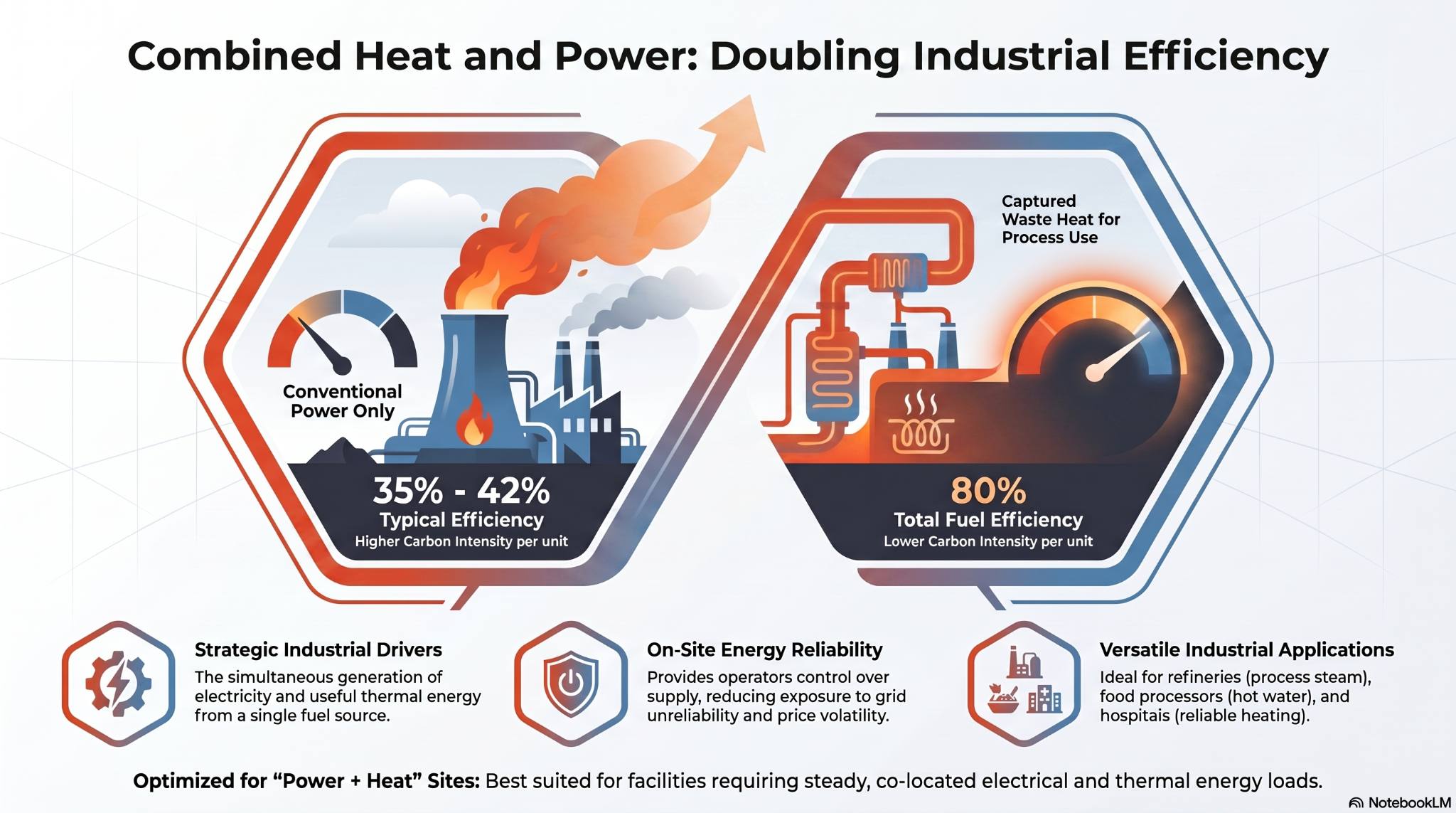
In a normal generating set, fuel is burned to produce electricity, and the heat in the exhaust and cooling circuits is simply rejected to the atmosphere. Combined heat and power recovers that heat and delivers it as useful steam, hot water, or process heat. The result is a dramatic rise in the proportion of fuel energy that does useful work, which is why cogeneration is so attractive wherever electricity and heat are needed together.
The table below contrasts conventional generation with combined heat and power.
|
Metric |
Conventional Power Only |
Combined Heat and Power |
|
Typical fuel efficiency |
Around 35 to 42 percent |
Up to 80 percent or more |
|
Waste heat |
Rejected to atmosphere |
Recovered as useful heat |
|
Best fit |
Power-only demand |
Sites needing power and heat |
|
Carbon intensity per unit useful energy |
Higher |
Lower |
Authoritative references frame the efficiency case. The United States Environmental Protection Agency documents combined heat and power efficiency and emissions benefits, the International Energy Agency tracks cogeneration in industrial energy use, and the United States Energy Information Administration covers the role of combined heat and power in the generation fleet. These sources consistently confirm that combined heat and power is among the most effective ways to raise energy efficiency at industrial sites.
Key Drivers of Combined Heat and Power: Why It Matters Now
Several forces are increasing demand for cogeneration across industrial and institutional sectors. Each one strengthens the case for evaluating it now.
- Energy cost pressure. Recovering waste heat directly reduces the fuel a site must buy for both power and thermal needs, cutting total energy cost.
- Because combined heat and power extracts far more useful energy per unit of fuel, it lowers carbon intensity per unit of output, supporting emissions targets.
- On-site cogeneration gives industrial operators control over both power and heat supply, reducing exposure to grid unreliability.
- Process heat demand. Refineries, food and beverage plants, paper mills, chemical works, and district energy systems all need heat alongside power, the exact profile cogeneration serves best.
The decision turns on the site’s heat to power ratio and the form of heat needed. The table below compares common combined heat and power applications.
|
Application |
Heat Form Needed |
Why CHP Fits |
|
Refinery and petrochemical |
Process steam |
High, steady steam and power demand |
|
Food and beverage |
Steam and hot water |
Continuous thermal and power load |
|
Hospital and campus |
Hot water and steam |
Reliable power plus heating demand |
|
District energy |
Hot water or steam network |
Serves many buildings efficiently |
A qualified power plant engineering partner models the heat to power balance and sizes the system to the site’s real demand profile.
EPC and O&M Solutions for Combined Heat and Power: A Technical and Commercial Overview
A combined heat and power system pairs a prime mover with a heat recovery system. The prime mover, usually a reciprocating gas engine or a gas turbine, generates electricity, while a heat recovery unit captures heat from the exhaust and, for engines, the cooling circuits, delivering it as steam, hot water, or process heat. Where very high steam pressures or large heat loads are involved, a heat recovery steam generator and even a steam turbine can be added, moving toward a combined cycle that further raises efficiency.
The table below sets out the core configurations.
|
CHP Configuration |
Prime Mover |
Heat Recovery |
Best Application |
|
Engine cogeneration |
Reciprocating gas engine |
Exhaust and jacket heat |
Hot water and lower pressure steam |
|
Gas turbine cogeneration |
Gas turbine |
Exhaust heat recovery steam generator |
Higher pressure process steam |
|
Combined cycle CHP |
Gas turbine plus steam turbine |
Maximised heat and power |
Large industrial and utility loads |
|
Biogas cogeneration |
Biogas engine |
Exhaust and jacket heat |
Waste to energy sites |
Matching the system to the site is the heart of good cogeneration engineering. A system sized to the electrical load may waste heat if the site cannot use it, while one sized to the heat load may need grid import or export of electricity. The right design balances both. A credible EPC construction partner engineers the prime mover, heat recovery, and integration with the site’s thermal and electrical systems as one scope.
Operations and maintenance for combined heat and power must keep both the generation and the heat recovery performing. Fouling in heat exchangers, engine maintenance, and the coordination of electrical and thermal output all require disciplined operation. A strong operations and maintenance model maintains both halves of the system under availability guarantees rather than treating heat recovery as an afterthought.
On honest economics, cogeneration carries a higher upfront cost than power only generation because of the heat recovery equipment, but it delivers a far lower cost per unit of useful energy when the heat is genuinely used. As a planning guide, fully installed distributed generation typically falls between 800,000 and 1,500,000 US dollars per megawatt of electrical capacity, with cogeneration adding heat recovery scope that pays back through fuel savings where the heat demand is real and steady. USP&E prices each configuration against the specific heat to power profile, and cogeneration integrates naturally with USP&E’s hybrid power systems capability.
Efficiency and Configuration Comparison for Combined Heat and Power
|
Factor |
Power Only |
Combined Heat and Power |
|
Useful energy per unit fuel |
Lower |
Much higher where heat is used |
|
Upfront cost |
Lower |
Higher, heat recovery added |
|
Best where |
Heat not needed |
Steady, co-located heat demand |
|
Carbon per unit useful energy |
Higher |
Lower |
Case Studies: Proven Capability Relevant to Combined Heat and Power
The most credible evidence is delivery of integrated generation and heat systems engineered to the site. USP&E engineers both power generation and heat recovery, and its record across industrial gas and steam systems is directly applicable to cogeneration.
In Iraq, USP&E delivered a 40 megawatt reciprocating engine power station for an industrial cement client, the kind of continuous industrial load where heat recovery adds substantial value. Across upstream oil and gas projects, USP&E has engineered exhaust heat and gas conditioning systems integrated with generation, demonstrating the heat recovery and integration discipline cogeneration demands. In Togo and Mali, USP&E has sustained high availability on continuous industrial and utility generation, the operating reliability a cogeneration site requires to capture its efficiency benefit.
These outcomes are documented in USP&E’s project experience and client references. The common thread is integrated engineering of power and heat, which is exactly what a combined heat and power project demands.
How to Select the Right EPC Partner for Combined Heat and Power: 10 Critical Criteria
Choosing a partner for a cogeneration project is a technical and commercial decision. These criteria help an industrial or institutional operator evaluate candidates objectively.
- Heat to power modelling. The partner must model the site’s heat and power demand to size the system correctly.
- Heat recovery expertise. Confirm experience engineering exhaust and jacket heat recovery into usable steam or hot water.
- Prime mover selection. The partner should match engine or turbine choice to the heat form and load profile.
- Integration capability. Cogeneration must integrate with the site’s existing thermal and electrical systems.
- Combined cycle option. For large steam loads, the partner should be able to add a heat recovery steam generator and steam turbine.
- Integrated EPC and O&M. A partner who builds and operates owns the efficiency and reliability outcome.
- Dual system maintenance. Operations must maintain both generation and heat recovery to sustain efficiency.
- Compliance posture. Confirm Foreign Corrupt Practices Act and Office of Foreign Assets Control compliance.
- Verify ISO 9001 quality and ISO 45001 safety certification.
- Honest payback analysis. The partner should model fuel savings against the real, sustained heat demand, not an optimistic assumption.
Evaluated against these criteria, the field of partners genuinely qualified for combined heat and power narrows considerably.
Frequently Asked Questions: Combined Heat and Power
What is combined heat and power?
Combined heat and power, also called cogeneration, is the simultaneous generation of electricity and useful heat from a single fuel source. Instead of rejecting engine or turbine exhaust heat to the atmosphere, a cogeneration system recovers it as steam, hot water, or process heat, raising total fuel efficiency from around forty percent to as high as eighty percent or more.
How efficient is combined heat and power?
Conventional power only generation typically converts around 35 to 42 percent of fuel energy into useful output, with the rest lost as heat. Combined heat and power can reach total efficiency of 80 percent or more by capturing and using that heat, provided the site has a genuine and steady demand for the recovered heat.
What sites are best suited to cogeneration?
Sites that need both electricity and heat, such as refineries, petrochemical plants, food and beverage processors, paper mills, hospitals, campuses, and district energy systems. The closer and steadier the heat demand sits to the power demand, the stronger the cogeneration case.
What equipment does a combined heat and power plant use?
It pairs a prime mover, usually a reciprocating gas engine or a gas turbine, with a heat recovery system that captures exhaust and, for engines, cooling heat. For large steam loads, a heat recovery steam generator and steam turbine can be added, moving toward a combined cycle for even higher efficiency.
Is combined heat and power more expensive than power only?
It carries a higher upfront cost because of the heat recovery equipment, but it delivers a far lower cost per unit of useful energy when the heat is genuinely used. The payback depends on having a real, steady heat demand, which is why honest heat to power modelling is essential before committing.
Does USP&E provide operations and maintenance for cogeneration plants?
Yes. USP&E offers operations and maintenance under long term service agreements that maintain both the generation and the heat recovery systems under availability guarantees, ensuring the efficiency benefit of combined heat and power is sustained over the plant’s life.
Summary: Key Takeaways for Combined Heat and Power Decision-Makers
- Combined heat and power captures the waste heat a conventional plant rejects, lifting total fuel efficiency from around forty percent to as high as eighty percent or more.
- It fits sites that need both electricity and heat, such as refineries, food processors, hospitals, campuses, and district energy systems.
- The system pairs a gas engine or turbine with heat recovery, and large steam loads can justify a heat recovery steam generator and steam turbine in a combined cycle.
- Correct sizing to the site’s heat to power balance is the heart of good cogeneration engineering and determines the payback.
- Cogeneration carries higher upfront cost but a much lower cost per unit of useful energy where the heat demand is real and steady.
- USP&E engineers integrated power and heat across 35 plus countries, bringing 150 plus projects and 350 plus engineers to combined heat and power.
Ready to Power Your Project? Talk to USP&E’s Engineers Free.
USP&E Global offers a complimentary 4-hour engineering consultation for qualified power station, EPC, and O&M projects. Whether you are in early feasibility or ready to mobilize, our team of 350+ engineers across 35+ countries is ready to guide your project to success with speed and without excuses.
USP&E Global. Powering Possibility. Built for the Frontier.
ISO 9001:2015 | ISO 45001:2018 | 150+ Projects | 35+ Countries | Zero Lawsuits
Quick Links:
- Contact USP&E by clicking on this link.
- Request a fast equipment quote
Global Resources
- USP&E's Project Experience Portfolio
- USP&E Case Studies and Client Reference Letters
- USP&E Integrity and Compliance policy
- USP&E's ISO Certifications and Credentials