

Portable Generator Market: How Global Manufacturing Growth Changes Buying Decisions
The portable generator market has changed shape in a generation. More factories, more models and more export routes mean that buyers have more choice than ever. They also have more risk, because a wide market includes products of very different quality. China’s industrial growth is a large part of that story, and it affects power buyers in every region. This guide explains what is driving the portable generator market, how to read the signals, what to budget, and how to choose a supplier who protects you from the weak end of a crowded field.
USP&E has delivered 150+ power projects in 45+ countries since 2002, with 25,000 MW contracted since 2002. USP&E holds ISO 9001:2015 and ISO 45001:2018 certification and works across equipment supply, EPC (Engineering, Procurement and Construction) and O&M (Operations and Maintenance). USP&E is more than a broker: it removes technical and commercial risk for buyers through engineering, inspection, EPC and O&M. Supply comes from USP&E’s own inventory plus equipment sourced from OEMs, IPPs, banks and asset owners. The guidance below reflects that engineering view of the portable generator market.
What Is Driving the Portable Generator Market?
The portable generator market is driven by demand for dependable power where the grid is weak, absent or interrupted. Construction sites, mines, events, telecom towers, farms and emergency services all use portable sets. Demand rises after storms and grid failures, and it rises as industry expands into places with little network capacity. Supply has grown to match, with many manufacturers competing on price, features and delivery time.
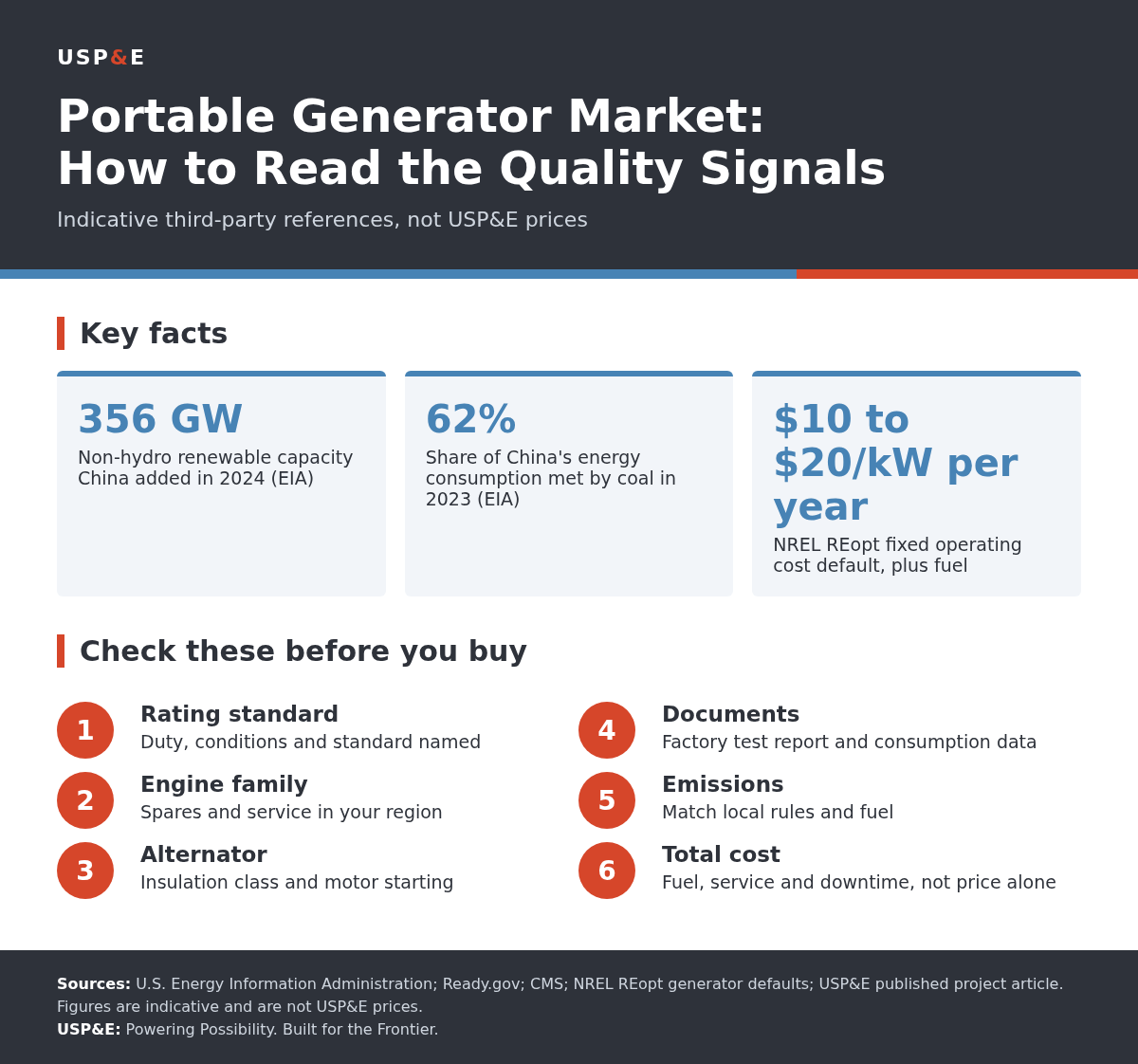
The wider energy picture shapes that demand. The U.S. Energy Information Administration reports in its China analysis that China’s economy is the world’s second largest, and that coal still supplied 62% of the energy it consumed in 2023. The same analysis shows China added 356 GW of non-hydro renewable generation capacity in 2024, of which solar accounted for 277 GW. A country that builds industry and generation at that pace also builds the supply chains that make engines, alternators and controls, and those supply chains serve buyers worldwide.
The International Energy Agency tracks the global picture in its World Energy Outlook 2025. Electricity demand is rising in many regions, and grids in some of them are under strain. Where new supply lags demand, portable and containerised sets fill the gap. That is why the portable generator market keeps growing even as renewables expand, because variable renewable output and weak networks both create a need for firm backup.
|
Portable generator market driver |
Effect on buyers |
What to do |
|
Industrial expansion |
More sites without grid capacity |
Plan onsite power early |
|
Grid instability |
More outages and load shedding |
Specify standby or prime duty correctly |
|
More manufacturers |
Wider choice and wider quality range |
Verify build quality and support |
|
Faster logistics |
Shorter delivery times |
Check that speed has not replaced testing |
|
Renewable growth |
More need for firm backup |
Pair solar or wind with thermal sets |
Reading Quality Signals in the Portable Generator Market
A crowded market rewards careful buyers. The first signal is the rating itself. A nameplate that states output without naming the standard, the duty or the conditions is a warning. Ask whether the quoted kVA or kW is standby, prime or continuous, and at what temperature and altitude. A set that is honestly rated may look weaker on paper than one with an inflated label, but it will run longer and cost less over its life.
The second signal is the engine and alternator. Established engine families have spare parts, service manuals and trained technicians in many countries. A set built around an obscure engine may be cheap on day one and impossible to repair on day four hundred. Alternator insulation class, winding quality and voltage regulation also decide how the set copes with motor starting and harmonic loads.
The third signal is documentation. Reputable suppliers provide factory test reports, datasheets that state fuel consumption at 50%, 75% and 100% load, emissions information and a clear warranty. Gaps in documentation are gaps in confidence. USP&E’s guide to industrial generator brands explains how to compare engine and alternator families without relying on marketing language.
USP&E is an independent seller and is not affiliated with any engine or generator manufacturer named by buyers during a project. Those names are trademarks of their respective owners.
|
Portable generator market quality signal |
Good sign |
Warning sign |
|
Nameplate |
States standard, duty and conditions |
Output given with no standard |
|
Engine |
Established family with regional support |
Unknown engine with no service network |
|
Alternator |
Insulation class and regulation stated |
No data on motor starting |
|
Paperwork |
Test report and consumption curve supplied |
Brochure only |
|
Seller |
Clear title and verifiable address |
Pressure to pay a deposit at once |
Quick checks for a portable generator market purchase
- Confirm the rating standard and the duty, and ask for site derating.
- Identify the engine and alternator makers and confirm local spares support.
- Request a factory test report and fuel consumption data.
- Check emissions and noise against local rules.
- Confirm warranty terms and who services the set in your region.
Regional Demand and Grid Access
Demand for portable and containerised power is strongest where grid access is limited. The World Bank publishes data on the share of people with access to electricity, and it shows large differences between regions. In places where connection is incomplete or supply is unreliable, businesses often run their own sets for hours each day. That use is hard on equipment, because sets meant for occasional use end up in near continuous service.
This pattern matters for the portable generator market because it changes the right specification. A buyer in a weak grid region should ask for a prime rating, robust cooling and a fuel system that suits long running hours. A buyer who treats the set as an occasional backup unit may be disappointed within a year. Fuel logistics, operator training and a stocked spares kit become part of the specification, not an afterthought. Sellers who ask about run hours and site conditions before quoting are usually the ones who understand the duty.
Portable Generator Market Pricing and Total Cost of Ownership
USP&E does not publish portable generator market prices, because they depend on model, rating, package and timing. Price is the most visible number in the portable generator market and often the least useful. Total cost of ownership includes fuel, service, downtime, spares and the residual value of the set. A cheaper set with higher fuel use and weak parts support can cost more over three years than a better set bought at a higher price.
For scale on larger plants, the National Renewable Energy Laboratory’s REopt model, in its published generator cost defaults, uses about $650 to $880 per kW for installed diesel generator plant, with fixed operating cost of about $10 to $20 per kW per year plus fuel. Those are model defaults for United States conditions, not quotations, and they do not describe small portable sets. They do show that fuel and operating cost sit alongside the equipment price in any serious budget.
The U.S. Energy Information Administration explains how thermal generation converts fuel to power in its guide to how electricity is generated. The same physics applies to a portable set. Fuel efficiency, load factor and maintenance quality drive cost per kilowatt-hour, and those depend on engineering, not on the label.
|
Portable generator market cost layer |
What it covers |
Risk if ignored |
|
Purchase price |
Set, frame, controls, enclosure |
Lowest price may hide a weak duty rating |
|
Fuel |
Consumption over running hours |
Fuel can exceed set cost over its life |
|
Service and spares |
Filters, oil, wear parts, labour |
No parts support means long downtime |
|
Downtime |
Cost of lost production when a set fails |
Often larger than the price difference between sets |
|
Residual value |
Resale or reuse value |
Unbranded or undocumented sets resell poorly |
Fuel Type Comparison
|
Fuel Type |
CapEx Range |
OpEx Range |
Typical Lead Time |
Best Application |
|
Petrol |
Lowest for small sets |
Highest fuel cost per kWh at small scale |
Usually short for common sizes |
Light tools and short jobs |
|
Diesel |
About $650 to $880/kW installed for larger plant (NREL REopt defaults) |
About $10 to $20/kW per year fixed, plus fuel (NREL REopt defaults) |
Varies with size and package |
Site power, backup and mining |
|
Natural gas |
Fuel often cheaper where pipeline gas is reliable |
Varies with size and package |
Fixed sites with firm gas supply |
|
|
Dual fuel |
Varies with size and package |
Sites with changing fuel supply |
Sources: NREL REopt generator defaults. Blank cells could not be verified from a comparable official source. These are not USP&E prices, and the NREL figures describe larger installed plants, not portable sets.
New vs Used Equipment in the Portable Generator Market
Used sets are part of the portable generator market, and they can offer good value when records are clear. Ask for engine hours, service history, the last overhaul and an alternator insulation test. Require a load test at the stated rating and proof of ownership or a written right to sell before any deposit. Buyers who need equipment quickly can review USP&E’s used diesel generators for sale guide and the diesel generators category.
Gas-fuelled options are also available where pipeline supply is firm, and buyers can review the natural gas generators category. A wide market also attracts bad actors. USP&E sets out the warning signs in its guide to how to spot a power plant broker scam.
Emissions rules vary by country. The U.S. Environmental Protection Agency regulates stationary engines under its stationary engines programme. Other countries set their own limits, so match the engine to the permit for the site where it will run, and do not assume that a certificate from one country covers another.
Case Studies: Portable Generator Market Lessons from Real Projects
USP&E only publishes approved case studies, and it does not name clients without permission. USP&E has delivered projects in 45+ countries, including power plant EPC projects and operations and maintenance work, and approved examples are collected on the case studies page. No outcome specific to the portable generator market is claimed here beyond what is published.
The lessons below reflect common practice, not a named project:
- Buyers who verify rating standards avoid sets that cannot carry their stated load.
- Buyers who choose established engine families can get spares and service in remote regions.
- Buyers who inspect and load test before paying avoid costly surprises on delivery.
- Buyers who judge total cost of ownership, not price alone, spend less over the life of the set.
How to Choose Within the Portable Generator Market: 10 Criteria
- Rating honesty. Confirm the standard, the duty and the site conditions behind the quoted output.
- Engine family. Prefer engines with spare parts and trained technicians in your region.
- Alternator quality. Check insulation class, voltage regulation and motor starting performance.
- Documentation. Require factory test reports, datasheets and fuel consumption data at several loads.
- Fuel and emissions. Match the engine to local fuel quality and emissions limits.
- Spares and service. Ask for a spares list and a clear plan for service in your region.
- Inspection and title. For used units, require a records audit, a load test and proof of ownership or a written right to sell before any deposit.
- Warranty. Understand what is covered, for how long, and who honours it locally.
- EPC and O&M depth. A supplier that can install, commission and maintain the plant reduces handover risk. USP&E offers O&M with 95%+ O&M availability as an official company figure.
- Contract clarity. Delivery date, tests, payment milestones and warranty should be in writing.
FAQ: Portable Generator Market
What is driving the portable generator market?
Demand comes from weak or interrupted grids, industrial expansion, construction, mining, events and emergency response. Supply has grown through more manufacturers and shorter delivery routes. As a result, the portable generator market offers wide choice, with a wide range of quality, so buyers must check ratings, engines and documentation carefully.
How do I judge the quality of a portable generator?
Check the rating standard and duty, the engine and alternator makers, and the documentation. Ask for a factory test report and fuel consumption at 50%, 75% and 100% load. Confirm spares and service in your region. A set with clear documentation and established components is usually the safer purchase.
Is the cheapest set a good buy?
Rarely. Price is only one part of total cost. Fuel, service, downtime and spares often exceed the price gap between sets. A cheap set with weak parts support can cost more over three years. Compare total cost of ownership, not only the invoice, before you commit in the portable generator market.
Does renewable growth reduce demand for generators?
Not necessarily. Variable solar and wind output create a need for firm backup, and weak grids still need onsite supply. The International Energy Agency’s outlook shows electricity demand rising in many regions. Many sites pair renewables with thermal sets, so generators remain part of the power mix.
Can I buy used equipment safely?
Yes, if you verify records and test the unit. Ask for engine hours, service history, the last overhaul and an alternator test. Require a load test at the stated rating and proof of ownership or a written right to sell. Do not pay a deposit before inspection.
What emissions rules apply?
Rules vary by country. In the United States, the EPA regulates stationary engines and sets diesel fuel standards. Other countries set their own limits. Match the engine and fuel to the permit for the site, and do not assume a certificate from one country covers another.
What does USP&E need to quote?
USP&E needs the site location, the load, the fuel you can use, the voltage and frequency, and when you need power. With these inputs, USP&E can recommend suitable equipment and explain how the portable generator market options compare for your project.
Key Takeaways: Portable Generator Market
- The portable generator market is wide, and quality varies widely, so verify ratings and documentation.
- Prefer established engine families with local spares and service.
- Judge total cost of ownership, not only the purchase price.
- Inspect used units, verify title and load test before paying a deposit.
- Choose a supplier with engineering, EPC and O&M depth, not a trader alone.
A crowded field is a solvable problem when the specification is clear. When you are ready to buy, USP&E’s engineers can help you navigate the portable generator market, check the equipment and bring the plant to power.
Ready to Power Your Project? Talk to USP&E’s Engineers.
Whether you are in early feasibility or ready to mobilise on a power station, EPC, or O&M project, USP&E’s engineers can help. With 150+ power projects delivered in 45+ countries since 2002, our engineers remove the technical and commercial risk from your project, with speed and without excuses.
Contact USP&E Today Request a Fast Quote
USP&E: Powering Possibility. Built for the Frontier. ISO 9001:2015 | ISO 45001:2018 | 150+ power projects in 45+ countries | 25,000 MW contracted since 2002 | 24+ years