

Baldor Generators: What to Verify Before You Buy a Branded Set
Baldor generators are a name buyers often meet when comparing industrial sets, motors and drives. A recognised brand is a useful starting point, but it is not a specification. Two sets with the same name on the label can differ in duty rating, age, configuration and condition. This guide explains what to verify when you are offered Baldor generators, new or used, how to compare them with other options, what to budget and how to choose a supplier who can stand behind the equipment.
USP&E has delivered 150+ power projects in 45+ countries since 2002, with 25,000 MW contracted since 2002. USP&E holds ISO 9001:2015 and ISO 45001:2018 certification and works across equipment supply, EPC (Engineering, Procurement and Construction) and O&M (Operations and Maintenance). USP&E is more than a broker: it removes technical and commercial risk for buyers through engineering, inspection, EPC and O&M. Supply comes from USP&E’s own inventory plus equipment sourced from OEMs, IPPs, banks and asset owners. The advice below is a buyer’s checklist for branded equipment. It makes no claim about the performance of any specific make or model.
What to Know Before Buying Baldor Generators
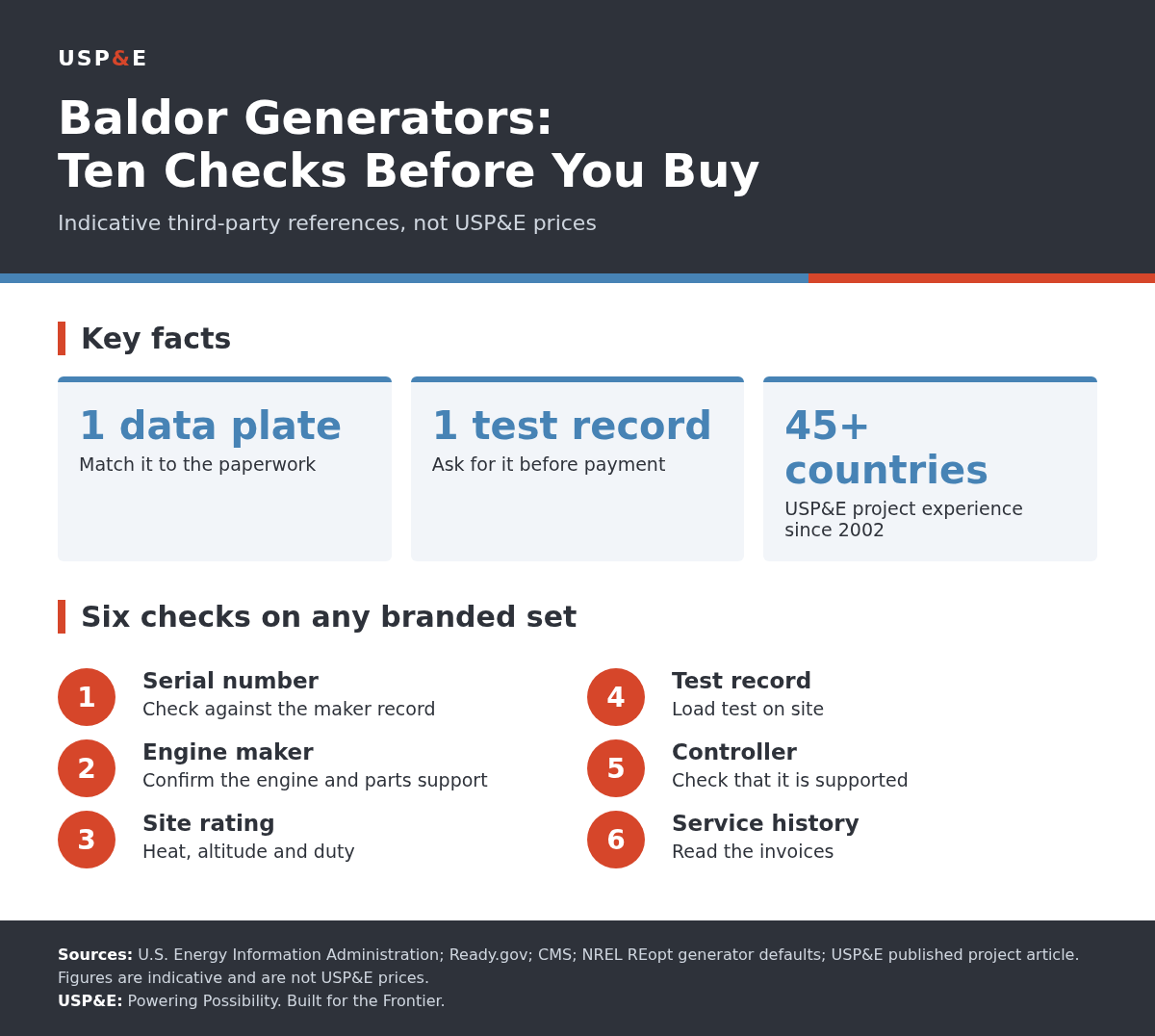
A brand name tells you who may have built the alternator or the set, not whether the unit in front of you suits your duty. Start by identifying exactly what is on offer. Record the model number, serial number, year of manufacture, rated output, voltage, frequency and the name of the engine maker. Ask for the data plate and the factory test record. Many sets are assembled from components by different makers, so the label on the alternator may differ from the label on the set.
Next, confirm the rating. Is the output standby, prime or continuous, and under which standard? A standby rating is not suited to running for months. Ask for the site rating at your temperature and altitude. Then confirm the control system, protection, enclosure and fuel system, because they decide how the set behaves in service.
The U.S. Energy Information Administration explains in its guide to how electricity is generated that a generator converts mechanical energy into electricity. Every Baldor generators offer, like any other, depends on the engine, the alternator and the controls working together, and the brand alone cannot assure that combination suits your load.
|
Baldor generators item to verify |
What to ask for |
Why it matters |
|
Identity |
Model, serial number, year, data plate |
Confirms what is on offer |
|
Rating |
Standby, prime or continuous, with standard |
Prevents overload and early failure |
|
Engine |
Maker, model, hours, service record |
Drives fuel use and spares |
|
Alternator |
Insulation class, test results |
Decides motor starting and life |
|
Controls |
Panel type, protection, monitoring |
Sets how the set behaves in service |
Comparing Baldor Generators With Other Options
A fair comparison uses the same duty, voltage, frequency and site conditions for every option. Do not compare a standby rating with a prime rating. Do not compare a factory rating with a site rating. Ask each supplier for fuel consumption at 50%, 75% and 100% load, the emissions standard the engine meets and the warranty terms.
Brand reputation helps with spares and service, but only if support exists in your region. Ask where parts come from, how long they take and who services the set at your site. A less familiar brand with strong local support can beat a well known one with none. USP&E’s guide to industrial generator brands explains how to compare engine and alternator families without relying on marketing language.
Emissions and fuel rules apply to every brand. The U.S. Environmental Protection Agency regulates stationary engines under its stationary engines programme, and publishes diesel fuel standards that affect which fuel an engine may burn in that market. Other countries set their own limits, so match the engine and fuel to the permit for your site.
Quick comparison steps for Baldor generators
- Fix the duty, voltage, frequency and site conditions.
- Ask each supplier for the same data on rating, fuel use and emissions.
- Check warranty terms and who services the set in your region.
- Compare total cost of ownership, not only the purchase price.
- Verify condition and title before paying any deposit.
Inspecting and Testing Baldor Generators
Inspection turns a brochure into evidence. For any set, new or used, arrange a visual inspection and a load test at the stated rating. Check for oil leaks, damaged cables, corrosion, cracked hoses and worn belts. Test starting, voltage regulation, frequency stability, protection trips and alarms. Run the set on load long enough to see cooling hold up.
For used sets, ask for engine hours, the maintenance log, the last major overhaul and an alternator insulation test. Hours alone do not tell the story. A set with low hours that stood idle for years may have fuel, seal and battery problems. The EIA’s explainer on diesel fuel shows why fuel quality varies, which is why stored fuel and tanks should also be checked.
|
Baldor generators inspection step |
What to check |
What it reveals |
|
Data plate and records |
Model, serial, hours, service log |
Identity and history |
|
Visual inspection |
Leaks, corrosion, cables, hoses |
Neglect or damage |
|
Load test |
Output, voltage, frequency, cooling |
Real performance |
|
Protection test |
Trips and alarms |
Safety readiness |
|
Fuel and battery check |
Fuel quality, battery condition |
Starting reliability |
Common Pitfalls With Baldor Generators and Other Branded Sets
Branded sets bring their own pitfalls. One is assuming that the brand covers the whole machine, when it may cover only the alternator or a component. Another is assuming that a set that was good in its original duty suits yours. A third is trusting an old photograph or a data plate that has been replaced. A fourth is skipping the load test because the set looks clean.
The remedy is evidence. Compare the data plate with the paperwork, check serial numbers against the factory record where possible and run the set on load. When buying Baldor generators or any other brand, ask who has serviced the set and ask to see the invoices. Check that parts are available for the model and that the controller is still supported. A tidy set with an unsupported controller can cost more to keep running than a plain set with a common one.
Keep a folder for each set: the data plate photograph, the test record, the service invoices and any correspondence with the maker. If the set is later moved or resold, the folder shows its history and protects both parties. Buyers who value paperwork as highly as paint usually avoid the worst surprises, and sellers who keep it often find that buyers trust them faster and ask fewer questions.
Baldor Generators Cost: What to Budget
USP&E does not publish Baldor generators prices, because they depend on model, rating, age, package and market timing. The figures below are indicative third-party references, not USP&E prices. The price of the set is only part of the cost. Installation, fuel system, switchgear, transport, commissioning and maintenance all follow. A cheap set that needs a new alternator or controller may cost more than a better set at a higher price, so inspect before you compare.
For scale, the National Renewable Energy Laboratory’s REopt model, in its published generator cost defaults, uses about $650 to $880 per kW for installed diesel generator plant, with fixed operating cost of about $10 to $20 per kW per year plus fuel. Those are model defaults for United States conditions, not quotations, and a real project may differ.
|
Baldor generators cost layer |
What it covers |
Risk if ignored |
|
Equipment |
Set, frame, enclosure, controls |
A low price may hide a weak rating |
|
Refurbishment |
Overhaul, new parts, testing |
Used sets may need work |
|
Installation |
Foundations, cabling, switchgear |
Poor install causes faults |
|
Fuel system |
Tanks, pumps, filtration |
Short running time |
|
Service |
Filters, oil, spares |
Skipped service shortens life |
Fuel Type Comparison
|
Fuel Type |
CapEx Range |
OpEx Range |
Typical Lead Time |
Best Application |
|
Diesel generating sets |
About $650 to $880/kW installed (NREL REopt defaults) |
About $10 to $20/kW per year fixed, plus fuel (NREL REopt defaults) |
Varies with size and package |
Backup, prime and remote power |
|
Natural gas engines |
Fuel often cheaper where pipeline gas is reliable |
Varies with package |
Sites with firm gas supply |
|
|
New industrial frame turbine plant |
About $1,158/kW installed (EIA 2026, 2025 US dollars) |
About $7.18/kW per year plus $4.17/MWh (EIA 2026) |
More than five years for large new units in tight markets |
Large utility or industrial plants |
|
New aeroderivative turbine plant |
About $2,275/kW installed (EIA 2026, 2025 US dollars) |
About $9.99/kW per year plus $5.97/MWh (EIA 2026) |
18 to 36 months for smaller new turbines is a published market range |
Fast-ramping larger plants |
Sources: NREL REopt generator defaults; U.S. Energy Information Administration, Assumptions to the Annual Energy Outlook 2026, Table 3. Blank cells could not be verified from a comparable official source. These are not USP&E prices, and the turbine figures describe much larger United States plants.
New vs Used Baldor Generators: Inspection, Hours and Title
Both new and used sets can be sound purchases. New sets bring warranty and a known starting point. Used sets can be available sooner and cost less, but they need evidence. Ask for engine hours, service history, the last overhaul and alternator tests, and require a load test at the stated rating and proof of ownership or a written right to sell before any deposit. Be wary of any seller who pressures you to pay quickly. USP&E explains how to inspect and buy in its guide to used diesel generators for sale and sets out the warning signs in its guide to how to spot a power plant broker scam. Buyers can browse the diesel generators category.
USP&E is an independent seller and is not affiliated with any engine, turbine or generator manufacturer named by buyers during a project. Those names are trademarks of their respective owners.
Case Studies: Baldor Generators in Real Projects
USP&E only publishes approved case studies, and it does not name clients without permission. USP&E has delivered projects in 45+ countries, including power plant EPC projects and operations and maintenance work, and approved examples are collected on the case studies page. No outcome specific to baldor generators is claimed here beyond what is published.
The lessons below reflect common practice, not a named project:
- Buyers who record the data plate and test record avoid mistaken identity.
- Buyers who compare on the same rating basis avoid overloaded sets.
- Buyers who check local support find parts and service when they need them.
- Buyers who inspect and load test before paying avoid costly surprises.
How to Choose Baldor Generators and a Supplier: 10 Criteria
- Identity. Record model, serial number, year and data plate details.
- Rating. Confirm standby, prime or continuous output and the standard behind it.
- Site rating. Ask for output at your temperature and altitude.
- Engine and alternator. Identify the makers, check hours and request test results.
- Controls and protection. Check the panel, protection trips and monitoring.
- Fuel and emissions. Match the engine and fuel to permits and local rules.
- Inspection and title. For used units, require a records audit, a load test and proof of ownership or a written right to sell before any deposit.
- Spares and service. Confirm parts supply and service in your region.
- EPC and O&M depth. A supplier that can install, commission and maintain the plant reduces handover risk. USP&E offers O&M with 95%+ O&M availability as an official company figure.
- Contract clarity. Delivery date, tests, payment milestones and warranty should be in writing.
FAQ: Baldor Generators
Are Baldor generators a good choice?
A recognised brand is a reasonable starting point, but it does not replace a specification. Check the duty rating, engine maker, alternator tests, controls and local support for the exact unit offered. Compare Baldor generators with alternatives on the same duty and site conditions before you decide.
How do I identify a unit properly?
Record the model number, serial number, year of manufacture, rated output, voltage, frequency and engine maker from the data plate. Ask for the factory test record and the maintenance log. Many sets combine components from different makers, so the alternator label may differ from the set label.
What rating should I look for?
Choose the rating that matches your duty. A standby rating suits short outages, a prime rating suits long hours with variable load and a continuous rating suits constant load. Also ask for the site rating at your temperature and altitude, not only the factory figure.
Should I buy used or new?
Both can work. New sets bring warranty and a known starting point, and used sets can be available sooner at lower cost. For used sets, ask for engine hours, service history, the last overhaul and alternator tests, and require a load test and proof of ownership or right to sell.
What tests should I require?
Require a visual inspection and a load test at the stated rating. Test starting, voltage regulation, frequency stability, protection trips and alarms, and watch cooling over a sustained run. For Baldor generators and any other brand, an alternator insulation test and fuel check add useful evidence.
How do I avoid a bad deal?
Verify identity and title, inspect and load test before paying, and be wary of pressure to pay a deposit quickly. Use written terms for delivery, tests and warranty. Work with a supplier that has engineering and O&M depth rather than a trader alone.
What does USP&E need to quote?
USP&E needs the site location, the load, the duty and running hours, the voltage and frequency, the fuel and the date you need power. With these inputs, USP&E can recommend suitable equipment and explain how Baldor generators or alternatives compare for your project.
Key Takeaways: Baldor Generators
- Baldor generators are a brand starting point, not a specification, so verify the exact unit.
- Compare options on the same duty, rating basis and site conditions.
- Inspect, load test and check title before paying a deposit.
- Check local spares and service support.
- Choose a supplier with engineering, EPC and O&M depth, not a trader alone.
A clear checklist turns a branded offer into a sound purchase. When you are ready to buy, USP&E’s engineers can help you assess Baldor generators and alternatives, verify the equipment and bring the plant to power.
Ready to Power Your Project? Talk to USP&E’s Engineers.
Whether you are in early feasibility or ready to mobilise on a power station, EPC, or O&M project, USP&E’s engineers can help. With 150+ power projects delivered in 45+ countries since 2002, our engineers remove the technical and commercial risk from your project, with speed and without excuses.
Contact USP&E Today Request a Fast Quote
USP&E: Powering Possibility. Built for the Frontier. ISO 9001:2015 | ISO 45001:2018 | 150+ power projects in 45+ countries | 25,000 MW contracted since 2002 | 24+ years