

Gas Turbine Generator Packages: What a 45 MW Package Includes and Excludes
Buying a gas turbine generator is rarely the hard part of a power project. Understanding exactly what you are buying is. Two quotes for the same headline megawatts can differ by millions once you compare what each package includes and what it leaves to you. Developers, data centre operators, mine energy managers and utility procurement teams lose months when scope gaps surface after contract signature.
This guide explains what a gas turbine generator package is, how its ratings are stated, what normally sits inside and outside the scope of supply, and how to budget for the full installed cost. It uses the FX-45, a new-build 45 mw gas turbine package from USP&E, as a worked example. Every FX-45 figure here comes from the published FX-45 product page.
USP&E has supplied 25,000 MW of power and built 150+ power stations across 45+ countries since 2002. USP&E holds ISO 9001:2015 and ISO 45001:2018 certification. USP&E works across equipment supply, EPC (Engineering, Procurement and Construction) and O&M (Operations and Maintenance), so the guidance below reflects how packages behave on real sites, not just on data sheets.
If you are planning onsite power without waiting for a grid connection, read the companion guide on behind the meter onsite power options. If you expect to grow into a larger plant, see the guide to building combined cycle power plants in phases.
What Is a Gas Turbine Generator? Specifications and Ratings
It is a machine that converts the energy in fuel into electricity. Air is compressed, mixed with fuel and burned, and the hot gas spins a turbine. The turbine drives a generator, either directly or through a gearbox. The U.S. Energy Information Administration explains the basic process in its guide to how electricity is generated.
A gas turbine package is the turbine, generator and supporting systems engineered as one arrangement. A gas turbine power plant is the complete installation around it. The FX-45 page draws this line clearly: the package is the generating equipment, while the plant adds civil works, the step-up transformer, grid interconnection and fuel supply.
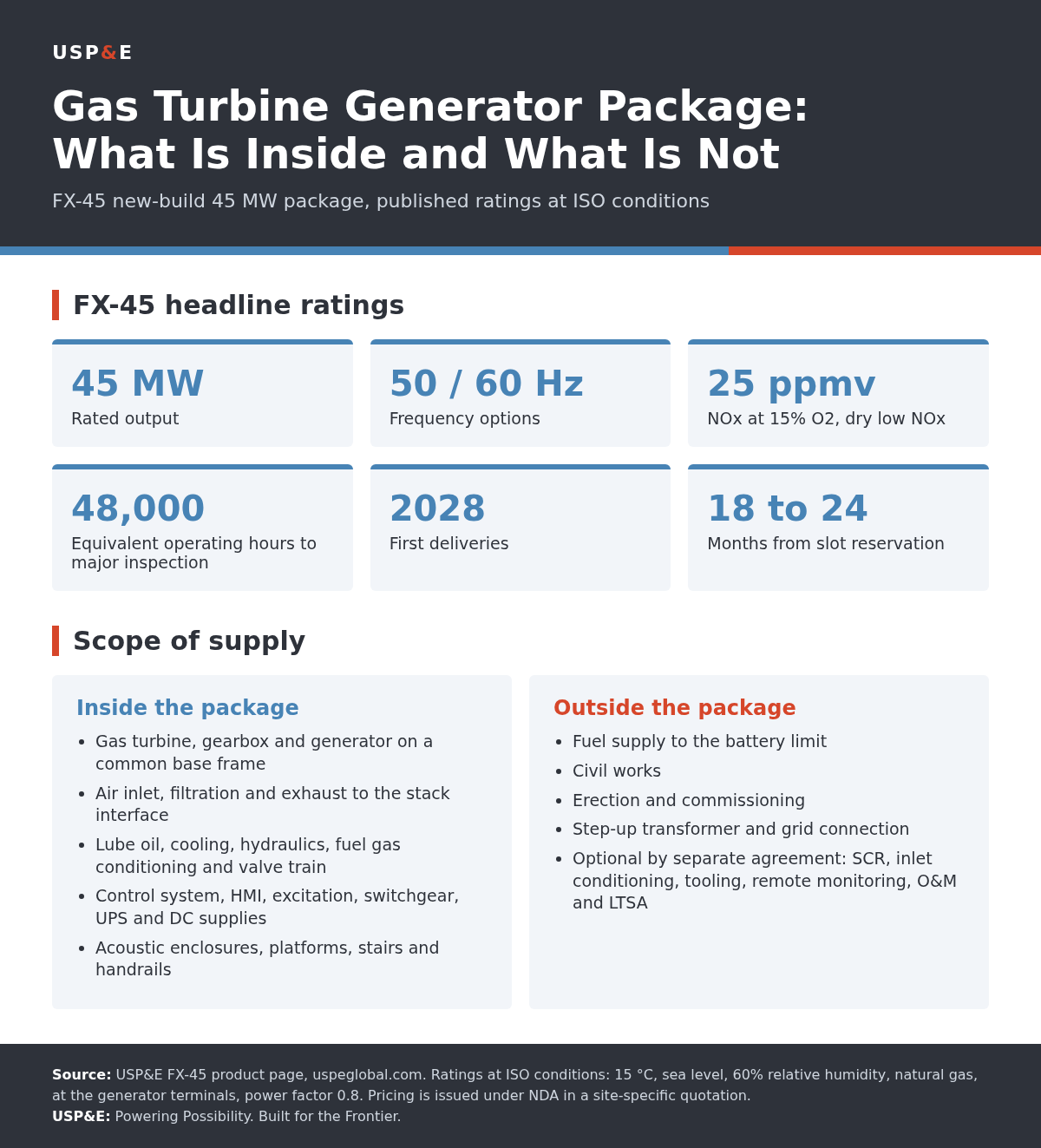
FX-45 headline ratings
|
Gas turbine generator parameter |
FX-45 published value |
Why it matters |
|
Rated output |
45 MW |
Sets block size for planning |
|
Frequency |
50 Hz or 60 Hz |
Must match your grid or load |
|
Generator voltage |
13.8 kV for 60 Hz; 11 kV or 15 kV for 50 Hz |
Drives transformer and switchgear design |
|
NOx emissions |
25 ppmv at 15% O2, dry low NOx combustion |
Determines permit route and need for SCR |
|
Major inspection interval |
48,000 equivalent operating hours |
Shapes maintenance planning and LTSA cost |
|
Primary fuel |
Natural gas |
Sets fuel supply and gas conditioning needs |
|
First deliveries |
2028 |
Defines the earliest realistic power date |
Source: USP&E FX-45 page. All performance figures are stated at ISO conditions: 15 degrees Celsius, sea level, 60% relative humidity, natural gas, new and clean, at the generator terminals and a power factor of 0.8.
ISO ratings are a starting point, not a site promise. Heat, altitude and humidity reduce output. USP&E explains the effect in its guide to gas turbine derating for heat, altitude and site conditions. Always ask for a site rating calculated for your conditions.
Gas Turbine Generator Price and Total Installed Cost: What Buyers Should Budget
The gas turbine generator price is only part of the total. FX-45 pricing is issued under a non-disclosure agreement in a site-specific quotation. USP&E sizes it to your site, fuel and configuration, so no public price is quoted here.
Third-party references help you sense-check budgets. These figures are indicative, not USP&E prices. The U.S. Energy Information Administration’s Assumptions to the Annual Energy Outlook 2026 (April 2026) puts the total overnight cost of a new industrial frame simple cycle plant at about $1,158 per kW in 2025 US dollars. These are complete installed plant costs in the United States, not package prices.
What sits inside and outside the FX-45 scope of supply
|
Item |
Inside the package |
Outside the package |
|
Gas turbine, gearbox and generator on a common base frame |
Yes |
|
|
Air inlet, filtration and exhaust to the stack interface |
Yes |
|
|
Lube oil, cooling, hydraulics, fuel gas conditioning and valve train |
Yes |
|
|
Control system, HMI, excitation, switchgear, UPS and DC supplies |
Yes |
|
|
Acoustic enclosures, platforms, stairs and handrails |
Yes |
|
|
SCR, inlet conditioning, tooling, remote monitoring, O&M and LTSA |
Optional, separate agreement |
|
|
Fuel supply to the battery limit |
Yes |
|
|
Civil works |
Yes |
|
|
Erection and commissioning |
Yes |
|
|
Step-up transformer and grid connection |
Yes |
Source: USP&E FX-45 page. LTSA means Long-Term Service Agreement.
The items outside the scope of supply are where budgets slip. A reference case from the Sargent & Lundy study for the EIA, Capital Cost and Performance Characteristics for Utility-Scale Electric Power Generating Technologies (January 2024), shows the scale. In that simple cycle case, major equipment made up about 46% of the total capital cost. The rest went on other equipment, labour, materials, engineering, fees, contingency and owner’s costs. Shares were calculated by USP&E from Table 3-1 of that report and are indicative only.
That is why balance of plant matters. BOP (Balance of Plant) covers every system needed to turn a gas turbine generator into a working plant. USP&E explains it in its guide to balance of plant in power generation.
New vs Used Gas Turbine Generator: Inspection, Hours, and Warranty
New and used units solve different problems. A new-build package gives you a known configuration, full documentation and a warranty. A used unit can arrive sooner but needs careful inspection.
Lead time is the main reason buyers look at used equipment. The Electric Power Research Institute (EPRI) reported in Utility Dive in March 2026 that large new gas turbines take more than five years from order to delivery, and smaller units 18 to 36 months. USP&E states that the FX-45 is delivered in 18 to 24 months from slot reservation.
New-build package compared with used units
|
Factor |
New-build 45 mw gas turbine package (FX-45) |
Used gas turbine |
|
Configuration |
Identical on every unit, one document set |
Varies by unit and history |
|
Warranty |
New-build with warranty |
Usually limited or none |
|
Spares |
One spares catalogue across a fleet |
Depends on model and age |
|
Delivery |
18 to 24 months from slot reservation, first deliveries 2028 |
Months if a unit is already built and relocated |
|
Inspection need |
Factory testing and documentation review |
Full records audit and borescope inspection |
|
Combined cycle |
Combined cycle ready as built |
Depends on design and condition |
Source: USP&E FX-45 page for FX-45 values. Used unit factors are general practice.
A used gas turbine generator should never be bought on hours alone. Check starts, trips, overhaul history and the condition of hot section parts. Verify ownership before any deposit. If speed matters more than a new-build configuration, you can browse current inventory on the USP&E natural gas turbines inventory page.
Maintenance planning starts before purchase. The FX-45 major inspection interval is 48,000 equivalent operating hours. USP&E offers an LTSA and O&M contracts alongside the equipment, contracted separately. The guide to what an LTSA for a gas turbine covers explains how these agreements work.
Fuel Type Comparison
The table compares common routes to onsite power. Figures are indicative third-party references for new plants in the United States, not USP&E prices.
|
Fuel Type |
CapEx Range |
OpEx Range |
Typical Lead Time |
Best Application |
|
Natural gas, industrial frame simple cycle |
About $1,158/kW (EIA 2026) |
About $7.18/kW per year fixed plus $4.17/MWh variable (EIA 2026) |
More than five years for large new units (EPRI 2026); FX-45 18 to 24 months from slot reservation |
Base load and peaking blocks |
|
Natural gas, aeroderivative simple cycle |
About $2,275/kW (EIA 2026) |
About $9.99/kW per year fixed plus $5.97/MWh variable (EIA 2026) |
18 to 36 months for smaller new units (EPRI 2026) |
Fast start, peaking and bridge power |
|
Natural gas, combined cycle |
About $1,032 to $1,086/kW (EIA 2026) |
About $12.69 to $16.23/kW per year fixed plus about $3.5/MWh variable (EIA 2026) |
About 40 to 42 months from development start, including 22 to 24 months construction (Sargent & Lundy for EIA, 2024) |
Base load where fuel efficiency matters most |
|
Diesel, containerised gensets |
About $650 to $880/kW installed (NREL REopt defaults) |
About $10 to $20/kW per year fixed, plus fuel (NREL REopt defaults) |
Often under 90 to 120 days, site dependent |
Standby and short-term supply |
|
HFO (Heavy Fuel Oil), engine power station |
About $800 to $1,000/kW, medium speed engines (IDB Invest, 2010 US dollars) |
Typically 9 to 14 months from deposit |
Remote base load without gas |
Sources: EIA, Assumptions to the Annual Energy Outlook 2026, Table 3 (2025 US dollars). Lead times: EPRI in Utility Dive (2026) and the USP&E FX-45 page. CapEx means capital expenditure and OpEx means operating expenditure. Diesel: NREL REopt model default values (REopt generator defaults, checked 2026). HFO: IDB Invest, Liquid and Gaseous Fossil Fuel Power Plant Guidelines, citing 2010 cost data, so treat it as an older reference.
Fuel cost matters as much as capital cost over the life of a gas turbine generator. The International Energy Agency tracks natural gas markets and supply, which helps you test fuel price assumptions.
Emissions rules shape the gas turbine generator package. The FX-45 holds NOx to 25 ppmv at 15% O2. Where a permit needs single-digit NOx, SCR is available under a separate agreement. In the United States, check the U.S. Environmental Protection Agency Clean Air Act standards for engines and combustion turbines.
Gas Turbine Generator Buying Process: From Enquiry to Commissioning
A gas turbine generator purchase follows a predictable sequence. Knowing it helps you run approvals, finance and site works in parallel instead of one after another.
Step 1: Define the load and the site
Start with peak load, expected growth and the redundancy the site needs. Record altitude, ambient temperature range and humidity. These set the site rating of any gas turbine generator you consider.
Step 2: Share the four sizing inputs
For the FX-45, USP&E asks for site location, gas analysis, frequency and voltage, and the date you need power. The same four inputs let you compare every gas turbine generator offer on equal terms.
Step 3: Review the scope and exclusions
Compare the scope line by line. Mark every excluded item, such as civil works, fuel supply and the step-up transformer. Assign each one to a named party before you sign.
Step 4: Plan permits, gas and grid in parallel
Emissions permits, gas supply agreements and grid studies all take time. Starting them while the gas turbine generator is being built protects your power date.
Step 5: Prepare the site
Foundations, fuel gas lines, cable routes and drainage should be ready before delivery. A gas turbine generator that arrives at an unprepared site sits idle, and idle equipment earns nothing.
Step 6: Install, commission and test
Erection, commissioning and performance testing follow delivery. Agree the test method, the site corrections and the acceptance criteria before the gas turbine generator leaves the factory.
Step 7: Operate and maintain
Plan operators, spares and service terms before handover. With an LTSA and O&M agreed early, the gas turbine generator moves from commissioning to steady operation without a gap.
Common gas turbine generator mistakes to avoid
- Comparing prices before scope. Two offers for the same gas turbine generator rating can cover very different equipment.
- Sizing on ISO ratings alone. Site heat and altitude reduce output, so use a site rating.
- Leaving gas supply until late. Without firm gas, a gas turbine generator cannot run.
- Ignoring the transformer and grid connection. These items often sit outside the package and can set the critical path.
- Signing without service terms. Spares and maintenance planning should start with the purchase, not after handover.
Avoiding these mistakes costs little at the start of a project. Fixing them after contract signature usually costs time, money or both.
Case Studies: Gas Turbine Generator in Real Projects
First FX-45 deliveries are stated from 2028, so no FX-45 project results exist yet. USP&E only publishes approved case studies.
A typical gas turbine generator package project starts with a clear scope of supply: the turbine and generator, controls, BOP, grid connection and commissioning. With the FX-45, buyers reserve a slot and USP&E coordinates engineering, delivery and installation over the stated 18 to 24 month window, supported by 350+ engineers and staff across 45+ countries.
The lessons below reflect common practice, not a specific project:
- Projects that define the battery limits in writing avoid disputes over civil works, fuel supply and transformers.
- Projects that request a site rating early avoid buying more or less capacity than they need.
- Projects that sign service terms with the equipment contract avoid outages waiting for parts.
How to Choose a Gas Turbine Generator Supplier: 10 Criteria
Use these criteria to compare offers on equal terms.
- Clear scope of supply. The offer should list every system included and every item excluded. Anything not written down should be treated as excluded.
- Stated rating conditions. Ratings should state ISO conditions and the measurement point. Ask for a separate site rating for your location.
- Emissions performance. The supplier should state NOx levels and the reference oxygen level. Ask whether SCR is included or separate.
- Delivery commitment. Ask for a written delivery window and what triggers it. A slot reservation date and a delivery date are not the same thing.
- Warranty terms. Confirm what the warranty covers and for how long. Ask who stands behind it.
- Fleet standardisation. Identical units simplify spares, training and maintenance. Ask whether the last unit will match the first.
- Service support. Ask about LTSA and O&M options and whether they are contracted separately. Check spares availability.
- EPC capability. A supplier that can also build the plant reduces interface risk. USP&E supports this through its power plant engineering team.
- Compliance and ethics. The supplier should screen every deal for sanctions and anti-corruption risk. Ask for its written policy.
- Certification and record. Look for ISO 9001 and ISO 45001 certification. USP&E holds ISO 9001:2015 and ISO 45001:2018 certification.
FAQ: Gas Turbine Generator
What is included in a turbine generator package?
A gas turbine generator package usually includes the turbine, gearbox, generator, auxiliaries, controls and enclosures. The FX-45 package covers these on a common base frame. Fuel supply, civil works, erection, commissioning and the step-up transformer sit outside it.
What is the difference between a gas turbine package and a power plant?
The package is the generating equipment. The power plant is the full installation, including civil works, transformer, grid interconnection and fuel supply. USP&E can build the plant under a separate EPC contract.
How much does a 45 MW gas turbine cost?
Pricing depends on site, fuel and configuration. FX-45 pricing is issued under a non-disclosure agreement in a quotation. As an indicative reference, the EIA put a new industrial frame simple cycle plant at about $1,158 per kW installed in 2025 dollars.
How long does delivery take?
USP&E states that the FX-45 is delivered in 18 to 24 months from slot reservation, with first deliveries from 2028. EPRI reported in 2026 that large new turbines take more than five years from order.
What voltage and frequency does the FX-45 support?
The FX-45 supports 50 Hz and 60 Hz. Generator voltage is 13.8 kV for 60 Hz, and 11 kV or 15 kV for 50 Hz projects.
Does the package meet emissions limits?
Dry low NOx combustion holds NOx to 25 ppmv at 15% O2. Where a permit needs single-digit NOx, SCR is available under a separate agreement. Local rules decide what is required.
What information does USP&E need to size a package?
USP&E needs four things: site location, gas analysis, frequency and voltage, and the date you need power. With these, USP&E can return a budget figure.
Key Takeaways: Gas Turbine Generator
- A package and a power plant are different scopes. Compare both before you compare prices.
- Read the exclusions first. Fuel supply, civil works, erection and the transformer often sit outside the package.
- ISO ratings are a starting point. Ask for a site rating.
- New-build packages offer warranty and standardisation. Used units offer speed with more inspection risk.
- Plan service terms, emissions controls and grid connection alongside the gas turbine generator.
The right gas turbine generator is the one whose scope, rating and schedule match your site. When you are ready, send USP&E your site location, gas analysis, frequency, voltage and power date, and its engineers will help you size the right package.
Ready to Power Your Project? Talk to USP&E’s Engineers.
USP&E offers a complimentary 4-hour engineering consultation for qualified power station, EPC, and O&M projects. Whether you are in early feasibility or ready to mobilise, our team of 350+ engineers and staff across 45+ countries is ready to guide your project with speed and without excuses.
Contact USP&E Today Request a Fast Quote
USP&E: Powering Possibility. Built for the Frontier. ISO 9001:2015 | ISO 45001:2018 | 150+ Power Stations Built | 45+ Countries | 25,000 MW Supplied | Zero Lawsuits