

Wartsila Generators for Sale: Model Guide to the 32, 46 and 50DF Engine Families
Buyers searching for wartsila generators for sale are almost never shopping for an engine. They are trying to close a capacity gap on a mine site, an island grid, a cement plant, or a utility network where the grid cannot be relied on and a new-build order book stretches past the point where the project still makes commercial sense. The engine is simply the fastest route to megawatts on the ground.
That is where the decision gets difficult. Wartsila has built medium speed engines for more than four decades across several distinct platforms, and the model designation stamped on the nameplate determines fuel compatibility, overhaul economics, spare part availability, footprint, and whether the unit can be relocated at all. A 12V32 and an 18V46 are not interchangeable, and a 50DF is a different commercial proposition again.
USP&E Global has engineered, constructed, and operated reciprocating engine power stations across 35+ countries, with 150+ projects delivered and 350+ engineers on staff. We hold Wartsila engine assets in our own inventory and under exclusive mandate, and we operate and maintain reciprocating plants under long term contracts. Your project is the objective. This guide is the technical groundwork you need before you commit capital, written to be read alongside our broader Wartsila engine power plant EPC and O&M guide.
Three definitions before we begin. EPC means engineering, procurement, and construction, the contract under which a plant is designed and built. O&M means operations and maintenance, the contract under which it is run. HFO means heavy fuel oil, the residual fuel that makes reciprocating engines economically attractive in markets without pipeline gas.
Why Buyers Search for Wartsila Generators for Sale: What the Market Data Shows
The demand for used and surplus medium speed engines is driven by one measurable variable: lead time. New-build reciprocating engine orders and the balance of plant that surrounds them are quoted in quarters, not weeks, and every month of delay carries a cost that the buyer absorbs directly.
The U.S. Energy Information Administration documents the continuing role of reciprocating engines in generation fleets, particularly for distributed and flexible duty. The International Energy Agency tracks thermal capacity additions globally, and the International Renewable Energy Agency publishes the generation cost backdrop that makes efficient, fuel-flexible engines attractive against alternatives. World Bank energy access data shows the scale of the underlying deficit in the frontier markets where these engines are most often deployed.
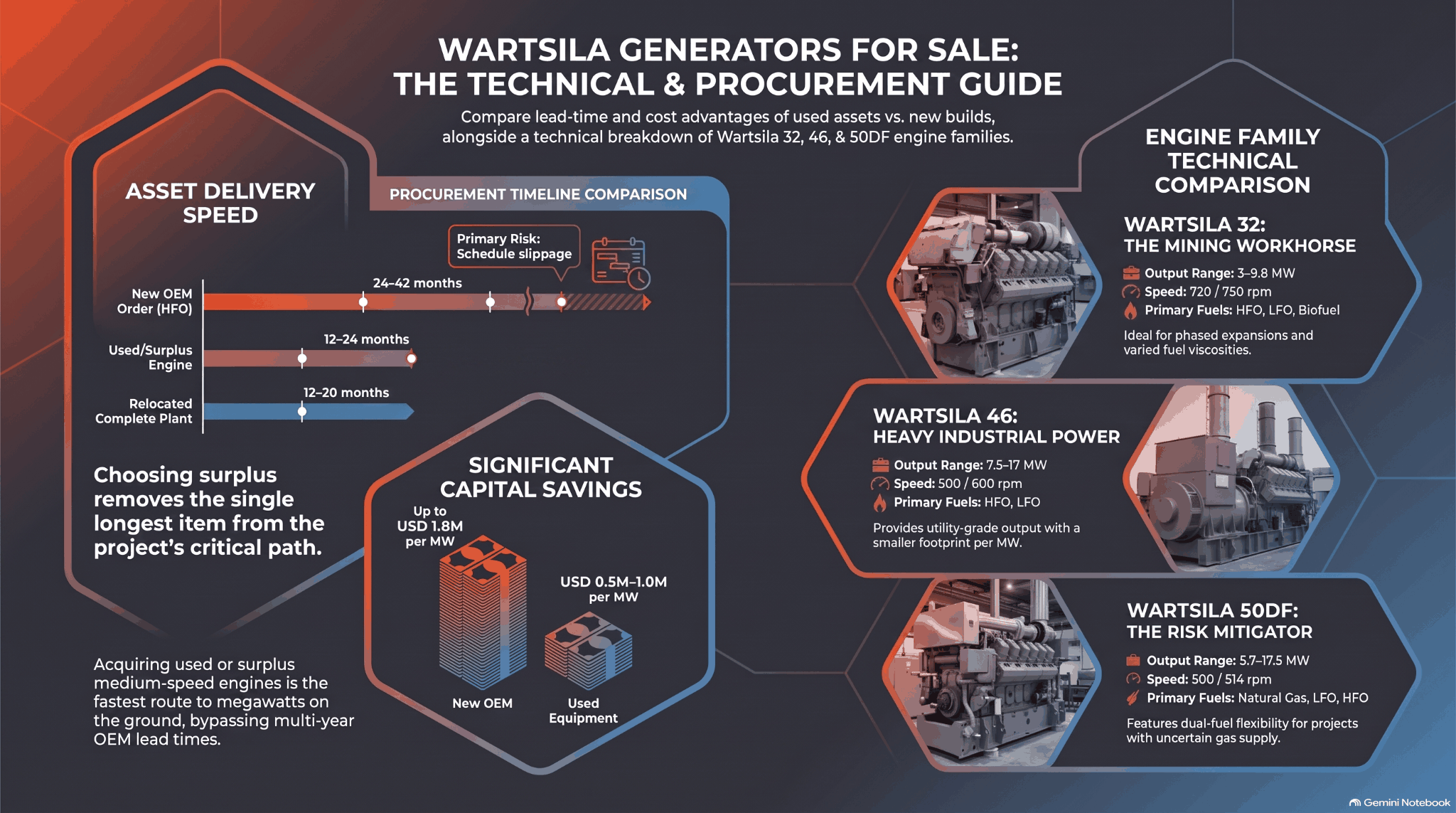
The procurement arithmetic is straightforward. The table below sets out typical timelines. Figures are indicative planning ranges drawn from USP&E project experience and should be confirmed against a specific scope of supply.
|
Procurement Route |
Engine Delivery |
Balance of Plant |
Total to Commissioning |
Typical Risk |
|
New OEM order, gas |
12 to 24 months |
6 to 12 months |
24 to 36 months |
Schedule slippage |
|
New OEM order, HFO |
12 to 24 months |
9 to 14 months |
30 to 42 months |
Schedule and fuel system complexity |
|
Used or surplus engine, relocated |
2 to 5 months |
6 to 12 months |
12 to 24 months |
Asset condition and spares |
|
Used complete plant, relocated |
3 to 6 months |
4 to 9 months |
12 to 20 months |
Dismantling and shipping |
Two conclusions follow. First, acquiring a used or surplus asset removes the single longest item from the critical path. Second, it does not remove the balance of plant, which remains site-specific and must still be engineered. Anyone quoting a complete HFO station in under six months is misrepresenting the work involved.
Key Drivers Behind Demand for Wartsila Generators for Sale: Why Now Is the Critical Window
Five forces are sustaining the market for used and surplus medium speed engines, and each one strengthens the case for securing an asset early rather than late.
- Heavy fuel oil economics. In markets without pipeline gas, HFO remains the lowest cost thermal fuel available at scale. The Wartsila 32 and 46 platforms are among the most capable HFO engines built, which is why they dominate mining and island generation across West Africa, East Africa, and South Asia.
- Fuel flexibility as an uptime strategy. Dual fuel and tri-fuel variants let a plant switch between gas and liquid fuel without stopping. Where gas supply is contractually uncertain or physically interruptible, this is not a convenience feature. It is the difference between a plant that runs and one that sits idle.
- Part load efficiency. Mines, islands, and industrial sites rarely run flat. Reciprocating engines hold efficiency across the load range far better than most turbines, which matters when the annual load factor sits below 70 percent.
- Plant retirements releasing assets. Power purchase agreement expiries, fuel switching programmes, and utility fleet rationalisation continue to release low-hour engines onto the market. These are frequently better maintained than their age suggests, because utility and IPP owners run structured maintenance regimes.
- Grid connection queues. Industrial and data centre loads facing multi-year interconnection delays are turning to captive generation. Reciprocating engines suit this duty because they scale in modules and tolerate frequent starts.
The cost comparison below shows why the used market is competitive on capital cost. Ranges are indicative and exclude civil works, fuel infrastructure, and grid interconnection, all of which are site-specific.
|
Technology |
Indicative CapEx per MW |
Net Electrical Efficiency |
Typical Unit Size |
|
New medium speed engine plant, gas |
USD 1.0M to 1.6M |
45 to 50 percent |
5 to 20 MW per unit |
|
New medium speed engine plant, HFO |
USD 1.1M to 1.8M |
43 to 47 percent |
5 to 18 MW per unit |
|
Used or relocated engine plant |
USD 0.5M to 1.0M |
40 to 46 percent |
4 to 18 MW per unit |
|
Simple cycle industrial gas turbine |
USD 0.7M to 1.2M |
30 to 38 percent |
5 to 50 MW per unit |
Efficiency for a used asset depends on hours, overhaul history, and turbocharger condition. Treat any efficiency figure quoted without a recent performance test as an estimate.
Wartsila 32, 46 and 50DF Engine Families Compared: A Technical and Commercial Overview
Three platforms account for the overwhelming majority of the wartsila generators for sale that reach the secondary market in power generation duty. Each was designed for a different point on the output curve, and each carries different consequences for fuel, footprint, and lifecycle cost.
|
Wartsila Generators for Sale by Model Family |
Bore and Stroke |
Speed |
Output Range per Unit |
Primary Fuels |
|
Wartsila 32 (incl. Vasa 32, 32LN, 32E) |
320 mm bore |
720 or 750 rpm |
Approx. 3 to 9.8 MW |
HFO, LFO, MDO, biofuel |
|
Wartsila 46 and 46F |
460 mm bore, 580 mm stroke |
500, 514 or 600 rpm |
Approx. 7.5 to 17 MW |
HFO, LFO |
|
Wartsila 50DF |
500 mm bore, 580 mm stroke |
500 or 514 rpm |
Approx. 5.7 to 17.5 MW |
Natural gas, LFO, HFO with modification |
The Wartsila 32 family is the workhorse of the mining and island generation sector. Available from 6 cylinders in line up to 18 or 20 cylinders in V configuration, it covers roughly 3 MW at the small end to 9.8 MW at the top. Wartsila states that more than 8,000 MW of Wartsila 32 generating sets have been delivered to energy customers. The platform tolerates a wide fuel viscosity band, which is precisely why it survives on the residual fuels available in frontier ports. Its modest unit size is an advantage for phased mine expansions where load grows in 5 MW increments rather than 50 MW steps.
The Wartsila 46 family steps up to 460 mm bore with roughly 1,050 to 1,155 kW per cylinder at 500 or 514 rpm, and 1,200 to 1,250 kW per cylinder on the later 46F at 600 rpm. A 12V46 delivers around 11.4 MW electrical and an 18V46 around 17.1 MW. This is utility and heavy industrial territory. Fewer, larger units mean a smaller footprint per MW and fewer maintenance events, but they also mean coarser redundancy granularity. Losing one 17 MW unit from a four-unit plant removes a quarter of your capacity.
The Wartsila 50DF was developed from the 46 platform and shares its engine block and crank mechanism. At 950 kW per cylinder and 500 or 514 rpm, configurations run from 6L to 18V, giving roughly 5.7 to 17.5 MW. It operates on the lean-burn Otto principle in gas mode with low pressure gas admission, and switches to liquid fuel without losing output. For projects with a gas supply that is real but not yet contractually bankable, the 50DF is the risk mitigation asset. It is also the platform where gas quality specification matters most, since methane number and calorific value directly constrain achievable output.
A note on sourcing. USP&E maintains Wartsila engine listings alongside our broader HFO generator inventory and natural gas generator inventory. Availability changes continuously. Confirm the current status of any specific asset before building it into a schedule.
Fuel Type Comparison for Wartsila Engine Power Projects
|
Fuel Type |
CapEx Impact |
OpEx Impact |
Lead Time |
Best Application |
|
Heavy fuel oil (HFO) |
Highest. Treatment plant, heated lines, separators |
Lowest fuel cost, highest maintenance cost |
12 to 24 months |
Mining and utility baseload without gas |
|
Light fuel oil / diesel |
Lowest. Minimal treatment |
Highest fuel cost, lowest maintenance cost |
6 to 14 months |
Fast track, peaking, bridging power |
|
Natural gas (SG) |
Moderate. Gas train and safety systems |
Low fuel cost where gas is available |
12 to 24 months |
Grid-connected baseload with firm gas |
|
Dual fuel (50DF and similar) |
Moderate to high. Both fuel systems required |
Optimised to fuel price, protects uptime |
14 to 26 months |
Projects with uncertain gas supply |
|
Tri-fuel (gas, HFO, diesel) |
Highest. Three fuel systems |
Maximum flexibility, maximum complexity |
16 to 30 months |
Utilities managing fuel price and supply risk |
On the operating side, three regional realities govern outcomes more than the engine choice does. Fuel quality is the first. Residual fuel delivered in frontier ports varies widely, and a plant designed around a laboratory specification it never actually receives will suffer accelerated wear. Insist on third party fuel analysis before design freeze. Ambient conditions are the second: high ambient temperature and altitude derate output, and derating must be applied at the sizing stage rather than discovered at commissioning. Logistics is the third. Spares for medium speed engines are heavy, and a remote site without a structured spares strategy will find that availability is limited by shipping schedules, not engineering. This is the operational reasoning behind our power plant engineering and operations and maintenance offerings.
Case Studies: Proven Results With Wartsila Generators for Sale and Comparable Reciprocating Assets
USP&E has delivered EPC and O&M scope on reciprocating engine plants across West Africa, East Africa, Southern Africa, the Middle East, and the Americas. Three examples illustrate the pattern, presented without client identification pending commercial clearance.
West African gold mining complex, HFO and diesel, O&M. USP&E operates and maintains captive generation for a multi-site gold mining operation in Mali, with more than 120 engineers and technicians on local payroll. The work covers availability management, fuel handling, overhaul planning, and spares logistics into a landlocked market. Structured maintenance regimes and fuel management are the mechanisms behind the cumulative savings referenced below.
Sierra Leone diesel and HFO generation, EPC and O&M. USP&E has designed, built, and operated diesel and HFO stations in Sierra Leone since 2009, serving mining and commercial clients. The recurring lesson from that market is that fuel treatment and operator training determine availability far more than nameplate capacity does.
Togo, gas turbine and reciprocating generation, O&M. USP&E maintains an operating presence in Togo with local staff running installed capacity for a power generation client. This is a live contract and project details are subject to client approval before publication.
Across the portfolio, USP&E reports more than USD 250M in cumulative fuel and operating savings delivered to clients, 260+ MW under active O&M management, and zero lawsuits in 25 years of operation. Full details are available on our project experience and client references pages, and our HFO track record is set out in the HFO power station authority guide.
How to Buy Wartsila Generators for Sale: 10 Critical Evaluation Criteria
Buying a used medium speed engine is a due diligence exercise, not a shopping exercise. These are the checks that separate a sound acquisition from an expensive mistake.
- Verify the exact model designation. A 12V32 and a 12V32LN differ in stroke and output. The nameplate governs everything downstream, including which spare parts fit. Photograph the nameplate and verify it against the seller’s documentation.
- Establish original hours and hours since overhaul separately. Total hours matter less than the position within the overhaul cycle. A 60,000 hour engine two years past a major overhaul is a better asset than a 30,000 hour engine that has never been opened.
- Demand a recent borescope report. Cylinder liner, piston crown, and valve condition cannot be assessed from photographs. If no borescope exists, budget for one before committing.
- Confirm the scope of supply in writing. Engine only, engine plus alternator, or engine plus alternator plus control panel and auxiliaries are three very different purchases. Radiator mounting arrangement, exhaust silencers, and fuel treatment equipment are commonly assumed and rarely included.
- Match frequency and voltage to the site before purchase. A 50 Hz engine on a 60 Hz grid requires conversion work that ranges from routine to prohibitive depending on platform. Establish this at the outset, not after deposit.
- Check fuel history against your fuel specification. An engine run on distillate for its whole life will need modification and a running-in regime before it sees residual fuel. Obtain the historical fuel specification.
- Confirm spare parts availability for the specific variant. Older platforms remain serviceable, but part lead times vary considerably by model and cylinder count. A spares strategy priced at acquisition is far cheaper than one improvised after breakdown.
- Audit the dismantling and relocation scope. For a complete plant, dismantling cost, port access, heavy lift requirements, and customs treatment frequently exceed the engine purchase price. Price the whole move, not the asset.
- Verify title, liens, and encumbrances. Confirm outright ownership, absence of pledges against debt, and clean export documentation before any funds move.
- Confirm sanctions and compliance position. Any transaction touching a sanctioned jurisdiction is not viable. USP&E operates under U.S. FCPA and OFAC compliance and requires project site coordinates and end buyer identification before quoting. This protects every party in the chain.
Frequently Asked Questions: Wartsila Generators for Sale
What is the difference between the Wartsila 32, 46 and 50DF engines?
The number denotes cylinder bore in centimetres. The Wartsila 32 has a 320 mm bore and produces roughly 3 to 9.8 MW per unit at 720 or 750 rpm on HFO or distillate. The Wartsila 46 has a 460 mm bore and produces roughly 7.5 to 17 MW per unit at 500 to 600 rpm, also on liquid fuels. The 50DF has a 500 mm bore, shares its block with the 46, and runs on natural gas with automatic switching to liquid fuel, producing roughly 5.7 to 17.5 MW per unit.
How much do used Wartsila generators for sale cost per MW?
Indicative capital cost for a used or relocated reciprocating engine plant runs approximately USD 0.5M to 1.0M per MW for the equipment, against roughly USD 1.0M to 1.8M per MW for a new-build plant. Installed cost is materially higher once civil works, balance of plant, fuel infrastructure, and grid interconnection are added, commonly reaching USD 800,000 to 900,000 per MW above the equipment price. Pricing depends on hours, condition, scope of supply, and location.
Can a Wartsila generator be converted from 50 Hz to 60 Hz?
It depends on the platform and the alternator. Some medium speed engines operate at speeds that support both frequencies with an alternator change and control system rework, while others require substantially more intervention. Frequency conversion should be assessed by engineering before purchase, since the cost varies from routine to project-defining. USP&E provides budget estimates for frequency conversion after a signed non-disclosure agreement and project qualification.
How long does it take to install a used Wartsila HFO power plant?
Realistically 12 to 24 months from deposit to commissioning. Engineering and design takes 4 to 12 weeks, balance of plant procurement 3 to 6 months, civil works 3 to 6 weeks, shipping 6 to 12 weeks, and mechanical and electrical assembly including class four pipefitting and welding 4 to 8 months depending on plant size, followed by pre-commissioning and commissioning. HFO plants are never fast track. Any supplier promising commissioning inside 90 days is not describing a real HFO project.
What hours are too many on a used Wartsila engine?
There is no universal ceiling. Medium speed engines are designed to run through multiple major overhaul cycles, and units with 30,000 to 60,000 hours are routinely returned to full baseload service. The meaningful questions are hours since last major overhaul, borescope condition, crankshaft deflection readings, and the completeness of the maintenance record. An undocumented low-hour engine carries more risk than a well documented high-hour one.
Does USP&E own the Wartsila generators for sale it lists?
USP&E holds a mix of owned inventory, exclusive mandates, and direct owner relationships. Ownership status for any specific asset is confirmed during qualification. USP&E is an EPC and O&M contractor with 350+ engineers rather than a broker, which means the same organisation that sells the asset can engineer, install, and operate it under warranty and availability guarantees.
What is required before USP&E discloses asset location and arranges inspection?
A signed mutual non-disclosure agreement, company registration documents for all parties including the end buyer, passport copies for inspection attendees, a signed term sheet, and proof of funds. USP&E charges a fixed inspection fee, refundable if the asset is found not as represented and partly credited against purchase if the buyer proceeds. Third party inspection by an independent surveyor is optional and arranged separately.
Summary: Key Takeaways for Wartsila Generators for Sale Decision-Makers
- Wartsila generators for sale fall into three main power generation platforms: the 32 at roughly 3 to 9.8 MW per unit, the 46 at roughly 7.5 to 17 MW, and the dual fuel 50DF at roughly 5.7 to 17.5 MW.
- The 32 suits phased mining and island loads, the 46 suits utility and heavy industrial baseload, and the 50DF suits projects where gas supply exists but is not yet contractually secure.
- Acquiring a used or surplus asset removes the longest item from the critical path but does not remove the site-specific balance of plant, which still requires 6 to 12 months.
- Indicative used equipment cost runs approximately USD 0.5M to 1.0M per MW, with installed cost materially higher once civil, fuel, and interconnection scope is included.
- Due diligence on exact model designation, hours since overhaul, borescope condition, scope of supply, frequency, and title determines whether the acquisition succeeds.
- HFO plants require 12 to 24 months to commission. Fast track claims below that range should be treated as a warning signal.
- USP&E Global brings 150+ projects across 35+ countries, 350+ engineers, ISO 9001:2015 and ISO 45001:2018 certification, and zero lawsuits in 25 years to the evaluation of wartsila generators for sale, acting as the guide while your project remains the objective.
Ready to Power Your Project? Talk to USP&E’s Engineers Free.
USP&E Global offers a complimentary 4-hour engineering consultation for qualified power station, EPC, and O&M projects. Whether you are in early feasibility or ready to mobilize, our team of 350+ engineers across 35+ countries is ready to guide your project to success with speed and without excuses.
USP&E Global. Powering Possibility. Built for the Frontier.
ISO 9001:2015 | ISO 45001:2018 | 150+ Projects | 35+ Countries | Zero Lawsuits
Quick Links:
- Contact USP&E by clicking on this link.
- Request a fast equipment quote
Global Resources
- USP&E's Project Experience Portfolio
- USP&E Case Studies and Client Reference Letters
- USP&E Integrity and Compliance policy
- USP&E's ISO Certifications and Credentials