

Shipping Power Equipment to Sanctioned Countries: A Sanctions Compliance Explainer for Generators, Gas Turbines and Spare Parts
Every month, brokers and developers ask the same dangerous question: can a generator, gas turbine, or spare part be quietly routed to Russia or Iran through a third country? The short answer is no. Shipping power equipment to sanctioned countries is a federal crime under United States law, and the penalties reach into the millions of dollars and into prison terms. Yet the requests keep coming, often disguised, often urgent, and almost always wrapped in a story about a buyer who “cannot disclose the location.”
Your project is the hero of this story. Whether you are an independent power producer, a mining energy manager, a data center developer, or an equipment owner, your goal is to move legitimate power assets to legitimate sites, on time and without legal exposure. USP&E Global has guided that journey across more than 35 countries and over 150 utility-grade projects since 2002, with 350-plus engineers and a 25-year record of zero lawsuits. This guide explains exactly why shipping power equipment to sanctioned countries is off the table, how the rules work, and how to keep your transaction clean.
The Sanctions Landscape for Power Equipment: What the Rules Show
Sanctions are not a single rule. They are a layered system enforced primarily by the U.S. Department of the Treasury’s Office of Foreign Assets Control, known as OFAC, alongside the Bureau of Industry and Security and the U.S. State Department. Power generation equipment, including diesel generators, natural gas engines, HFO engines, and gas turbines, frequently falls under both economic sanctions programs and export controls because turbines and engines carry dual-use and energy-sector classifications.
Comprehensive sanctions on countries such as Iran, North Korea, Syria, Cuba, and the Russian energy sector mean that even indirect involvement can trigger liability. The authoritative primary sources every buyer and seller should know are listed below.
For the governing rules, see the U.S. Department of the Treasury OFAC Sanctions Programs, the Bureau of Industry and Security Export Administration Regulations, and the U.S. Department of State Sanctions overview. For trade restriction context, the U.S. Energy Information Administration tracks energy-sector sanctions impacts. These are the controlling references when assessing any cross-border power equipment shipment.
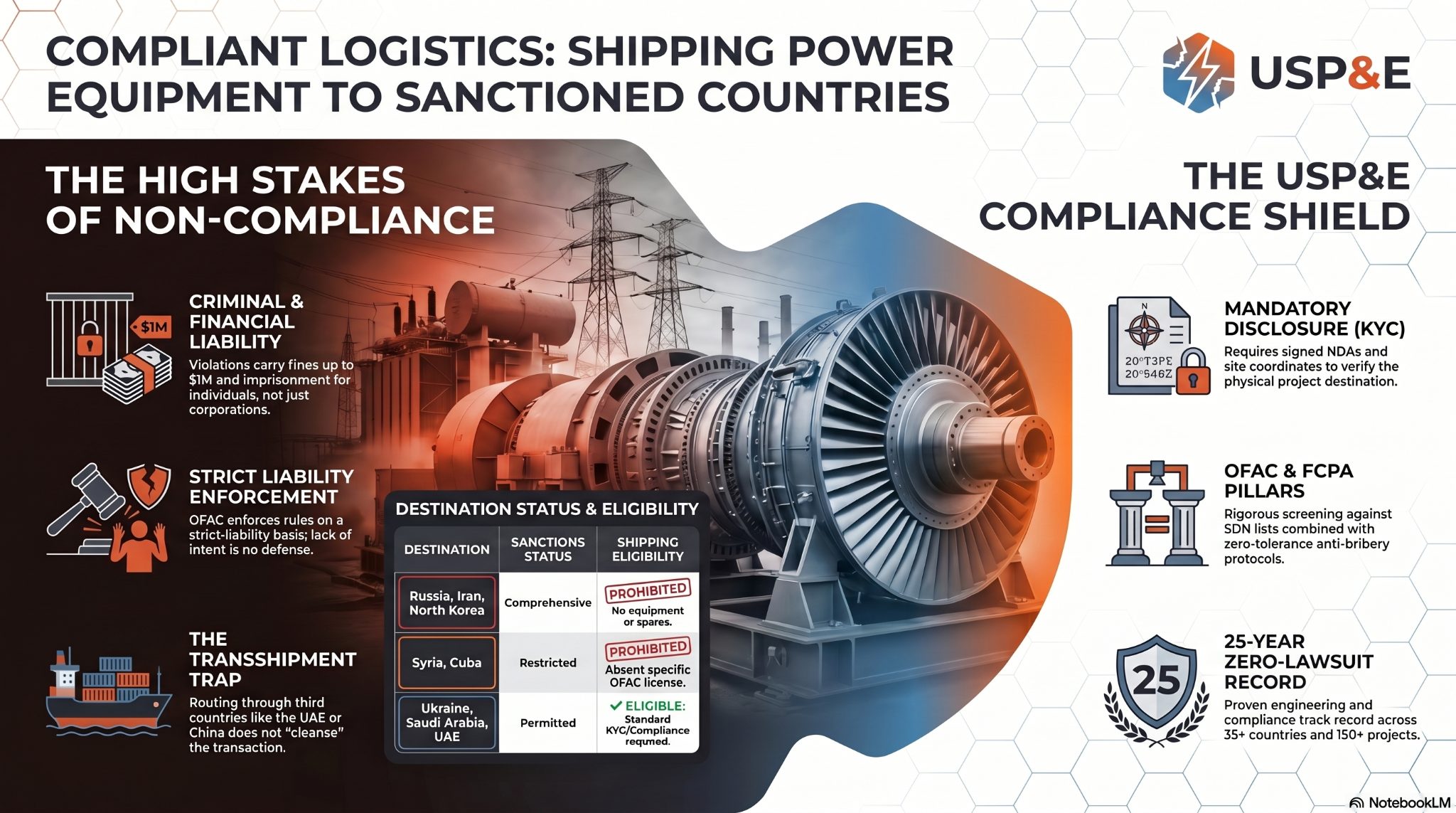
Table 1: Sanctions Status and Power Equipment Shipping Eligibility by Destination
|
Destination |
Sanctions Status |
Power Equipment Shipping Eligibility |
|
Russia (energy sector) |
Comprehensive / sectoral |
Prohibited. No generators, turbines, or spares. |
|
Iran |
Comprehensive embargo |
Prohibited. No equipment or spares, directly or indirectly. |
|
North Korea |
Comprehensive embargo |
Prohibited under all circumstances. |
|
Syria |
Comprehensive, limited licenses |
Restricted. OFAC license required for most activity. |
|
Cuba |
Comprehensive embargo |
Prohibited absent specific authorization. |
|
Ukraine, Saudi Arabia, UAE, Iraq |
Non-sanctioned / permitted |
Eligible with standard KYC and compliance. |
Sanctions programs change frequently. Always confirm current status with OFAC before any transaction. The table reflects general program structure, not legal advice.
Why Shipping Power Equipment to Sanctioned Countries Carries Extreme Risk
The temptation is understandable. Sanctioned markets often have severe power deficits and buyers willing to pay premiums. But the risk profile of shipping power equipment to sanctioned countries is uniquely punishing for several reasons.
- Strict liability exposure. OFAC enforces many violations on a strict-liability basis, meaning intent is not required. A company can be penalized even when it did not know the final destination was sanctioned.
- Personal criminal liability. Willful violations under the International Emergency Economic Powers Act can result in criminal fines up to one million dollars per violation and imprisonment for individuals, not just corporate penalties.
- Secondary sanctions and reputational loss. Non-U.S. parties that facilitate prohibited Russian or Iranian transactions can themselves be designated, losing access to the U.S. financial system. Banks freeze accounts. Insurers walk away.
- Diversion schemes are visible. Routing equipment through the UAE, China, Turkey, or Central Asia to mask an Iranian or Russian end user is a known evasion pattern that enforcement agencies actively monitor. The transshipment does not cleanse the transaction.
- Asset seizure. Equipment in transit to a prohibited destination can be detained or seized, destroying the value of a multimillion-dollar gas turbine package.
USP&E treats this risk as non-negotiable. The moment Iran or Russia is mentioned as a destination, the transaction is closed and the broker is recorded. This is not caution for its own sake. It protects the client, the owners we represent, and the global utilities and listed industrials whose compliance standards we are bound to uphold.
How Compliant Power Equipment Shipping Works: The USP&E Process
Avoiding the trap of shipping power equipment to sanctioned countries begins long before a container is loaded. It begins with knowing exactly who the end buyer is and where the equipment will operate. As an EPC and O&M provider, USP&E applies the same verification discipline whether the asset is a single diesel generator or a complete natural gas turbine power station. The core controls are summarized below.
Table 2: Compliance Controls for Power Equipment Shipping
|
Compliance Control |
What It Verifies and Why It Matters |
|
Signed NDA with KYC |
Establishes the identity of all parties and binds them to disclosure and non-circumvention terms before any technical or location data is shared. |
|
Project site coordinates |
Confirms the physical destination is not in or adjacent to a sanctioned jurisdiction. A buyer who will not disclose location is an immediate red flag. |
|
End buyer identification |
Verifies the ultimate user, not just an intermediary broker, screening against OFAC Specially Designated Nationals lists. |
|
Integrity questionnaire |
Captures shareholders, officers, and politically connected individuals to satisfy FCPA anti-bribery obligations. |
|
Proof of funding |
Confirms a legitimate, financed project rather than a speculative or fraudulent inquiry. |
|
Destination screening |
Cross-checks the country and end user against current OFAC, BIS, and State Department restrictions before quoting. |
This is why USP&E requires a signed NDA, full project disclosure, and answers to its standard qualification questions before issuing any official quote. The process is documented in detail on the USP&E EPC Construction and Operations and Maintenance pages, and it is the same discipline applied across every USP&E power plant engineering engagement.
OFAC and FCPA: The Two Compliance Pillars Behind Every Shipment
Two U.S. legal frameworks govern the conduct of any company involved in international power projects, and both bear directly on shipping power equipment to sanctioned countries.
OFAC and Economic Sanctions
OFAC administers and enforces economic and trade sanctions based on U.S. foreign policy and national security goals. It maintains the Specially Designated Nationals and Blocked Persons List, screens transactions, and authorizes specific licenses where narrow exceptions exist, such as certain humanitarian or reconstruction activity in Syria. No legitimate exporter ships first and seeks a license later. Authorization comes first or the shipment does not move.
FCPA and Anti-Bribery
The Foreign Corrupt Practices Act prohibits paying or offering anything of value to foreign officials to obtain or retain business. USP&E operates under a zero-tolerance anti-bribery policy and a formal integrity questionnaire that screens for politically connected individuals in every transaction. When a government award involves family members or officials tied to commissions, USP&E declines. Combined, OFAC and FCPA compliance form the foundation of a 25-year, zero-lawsuit track record, detailed further on the About USP&E and USP&E number one top-rated EPC and O&M pages.
Red Flags That Signal an Illegal Sanctioned-Country Shipment
Most attempts at shipping power equipment to sanctioned countries announce themselves through recognizable warning signs. Procurement teams and equipment owners should treat any of the following as a reason to stop and verify.
- A buyer who refuses to disclose the project location or says “the location does not matter.”
- Requests to ship to the UAE, China, Turkey, or a Central Asian hub with vague onward plans.
- Insistence on new natural gas turbines or engines with no interest in diesel or HFO packages, a pattern common in Iran-linked inquiries.
- Pressure to skip the NDA, skip KYC, or quote without speaking to the end user.
- Payment offered in gold or other non-standard instruments to obscure the money trail.
- An intermediary who cannot or will not connect you with the actual owner or developer.
When these signals appear, the compliant response is simple: decline and document. USP&E will not ship spares or equipment into any region when the intention is onward delivery to Iran, Russia, or any other sanctioned country, regardless of how the deal is framed.
Frequently Asked Questions: Shipping Power Equipment to Sanctioned Countries
Can I ship a generator or gas turbine to Russia or Iran?
No. Shipping power equipment to sanctioned countries such as Russia’s energy sector or Iran is prohibited under U.S. sanctions enforced by OFAC. This applies to generators, gas turbines, engines, and spare parts. It also applies to indirect shipments routed through a third country. A U.S.-linked company that facilitates such a transaction faces civil and criminal penalties.
Is it legal to ship power equipment to the UAE or China if it will be forwarded to Iran?
No. Transshipment does not make the transaction legal. If equipment is shipped to the UAE, China, or any intermediate country with the intention of onward delivery to a sanctioned destination, the shipment is still a violation. Enforcement agencies actively monitor for these diversion patterns, and the original exporter remains liable.
What are the penalties for shipping power equipment to sanctioned countries?
Penalties include civil fines that can exceed the value of the transaction, criminal fines up to one million dollars per willful violation, and imprisonment for responsible individuals. Companies can also be added to sanctions lists, lose banking access, and have equipment seized in transit. Many OFAC violations are enforced on a strict-liability basis, so a lack of intent is not a defense.
Why does USP&E require the project location before quoting?
USP&E requires verified site coordinates to confirm the equipment is not destined for a sanctioned country and to satisfy OFAC and FCPA obligations. A buyer who will not disclose the location cannot be qualified. This is why a signed NDA, KYC, end buyer identification, and proof of funding precede any official quote.
Can sanctioned-country equipment ever be authorized?
In narrow cases, OFAC issues specific licenses, for example certain reconstruction or humanitarian activity in Syria. Authorization must be obtained in advance from OFAC. No legitimate exporter ships first and requests permission afterward. Absent a valid license, the equipment does not move.
Does USP&E work in conflict regions like Ukraine or Syria?
Yes, USP&E works in non-sanctioned conflict regions including Ukraine, and supports Syria for feasibility and audit work where OFAC authorization permits. The distinction is sanctions status, not conflict. USP&E supports Ukraine, Israel, Saudi Arabia, Iraq, the UAE, Oman, Turkey, and other peaceful and non-sanctioned nations, while declining Iran and Russia outright.
Summary: Key Takeaways on Shipping Power Equipment to Sanctioned Countries
- Shipping power equipment to sanctioned countries such as Russia and Iran is prohibited under U.S. law, including indirect shipments through third countries.
- OFAC enforces many violations on a strict-liability basis, with criminal fines up to one million dollars per violation and possible imprisonment.
- Transshipment through the UAE, China, or Turkey does not legalize a shipment to a sanctioned end user.
- Compliant shipping power equipment to sanctioned-country avoidance starts with a signed NDA, verified site coordinates, end buyer identification, integrity screening, and proof of funding.
- FCPA anti-bribery rules apply in parallel, prohibiting improper payments to foreign officials.
- Clear red flags, including refusal to disclose location, point to illegal intent and should stop any transaction.
- USP&E declines Iran and Russia outright while serving Ukraine, the Middle East, Africa, and the Americas with full compliance.
Ready to Power Your Project? Talk to USP&E’s Engineers Free.
USP&E Global offers a complimentary 4-hour engineering consultation for qualified power station, EPC, and O&M projects. Whether you are in early feasibility or ready to mobilize, our team of 350+ engineers across 35+ countries is ready to guide your project to success with speed and without excuses.
USP&E Global — Powering Possibility. Built for the Frontier.
ISO 9001:2015 | ISO 45001:2018 | 150+ Projects | 35+ Countries | Zero Lawsuits
Quick Links:
- Contact USP&E by clicking on this link.
- Request a fast equipment quote
Global Resources
- USP&E's Project Experience Portfolio
- USP&E Case Studies and Client Reference Letters
- USP&E Integrity and Compliance policy
- USP&E's ISO Certifications and Credentials