

Rent vs Buy Power Station: Total Cost of Ownership Analysis for Mining and Industrial Projects
A mine site or industrial facility that depends on captive generation eventually faces a decision worth tens of millions of dollars over the life of the operation. Should the operator rent a power station, paying a recurring fee for equipment and often service, or buy the assets outright and own the generation? The rent vs buy power station question rarely has a single right answer, because it turns on project duration, capital availability, risk appetite, and how each path treats fuel and maintenance over time. Choosing wrongly can leave money on the table for years. This guide builds an honest ten year total cost of ownership framework, sets out where renting wins and where owning wins, and shows how to structure the decision around real project economics. USP&E Global owns generating assets, operates plants under long term agreements, and supports both rental and purchase models, and we act as the guide while your project remains the priority.
The Rent vs Buy Power Station Decision: What the Data Shows
The economics of captive power are dominated by two facts. First, fuel and operations usually cost far more over a plant’s life than the equipment itself, which means the decision is about lifecycle cost, not just the purchase or rental price. Second, the right answer depends heavily on how long the operation needs power, because rental favours short horizons and ownership favours long ones.
The table below frames the core trade offs that drive the rent vs buy power station decision.
| Decision Factor | Renting Favoured | Buying Favoured |
| Project duration | Short, under roughly 2 to 3 years | Long, 5 years or more |
| Capital availability | Limited upfront capital | Capital available or financeable |
| Demand certainty | Uncertain or temporary | Stable and long term |
| Risk appetite | Prefer to offload asset risk | Comfortable owning assets |
Authoritative cost context supports a disciplined approach. The United States Energy Information Administration publishes generation cost benchmarks, the International Renewable Energy Agency documents power generation cost data across technologies, and the World Bank energy and mining data portal provides the broader market context for frontier and industrial power. These sources reinforce that lifecycle cost, dominated by fuel and operations, should anchor any rent vs buy power station analysis.
Key Drivers of the Rent vs Buy Power Station Decision: Why It Matters Now
Several forces make this decision more consequential than ever for mining and industrial operators. Each one affects where the break even between renting and owning falls.
- Long mine lives. Many mining operations run for a decade or more, a horizon over which cumulative rental payments can substantially exceed the cost of owning the same capacity.
- Capital discipline. Boards increasingly scrutinise capital allocation, which can favour rental in the short term even when ownership is cheaper over the full life.
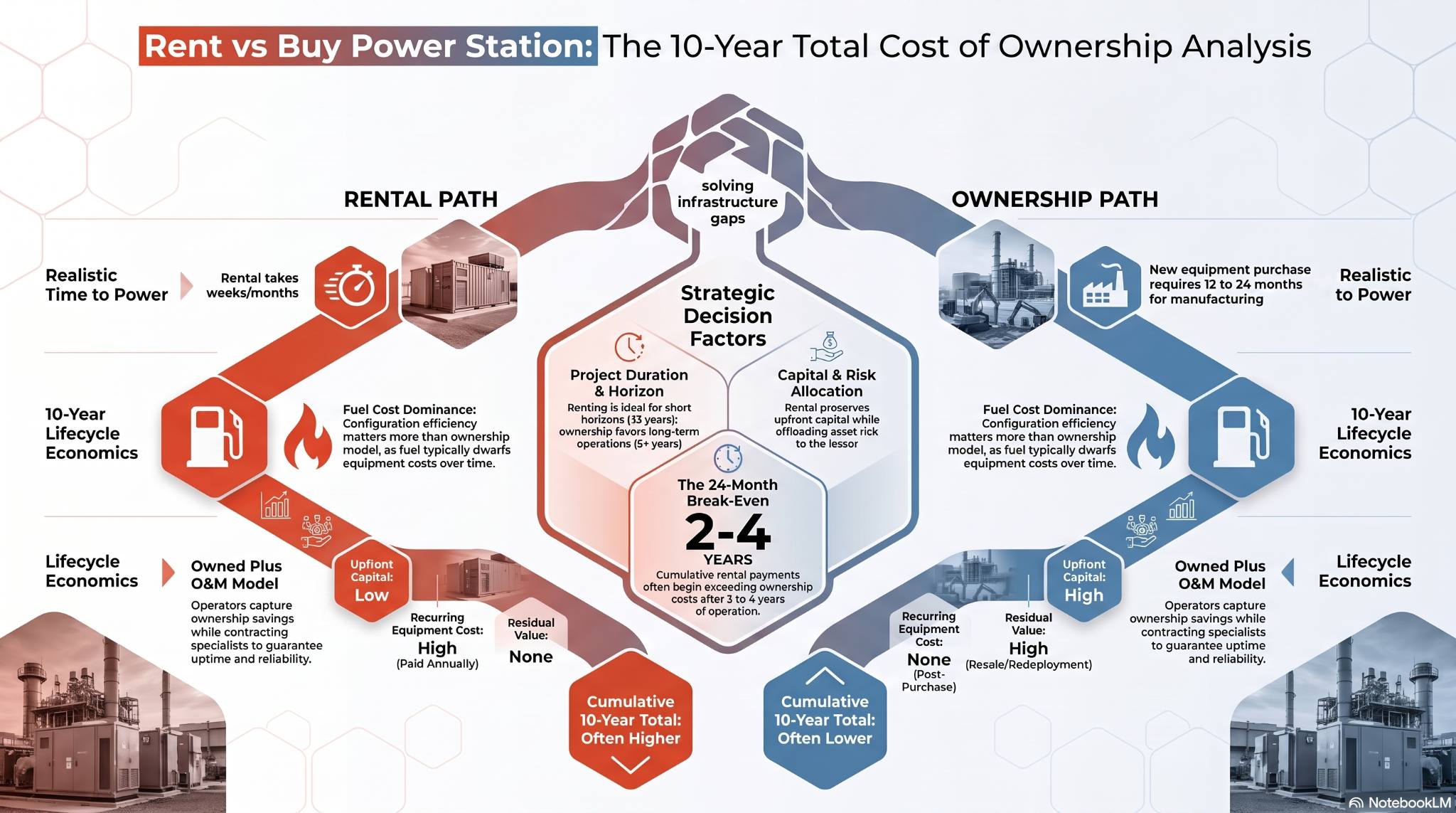
- Fuel cost dominance. Because fuel typically dwarfs equipment cost over time, the configuration that lowers fuel burn, whether owned or rented, often matters more than the rental versus purchase choice itself.
- Lead time pressure. New equipment can take 12 to 24 months to manufacture, so rental or owned surplus inventory can both compress the path to power, depending on availability.
The financial logic is best seen through a simplified ten year comparison. The table below illustrates the typical pattern, using indicative relative figures rather than a specific quote.
| Cost Element Over 10 Years | Rental Path | Ownership Path |
| Upfront capital | Low | High |
| Recurring equipment cost | High, paid every year | None after purchase |
| Fuel cost | Comparable, configuration driven | Comparable, configuration driven |
| Maintenance | Often bundled in rental | Owner or O&M contract |
| Cumulative 10 year total | Often higher for long projects | Often lower for long projects |
The pattern is clear. For short or uncertain horizons, rental avoids stranded capital and offloads asset risk. For long, stable operations, ownership usually wins because recurring rental payments accumulate while an owned asset’s equipment cost is paid once. A qualified power plant engineering partner can model the specific break even for a given project.
EPC and O&M Solutions for the Rent vs Buy Power Station Decision: A Technical and Commercial Overview
The rent vs buy power station decision is not purely financial, because the chosen path shapes how fuel, maintenance, and reliability are managed. Rental arrangements often bundle equipment with service, which simplifies operations but embeds a recurring premium. Ownership shifts both the asset and the operating responsibility to the operator, who can either run the plant in house or contract operations and maintenance to a specialist, frequently the better choice in frontier and remote settings.
The middle path matters too. Many operators own the assets to capture long term value while contracting a specialist for operations and maintenance under a long term service agreement that provides availability guarantees and spare parts management. This combines the lifecycle savings of ownership with the reliability discipline of professional operation.
The table below sets realistic time to power expectations, which influence whether rental or ownership is even feasible on a given schedule.
| Path to Power | Realistic Timeline | Notes |
| Rental from available fleet | Weeks to a few months | Fastest where suitable units exist |
| Purchase of owned or surplus inventory | 90 to 180 days for diesel | Compresses versus new manufacturing |
| Purchase of new equipment | 12 to 24 months | Longest lead time |
| HFO plant (rent or buy) | 9 to 14 months | Never genuinely fast track |
Fuel quality, ambient conditions, remote logistics, and spare parts pre positioning all affect operating cost regardless of whether the plant is rented or owned. This is why the configuration decision, including the choice between diesel, heavy fuel oil, and hybrid systems, often influences total cost more than the rental versus purchase question. A credible EPC construction and operations partner evaluates all of these together.
On honest cost ranges, fully installed owned capacity typically falls between 800,000 and 1,500,000 US dollars per megawatt once balance of plant and interconnection are included, while rental is priced as a recurring fee that, over a long horizon, can exceed that installed cost several times. USP&E supports both models and prices each against the specific project rather than pushing a single answer.
Cost Structure Comparison for Rent vs Buy Power Station Decisions
| Cost Structure | Rental | Ownership | Owned Plus O&M Contract |
| Upfront capital | Low | High | High |
| Recurring fee | High | None | O&M fee only |
| Asset risk | Held by lessor | Held by owner | Held by owner |
| Reliability accountability | Lessor or operator | Owner | O&M contractor guarantees |
Case Studies: Proven Rent vs Buy Power Station Outcomes in Mining and Industrial Markets
The most credible evidence is delivery across both models in demanding conditions. USP&E owns more than 100 megawatts of generating assets, holds exclusivity on hundreds more, operates more than 260 megawatts under long term agreements, and supports rental, purchase, and owned plus operated structures.
In Mali, USP&E has operated owned and managed power for major gold producers, sustaining availability above 97 percent across multiple years, demonstrating the long term reliability that justifies an ownership or owned plus operated decision on a long life mine. Across West Africa, USP&E has deployed power barges and rental capacity for clients with shorter or bridging requirements, demonstrating the rental path where it fits. In Togo, USP&E delivered a 50 megawatt natural gas turbine station under full EPC and a multi year operations and maintenance contract, an example of the owned plus operated model that captures lifecycle value while guaranteeing uptime.
These outcomes are documented in USP&E’s project experience and client references. Because USP&E both owns assets and operates plants, the rent vs buy power station advice it gives is grounded in delivering every option, not selling one.
How to Decide Between Renting and Buying a Power Station: 10 Critical Criteria
Making the rent vs buy power station decision well is a structured analysis. These criteria help a mine energy manager or industrial operator evaluate the choice objectively.
- Project duration. Map the expected operating life. Short or uncertain horizons favour rental, long stable ones favour ownership.
- Total cost of ownership. Model the full ten year cost including fuel and maintenance, not just the upfront or monthly figure.
- Capital availability. Assess whether capital is available or financeable, since rental preserves capital at a recurring premium.
- Fuel configuration. Because fuel dominates lifecycle cost, evaluate diesel, heavy fuel oil, and hybrid options carefully under either path.
- Reliability accountability. Decide who guarantees uptime. An owned plus operated model places that on the operations and maintenance contractor.
- Asset risk tolerance. Rental offloads asset risk to the lessor, while ownership retains both the risk and the residual value.
- Lead time. Confirm whether rental, owned surplus, or new equipment fits the project schedule.
- Residual value. Owned assets retain resale or redeployment value at the end of the project, which rental does not.
- Compliance and certification. Under either path, confirm Foreign Corrupt Practices Act and Office of Foreign Assets Control compliance and ISO 9001 and ISO 45001 certification.
- Partner flexibility. Choose a partner who offers rental, purchase, and owned plus operated structures honestly rather than pushing a single model.
Evaluated against these criteria, the rent vs buy power station decision becomes a disciplined financial and engineering analysis rather than a guess, especially with hybrid power systems increasingly in the mix.
Frequently Asked Questions: Rent vs Buy Power Station
Is it cheaper to rent or buy a power station?
It depends on project duration. For short or uncertain horizons, renting is usually cheaper and avoids stranded capital. For long, stable operations of roughly five years or more, buying is usually cheaper over the full life because recurring rental payments accumulate while an owned asset’s equipment cost is paid once.
How do I calculate total cost of ownership for a power station?
Model the full project life, including upfront capital or cumulative rental fees, fuel cost, maintenance, and residual value. Because fuel and operations typically dominate, the configuration that lowers fuel burn often matters more than the rent versus buy choice itself. A qualified partner can build the break even model for your specific project.
What is the break even point between renting and buying?
The break even varies by project, but it commonly falls somewhere in the range of two to four years of continuous operation, after which cumulative rental payments tend to exceed the cost of owning the same capacity. The exact point depends on rental rates, capital cost, and fuel configuration.
Can I own the power station but still have it professionally operated?
Yes. The owned plus operated model is common and often optimal in frontier and remote settings. The operator owns the assets to capture lifecycle value while contracting a specialist for operations and maintenance under a long term service agreement with availability guarantees.
How fast can I get power if I rent versus buy?
Rental from an available fleet can deliver in weeks to a few months. Purchasing owned or surplus diesel inventory can deliver in roughly 90 to 180 days, while new equipment can take 12 to 24 months to manufacture. Heavy fuel oil plants require 9 to 14 months under either path.
Does USP&E offer both rental and purchase options?
Yes. USP&E owns generating assets, holds exclusivity on hundreds of additional megawatts, operates more than 260 megawatts under long term agreements, and supports rental, purchase, and owned plus operated structures, which means its advice is grounded in delivering every option.
Summary: Key Takeaways for Rent vs Buy Power Station Decision-Makers
- The rent vs buy power station decision turns on project duration, capital availability, fuel configuration, and risk appetite, not on a single universal answer.
- Renting favours short or uncertain horizons and preserves capital, while buying favours long, stable operations because recurring fees accumulate over time.
- Lifecycle cost dominated by fuel and operations should anchor the analysis, often more than the rental versus purchase choice itself.
- The break even commonly falls around two to four years of continuous operation, depending on rates, capital cost, and configuration.
- An owned plus operated model captures ownership savings while guaranteeing uptime through a long term operations and maintenance contract.
- USP&E owns assets, operates plants, and supports every rent vs buy power station structure, bringing 150 plus projects and 350 plus engineers to the decision.
Ready to Power Your Project? Talk to USP&E’s Engineers Free.
USP&E Global offers a complimentary 4-hour engineering consultation for qualified power station, EPC, and O&M projects. Whether you are in early feasibility or ready to mobilize, our team of 350+ engineers across 35+ countries is ready to guide your project to success with speed and without excuses.
USP&E Global. Powering Possibility. Built for the Frontier.
ISO 9001:2015 | ISO 45001:2018 | 150+ Projects | 35+ Countries | Zero Lawsuits
Quick Links:
- Contact USP&E by clicking on this link.
- Request a fast equipment quote
Global Resources
- USP&E's Project Experience Portfolio
- USP&E Case Studies and Client Reference Letters
- USP&E Integrity and Compliance policy
- USP&E's ISO Certifications and Credentials