

Power Plant Project Insurance: The Complete Guide to CAR, DSU and Political Risk Cover for Frontier EPC Projects
A 40 MW gas turbine sitting on a quayside in West Africa is worth more than every vehicle, building and spare part on the project site combined. It arrives by breakbulk vessel, is lifted by a crane hired from a third party, travels inland on a road that may not have carried that axle load before, and is then erected, fuelled and fired for the first time by a construction crew. At each of those handovers, someone is carrying the risk of total loss. Power plant project insurance is the mechanism that decides whether that someone is you.
Most developers discover this late. The financial model is built, the equipment is bought, the engineering, procurement and construction contract is drafted, and then a lender’s independent engineer asks for the insurance schedule and the project stops for six weeks. The cover is not exotic, but it is specific, it must be placed in the right sequence, and in many frontier jurisdictions it cannot legally be bought offshore.
This guide sets out the cover types that a thermal power project actually needs, when each must be in force, how frontier market conditions change the placement, and what a procurement team should ask an EPC contractor before award. Your project and its bankability are the subject here. USP&E Global’s role is the guide that has moved turbines through ports, borders and conflict-adjacent regions across more than 35 countries and has had to satisfy these requirements on every one of them.
A note on scope. USP&E Global is an EPC and operations and maintenance contractor, not an insurance broker, underwriter or legal adviser. What follows is general engineering and commercial guidance drawn from project delivery experience. Specific policy wordings, limits and placements must be arranged through a licensed broker and reviewed by your own legal and insurance advisers.
The Power Plant Project Insurance Challenge in Frontier Markets: What the Data Shows
Insurance for power projects is priced against country risk, and frontier country risk is measurable. The underlying reason these projects exist is the same reason they are difficult to insure: the grid does not work, the institutions are stretched, and the operating environment is volatile.
The scale is documented. According to the International Energy Agency, around 600 million people in sub-Saharan Africa lacked access to electricity as of 2024, close to half the region’s population. The Multilateral Investment Guarantee Agency, part of the World Bank Group, reports that unreliable electricity costs firms in sub-Saharan Africa an estimated 2.1 percent of total economic output annually, with more than 75 percent of firms in the region experiencing frequent outages averaging eight times per month and lasting over five hours.
Risk cover is also becoming a deliberate instrument of energy policy. In 2025 MIGA executed framework terms of USD 495 million with a single distributed energy investor, covering currency inconvertibility and transfer restriction risk for up to 15 years across around 100 projects in as many as 20 African countries. The African Development Bank and the World Bank are pursuing the Mission 300 target of connecting 300 million people in sub-Saharan Africa by 2030, and World Bank energy sector data underpins the country risk assessments that underwriters and development finance institutions apply. Lenders attach insurance conditions to almost every facility they advance.
|
Frontier Power Risk Indicator |
Latest Reported Figure |
Source and Year |
Insurance Implication |
|
Cost of unreliable electricity to firms, sub-Saharan Africa |
About 2.1 percent of total economic output each year |
MIGA, World Bank Group, 2025 |
Establishes the business interruption exposure that DSU and BI cover addresses |
|
Firms experiencing frequent outages, sub-Saharan Africa |
Over 75 percent, averaging 8 outages per month lasting more than 5 hours |
MIGA, World Bank Group, 2025 |
Drives captive generation demand and the insurable asset base |
|
People without electricity access, sub-Saharan Africa |
About 600 million, roughly 47 percent of the population |
IEA, 2024 data |
Confirms the pipeline of new insurable thermal and hybrid projects |
|
Portfolio political risk guarantee, African distributed energy |
USD 495 million framework, about 100 projects, up to 20 countries, 15 year tenor |
MIGA, World Bank Group, 2025 |
Shows political risk cover moving to portfolio structures for scale |
|
Mission 300 connection target |
300 million people connected by 2030 |
World Bank and African Development Bank, 2024 |
Signals sustained development finance conditionality on insurance |
Key Drivers of Power Plant Project Insurance in Frontier Markets: Why Now Is the Critical Window
Five forces have moved insurance from a back office formality to a gating item on the critical path.
- Lenders now dictate the schedule. Development finance institutions and commercial lenders make disbursement conditional on evidence of specific cover at specific limits, with the lender named as loss payee. The International Finance Corporation and peer institutions apply this consistently. A project that has not resolved its insurance structure cannot reach financial close, regardless of how complete the engineering is.
- Equipment values have concentrated. A modern power station carries an enormous share of its value in a small number of items: the turbine or engine, the generator, the step up transformer. Losing one transformer in transit can idle an entire plant, and its replacement lead time is measured in many months, which converts a property loss directly into a revenue loss.
- Local admitted insurance rules have tightened. A significant number of African, Middle Eastern and Asian jurisdictions require that risks located in country be insured by a locally licensed insurer, with capacity then reinsured offshore. Buying a neat international policy and assuming it will respond is one of the most common and most expensive errors in frontier project delivery.
- Political and security risk has repriced. Coups, currency controls, expropriation risk and civil disturbance across parts of the Sahel and the wider frontier have hardened terms for war and political violence cover. Where cover remains available, sub-limits and exclusions have tightened, and lead times to place have lengthened.
- Schedule certainty has become a financial instrument. Where a power purchase agreement carries delay damages, or a mine has sequenced production against an energisation date, a delay caused by an insured physical loss is a revenue event. Delay in start up cover exists precisely to bridge that, and it is only purchasable before the loss occurs.
|
Power Plant Project Insurance Cover Type |
What It Protects |
Period It Applies |
Typically Required By |
|
Construction and Erection All Risks (CAR and EAR) |
Physical loss or damage to works, materials and plant during construction and erection |
Site mobilisation to provisional acceptance, including the testing and commissioning period |
Lenders, owner, EPC contract |
|
Marine cargo and transit |
Loss or damage to equipment in ocean transit, port handling, storage and inland haulage |
Ex works or port of loading through to site delivery |
Owner, EPC contract, supplier terms |
|
Delay in Start Up (DSU) and Advance Loss of Profits |
Lost revenue or debt service where an insured physical loss delays commercial operation |
Attaches to CAR and marine cargo, runs to commercial operation date |
Lenders, almost always mandatory in project finance |
|
Third party liability |
Injury to third parties and damage to third party property arising from the works |
Construction and commissioning period |
EPC contract, local law, lenders |
|
Operational property damage and machinery breakdown |
Physical damage and internal mechanical or electrical failure of plant once operating |
Commercial operation date onwards, renewed annually |
Lenders, O&M contract, owner |
|
Operational business interruption |
Lost gross profit or revenue following an insured operational loss |
Runs alongside operational property damage cover |
Lenders, PPA counterparties |
|
Political risk insurance |
Expropriation, currency inconvertibility, transfer restriction, war and civil disturbance, breach of contract |
Investment life, commonly 10 to 15 year tenors |
Equity investors, lenders, export credit agencies |
|
Employer’s liability and workmen’s compensation |
Statutory cover for injury to the workforce |
Throughout construction and operation |
Local law, non-negotiable |
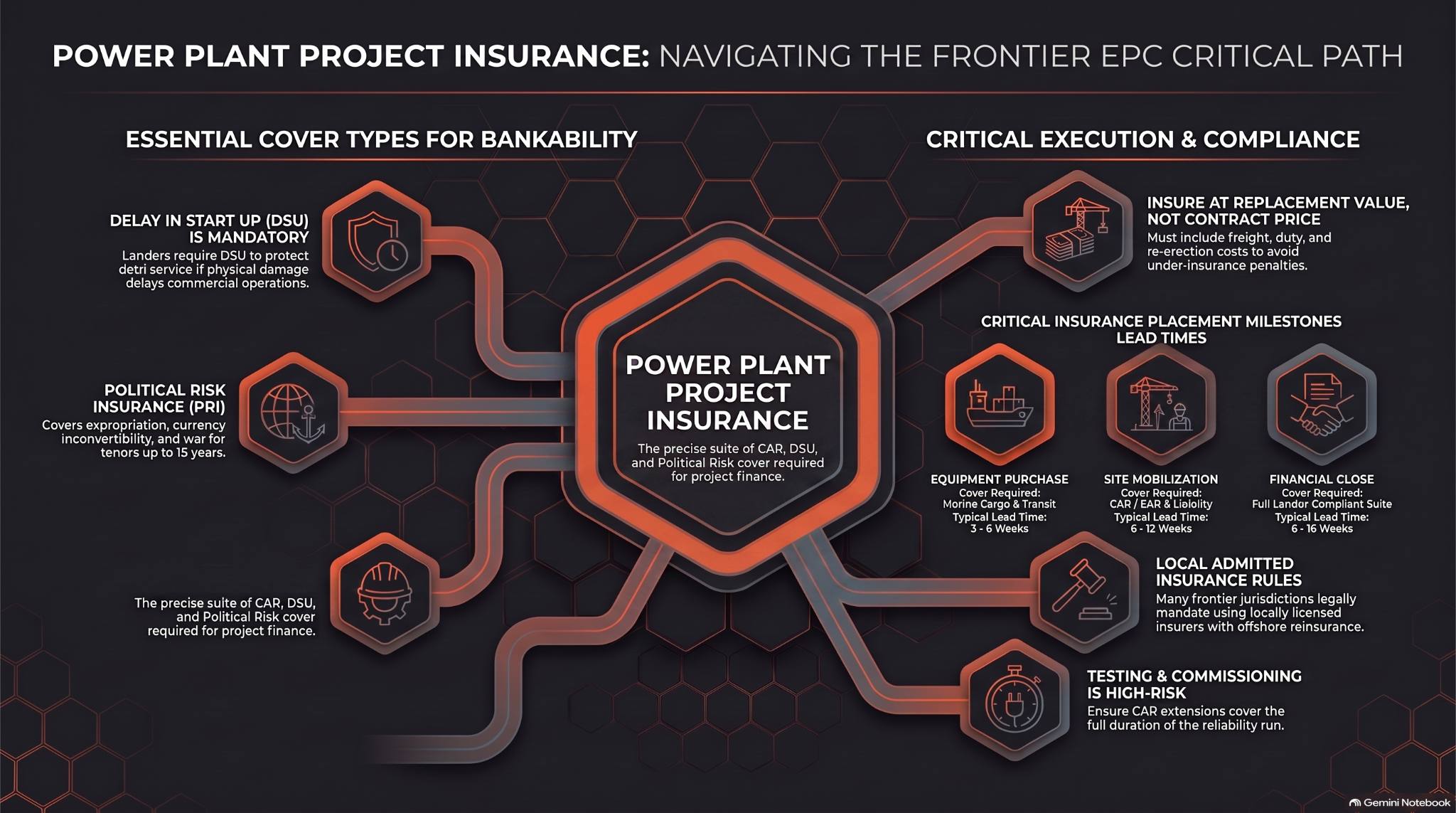
EPC and O&M Solutions for Power Plant Project Insurance: A Technical and Commercial Overview
Insurability is an engineering outcome. Underwriters price what they can see, and a project that presents a coherent design, a competent contractor and a documented method statement is quoted differently from one that does not.
Get the sum insured right. The most frequent structural error is insuring at contract price. The correct basis is full replacement value, which includes the cost of the replacement equipment, ocean and inland freight, import duties and taxes, customs clearance, re-erection labour, professional fees and an allowance for escalation. In a frontier market, freight, duty and re-erection can add a very substantial percentage on top of the equipment cost. Under-insurance triggers average, meaning a partial loss is settled only in the proportion that the sum insured bears to the true value.
Treat testing and commissioning as its own risk. The period from first fire to reliability run concentrates more risk than the entire civil and erection programme. Rotating equipment is turned for the first time, fuel systems are live, and protection settings are being proven. CAR policies commonly sub-limit or time-limit the testing and commissioning extension, and cold testing and hot testing may be treated differently. Confirm the extension covers the full reliability run duration your PPA or EPC construction contract requires, not a standard four week default.
Understand the defects exclusions. Policies exclude defective design, material or workmanship to varying degrees. The market standard clauses progressively narrow that exclusion, and the difference between the narrowest and widest wording is the difference between recovering the cost of resulting damage and recovering nothing. This is a wording negotiation, not a price negotiation, and it is where broker quality shows.
Plan the transit as a documented chain. Breakbulk turbine and engine movements need packing specifications, lifting studies, route surveys for axle loading and bridge clearance, and defined storage conditions if the cargo waits at port. Underwriters will ask for these. Projects that can produce them get better terms, and projects that cannot often find storage sub-limits and port congestion exclusions applied.
Confirm the local placement structure early. Establish at feasibility stage whether the jurisdiction mandates local admitted insurance, which local insurers hold the licence, what reinsurance capacity sits behind them and what security rating the lender will accept. This takes months, not weeks, in some markets.
Align the O&M contract with the operational policy. After the commercial operation date, cover shifts from construction to operational property damage, machinery breakdown and business interruption. Deductibles, maintenance warranties and spare parts holding requirements in the policy must match what the O&M contract actually delivers. A policy that assumes a critical spares holding the operator does not maintain is a claim waiting to be declined.
|
Project Milestone |
Cover That Must Be In Force |
Typical Lead Time to Place |
|
Equipment purchase and ex works collection |
Marine cargo, including storage and transit extensions |
3 to 6 weeks |
|
Site mobilisation and civil works start |
Construction and Erection All Risks, third party liability, employer’s liability |
6 to 12 weeks |
|
Financial close and first drawdown |
Full lender-compliant suite including DSU, with lender named as loss payee |
8 to 16 weeks, often the binding constraint |
|
First fire and reliability run |
CAR testing and commissioning extension, confirmed for the full test duration |
Confirm at CAR placement, not at first fire |
|
Commercial operation date |
Operational property damage, machinery breakdown and business interruption |
4 to 8 weeks before handover |
Fuel Type Comparison for Frontier Power Projects
Fuel and technology choice changes the construction risk profile that underwriters price, because it changes the erection scope, the testing duration and the concentration of value in single items. The ranges below are honest planning bands for fully installed capacity, not quotations.
|
Fuel Type |
CapEx per MW Installed |
OpEx Profile |
Lead Time |
Best Application |
Construction Risk Profile for Underwriters |
|
Diesel gensets |
USD 700,000 to 1,200,000 |
Highest fuel cost per kWh |
8 to 16 weeks |
Bridging power, camps, peaking, emergency cover |
Lowest, modular units, short testing period, value spread across many machines |
|
Heavy fuel oil plant |
USD 400,000 to 900,000 |
Lowest thermal fuel cost per kWh |
9 to 14 months |
Large continuous baseload for mining and island grids |
Highest, long erection, extensive welding and fuel treatment systems |
|
Natural gas reciprocating or turbine |
USD 500,000 to 1,200,000 |
Low where gas supply exists |
9 to 18 months |
Utilities, industrial hosts, data centres |
Moderate to high, value concentrated in turbine and transformer |
|
Hybrid solar with storage plus thermal |
USD 900,000 to 1,600,000 |
Lowest blended fuel burn |
9 to 18 months |
Remote mines targeting structural fuel reduction |
Moderate, dispersed asset value, battery fire risk assessed separately |
|
Mobile gas turbine such as GE TM2500 |
USD 700,000 to 1,300,000 |
Varies with fuel and duty |
Weeks to a few months |
Emergency, bridging and fast track grid support |
Lower schedule risk, which materially reduces DSU exposure |
Where schedule risk is the dominant exposure, mobilising proven equipment shortens the window in which a delay can occur. USP&E’s mobile gas turbine fleet and broader natural gas turbine inventory exist for exactly that reason.
Case Studies: Risk, Logistics and Schedule Certainty in Frontier Delivery
The following examples are drawn from USP&E’s documented project record. Each illustrates a risk that insurance is designed to address, and each shows that the cheapest form of risk transfer is delivery competence.
Guinea, 40 MW heavy fuel oil power station for the national utility. USP&E engineered, procured, constructed and commissioned a 40 MW HFO plant in Conakry using four MAN 18V32/40 engines on RME180 fuel. The project completed in 10 months and was commissioned two months ahead of schedule and on budget. Early commissioning is the most direct reduction of delay in start up exposure available to any project, because the exposure only exists between the planned and actual energisation dates.
Sierra Leone, 16 MW heavy fuel oil power station for an iron ore mining client. USP&E designed and delivered a 16 MW HFO station for a mine near Lunsar using ten HHI 9L21/32 engines on RME180 fuel. The project took five months and was commissioned two months ahead of schedule and on budget. A mine sequencing production against an energisation date carries the schedule risk directly on its own revenue, which is the exposure DSU cover is written to protect.
Iraq, 32 MW MAN power plant relocated across jurisdictions. A client held an unused 32 MW MAN power plant, with equipment stored in Germany and Indonesia, which a regulatory change had made unusable in its intended market. USP&E secured a buyer in Iraq and coordinated the transfer of equipment and designs across both storage locations. This is the multi jurisdiction cargo and storage scenario that marine policies handle poorly when transit routes, storage durations and insurable interests are not documented before the equipment moves.
USP&E has operated across frontier and conflict-adjacent regions in more than 35 countries with a 25 year record and zero lawsuits, and holds ISO 9001:2015 and ISO 45001:2018 certification. Documented management systems and a clean claims history are the two things that most reliably improve terms at renewal. The full record is available in USP&E’s project portfolio and client references.
How to Select an EPC Partner Who Strengthens Your Insurance Position: 10 Critical Criteria
- Ask who places what. Establish at bid stage whether the owner or the EPC contractor places CAR, marine cargo and third party liability. Ambiguity here produces either double cover, which is wasted money, or a gap, which is uninsured loss.
- Require all parties to be named insured. The policy should name the owner, the EPC contractor, subcontractors and the lender, with a cross liability clause. Otherwise an insurer can pay a claim and then pursue the contractor who caused it, which simply relocates the loss inside your project.
- Confirm the testing and commissioning extension explicitly. Ask the bidder to state, in writing, the duration and scope of the testing extension assumed in their price, and check it against your reliability run requirement.
- Check the sum insured basis. The bid should show replacement value including freight, duty, clearance, re-erection and escalation, not contract price. A bidder who cannot explain the difference has not placed cover in a frontier market before.
- Test their local admitted insurance knowledge. Ask directly which local insurer they intend to use, what the reinsurance structure is and what security rating sits behind it. Vague answers here become financial close delays later.
- Review the claims history and management systems. ISO 9001:2015 and ISO 45001:2018 certification, a documented safety record and an absence of material litigation all price into the risk. Ask for the loss record, not just the safety policy.
- Examine logistics capability as risk control. Route surveys, lifting studies, packing specifications and port handling experience are what underwriters actually assess on a breakbulk power project. A contractor who has moved turbines through the specific ports in question is a lower risk than one who has not.
- Probe schedule realism. An unrealistic programme is an insurance problem because DSU is priced against the planned commercial operation date. A contractor who promises a heavy fuel oil plant in 90 days is creating an exposure, not removing one.
- Align the O&M scope with the operational policy. Confirm that maintenance regimes, spares holdings and monitoring in the operations and maintenance scope satisfy the warranties the operational policy will impose.
- Verify compliance credentials. Foreign Corrupt Practices Act and Office of Foreign Assets Control compliance affect both insurability and lender acceptance, particularly where political risk cover is involved. USP&E’s approach is documented in its commitment and company
Frequently Asked Questions: Power Plant Project Insurance
What insurance does a power plant project need?
A thermal power project typically needs construction and erection all risks cover, marine cargo and transit cover, delay in start up cover, third party liability, employer’s liability or workmen’s compensation, and, once operating, property damage, machinery breakdown and business interruption cover. Projects in frontier markets frequently add political risk insurance covering expropriation, currency inconvertibility, transfer restriction and political violence. Lenders usually specify the exact suite and limits as conditions precedent to disbursement.
What is delay in start up insurance and why do lenders require it?
Delay in start up insurance, sometimes called advance loss of profits, pays the revenue or debt service a project loses when an insured physical loss pushes back the commercial operation date. It attaches to the construction and marine policies, so it only responds where the underlying delay was caused by an insured physical event, not by ordinary contractor delay. Lenders require it because their repayment schedule begins at commercial operation, and a six month delay to energisation is a six month hole in debt service.
Can I insure a power plant project in Africa with an international policy?
Often not directly. Many African, Middle Eastern and Asian jurisdictions require risks located in country to be insured by a locally licensed insurer, with the capacity then reinsured into the international market through a fronting arrangement. Assuming an offshore policy will respond is a common and expensive mistake. Confirm the local admitted insurance position during feasibility, because establishing the structure and satisfying lender security rating requirements can take months.
What should the sum insured be on a power plant?
The sum insured should reflect full replacement value, not the contract price. That means the replacement cost of the equipment plus ocean and inland freight, import duties and taxes, customs clearance, re-erection labour, professional fees and an allowance for cost escalation over the project period. In remote frontier locations these additional elements are substantial. Insuring at contract price leaves the project under-insured, which means partial losses are settled proportionally rather than in full.
Does construction insurance cover the testing and commissioning period?
Only if the extension is specifically arranged, and often only within a sub-limit or a defined time window. Testing and commissioning is the highest risk phase of a thermal power project, because rotating equipment runs for the first time and fuel systems go live. Cold testing and hot testing may be treated differently in the wording. Confirm that the extension covers the full duration and scope of your reliability run before the policy is bound.
What is political risk insurance and who provides it?
Political risk insurance protects against non-commercial risks arising from government action or inaction, typically including expropriation, currency inconvertibility and transfer restriction, war, terrorism and civil disturbance, breach of contract, and non-honouring of financial obligations. It is provided by the Multilateral Investment Guarantee Agency within the World Bank Group, by export credit agencies, and by private underwriters. Tenors commonly run to 15 years, matching project debt.
Who should place the insurance, the owner or the EPC contractor?
Both structures are used and both work if the allocation is explicit. Owner controlled placement gives consistent wordings across all contractors and avoids duplicated premium, while contractor controlled placement puts cover in the hands of the party managing the site risk. What fails is silence in the EPC contract, which produces either overlapping policies or an uninsured gap. Resolve it in the contract, not after mobilisation.
Summary: Key Takeaways for Power Plant Project Insurance Decision-Makers
- Power plant project insurance is a critical path item, not an administrative one. Lender conditions precedent regularly gate financial close on it.
- The core construction suite is CAR and EAR, marine cargo and transit, delay in start up, third party liability and statutory employer’s liability, converting at commercial operation to property damage, machinery breakdown and business interruption.
- Sum insured must be full replacement value including freight, duty, clearance, re-erection and escalation. Insuring at contract price causes proportional settlement of partial losses.
- Testing and commissioning is the highest risk phase and is frequently sub-limited. Confirm the extension covers the full reliability run.
- Many frontier jurisdictions mandate local admitted insurance with offshore reinsurance, so the placement structure must be resolved during feasibility.
- Political risk insurance covering expropriation, currency inconvertibility, transfer restriction and political violence is available at tenors matching project debt, including from the World Bank Group.
- Delivery competence is risk transfer. Early commissioning, documented logistics and certified management systems improve both insurability and pricing.
- Power plant project insurance rewards contractors with clean claims records and documented systems, which is why the EPC selection decision and the insurance outcome cannot be separated.
Ready to Power Your Project? Talk to USP&E’s Engineers Free.
USP&E Global offers a complimentary 4-hour engineering consultation for qualified power station, EPC, and O&M projects. Whether you are in early feasibility or ready to mobilize, our team of 350+ engineers across 35+ countries is ready to guide your project to success with speed and without excuses.
USP&E Global. Powering Possibility. Built for the Frontier.
ISO 9001:2015 | ISO 45001:2018 | 150+ Projects | 35+ Countries | Zero Lawsuits
Quick Links:
- Contact USP&E by clicking on this link.
- Request a fast equipment quote
Global Resources
- USP&E's Project Experience Portfolio
- USP&E Case Studies and Client Reference Letters
- USP&E Integrity and Compliance policy
- USP&E's ISO Certifications and Credentials