

Power Plant EPC for Oil Refineries in Israel: The Complete Guide to Cogeneration, Gas Turbine Installation, and Industrial Power O&M
Israel’s oil refining sector depends on uninterrupted, reliable power. When an Iranian ballistic missile struck the Bazan Group‘s Haifa cogeneration plant in June 2025, causing an estimated USD 150 to 200 million in direct damage and forcing the shutdown of the country’s largest refinery, the lesson for every industrial energy manager in the Eastern Mediterranean was immediate: power plant EPC for oil refineries in Israel is not an operational convenience. It is critical national infrastructure. For energy managers, procurement officers, and EPC project developers at Israel’s petrochemical and refining facilities, this discipline demands a partner who has built and operated power stations under pressure, in complex industrial environments, and in geopolitically challenging conditions. USP&E Global has done exactly that across 35 countries and 150 plus projects over 25 years.
The Energy Challenge in Israel’s Industrial Sector: What the Data Shows
Israel’s electricity market is among the most strategically significant in the Eastern Mediterranean. With an installed capacity of 24.7 GW as of end-2024, a peak demand record of 15.5 GW set in August 2023, and a national target of 39.6 to 41.7 GW by 2030 as stated by the Israel Electricity Authority, the country is managing rapid capacity expansion against a backdrop of grid reform, natural gas transition, and wartime infrastructure risk. Approximately 70 percent of Israel’s electricity generation is fueled by natural gas, supplied from the offshore Tamar and Leviathan fields operated by Chevron and its partners. In January 2026, Chevron took a Final Investment Decision on a USD 2.36 billion Leviathan expansion to lift output to approximately 21 billion cubic meters per year, securing Israel’s gas-supply backbone for decades.
For oil refineries specifically, power reliability is existential. At Bazan Group, Israel’s largest integrated refinery operating at 197,000 barrels per day with a Nelson Complexity Index of 11.1, the onsite cogeneration plant delivered approximately 40 MWe and 350 tonnes of steam per hour to the refinery and its petrochemical subsidiaries Carmel Olefins and Gadiv Petrochemicals. When that plant was destroyed in June 2025, all refinery operations halted, with total losses reaching an estimated USD 220 million including foregone production. The event demonstrated that even the most technologically advanced industrial operators in Israel can be fatally exposed by a single power infrastructure failure.
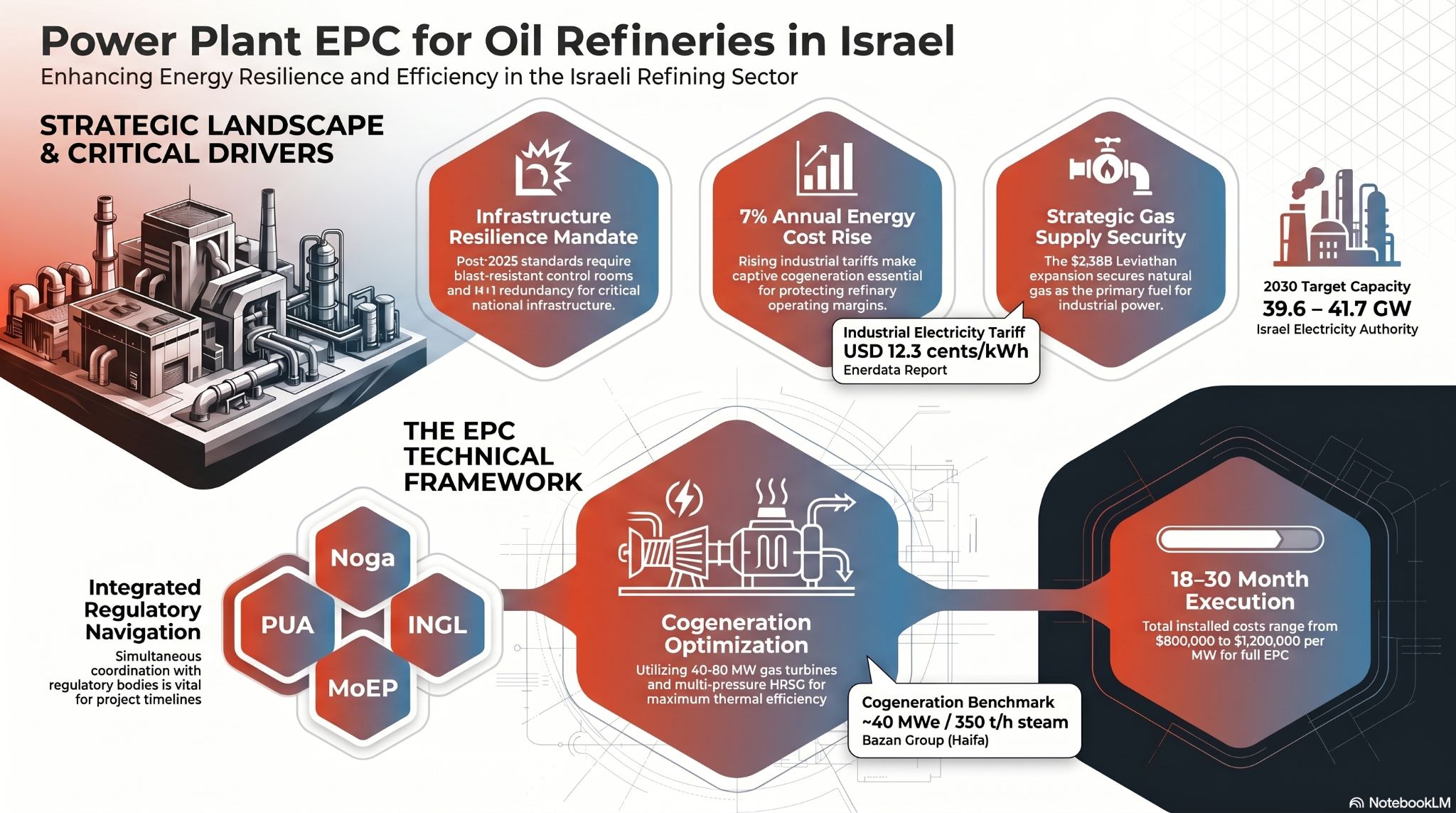
The Israel Ministry of Energy and Infrastructure and the Israel Electricity Authority have reported that industrial electricity prices have risen at approximately 7 percent per year since 2018, reaching USD 12.3 cents per kilowatt hour in 2023. This is approximately 30 percent higher than in Jordan and twice the cost in Egypt. For energy-intensive refinery and petrochemical operations consuming 65 to 100 MW continuously, every improvement in generation efficiency produces a direct and measurable improvement in operating margin.
Table 1: Israel Electricity Market and Refinery Power Key Indicators (2023 to 2026)
|
Indicator |
Value |
Source |
|
Installed capacity end-2024 |
24.7 GW |
Israel Electricity Authority / LNRG Technology |
|
Peak demand record |
15.5 GW (August 2023) |
Israel Electricity Authority Annual Report 2023 |
|
Natural gas share of generation |
~70% |
Enerdata Israel Energy Market Report |
|
Solar PV added in 2024 |
900 MW |
pv magazine / Electricity Authority |
|
Target capacity by 2030 |
39.6 to 41.7 GW |
Israel Electricity Authority / State Comptroller 2024 |
|
Industrial electricity tariff (2023) |
USD 12.3 cents/kWh, rising 7%/yr |
Enerdata Israel Energy Market Report |
|
Bazan Group refinery crude capacity |
197,000 barrels per day |
Bazan Group 2024 Periodic Report |
|
Bazan onsite cogen (pre-June 2025) |
~40 MWe / 350 t/h steam (commissioned 1984) |
TheMarker / LNRG Technology 2025 |
|
Leviathan expansion FID (Jan 2026) |
USD 2.36 billion / ~21 bcm/yr |
Chevron press release, January 2026 |
Further detail on Israel’s electricity-sector planning framework is available in the State Comptroller’s November 2024 report on the Development of the Electricity Sector Towards 2030, which projects a potential peak-demand shortfall of 2,150 MW by 2028 without accelerated capacity build, and recommends significant investment in both utility-scale and industrial self-generation.
Key Drivers of Power Plant EPC for Oil Refineries in Israel: Why Now Is the Critical Window
Five structural forces are converging to make investment in industrial power generation EPC at Israeli oil refineries and petrochemical plants more urgent now than at any point in the past decade.
- Wartime infrastructure vulnerability and resilience mandates.
The June 2025 Iranian missile strikes on the Bazan complex, and a second strike in March 2026, have permanently changed the engineering philosophy for industrial power in Israel. Blast-resistant control rooms, N+1 generator redundancy, hardened enclosures, and dispersed generation topology are now regulatory expectations rather than optional upgrades. The Israeli High Court of Justice ruling in March 2026 that authorized Bazan’s power plant rebuild required the replacement facility to use ‘improved technology,’ establishing a new baseline for what rebuilt or new industrial cogeneration plants in Israel must achieve.
- Industrial electricity cost pressure.
At USD 12.3 cents per kilowatt hour for industrial consumers in 2023, rising at 7 percent per year, the financial case for captive cogeneration at Israeli refineries is compelling. A 60 MW captive cogen plant at a refinery consuming 65 to 100 MW continuously delivers returns that exceed almost any other capital investment available to refinery management, particularly when the cost of grid outages and fuel-displacement losses is factored in.
- Natural gas transition and confirmed gas supply.
Israel’s coal phase-out, with the Orot Rabin coal units in Hadera being retired or converted through 2025 to 2027 and monitored by Israel Natural Gas Lines (INGL), has established natural gas as the only viable long-term fuel for industrial cogeneration at scale. The USD 2.36 billion Leviathan expansion FID and Tamar Phase 2 investments confirm gas supply security through 2040 and beyond, removing the upstream risk that previously constrained industrial CHP investment decisions.
- Refinery modernization and green chemistry investment.
Bazan Group alone has announced a USD 1.5 billion ESG and green polymer investment program targeting 30 percent green polyolefins by 2030, with Carmel Olefins producing 240,000 tonnes per year of ethylene from the Haifa Bay complex. Any material expansion in process capacity demands a parallel expansion in captive power and steam generation, creating a continuous pipeline of power EPC opportunity for the duration of the investment program.
- Grid capacity shortfall risk.
The State Comptroller warned in November 2024 that without accelerated investment, peak-demand shortfalls of up to 2,150 MW could emerge by 2028. Noga, Israel’s Independent System Operator, already reported that the electricity system exceeded its emissions permits 49 times in 2025 as the grid was operated at near-maximum capacity. For major industrial consumers like oil refineries classified as critical national infrastructure, a grid connection alone is insufficient protection. Captive generation backed by emergency diesel black-start is the only path to guaranteed uptime.
How Power Plant EPC for Oil Refineries in Israel Works: The Technical Framework
A gas-fired cogeneration power station at an Israeli oil refinery is substantially more complex than a standalone power plant. Every refinery site presents a unique combination of process loads, steam demand profiles, grid connection requirements, and safety constraints that must be engineered to suit. This is why experienced EPC contractors with direct industrial cogeneration experience are categorically different from equipment dealers or plant brokers.
The core technical elements of power plant EPC for oil refineries in Israel span five engineering disciplines.
Gas Turbine Selection and Sizing
For a Bazan-class refinery consuming 65 to 100 MW continuously, the appropriate prime mover is a gas turbine in the 40 to 80 MW range with dual-fuel capability covering natural gas from INGL at transmission pressure, refinery off-gas, and diesel backup as required by Noga’s grid code. Technology appropriate to this size class includes Rolls-Royce WLE and Trent industrial gas turbines in the 60 to 80 MW range, GE Vernova LM6000 aeroderivative units, and Siemens Energy SGT-800 at approximately 62 MW. The precedent at Paz Ashdod Refinery, EPC-managed by Ludan Engineering, used a Rolls-Royce DLE 44 MW train and a Rolls-Royce WLE 64 MW train, each with a 90 tonne per hour heat recovery steam generator.
Heat Recovery and Steam Generation
An Israeli refinery cogeneration plant requires an HRSG producing multiple steam pressure levels to serve crude distillation, hydrocrackers, hydrotreaters, and the ethylene cracker complex. For Bazan’s replacement facility, the pre-2025 benchmark of approximately 350 tonnes per hour of steam establishes the minimum design target, with the High Court’s requirement for ‘improved technology’ implying a higher-capacity, more efficient replacement. For greenfield cogeneration projects at comparable Israeli petrochemical facilities, USP&E targets HRSG designs in the 90 to 300 tonne per hour range, sized to the specific process steam demand profile determined during the feasibility and detailed engineering phases.
Grid Connection and Regulatory Coordination
Under Israeli electricity regulations, industrial consumers above 16 MW connect to the transmission network at extra-high voltage under Noga’s grid code. Any captive generator above 0.5 MW requires a generation licence from the Israel Electricity Authority (PUA). Gas connection requires INGL approval for the pressure-reducing and metering station. Environmental emissions permits covering NOx, SO2, particulates, and volatile organic compounds are issued by the Ministry of Environmental Protection under Israel’s Clean Air Law. All four regulatory pathways must be progressed simultaneously during the EPC design phase to avoid sequential permitting delays that can extend project timelines by 6 to 18 months.
Hazardous-Area Engineering and Blast Resilience
Oil refinery sites in Israel require ATEX and IEC 60079 hazardous-area classification for all electrical equipment within the turbine enclosure and fuel-handling areas. Post-June 2025, blast-resistant control rooms are a practical requirement on all projects classified as critical national infrastructure. API 521 flare and pressure-relief integration, NFPA 850 fire protection for gas turbine enclosures, and seismic design to Israeli standard SI 413 are all mandatory scope items for a properly engineered refinery power station in Israel.
Emergency Diesel Black-Start Capability
Israel’s designation of facilities such as Bazan Group as critical national infrastructure requires the refinery power station to maintain emergency diesel generation capable of executing a controlled process shutdown without grid support. This emergency power capability must be designed, certified, and integrated with the plant’s distributed control system as part of the EPC scope, not retrofitted as an afterthought. USP&E’s operations and maintenance practice includes testing and maintaining black-start systems under long-term O&M agreements.
USP&E Global: Your Proven EPC Partner for Oil Refinery Power Projects in Israel
For your power station EPC or industrial O&M contract in Israel, the question is not whether captive cogeneration adds value. The June 2025 events at Bazan, the USD 12.3 cent industrial tariff, and the State Comptroller’s 2024 capacity-shortfall warnings have answered that conclusively. The question is whether your EPC partner has the engineering depth, the global track record, and the on-the-ground presence in Israel to deliver a complex industrial power project in a regulated, high-risk environment without failing you.
USP&E Global has been designing, procuring, constructing, and operating power stations across 35 countries for 25 years. With 350 plus engineers and technical staff, offices in the USA, UAE, South Africa, and Mali, and a new regional office in Tel Aviv staffed with South African and Israeli expatriate engineers, USP&E brings a combination of global scale and local engineering presence that no local installer or equipment dealer can match. Learn more about USP&E’s power plant engineering capabilities and EPC construction track record.
Table 2: EPC Scope Comparison for Israeli Refinery Cogeneration Projects
|
Scope Element |
Equipment Dealer |
Standard EPC |
USP&E Global |
|
Feasibility and site study |
No |
Partial |
Full scope with site visit |
|
Gas turbine technology selection |
Basic data only |
Standard spec |
Optimised multi-OEM analysis |
|
HRSG and steam system design |
No |
Standard scope |
Custom multi-pressure HRSG |
|
Regulatory navigation (PUA / Noga / INGL / MoEP) |
No |
Partial |
Full coordination, all four bodies |
|
Blast-resistant design (post-2025) |
No |
Optional extra |
Integrated standard EPC scope |
|
Noga ancillary-services qualification |
No |
Basic only |
Full capacity-market compliance |
|
Emergency diesel black-start |
No |
Separate contract |
Integrated EPC scope |
|
O&M post-commissioning |
No |
Third-party recommended |
USP&E in-house, sub-4-hour Tel Aviv |
|
ISO 9001:2015 certified |
Rarely |
Sometimes |
Yes |
|
FCPA and OFAC compliant |
Rarely |
Sometimes |
Yes |
USP&E holds ISO 9001:2015 and ISO 45001:2018 certification, the two certifications that matter most when qualifying to work on Israeli critical national infrastructure. USP&E is fully FCPA and OFAC compliant, an essential credential for any project involving government-adjacent entities or internationally funded infrastructure. USP&E’s case studies and client references demonstrate a 25-year track record of delivery without a single lawsuit filed in any jurisdiction.
EPC Timeline and Cost Framework for Oil Refinery Power Stations in Israel
For Israeli oil refinery and petrochemical operators evaluating a captive power generation project, the following planning framework reflects the realistic timelines and cost ranges that apply to gas-fired cogeneration EPC in the 40 to 110 MW range in Israel.
- Feasibility and conceptual engineering: 30 to 90 days. Cost: USD 30,000 to USD 250,000 depending on site complexity and gas-connection scope.
- Detailed engineering and design: 60 to 120 days following feasibility approval. Cost: 4 to 7 percent of total project value, typical range USD 2 million to USD 6 million for a 40 to 110 MW plant.
- Equipment procurement and lead time: Gas turbines in the 40 to 80 MW class carry OEM lead times of 12 to 24 months. USP&E’s existing relationships with Rolls-Royce, GE, Siemens, and Solar Turbines, plus its inventory of new-surplus equipment, can materially compress this timeline for qualified projects.
- Civil works and foundations: 6 to 12 weeks for a prepared site with existing refinery infrastructure.
- Mechanical and electrical installation: 4 to 8 months depending on plant complexity and dual-fuel scope.
- Pre-commissioning and commissioning: 4 to 8 weeks.
Total EPC timeline for a 40 to 80 MW gas-fired cogeneration plant at an Israeli refinery is 18 to 30 months from feasibility approval to commercial operations date, subject to regulatory fast-track provisions such as Section 266E of the Israel Planning and Building Law, which the Bazan Group is utilizing for its post-2025 rebuild. Total installed cost is USD 800,000 to USD 1,200,000 per MW, inclusive of engineering, equipment, civil works, mechanical and electrical installation, and commissioning, but exclusive of INGL gas-connection infrastructure and Noga grid-interconnection works, which are project-specific.
USP&E’s SmartPower AI platform integrates with plant DCS systems to provide real-time performance monitoring, predictive maintenance alerts, and fuel optimization across the full lifecycle of the cogeneration plant, reducing unplanned outage rates and extending major inspection intervals for clients operating under long-term O&M agreements.
Frequently Asked Questions: Power Plant EPC for Oil Refineries in Israel
What does a power plant EPC project for an oil refinery in Israel typically cost per MW?
A gas-fired cogeneration plant at an Israeli oil refinery costs approximately USD 800,000 to USD 1,200,000 per MW installed, covering engineering, procurement, construction, and commissioning. This figure excludes Israel Natural Gas Lines (INGL) gas-connection infrastructure and Noga grid-interconnection works, which add USD 5 million to USD 20 million depending on distance and voltage level. Feasibility studies range from USD 30,000 for conceptual studies to USD 250,000 for full bankable feasibility reports with site visits and geotechnical analysis.
How long does it take to build a cogeneration power plant at an Israeli oil refinery?
A 40 to 80 MW gas-fired cogeneration plant at an Israeli oil refinery typically takes 18 to 30 months from feasibility approval to commercial operations date. Gas turbines in this size range carry OEM lead times of 12 to 24 months. Civil works, mechanical and electrical installation, and commissioning add 6 to 12 months running in parallel. Under Israel’s Section 266E fast-track planning provisions, which the Bazan Group is using for its post-2025 power plant rebuild, permitting can be accelerated, but gas turbine and HRSG equipment lead times remain independent of the permitting timeline.
What regulatory approvals are required for a power plant EPC project at an Israeli refinery?
A refinery cogeneration plant in Israel requires a generation licence from the Israel Electricity Authority (PUA). Grid connection requires capacity-market and ancillary-services agreements with Noga, Israel’s Independent System Operator. Gas connection requires INGL approval for the pressure-reducing and metering station at the plant boundary. Environmental emissions permits covering NOx, SO2, particulates, and volatile organic compounds are issued by the Ministry of Energy and Infrastructure under Israel’s Clean Air Law. Hazardous-area and fire-safety approvals apply under ATEX, IEC 60079, and NFPA 850 standards.
What is the difference between a cogeneration plant and a simple-cycle gas turbine for an oil refinery?
A cogeneration plant, also called a combined heat and power (CHP) plant, uses the exhaust heat from the gas turbine to generate steam in a heat recovery steam generator (HRSG), delivering both electricity and process steam to the refinery simultaneously. This makes cogeneration far more efficient for refineries, which require large quantities of steam for crude distillation, hydrotreating, reforming, and steam cracking. A simple-cycle gas turbine generates only electricity and wastes the exhaust heat to atmosphere. At Israeli industrial electricity prices of USD 12.3 cents per kilowatt hour and rising, cogeneration is economically superior for any refinery consuming more than 20 MW continuously and requiring 50 tonnes per hour or more of process steam.
Can USP&E Global provide emergency generator callout and O&M services for Israeli oil refineries?
Yes. USP&E Global’s new Tel Aviv regional office provides sub-four-hour emergency callout for unplanned generator and gas turbine outages at Israeli industrial facilities. The office is staffed with South African and Israeli expatriate engineers experienced in gas turbine operations and maintenance, and holds a workshop and spare-parts inventory covering GE, Siemens, Rolls-Royce, and Solar Turbines equipment. USP&E manages over 260 MW of generation assets globally under long-term O&M agreements and holds ISO 9001:2015 and ISO 45001:2018 certification. For Haifa Bay operators, the Tel Aviv office provides rapid response without the multi-day international mobilization lag typical of offshore EPC firms.
How has the June 2025 Bazan missile strike changed EPC design standards for Israeli refinery power plants?
The June 2025 Iranian missile strikes on Bazan Group’s Haifa cogeneration plant, which caused USD 150 to 200 million in direct damage and halted all refinery operations, have materially changed the design standards expected for industrial power stations in Israel. Post-2025, blast-resistant and structurally hardened control rooms are a de facto design requirement. N+1 redundancy on all critical generation equipment is expected on all projects meeting the critical national infrastructure threshold. Physical separation of generation units in hardened enclosures with blast bunds, and dispersed generation topology allowing partial operation after a direct strike, are now part of responsible EPC design for any Israeli industrial power project. USP&E incorporates these design standards as part of its standard EPC scope.
Does USP&E Global work on power plant EPC projects across the Middle East and Arab regions as well as Israel?
Yes. USP&E Global operates without geographic discrimination across all non-sanctioned countries in the Middle East and Eastern Mediterranean, including Saudi Arabia, Iraq, Qatar, UAE, Jordan, and Israel. USP&E is fully FCPA and OFAC compliant and does not and will not participate in any project involving sanctioned countries or politically connected corruption. USP&E’s Middle East presence includes live projects in Saudi Arabia and Qatar, as well as active pre-mobilization engagements across the region. View USP&E’s full project portfolio at the link in the footer section below.
Summary: Key Takeaways for Power Plant EPC for Oil Refineries in Israel Decision-Makers
- Power plant EPC for oil refineries in Israel requires integration of gas turbine and HRSG engineering, Israel Electricity Authority licensing, Noga grid-code compliance, INGL gas-connection design, and post-2025 blast-resilience requirements across a single coordinated EPC scope.
- Israel’s 24.7 GW installed electricity capacity is targeted to grow to 39.6 to 41.7 GW by 2030, with natural gas at approximately 70 percent of generation, underpinned by the USD 2.36 billion Leviathan expansion FID taken by Chevron in January 2026.
- Industrial electricity prices of USD 12.3 cents per kilowatt hour, rising at 7 percent per year, make captive cogeneration at Israeli refineries financially compelling, with payback periods typically in the 5 to 8 year range for well-engineered plants.
- The Bazan Group’s 197,000 barrels per day Haifa refinery, with its pre-2025 cogeneration capacity of approximately 40 MWe and 350 tonnes per hour of steam, is the benchmark industrial power project in northern Israel and a direct proof point for the scale and complexity of power plant EPC for oil refineries in Israel.
- EPC contractors serving Israeli refinery clients must navigate the Israel Electricity Authority, Noga, INGL, and the Ministry of Environmental Protection in parallel, while delivering to ISO 9001:2015 and ISO 45001:2018 standards with FCPA and OFAC compliance.
- USP&E Global’s 25-year track record across 150 plus projects in 35 plus countries, ISO certification, FCPA compliance, and new Tel Aviv office with sub-four-hour emergency response capability makes it uniquely positioned to serve Israeli oil refinery and petrochemical operators for both EPC and long-term O&M.
- Realistic EPC timelines for a 40 to 80 MW industrial cogeneration plant in Israel are 18 to 30 months from feasibility approval to commercial operations, with total installed costs of USD 800,000 to USD 1,200,000 per MW.
READY TO POWER YOUR PROJECT? TALK TO USP&E’S ENGINEERS FREE.
USP&E Global offers a complimentary 4-hour engineering consultation for qualified power station, EPC, and O&M projects in Israel and the Eastern Mediterranean. Whether you are in early feasibility, evaluating cogeneration options, or ready to mobilize, our team of 350 plus engineers across 35 plus countries is ready to guide your project to success with speed and without excuses.
USP&E Global — Powering Possibility. Built for the Frontier.
ISO 9001:2015 | ISO 45001:2018 | 150+ Projects | 35+ Countries | Zero Lawsuits
Quick Links:
- Contact USP&E by clicking on this link.
- Request a fast equipment quote
Global Resources
- USP&E's Project Experience Portfolio
- USP&E Case Studies and Client Reference Letters
- USP&E Integrity and Compliance policy
- USP&E's ISO Certifications and Credentials