

Power Generation Equipment Inventory: The Complete Guide to 3,000+ MW of Frontier-Ready Assets
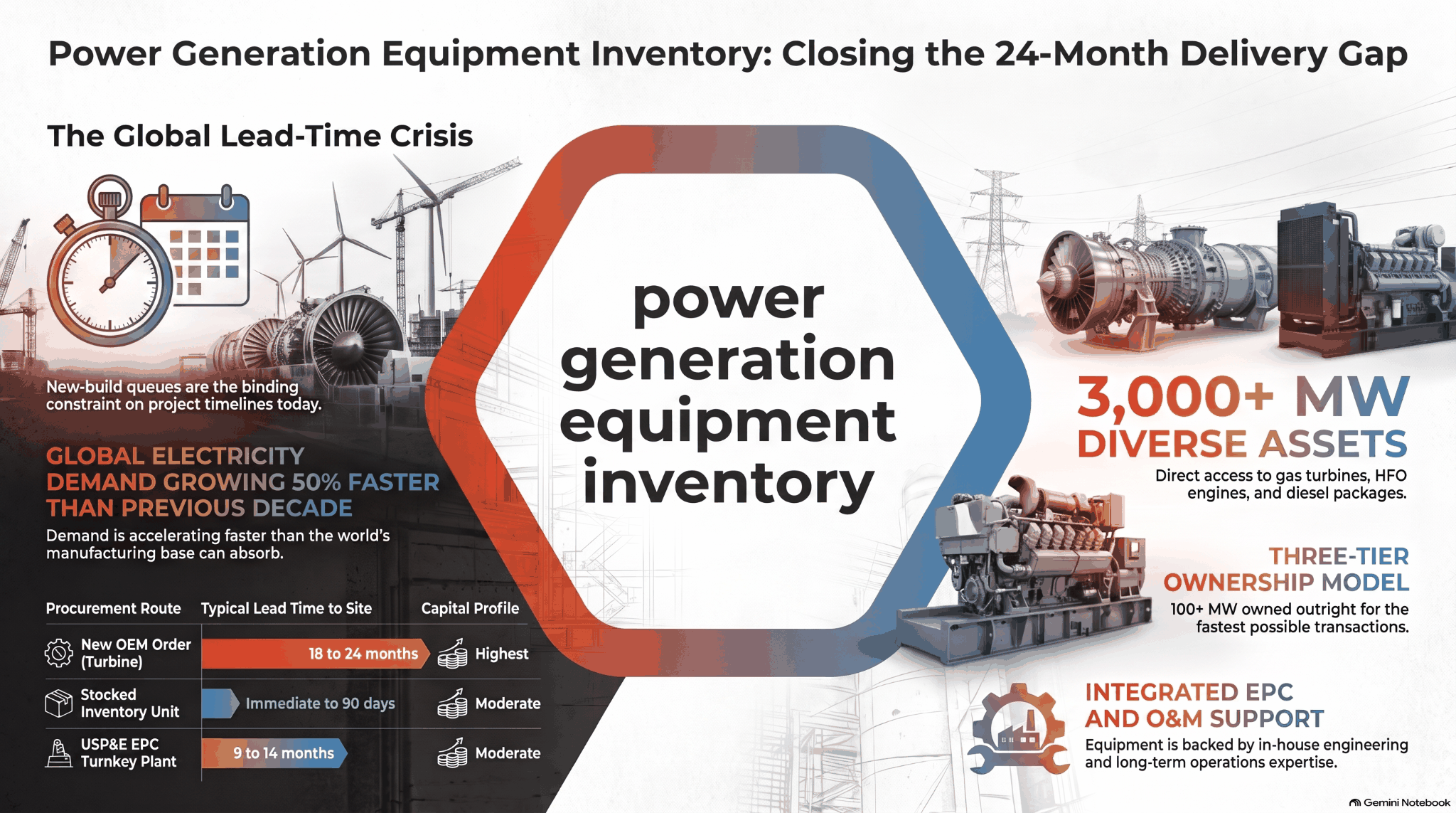
Your project does not fail because the engineering was wrong. It fails because the machine arrives eighteen months after the load did. That is the single hardest constraint in power development today, and it is the reason a ready power generation equipment inventory has become a strategic asset rather than a procurement convenience. The International Energy Agency forecasts global electricity demand growing at an average of 3.6 percent per year through 2030, roughly 50 percent faster than the average of the previous decade, with emerging and developing economies accounting for the overwhelming majority of that growth. Meanwhile, new-build queues at the major turbine OEMs are commonly quoted at 18 to 24 months before a machine is even released to manufacturing.
USP&E Global exists in the gap between those two facts. Since 2002, USP&E has designed, built and operated more than 150 power stations across 35+ countries, and holds direct owner relationships on more than 3,000 MW of gas turbines, heavy fuel oil engines, natural gas gensets, diesel packages and steam turbines. This guide is a complete map of that equipment: what is stocked, what can be acquired, what each asset class is actually good for, and how to move from enquiry to energised site.
USP&E is not the hero of this story. Your project is. USP&E is the guide that has walked this road 150 times before, in the countries where the road runs out.
The Global Power Equipment Shortage: What the Data Shows
The shortage is not a shortage of capital. It is a shortage of delivery slots. Demand for firm, dispatchable generation has accelerated faster than the world’s turbine and engine manufacturing base can absorb, and the queue is now the binding constraint on project timelines across mining, utilities, independent power production and data centre development.
The scale of the demand shift is documented by the International Energy Agency, which recorded global electricity demand growth of around 3 percent in 2025 and forecasts an average of 3.6 percent annually from 2026 to 2030. Emerging market and developing economies accounted for roughly 80 percent of the 2025 increase. In the United States, data centre load has become the dominant driver of demand growth, a shift tracked in detail by the U.S. Energy Information Administration. Access and reliability gaps across Sub-Saharan Africa, South Asia and Latin America are documented in the World Bank energy and mining data set, and the accelerating role of hybrid and renewable integration is tracked by IRENA.
The commercial consequence is straightforward. When a new machine carries a two-year queue, an existing machine with documented history and immediate availability is not a compromise. It is the only path to power inside the project’s actual window.
| Procurement Route | Typical Lead Time to Site | Capital Profile | Documentation Risk |
| New OEM order, heavy frame turbine | 18 to 24 months to release, plus build | Highest | Lowest |
| New OEM order, reciprocating genset | 9 to 18 months | High | Lowest |
| Power generation equipment inventory, stocked unit | Immediate to 90 days ex works | Moderate | Managed by inspection and condition report |
| Broker-sourced used unit, no chain control | Unpredictable | Variable | Highest |
| USP&E EPC turnkey plant from stocked assets | 9 to 14 months from deposit | Moderate | Managed end to end |
Two definitions matter before going further. EPC means engineering, procurement and construction: the single contract under which a plant is designed, supplied, built and commissioned. O&M means operations and maintenance: the long-term contract under which the plant is actually run, staffed and kept available. USP&E delivers both in house, which is the structural difference between an equipment inventory and a dealer’s price list.
Key Drivers of Power Generation Equipment Inventory Demand: Why Now Is the Critical Window
Five drivers are compressing procurement timelines simultaneously. Any one of them would tighten the market. Together they have made ready inventory the deciding factor in whether a project reaches financial close.
- Artificial intelligence and data centre load growth. Hyperscale and AI infrastructure operators in North America, the Middle East and Africa are contracting for primary power at a pace grid interconnection queues cannot serve. Behind-the-meter gas turbines have become the default bridge, and the machines specified for that duty are the same aeroderivative units the mining and IPP sectors compete for.
- Mining expansion and electrification in frontier markets. Gold, lithium, copper and bauxite operations across West Africa and Central Africa are expanding processing capacity in locations with no reliable grid. A mine that cannot power its mill does not produce. Downtime is measured in hundreds of thousands of dollars per day, which changes the arithmetic on what a delivery slot is worth.
- Utility reform and IPP policy liberalisation. Independent power producer frameworks across Africa, the Middle East and Latin America have opened generation to private capital faster than the equipment supply chain has scaled. Development finance is available. Machines are not.
- Stranded and associated gas monetisation. Flared associated gas at upstream oil sites and coal bed methane resources represent effectively zero-cost fuel. Converting that to power requires gas engines or turbines on site quickly enough to capture the economics before the field profile changes.
- Fleet turnover and end-of-PPA asset release. As power purchase agreements expire and utilities retire or repower older plants, well-maintained machines with decades of remaining life enter the secondary market. This is the supply side of the inventory model, and it is why acquisition capability matters as much as stock on hand.
| Market Driver | Primary Asset Class Demanded | Typical Size Band | Speed Requirement |
| Data centre and AI infrastructure | Aeroderivative and industrial gas turbines | 20 MW to 500 MW | Under 90 days for mobile units |
| Mining baseload, off-grid | HFO and diesel reciprocating engines | 5 MW to 100 MW | 9 to 14 months turnkey |
| Utility and IPP baseload | Heavy frame turbines, HFO plants | 50 MW to 500 MW | 12 to 24 months |
| Stranded and associated gas | Natural gas gensets, small turbines | 1 MW to 15 MW | 4 to 8 months |
| Bridge and emergency power | Containerised diesel, mobile turbines | 0.5 MW to 27 MW | 4 to 12 weeks |
Asset Classes in the USP&E Power Generation Equipment Inventory: A Technical and Commercial Overview
USP&E maintains active inventory across nine equipment categories, spanning 0.5 MW single sets to utility-scale plants above 400 MW, in both 50 Hz and 60 Hz, in new, new surplus, refurbished and used low-hour condition. Each category below links directly to the live listings.
Natural gas turbines** are the backbone of the inventory, covering 1 MW to 500 MW per package in aeroderivative and industrial heavy frame configurations. Aeroderivative machines derive from jet engine designs, start in under ten minutes, occupy compact footprints and are maintained by modular engine swap-out, which suits mobile deployment, peaking duty and data centre primary power. Industrial heavy frame machines are purpose-built for baseload and combined cycle, delivering higher absolute output and longer inspection intervals. Both are supplied in simple cycle at 33 to 40 percent efficiency, combined cycle at 55 to 62 percent, or combined heat and power configurations exceeding 80 percent total energy efficiency.
HFO generators** cover more than 500 MW of stock from 0.9 MW to 168 MW per unit. HFO means heavy fuel oil, the residual fuel grade that remains the lowest cost per kWh option in markets where fuel price dominates lifetime operating expense. These are slow speed reciprocating engines running at 500 to 750 rpm, which is why properly maintained units reach 25 to 30 year service lives. HFO is never fast track: the fuel treatment train, heated storage and class four pipework make it a major industrial build. Any supplier promising an HFO plant in 90 days is not describing a real project.
Diesel generators** range from 0.5 MW single sets to 100 MW multi-unit packages, in open, enclosed, containerised and trailer-mounted configurations. Diesel is the correct answer when speed to power outweighs lifetime fuel cost, when duty is intermittent, or when the site is remote or mobile. Containerised packages ship plug-and-play in 4 to 8 weeks.
Natural gas generators** are reciprocating gas engines typically sized 0.5 MW to 15 MW per unit, delivering 42 to 45 percent electrical efficiency with excellent part-load and load-following behaviour. They suit distributed generation, CHP, pipeline gas, coal bed methane and associated gas monetisation.
Dual fuel generators** run on two fuels, typically natural gas with a diesel fallback. In frontier markets where pipeline pressure fluctuates or gas supply is contractually fragile, dual fuel capability is not a luxury. It is the difference between a plant that runs and a plant that stops.
Steam generators** and heat recovery steam generator packages cover 1.5 MW to 60 MW and above in condensing, back-pressure and extraction configurations. A steam turbine burns no fuel of its own. It converts waste heat into additional electricity, which is what lifts a simple cycle plant from around 38 percent to 60 percent or better in combined cycle, and what makes biomass, waste-to-energy, sugar mill and refinery cogeneration projects viable.
Biogas generators** cover landfill, digester and sewage gas applications from 1 MW to 4 MW and above. The engine is the easy part. Gas treatment determines whether the plant runs for twenty years or fails in its second year.
Diesel marine generators serve offshore and onboard auxiliary duty, and also feed the land-based market through marine-converted engine packages. Wind turbines** complete the category list for developers building hybrid generation portfolios.
Fuel Type Comparison for Power Generation Equipment Inventory Selection
| Fuel Type | CapEx per MW Installed | OpEx Profile | Lead Time to Power | Best Application |
| Natural gas turbine (simple cycle) | US$500,000 to US$1.2M used | Low fuel cost where gas exists | Under 90 days mobile, 9 to 14 months turnkey | Data centres, utility peaking, IPP baseload |
| Natural gas turbine (combined cycle) | Add US$400,000 to US$700,000 | Lowest per kWh at high load factor | 18 to 24 months | Utility baseload, national grid |
| HFO reciprocating | US$400,000 to US$900,000 used | Lowest fuel cost per kWh, high maintenance | 9 to 14 months minimum | Mining and utility baseload, off-grid |
| Diesel reciprocating | Lowest of all classes | Highest fuel cost per kWh | 4 to 12 weeks containerised | Peaking, standby, bridge, mobile |
| Natural gas reciprocating | Mid range | Low where pipeline or associated gas exists | 4 to 8 months | Distributed generation, CHP, gas monetisation |
| Steam turbine and HRSG | Varies by heat source | Near zero incremental fuel | Immediate to 120 days stocked | Waste heat recovery, cogeneration, biomass |
CapEx means capital expenditure, the upfront cost of building the plant. OpEx means operating expenditure, the ongoing cost of running it. The ranges above are honest bands, not quotations. Real cost per MW depends on site logistics, civil scope, grid interconnection and balance-of-plant completeness, which is why USP&E prices project by project rather than publishing flat rates.
Every asset in the inventory is supported by in-house power plant engineering, EPC and EPCM delivery, and long-term operations and maintenance. For developers who prefer not to own the asset, IPP partnerships and rentals and bridge power structures are available, and older fleets can be brought back to service through power generation asset refurbishment.
What USP&E Can Acquire: The Sourcing Model Behind the Power Generation Equipment Inventory
Stock on hand is only half the answer. The more important question for a developer is what can be acquired against a specific requirement, and how quickly. USP&E operates a three-tier ownership model that determines how fast a given asset can move.
| Power Generation Equipment Inventory Tier | Approximate Volume | What It Means for Your Project |
| Owned outright by USP&E | 100+ MW | Fastest transaction. No third-party consent, no chain, deposit secures the unit |
| Held under exclusivity agreement | 500+ MW | USP&E is the sole authorised seller. Pricing controlled, no competing broker markup |
| Direct owner relationships | 3,000+ MW | Assets located and negotiated directly with utilities, banks, IPPs and OEMs |
Beyond stock, USP&E acquires against requirement through five channels. Cancelled OEM orders and factory surplus put new, zero-hour machines into the market at a fraction of queue time. End-of-PPA and repowering releases free well-documented utility fleets as power purchase agreements expire. Bank-held and financier-controlled assets come to market through lender relationships built over two decades. Marine engine conversions bring proven slow speed HFO and diesel engines into land-based service. Refurbishment programmes return legacy machines to specification with documented condition reporting.
This matters because it changes what “unavailable” means. When a required configuration is not in stock, USP&E’s role shifts from selling to sourcing, backed by the same engineering team that will eventually install and operate the plant.
USP&E’s track record on the O&M side is the evidence that this model works past the point of sale. At a major West African gold mining complex, USP&E took over a 100+ MW HFO power plant in critical condition from a previous contractor. The engine fleet was suffering limestone scale, turbocharger inefficiency, contaminated fuel and lube oil, and corroded pistons. USP&E delivered 95 percent plant availability and a 66 percent cost reduction per engine within the contract period. In Togo, USP&E delivered a gas turbine power plant rehabilitation that restored availability and grid reliability. Across the portfolio, USP&E has delivered more than US$250 million in fuel and operating savings to clients. Full detail is available in the USP&E case studies library and client references.
How to Select the Right Power Generation Equipment Inventory Partner: 10 Critical Criteria
Procurement officers, mine energy managers and IPP developers evaluating equipment suppliers should test every counterparty against the following.
- Ownership position, not listing position. Ask whether the supplier owns the asset, holds exclusivity, or is one link in a broker chain. A chain of intermediaries adds cost at every node and collapses under due diligence. Ask for the ownership tier in writing.
- In-house engineering capability. A dealer sells a machine. An EPC contractor is accountable for whether it produces power on your site, at your altitude, on your fuel. Confirm the supplier employs engineers rather than subcontracting design.
- Documented condition reporting. For used equipment, insist on operating hours, starts, time since hot section and combustion inspection, time since major overhaul, borescope reports, blade replacement records and lube oil analysis history. A supplier who cannot produce these has not inspected the asset.
- Balance-of-plant honesty. The prime mover is typically a fraction of installed cost. Fuel treatment, transformers, switchgear, civil works, grid interconnection and controls routinely add one to two times the engine price. A supplier who quotes only the machine is setting up a cost overrun.
- O&M capability and availability guarantees. Ask whether the supplier will operate what it sells, and whether it will contract to an availability figure. This aligns incentives more powerfully than any warranty clause.
- Frontier logistics experience. Port congestion, customs regimes, inland transport over unsealed roads and final-mile heavy lift are where schedules actually fail. Ask for named projects in comparable conditions.
- Sanctions and anti-corruption compliance. Confirm OFAC and FCPA compliance, and confirm the supplier requires project location and end-user disclosure before quoting. A supplier who will quote without knowing the destination is a liability to your project and your lenders.
- Certification and safety record. ISO 9001:2015 for quality management and ISO 45001:2018 for occupational health and safety are the baseline. Ask for current certificates, not claims.
- Litigation history. Ask directly how many lawsuits the supplier has faced from clients or partners. USP&E has been operating for 25 years without a single client or partner lawsuit filed against it.
- Local content and workforce capability. Ask how the supplier staffs a plant in your jurisdiction, how it trains national technicians, and what its local employment position is. Community and regulatory outcomes depend on it, as does long-term plant availability.
Frequently Asked Questions: Power Generation Equipment Inventory
What is in USP&E’s power generation equipment inventory?
USP&E’s power generation equipment inventory spans nine categories: natural gas turbines from 1 MW to 500 MW, HFO generators from 0.9 MW to 168 MW, diesel generators from 0.5 MW to 100 MW packages, natural gas reciprocating generators from 0.5 MW to 15 MW, dual fuel generators, biogas generators, steam turbines and HRSG packages from 1.5 MW to 60 MW and above, diesel marine generators, and wind turbines. Equipment is available in new, new surplus, refurbished and used low-hour condition, in 50 Hz and 60 Hz, in open, enclosed and containerised configurations.
How fast can USP&E deliver equipment from stock?
Stocked units are available immediately to 90 days ex works. Mobile and trailer-mounted gas turbines can be operational on site in under 90 days from order. Containerised diesel packages ship in 4 to 8 weeks. Complete turnkey plants delivered under EPC contract typically take 9 to 14 months from deposit, and greenfield combined cycle plants with heat recovery and steam turbine integration require 18 to 24 months. New-build OEM orders currently carry queues commonly quoted at 18 to 24 months before manufacturing even begins.
Does USP&E own the equipment or is it a broker?
USP&E is not a broker. USP&E owns more than 100 MW of power generation equipment outright, holds exclusivity agreements on more than 500 MW, and maintains direct owner relationships on more than 3,000 MW. Behind the inventory sits a full EPC and O&M contractor with 350+ engineers and technicians, live projects across multiple countries, and 150+ power stations built and operated since 2002.
Can USP&E source equipment that is not currently in stock?
Yes. When a required configuration is not in stock, USP&E sources against requirement through cancelled OEM orders and factory surplus, end-of-PPA and repowering releases from utilities, bank-held and financier-controlled assets, marine engine conversions, and refurbishment of legacy machines. Sourcing is handled by the same engineering team that will design, install and operate the resulting plant.
What is the difference between a gas turbine and a reciprocating engine?
A gas turbine is a continuous-flow machine, typically 1 MW to 500 MW per unit, delivering 33 to 40 percent simple cycle efficiency and up to 62 percent in combined cycle. It favours large baseload, data centre and utility-scale duty. A reciprocating engine is piston-based, typically 0.5 MW to 15 MW per unit for gas and up to 168 MW for large HFO units, delivering 42 to 45 percent electrical efficiency with superior part-load performance and load-following. The right choice depends on load profile, fuel cost and project size.
How much does a used power plant cost per MW installed?
A used gas turbine simple cycle plant typically ranges from US$500,000 to US$1.2 million per MW installed. A used HFO power station typically ranges from US$400,000 to US$900,000 per MW installed. New HFO stations typically run US$1.2 million to US$1.8 million per MW. Combined cycle adds a further US$400,000 to US$700,000 per MW for the heat recovery steam generator and steam turbine. These are indicative bands only. Real cost depends on engine age and condition, balance-of-plant scope, site logistics and grid interconnection complexity.
How do I inspect equipment before buying?
USP&E inspects every used unit before listing and provides a documented technical condition summary with each Fast Quote response. Buyers may also commission independent third-party inspection through SGS, TUV or a comparable body. USP&E requires a signed non-disclosure agreement, disclosure of the project location and end buyer for OFAC and FCPA compliance, passport copies for attending personnel, and payment of the inspection fee before the asset location is disclosed and inspection is scheduled.
Summary: Key Takeaways for Power Generation Equipment Inventory Decision-Makers
- Global electricity demand is forecast by the IEA to grow at 3.6 percent annually through 2030, while OEM new-build queues are commonly quoted at 18 to 24 months. Ready inventory is now a schedule strategy, not a discount strategy.
- USP&E’s power generation equipment inventory covers nine asset classes from 0.5 MW single sets to utility-scale plants above 400 MW, in 50 Hz and 60 Hz, new through used low-hour condition.
- Ownership position determines transaction speed: 100+ MW owned outright, 500+ MW under exclusivity, 3,000+ MW in direct owner relationships.
- When a configuration is not in stock, it can be acquired through OEM surplus, end-of-PPA releases, bank-held assets, marine conversions and refurbishment programmes.
- Fuel choice drives everything downstream. Diesel buys speed, HFO buys the lowest fuel cost, gas turbines buy scale and density, steam turbines buy efficiency from heat you already paid for.
- The prime mover is a fraction of installed cost. Balance of plant, civils, fuel systems and grid interconnection commonly add one to two times the machine price.
- Equipment supply without engineering and O&M accountability is where projects fail. USP&E backs its power generation equipment inventory with all three under one contract, ISO 9001:2015 and ISO 45001:2018 certified, across 25 years of operation with zero client lawsuits.
Ready to Power Your Project? Talk to USP&E’s Engineers Free.
USP&E Global offers a complimentary 4-hour engineering consultation for qualified power station, EPC, and O&M projects. Whether you are in early feasibility or ready to mobilize, our team of 350+ engineers across 35+ countries is ready to guide your project to success with speed and without excuses.
USP&E Global. Powering Possibility. Built for the Frontier.
ISO 9001:2015 | ISO 45001:2018 | 150+ Projects | 35+ Countries | Zero Lawsuits
Quick Links:
- Contact USP&E by clicking on this link.
- Request a fast equipment quote
Global Resources
- USP&E's Project Experience Portfolio
- USP&E Case Studies and Client Reference Letters
- USP&E Integrity and Compliance policy
- USP&E's ISO Certifications and Credentials