

Perkins Diesel Generator Specifications: The Complete 4000 Series Rating Guide
Perkins has been building generator drive engines since 1932, and the name now covers everything from a 10 kVA compact set to a 2,500 kVA industrial machine. That breadth is the problem. Search for Perkins Diesel Generator Specifications and you will find rating tables from four decades and five product generations sitting side by side, many of them for engines that went out of production before the plant you are specifying was designed. Sizing a mine, a data centre, or an industrial process from the wrong table is a mistake that surfaces at commissioning, when it is most expensive to fix.
This guide covers the Perkins 4000 Series, the heavy industrial range that carries almost all megawatt class Perkins power generation work today, and sets out its published generator outputs model by model. It also puts the superseded small frame range in its proper place, so anyone holding older equipment can see where they stand. Your plant has to carry a real load in real conditions. Our job is to make sure the specification behind it survives contact with the site.
Two definitions first. kVA is apparent power, and it exceeds kW by the inverse of the power factor, conventionally 0.8 for three phase industrial sets. ElectropaK is Perkins’ term for an engine supplied as a complete generator drive package with radiator and air cleaner fitted, as distinct from an engine only supply.
What Perkins Diesel Generator Specifications Cover: The 4000 Series Range
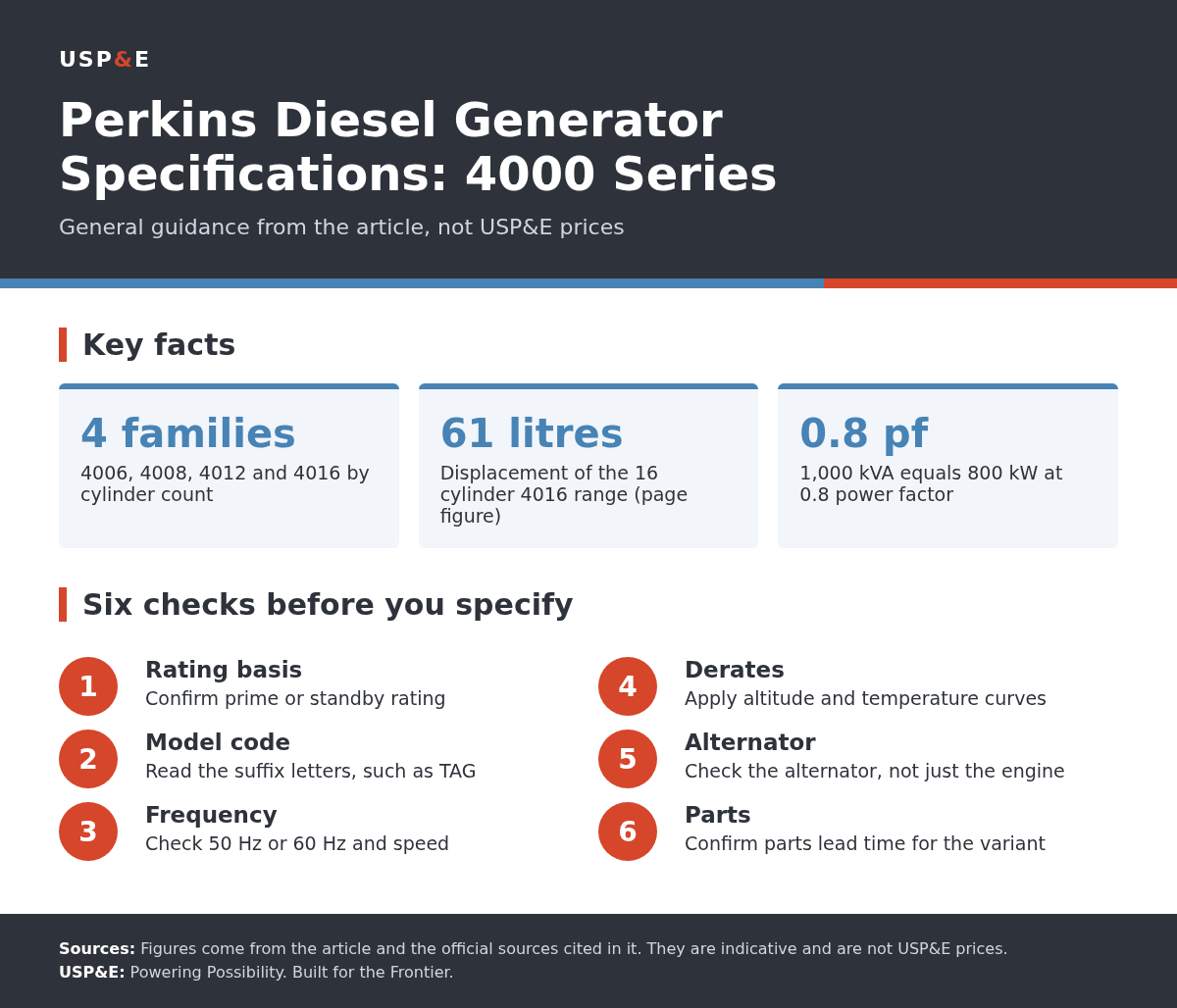
The Perkins 4000 Series is the company’s heavy duty industrial platform for power generation. It is built around four displacement families, distinguished by cylinder count, and offered in both ElectropaK and Electro Unit variants. To see how Perkins sits against Cummins, MTU and Caterpillar, read our diesel generator manufacturer comparison.
| Perkins 4000 Series Engine | Cylinders | Displacement | Generator Output Range |
| 4006-23TAG | 6 | 23 litres | 750 to 900 kVA |
| 4008TAG | 8 | 30 litres | 849 to 1,022 kVA |
| 4008-30TAG | 8 | 30 litres | 1,000 to 1,250 kVA |
| 4012-46TWG | 12 | 46 litres | 989 to 1,600 kVA |
| 4012-46TAG | 12 | 46 litres | 1,000 to 1,880 kVA |
| 4016TAG | 16 | 61 litres | 1,463 to 2,263 kVA |
| 4016-61TRG | 16 | 61 litres | 1,400 to 2,500 kVA |
Perkins describes the 6 cylinder 4006 range as delivering 750 to 900 kVA in ElectropaK and Electro Unit form, supplied with or without radiator and air cleaner, with proven service in prime and standby installations across manufacturing, hospitals, and data centres. The 8 cylinder 4008 range is published at 849 to 1,022 kVA in its TAG form and 1,000 to 1,250 kVA in the later 4008-30TAG form. The 12 cylinder 4012 range, at 46 litres, is published at 989 to 1,600 kVA for the TWG variant and 1,000 to 1,880 kVA for the TAG variant.
At the top of the range, the 16 cylinder 4016 carries a 61 litre displacement, with the 4016TAG published at 1,463 to 2,263 kVA and the 4016-61TRG range at 1,400 to 2,500 kVA. Perkins notes that a key benefit of the 4016-61TRG is the option of a remote cooling system, which makes it viable in installations where a conventional radiator cannot be accommodated, such as high rise buildings and confined plant rooms.
Decoding a Perkins 4000 Series Designation
Take 4016-61TRG3 as the worked example, a widely used configuration in the 4016 family.
- 40 identifies the 4000 Series.
- 16 is the cylinder count.
- 61 is the displacement in litres.
- T denotes turbocharged. W denotes charge air cooling by water in some variants and A denotes air to air charge cooling.
- R denotes the remote cooling arrangement.
- G denotes generator drive duty, as opposed to industrial or marine.
- 3 is the build or rating standard, with suffix A denoting a later revision.
Getting this decode right matters commercially. A 4016TAG2A and a 4016-61TRG3 share a block and a displacement but differ in cooling arrangement, rating, and parts position.
Perkins Diesel Generator Specifications: Reading the Rating Basis Correctly
Every published output figure carries a rating basis, and the basis changes the number by more than most procurement processes allow for.
| Rating Basis | Permitted Operation | Load Profile | Overload | Correct Application |
| Standby | Duration of a utility outage only | Varying | None | Emergency backup behind a reliable grid |
| Prime | Unlimited hours, subject to a load factor limit | Varying | Typically available for short periods | Off grid sites, unstable grids, peak shaving |
| Continuous | Unlimited hours | Constant, non varying | None | Base load and grid parallel operation |
The kVA ranges published for each 4000 Series engine span both frequency and rating basis. A single engine will show its highest number as a 1500 RPM or 1800 RPM standby rating and its lowest as a continuous rating, and the spread across a family can exceed 20 percent. When comparing quotations, fix the rating basis, the frequency, and the power factor in writing before any price is compared, or the comparison is meaningless. The same rule applies to smaller sets; see how ratings are stated for each John Deere diesel generator.
Frequency is set by engine speed. A four pole alternator produces 50 Hz at 1500 RPM and 60 Hz at 1800 RPM. Because a 1500 RPM machine completes fewer power strokes per minute, the 50 Hz rating for a given engine sits materially below its 60 Hz rating. Most frontier markets in Africa, the Middle East, and South Asia operate at 50 Hz, while the Americas and parts of Asia operate at 60 Hz.
The Legacy Perkins Small Frame Range: Where Older Equipment Sits
A large installed base of older Perkins generating sets remains in service, built on the 3.152, 4.236, 1000 Series, and 1300 Series engines. These are broadly in the 15 kW to 200 kW band and were typically packaged with mechanical governors, brushless single bearing alternators, and basic instrument panels rather than electronic controls.
| Legacy Perkins Engine | Typical Genset Band | Aspiration | Current Status |
| 3.152 | 15 kW to 30 kW | Naturally aspirated | Superseded, long service history |
| 4.236 and T4.236 | 25 kW to 60 kW | Naturally aspirated and turbocharged | Superseded |
| 1004 and 1006 Series | 50 kW to 135 kW | Turbocharged, some aftercooled | Superseded by 1100 and 1200 Series |
| 1306 Series | 120 kW to 205 kW | Turbocharged aftercooled | Superseded by 1500 and 2000 Series |
Three practical points for anyone holding this equipment.
Parts availability is the binding constraint, not engine condition. These blocks are mechanically durable and many are still running well. The commercial question is whether injectors, liners, and turbocharger cartridges for the specific variant can still be sourced on a lead time your operation can absorb.
Emissions status is legacy. Sets of this generation predate modern non road and stationary emissions tiers. Where a jurisdiction applies current standards to replacement or relocation, an older set may not be permittable even if it is serviceable. Verify with the regulator before planning a redeployment.
Rating tables from packager literature need checking. Older sets were assembled by regional packagers to varying standards, and the rating tables in circulation contain transcription errors. Confirm output against the engine and alternator nameplates on the physical machine rather than a catalogue.
Site Conditions: The Derates That Move Every Published Number
Published Perkins Diesel Generator Specifications are reference ratings, established at defined reference conditions. Four site variables move them, and all four must be established before the single line diagram is drawn.
| Site Variable | Effect on Available Output | What the Engineer Needs |
| Altitude | Reduced air density cuts charge mass and output | Site elevation above sea level |
| Ambient temperature | Higher intake and radiator air temperature cuts output | Design maximum ambient, not annual average |
| Fuel specification | Off specification fuel affects injection, combustion and service life | Third party laboratory fuel analysis |
| Power factor | Alternator kVA capability is set at a defined power factor | Actual site power factor, not an assumed 0.8 |
Altitude and temperature are not optional adjustments. A set rated at sea level and 25 degrees Celsius will not produce nameplate output at 1,500 metres on a 40 degree afternoon, and mine sites in Mali, the Democratic Republic of Congo, and Zambia routinely present both conditions simultaneously. Derate factors must come from Perkins curves for the specific build, not from a general rule of thumb.
Fuel quality determines service life. Sulphur content, water, particulates, and cetane number all bear on injector life, liner wear, and oil change intervals. In frontier markets where fuel is trucked long distances, a fuel management and filtration regime is part of the plant design, not an afterthought.
Emissions permitting is jurisdictional and current. In the United States, stationary compression ignition engines are regulated under standards administered by the U.S. Environmental Protection Agency, with applicable limits varying by engine size, build date, and emergency or non emergency classification. Elsewhere, national environment agencies apply their own regimes. Confirm the applicable rule with the regulator before capital is committed.
Diesel remains the fastest technology to deploy for prime, standby, peaking, and mobile generation, which is why it continues to carry so much industrial and off grid load. Fuel cost is normally the dominant lifetime expense, a pattern visible in the generation cost data published by the U.S. Energy Information Administration and in the access and reliability analysis maintained by the International Energy Agency and the World Bank.
How to Specify and Verify Perkins Diesel Generator Specifications
These nine checks apply to new purchase, used purchase, and fleet takeover alike.
- Fix the rating basis before comparing prices. Standby, prime, and continuous are three different products at three different prices. A quotation that does not state its basis cannot be compared with one that does.
- Confirm frequency and speed against the site. 1500 RPM for 50 Hz markets, 1800 RPM for 60 Hz markets, at different published outputs from the same engine.
- Calculate site rated output, not reference output. Apply Perkins derate curves for actual elevation, design maximum ambient, and real power factor.
- Size for block load, not just running load. Motor starting and transient pickup frequently dictate a larger set than steady state demand implies.
- Verify the full engine designation against the nameplate. A 4016TAG2A and a 4016-61TRG3 are not interchangeable despite sharing a displacement. Photograph the plate.
- Establish original hours and hours since overhaul separately for used units. Two different numbers, both material. Request oil analysis trend data alongside them.
- Confirm the alternator, not just the engine. Make, rating, insulation class, excitation type, and bearing arrangement all affect performance and parts. Many specifications cover the engine in detail and the alternator in one line.
- Price the balance of plant. Fuel storage and treatment, exhaust, radiators or remote cooling, switchgear, transformers, controls, synchronising, and civil works routinely exceed the cost of the generating set.
- Confirm parts lead time for the specific variant before signing. A well priced machine with a long parts queue is not well priced.
Frequently Asked Questions
What is the largest Perkins diesel generator?
The largest Perkins power generation platform is the 16 cylinder 4016 range, at 61 litres displacement. Perkins publishes the 4016 family at up to roughly 2,500 kVA of generator output, depending on the variant. Larger plants usually parallel several sets or move to medium speed engines or gas turbines.
What is the difference between the Perkins 4000 Series and the 1000 Series?
They cover different power bands and product generations. The 1000 Series is a legacy compact range used in smaller generating sets and has been superseded by newer Perkins ranges. The 4000 Series is the heavy industrial platform, built in 6, 8, 12 and 16 cylinder configurations for larger sets.
How many kW is a 1000 kVA Perkins generator?
At the conventional 0.8 power factor used for three phase industrial sets, 1,000 kVA corresponds to 800 kW, because kW equals kVA multiplied by power factor. Power factor depends on the site load, so specify the actual site power factor rather than assuming the standard figure.
What does TAG mean in a Perkins engine model number?
The suffix letters describe the engine’s induction and duty configuration. T denotes turbocharged, A denotes air to air charge air cooling, W denotes water cooled charge air, R denotes a remote cooling arrangement, and G denotes generator drive duty as opposed to industrial or marine service.
Is Perkins owned by Caterpillar?
Yes. Perkins is part of the Caterpillar group. In power generation the Perkins 4000 Series sits below the larger Cat branded heavy frame engines, and the two brands are often specified in the same plant. Always confirm ratings and support arrangements with the manufacturer or its authorised dealer.
What derate should I allow for altitude and temperature?
There is no single correct figure, and any source offering one should be treated with caution. Derate depends on the engine build, its turbocharger match, its charge air cooling and the combination of altitude and ambient temperature at the site, so apply the manufacturer’s published derate curves.
How should I verify Perkins diesel generator specifications before buying?
Ask for the current manufacturer data sheet for the exact engine and alternator, the rating standard and duty used, the serial numbers and the service history for any used set. Check the derate curves against your site conditions and have an independent engineer witness a load test before acceptance.
Summary: Key Takeaways on Perkins Diesel Generator Specifications
- The Perkins 4000 Series is the heavy industrial platform, spanning 6, 8, 12, and 16 cylinder configurations from 23 to 61 litres displacement.
- Published Perkins Diesel Generator Specifications across the 4000 Series run from 750 kVA on the 4006 to 2,500 kVA on the 4016-61TRG.
- The legacy 3.152, 4.236, 1000 Series, and 1300 Series sets occupy a much lower band, roughly 15 kW to 205 kW, and are superseded.
- Rating basis changes the published number substantially. Standby, prime, and continuous are three different products.
- Frequency follows engine speed. 1500 RPM serves 50 Hz markets and 1800 RPM serves 60 Hz markets, at different outputs.
- Altitude, design ambient temperature, fuel specification, and actual power factor all move the usable rating away from the catalogue figure.
- Balance of plant, fuel treatment, and interconnection costs routinely exceed the cost of the generating set itself.
A catalogue rating is where specification starts, not where it finishes.
USP&E is an independent seller and is not affiliated with any engine, turbine or generator manufacturer named in this guide. Those names are trademarks of their respective owners, and no endorsement or ranking is intended.
Ready to Power Your Project? Talk to USP&E’s Engineers.
Whether you are in early feasibility or ready to mobilise on a power station, EPC, or O&M project, USP&E’s engineers can help. With 150+ power projects delivered in 45+ countries since 2002, our engineers remove the technical and commercial risk from your project, with speed and without excuses.
Contact USP&E Today Request a Fast Quote
USP&E: Powering Possibility. Built for the Frontier. ISO 9001:2015 | ISO 45001:2018 | 150+ power projects in 45+ countries | 25,000 MW contracted since 2002 | 24+ years