
How to Power a Mine in the Sahel: Modular Power Solutions for Mali, Burkina Faso and Niger
Understanding how to power a mine in the Sahel is one of the most technically demanding and commercially consequential questions facing the global mining industry today. The Sahel region, covering Mali, Burkina Faso, Niger, Mauritania, and Chad, holds some of the most significant gold, lithium, uranium, zinc, and base metal deposits on the planet. Yet grid electricity across these landlocked countries is critically underdeveloped, unstable, and in many mining zones, completely absent. For mine developers, IPP investors, and energy procurement officers, the answer to powering these remote industrial sites requires a combination of strategic engineering, modular deployment, and an EPC partner with genuine boots-on-the-ground experience in frontier markets.
USP&E Global has operated continuously across the Sahel since 2006. With over 120 engineers and technicians deployed in Mali alone, active projects at Syama, Loulo-Gounkoto, and Morila, and O&M experience at Perkoa Mine in Burkina Faso, USP&E is the only EPC and O&M company that can answer the question of how to power a mine in the Sahel from a position of lived, proven, and documented experience. This article is designed to give mining energy managers, project developers, and financial institutions the complete technical and commercial picture.
The Energy Challenge in the Sahel: What the Data Shows
The Sahel is among the least electrified regions in the world. According to the International Energy Agency Africa Energy Outlook, sub-Saharan Africa requires over USD 25 billion annually in energy investment to close its power deficit by 2030. Within the Sahel specifically, national grid penetration rates are among the lowest on the continent: Mali’s national electrification rate sits at approximately 52 percent in urban centers and below 20 percent in rural and mining regions, according to USAID Power Africa. Burkina Faso’s Societe Nationale d’Electricite du Burkina (SONABEL) supplies a grid that reaches only a fraction of mining zones in the centre-north and west. Niger’s Nigelec grid is similarly constrained, with large-scale mining assets in the Agadez region operating almost entirely on captive isolated power.
For a mine in the Sahel, grid connection is not a realistic option in the near term. The decision on how to power a mine in the Sahel must therefore be made on the basis of captive power generation, modular deployment, and long-term fuel logistics. The African Development Bank Energy Sector portal identifies fuel-fired isolated power as the dominant near-term solution for mining operations across the Sahel while renewable hybrid integration scales over the 2026 to 2035 planning horizon.
Table 1: Sahel Energy Access and Mining Power Context (2024/2025)
|
Country |
Grid Electrification Rate |
Mining Zones on Grid |
Primary Mining Power Mode |
Dominant Power Fuel |
|
Mali |
~52% urban / <20% rural |
Less than 5% |
Captive isolated generation |
HFO / Diesel |
|
Burkina Faso |
~45% urban / <15% rural |
Less than 10% |
Captive isolated generation |
HFO / Diesel |
|
Niger |
~18% national average |
Less than 3% |
Fully captive off-grid |
Diesel / HFO |
|
Mauritania |
~46% national |
Less than 8% |
Captive generation |
Diesel / Solar Hybrid |
|
Chad |
~11% national |
Less than 2% |
Fully captive off-grid |
Diesel |
Sources: IEA Africa Energy Outlook 2022, African Development Bank Energy Sector Report 2024, USAID Power Africa Country Profiles.
Key Drivers of Sahel Mining Power: Why 2025 to 2030 Is the Critical Window
The question of how to power a mine in the Sahel has never been more commercially urgent. Five converging drivers are accelerating demand for reliable mining power across Mali, Burkina Faso, and Niger over the 2025 to 2030 period.
- Gold and Critical Minerals Demand. Mali is the third-largest gold producer in Africa. Burkina Faso ranks in the top five. Niger hosts the Imouraren uranium deposit, one of the largest on the continent. The global energy transition is driving demand for lithium, manganese, and cobalt from West African deposits at precisely the time when mine developers are fast-tracking investment decisions.
- Expanding Capital Investment by Major Mining Groups. Barrick Gold, Resolute Mining, Leo Lithium, GanFeng Lithium, Endeavour Mining, and West African Resources all have active projects across the Sahel that require expanded or new captive power generation. Each new mine opening or production expansion triggers a direct power generation investment cycle.
- Political Transition and Security-Driven Urgency. Political transitions in Mali, Burkina Faso, and Niger since 2021 have shifted government priorities toward resource revenue generation. Mining activity is being maintained and expanded, but with greater pressure on mine operators to demonstrate economic benefit. Reliable power is foundational to that case.
- Critical Failure of Ageing Power Infrastructure. Many existing captive power stations at Sahel mining sites are operating on overaged engine fleets with deferred maintenance, rising fuel costs, and declining availability rates. The urgency to either upgrade, replace, or expand these assets is at a peak.
- Renewable Hybrid Integration Mandates. International mining companies operating in the Sahel are under shareholder and ESG pressure to reduce diesel consumption. Hybrid power solutions, combining HFO base load with solar PV and battery storage, are entering the procurement cycle across multiple Sahel projects for the first time.
How to Power a Mine in the Sahel: Technical Options and Modular Power Solutions Compared
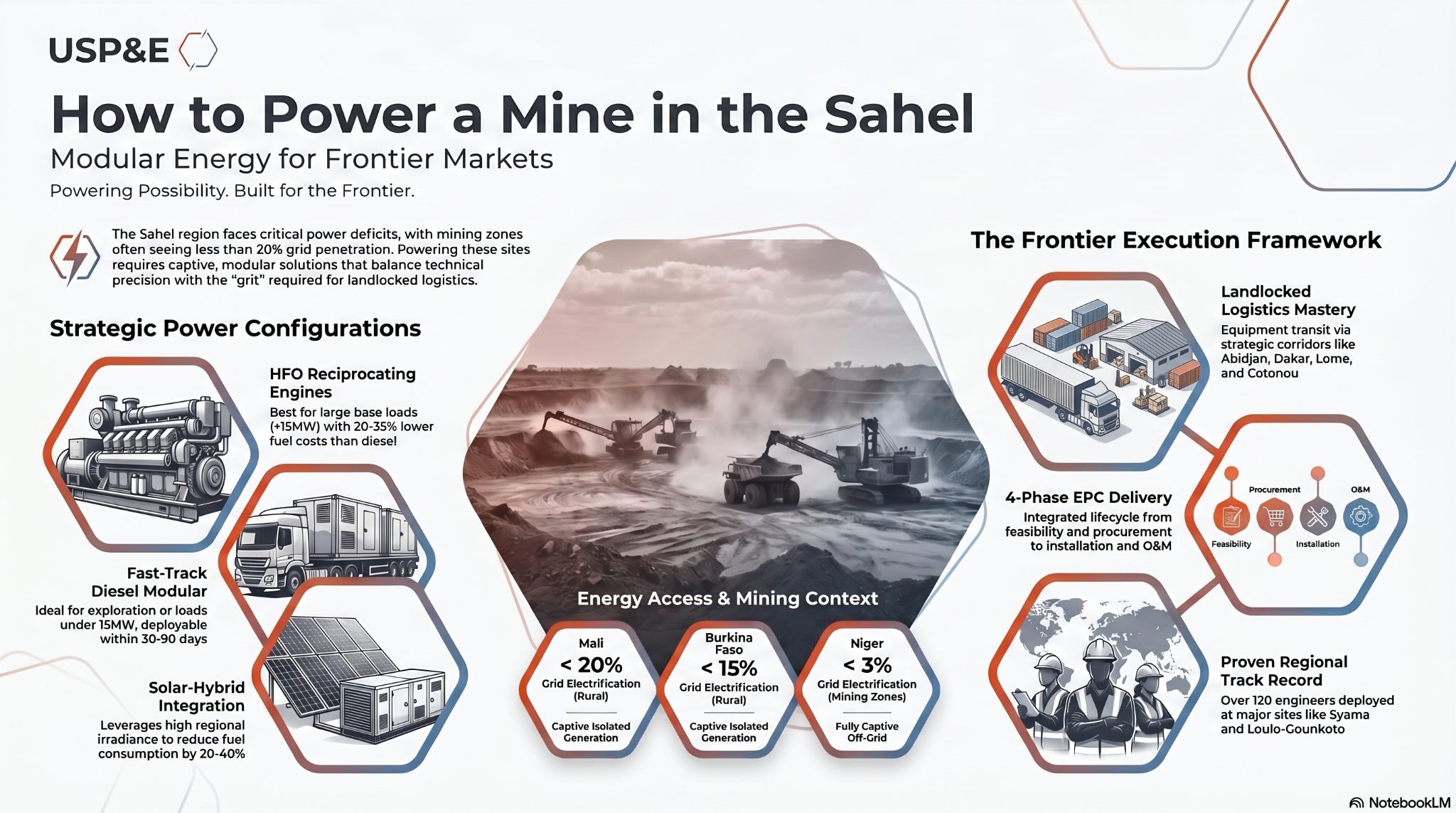
There is no single answer to how to power a mine in the Sahel. The optimal solution depends on the mine’s load profile, fuel logistics, production timeline, capital structure, and ESG commitments. The four primary technical configurations that USP&E evaluates for Sahel mining clients are set out below.
Option 1: HFO Reciprocating Engine Power Station (10 MW to 150 MW)
Heavy Fuel Oil (HFO) reciprocating engine power stations remain the dominant configuration for established Sahel mining projects with loads above 15 MW. HFO delivers a lower fuel cost per kWh than diesel in volumes above approximately 1 million litres per month, making it economically compelling for high-load continuous operations such as processing plants and shaft hoisting. USP&E has designed, built, and operated HFO power stations at Syama Gold Mine (30 MW), Loulo-Gounkoto (up to 112 MW under O&M), and Morila Gold Mine (16.1 MW) in Mali. The USP&E HFO power station authority page documents the technical depth behind these deployments. HFO installations require 9 to 14 months from deposit to commissioning, making early procurement critical.
Option 2: Diesel Reciprocating Engine Power Station (1 MW to 30 MW)
For mines with loads below 15 MW, exploration camps, or projects requiring fast-track power under 90 days, diesel-fired reciprocating engine power stations offer the most practical modular power solution in the Sahel. Caterpillar 3516 and 3512 series, Cummins QSK and KTA series, and Rolls Royce/Bergen engine packages are the most commonly deployed platforms. Diesel gensets offer the greatest deployment speed, simplest fuel logistics, and lowest civil works requirements of any thermal option. USP&E maintains an active inventory of new, new surplus, and low-hour used diesel generator sets available for immediate deployment. See the current USP&E diesel generator inventory for available assets.
Option 3: Natural Gas or Dual-Fuel Gas Turbine Power Station (10 MW to 100 MW)
Where pipeline natural gas or compressed gas supply can be secured, or where associated gas from oil production is available, gas turbine power stations offer significant operating cost advantages over both diesel and HFO. GE aeroderivative gas turbines, including the GE TM2500 mobile gas turbine platform, are particularly well suited to Sahel conditions: they offer rapid mobilization, high ambient temperature tolerance, and the ability to run on both diesel distillate and natural gas. In the absence of pipeline gas, gas-to-power projects based on LNG or CNG import are also feasible for mines above 30 MW load.
Option 4: Hybrid Diesel-Solar-Battery Modular Power Solution
Hybrid power solutions, combining diesel or HFO base load with solar PV and battery energy storage, are growing rapidly across Sahel mining sites. The Sahel receives among the highest solar irradiance levels in the world, with Global Horizontal Irradiance (GHI) values averaging 5.5 to 6.5 kWh per square metre per day across Mali, Burkina Faso, and Niger. This makes solar integration economically compelling even for remote sites. USP&E’s hybrid power systems capability allows mine operators to reduce diesel or HFO consumption by 20 to 40 percent through intelligent load management and renewable integration, without compromising the 24/7 reliability that process plant operations demand.
Table 2: Modular Power Solutions for Sahel Mining Compared
|
Power Solution |
Typical Capacity |
Deployment Timeline |
Best Application |
Fuel Cost vs Diesel |
Hybrid-Ready |
|
HFO Reciprocating Engine |
10 MW to 150 MW |
9 to 14 months |
Large base load process plants |
20 to 35% lower |
Yes |
|
Diesel Reciprocating Engine |
1 MW to 30 MW |
30 to 90 days |
Fast track, exploration, <15 MW load |
Baseline reference |
Yes |
|
Gas Turbine (GE TM2500 / LM) |
5 MW to 100 MW |
60 to 120 days |
Dual-fuel, gas availability, >20 MW |
Variable, often lower |
Partial |
|
Diesel-Solar-Battery Hybrid |
1 MW to 50 MW |
90 to 180 days |
ESG targets, medium load, solar GHI >5.5 |
15 to 40% reduction |
Native |
EPC Execution for Sahel Mining Power: Timeline, Cost and Risk Factors
Executing a power station EPC project in Mali, Burkina Faso, or Niger is not equivalent to executing in South Africa or the Middle East. Frontier market EPC in the Sahel carries logistical, geotechnical, security, and import compliance dimensions that most international engineering firms are not equipped to manage. USP&E has 19 years of continuous Sahel operating experience, which means the execution frameworks below are derived from actual project delivery rather than theoretical planning.
Phase 1: Feasibility Study and Conceptual Engineering (30 to 60 Days)
Every power station project for a Sahel mine begins with a site-specific feasibility study. No two sites across Mali, Burkina Faso, or Niger are identical: ambient temperatures range from 25 degrees Celsius at night to 48 degrees during dry season peaks, site elevations vary, fuel supply chains differ, grid interconnection does not exist, and geotechnical conditions for civil foundations vary significantly. A conceptual feasibility study for a Sahel mine power project costs between USD 30,000 and USD 250,000 depending on complexity and site access. This study defines load profiles, fuel logistics, power configuration, civil requirements, CAPEX and OPEX projections, and risk mitigation strategy. See the USP&E power plant engineering page for the complete scope of engineering services.
Phase 2: Equipment Procurement and EPC Contract Award (30 to 90 Days)
Once the feasibility study is approved and a term sheet signed, USP&E procures prime mover equipment from its owned inventory (over 100 MW owned), exclusive inventory (over 500 MW), or direct-from-owner supply relationships (over 3,000 MW). For Sahel mining projects, procurement lead times are a critical path item: used low-hour HFO or diesel engine packages can often ship within 60 to 90 days, whereas new equipment manufacturing can take 6 to 18 months. USP&E’s ability to place multimillion-dollar deposits on equipment at the term sheet stage saves mining clients 12 to 24 months compared to standard OEM procurement timelines. The full EPC construction scope, including balance of plant, fuel farms, transformers, switchgear, and civil works, is managed under a single contract by USP&E’s EPC construction team.
Phase 3: Logistics, Import Clearance and Civil Works (60 to 180 Days)
Landlocked Sahel logistics present the most significant execution challenge in the region. Mali, Burkina Faso, and Niger have no direct port access. Equipment must transit through Abidjan (Cote d’Ivoire), Dakar (Senegal), Lome (Togo), Cotonou (Benin), or Tema (Ghana) before overland transit to site. Road infrastructure, bridge load limits, import duty regimes, and customs clearance timelines vary significantly by country and by political period. USP&E maintains established logistics partnerships across all relevant transit corridors and has direct experience navigating the Malian Direction Generale des Douanes, the Burkina Faso customs authority, and the Niger Ministry of Finance import regime for mining equipment.
Phase 4: Installation, Commissioning and Handover (60 to 120 Days)
Installation of a modular power station at a Sahel mining site requires Class 4 pipefitting and welding, high-voltage electrical terminations, fuel system commissioning, generator paralleling and synchronization, and load testing under ambient conditions that may reach 45 degrees Celsius. USP&E’s commissioning teams are experienced in all of these disciplines and have delivered first-fire milestones on schedule at every Sahel project to date. Following commissioning, the plant is handed over under a structured Operations and Maintenance agreement, with performance guarantees and fuel optimization built into the contract from day one.
USP&E’s Proven Track Record: How to Power a Mine in the Sahel With Documented Results
USP&E Global is not a new entrant to Sahel mining power. The company has been operating in Mali since 2006 and in Burkina Faso since 2019, with a total of over 120 engineers and technicians deployed across the region at present. The projects below represent a sample of the completed and ongoing Sahel mining power portfolio. For the full project list, see the USP&E project portfolio.
- Syama Gold Mine, Mali (30 MW HFO): Full turnkey EPC and O&M services for a complete HFO-fired power station serving Resolute Mining’s Syama operation, one of the largest gold mines in West Africa.
- Loulo-Gounkoto Mine, Mali (22 MW EPC, 90 to 112 MW O&M): Full turnkey EPC for a 22 MW HFO plant and ongoing O&M for up to 112 MW of generation at Barrick Gold’s Loulo-Gounkoto complex, one of the most technically demanding mining power projects in the region.
- Morila Gold Mine, Mali (16.1 MW O&M): O&M services for the complete HFO-fired power station at the Firefinch/Government of Mali Morila joint venture, restoring plant stability and availability to the highest standards.
- Perkoa Zinc Mine, Burkina Faso (12 MW HFO, CAT and MAK): Emergency maintenance services and major overhauls for Trevali’s Caterpillar 3516B and MAK 6CM32 engine fleet, 120 km west of Ouagadougou. USP&E deployed a team within days of the initial call, shipping certified spare parts and restoring plant availability under a 12-month warranty.
- Leo Lithium and GanFeng Lithium, Mali: Power station scoping, feasibility, and EPC services for new lithium processing power requirements in Mali’s Kayes and Sikasso regions.
These projects are documented in full in the USP&E combined case studies portfolio. A reference letter from Barrick Gold’s Senior Manager for Intermediate Power Generation confirms that USP&E saved the Loulo project over USD 10 million on Siemens gas turbine procurement.
Frequently Asked Questions: How to Power a Mine in the Sahel
What is the best fuel type for a mining power station in Mali or Burkina Faso?
For mines with electrical loads above 15 MW operating 24 hours a day, seven days a week, HFO (Heavy Fuel Oil) is typically the most cost-effective fuel in the Sahel. HFO delivers 20 to 35 percent lower fuel cost per kWh than diesel at volumes above approximately 1 million litres per month, which is standard for a processing plant of this scale. For loads below 15 MW, or where project timelines require first power in less than 90 days, diesel reciprocating engines offer the fastest and most practical solution. The ECOWAS Regional Electricity Authority recognizes HFO and diesel as the primary fuels for off-grid industrial power generation across the ECOWAS region through 2030.
How long does it take to install a power plant at a mine in Niger or Burkina Faso?
Timeline depends on fuel type, site conditions, and equipment availability. A diesel-fired modular power station using available inventory can achieve first power in 30 to 90 days. An HFO power station with required balance of plant manufacturing will typically require 9 to 14 months from contract award to commissioning. A hybrid solar-diesel system with battery storage usually requires 90 to 180 days. Frontier logistics in landlocked Mali, Burkina Faso, and Niger add an additional 30 to 60 days of customs and overland transit time that must be factored into all project schedules.
How much does it cost to build a power plant for a mine in Mali?
Total installed cost for a mining power station in Mali typically ranges from USD 700,000 to USD 1,200,000 per MW installed, depending on fuel type, site location, access road conditions, and scope of balance of plant. This figure includes prime mover equipment, fuel systems, civil foundations, switchgear, transformers, grid protection, cooling systems, and commissioning. It does not include the feasibility study, detailed engineering, or ongoing O&M costs. Fuel logistics and fuel storage infrastructure can add a further USD 50,000 to USD 300,000 per MW depending on remoteness. The World Bank’s Energy Sector Management Assistance Program (ESMAP) publishes reference cost benchmarks for off-grid industrial power in Sub-Saharan Africa that are consistent with USP&E’s field experience.
Can I integrate solar power with a mining power station in the Sahel?
Yes. The Sahel is one of the highest solar resource regions in the world, with Global Horizontal Irradiance values of 5.5 to 6.5 kWh per square metre per day across Mali, Burkina Faso, and Niger. Solar PV integration with diesel or HFO base load can reduce fuel consumption by 20 to 40 percent when properly engineered with smart load management and battery storage. USP&E designs and builds hybrid power systems for mining applications where the solar fraction is sized to maximize fuel savings without compromising the 24/7 availability that process plants require. A hybrid power system design engagement begins with a site-specific resource assessment and load profile analysis.
What is the difference between EPC and O&M for a Sahel mining power station?
EPC (Engineering, Procurement and Construction) covers the design, supply, installation, and commissioning of the power station. O&M (Operations and Maintenance) covers the ongoing management, staffing, maintenance scheduling, spare parts supply, and performance reporting of the plant once commissioned. For remote Sahel mining sites, the separation between EPC and O&M is often commercially significant: a mine that builds its own power station without an O&M partner typically experiences availability degradation within 12 to 18 months due to inadequate local technical capacity. USP&E provides both EPC and long-term O&M under integrated contracts, ensuring that the same engineering team that built the plant is accountable for its performance. See the full USP&E Operations and Maintenance capability.
Does USP&E work in countries with active security challenges like Mali and Burkina Faso?
Yes. USP&E has maintained continuous operations in Mali since 2006 and in Burkina Faso since 2019, including through periods of political transition and elevated security risk. USP&E currently has over 120 engineers and technicians deployed across Mali. The company operates under strict FCPA (Foreign Corrupt Practices Act) compliance, and all contracts include appropriate risk mitigation, security protocols, and force majeure provisions. USP&E’s frontier market operating framework is one of its primary competitive advantages, and is the reason leading global mining companies continue to award O&M and EPC contracts to the company in these environments. USP&E is ISO 9001:2015 and ISO 45001:2018 certified.
How do I fast-track a mining power station installation in the Sahel?
Fast-tracking mining power in the Sahel requires three things: available equipment inventory, pre-approved feasibility engineering, and an EPC partner with established in-country logistics. USP&E’s inventory of over 100 MW of owned diesel and HFO generation assets, combined with exclusivity on a further 500 MW, means that equipment that would typically take 12 to 18 months to manufacture can often be procured, inspected, and shipped within 60 to 90 days. USP&E can place a multimillion-dollar deposit on equipment at term sheet stage, securing availability immediately. Contact the USP&E team for a fast-track assessment of your Sahel mining power project.
Summary: Key Takeaways for How to Power a Mine in the Sahel Decision-Makers
This article has covered the full landscape of how to power a mine in the Sahel for energy managers, project developers, and procurement officers working in Mali, Burkina Faso, and Niger. The key takeaways are:
- How to power a mine in the Sahel requires captive isolated generation in almost every mining zone: grid connection is not a viable near-term option across the region.
- HFO is the lowest operating cost fuel for large base load mining operations (above 15 MW), but requires 9 to 14 months of lead time and specialist EPC capability to execute.
- Diesel modular power stations offer the fastest deployment (30 to 90 days) for mines requiring immediate power below 15 MW or for exploration and early production phases.
- Hybrid solar-diesel systems are the fastest-growing configuration for Sahel mining power and can reduce fuel consumption by 20 to 40 percent where solar irradiance is combined with intelligent load management.
- EPC execution in landlocked Mali, Burkina Faso, and Niger requires a partner with established logistics corridors, in-country compliance frameworks, and a proven track record in frontier markets.
- USP&E Global is the only EPC and O&M company with continuous operational presence across the Sahel since 2006, with 120+ engineers deployed in Mali, active O&M at Barrick’s Loulo-Gounkoto complex, and completed projects at Syama, Morila, and Perkoa.
- Total installed cost for Sahel mining power typically ranges from USD 700,000 to USD 1,200,000 per MW. Engaging an EPC partner with owned equipment inventory reduces both cost and schedule risk substantially.
Ready to Power Your Mine in the Sahel? Talk to USP&E’s Engineers Free.
USP&E Global offers a complimentary 4-hour engineering consultation for qualified power station, EPC, and O&M projects in Mali, Burkina Faso, Niger, and across the Sahel. Whether you are in early feasibility or ready to mobilize, our team of 350+ engineers across 35+ countries is ready to guide your mining power project to success with speed and without excuses.
USP&E Global. Powering Possibility. Built for the Frontier.
ISO 9001:2015 | ISO 45001:2018 | 150+ Projects | 35+ Countries | Zero Lawsuits
Quick Links:
- Contact USP&E by clicking on this link.
- Request a fast equipment quote
Global Resources
- USP&E's Project Experience Portfolio
- USP&E Case Studies and Client Reference Letters
- USP&E Integrity and Compliance policy
- USP&E's ISO Certifications and Credentials