

How to Power a Data Center in South Africa Without Eskom: The Complete Captive Gas Turbine EPC Guide
If you are planning to build, expand, or operate a data center in South Africa in 2025 or 2026, you already know the single biggest threat to your project is not competition, capital, or connectivity. It is power. The question of how to power a data center in South Africa without depending on Eskom has become the most critical procurement decision any data center developer or hyperscale operator faces in this market today.
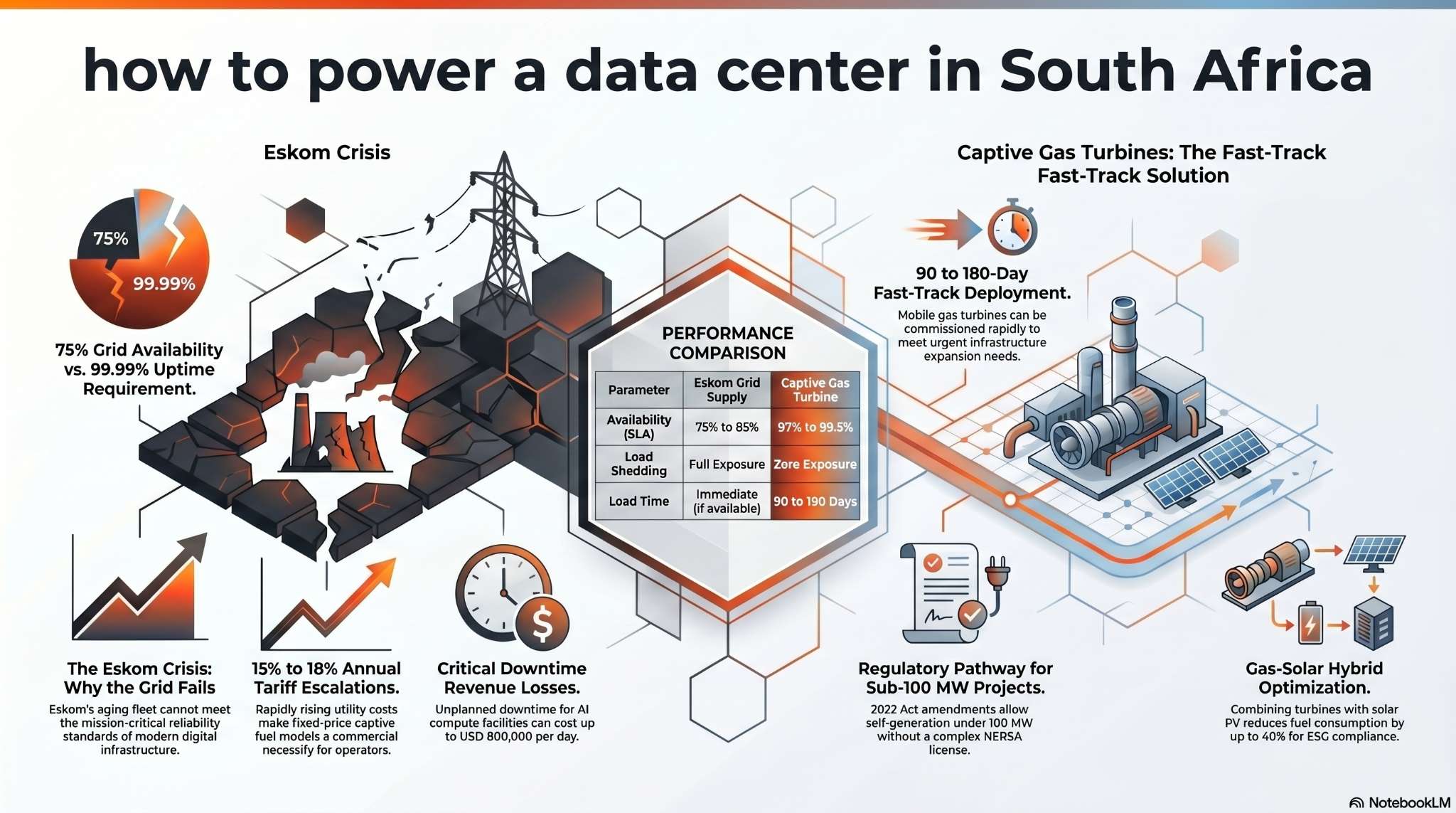
South Africa’s grid crisis is not a temporary inconvenience. It is a structural, long-term infrastructure challenge that has cost the South African economy an estimated R1 trillion in losses since 2007, according to the South African Reserve Bank. Load shedding, which reached Stage 6 and Stage 8 levels between 2022 and 2024, has triggered a fundamental shift in how mission-critical infrastructure is powered. Tier III and Tier IV data centers require 99.982% to 99.995% uptime guarantees. Eskom cannot provide this. A captive gas turbine power plant, engineered and operated correctly, can.
This guide explains exactly how to power a data center in South Africa using captive gas turbine generation, what the EPC process looks like, what it costs, and how USP&E Global has delivered fast-track captive power solutions for mining companies, utilities, and industrial operators across South Africa and the African continent. Whether you are a hyperscale operator preparing for 100 MW of AI workload, a colocation provider expanding in Johannesburg or Cape Town, or a bitcoin mining operation requiring uninterrupted power, this article is your definitive starting point.
USP&E Global has operated in South Africa since 2010, with over 60 engineers and project professionals based locally. Our team has designed, procured, and commissioned captive power stations for mining clients including Barrick Gold, Resolute Mining, and others across the region. Learn more about our power plant engineering capabilities or review our full project portfolio across 35 countries.
The South Africa Data Center Power Crisis: What the Data Shows
South Africa has the most advanced digital economy on the African continent, but it is constrained by the most unreliable national grid of any major emerging market. Eskom, the state-owned power utility, supplies approximately 95% of South Africa’s electricity from a fleet of coal-fired power stations that are ageing, under-maintained, and structurally underbuilt for the demands of a 21st-century digital economy.
The data center sector in South Africa is growing at a compound annual growth rate of between 22% and 27% through 2030, driven by hyperscaler entries from Microsoft Azure, Amazon Web Services, and Google Cloud, all of which have committed major infrastructure investments in Johannesburg and Cape Town. These hyperscalers require reliable, scalable, low-carbon power. Eskom cannot reliably deliver any of these three requirements at scale without supplementary captive generation.
Table 1: South Africa Data Center Power Market Overview (2025)
|
Indicator |
Current Status (2025) |
Eskom Risk Factor |
Captive Power Solution |
|
National grid reliability |
Approximately 75% availability |
High |
Gas turbine captive power plant |
|
Average load shedding (2024) |
Stage 2 to Stage 4 recurring |
Critical |
Off-grid or grid-independent generation |
|
Data center power demand (SA) |
800 MW to 1,200 MW by 2030 |
Very High |
Captive gas turbine or hybrid system |
|
Eskom tariff escalation |
15% to 18% per year average |
High |
Fixed-cost captive fuel model |
|
Colocation market growth (CAGR) |
22% to 27% projected to 2030 |
Moderate |
Reliable captive generation required |
|
Hyperscaler entrants (2024 to 2026) |
Microsoft, Amazon, Google confirmed |
Very High |
Dedicated generation infrastructure critical |
Source: Eskom Holdings, South African Reserve Bank, IRENA Africa Energy Outlook, industry estimates.
According to the International Energy Agency Africa Energy Outlook, South Africa accounts for roughly 40% of sub-Saharan Africa’s electricity consumption, yet power outages cost the country’s business sector between R4 billion and R9 billion per month. The World Bank Energy Data confirms that South Africa’s energy intensity is among the highest of any middle-income economy, making captive power not a luxury but a commercial necessity for operators who require guaranteed uptime.
For data center developers, the implications are clear. A colocation facility suffering two hours of load shedding daily loses between 7% and 10% of its available SLA capacity. An AI compute facility with 10,000 GPU nodes loses between USD 200,000 and USD 800,000 per day of unplanned downtime depending on utilisation rates and contract penalties. The business case for captive gas turbine power in South Africa does not need to be argued. It needs to be executed.
Key Drivers for Captive Gas Turbine Power in South African Data Centers: Why 2025 Is the Critical Window
Five converging market forces are making captive power for data centers in South Africa not just viable but essential in the current window. Project developers who act in 2025 and 2026 will secure fuel contracts, grid interconnection approvals, and EPC partners ahead of what will become an intensely competitive procurement market by 2027.
1. Hyperscaler Infrastructure Commitments
Microsoft announced a USD 2.1 billion investment in South African cloud infrastructure in 2024. Amazon Web Services followed with a commitment of USD 500 million for a Cape Town expansion. Google Cloud has confirmed Johannesburg data center capacity additions. Each of these facilities requires power in the range of 20 MW to 100 MW at launch, scaling to several hundred megawatts within three to five years. None of these operators will accept Eskom grid dependency as their primary power strategy.
2. Eskom Tariff Escalation
Eskom has applied for, and received, tariff increases averaging between 15% and 18% per annum since 2020. The South African National Energy Regulator (NERSA) approved a further multi-year tariff path in 2023 that projects real increases above inflation through 2027. A captive gas turbine operating on a fixed-price natural gas or LNG supply contract provides price certainty that is simply not available through Eskom’s tariff schedule. For a 50 MW data center facility, a 15% annual tariff increase translates into USD 3 million to USD 6 million in additional energy costs per year.
3. RMIPPPP and REIPPP Policy Reform
South Africa’s Risk Mitigation Independent Power Producer Procurement Programme (RMIPPPP) and Renewable Energy IPP Procurement Programme (REIPPP) Rounds 5 and 6 have created a clear regulatory pathway for private captive power generation. The Electricity Regulation Act amendments of 2022 removed the requirement for a generation licence for facilities under 100 MW, enabling data center operators to self-generate legally without complex licensing processes for most scale deployments.
4. AI Compute and GPU Cluster Demand
AI training workloads are 5 to 10 times more power-dense than traditional cloud compute. A single H100 GPU server rack draws between 10 kW and 20 kW. A 10,000-GPU AI training cluster requires between 10 MW and 20 MW of dedicated, uninterrupted power. Load shedding exposure of any kind is commercially unacceptable at this density. South Africa’s emerging position as the AI compute hub of Africa, supported by fibre connectivity through the WACS and SEACOM cable systems, depends entirely on solving the captive power equation.
5. LNG and Gas Infrastructure Growth
The development of LNG import infrastructure at the Port of Richards Bay, the Coega Industrial Development Zone in Gqeberha, and proposed floating storage and regasification units along the South African coastline is opening a natural gas supply pathway that did not exist at scale before 2022. Gas turbines operating on LNG or pipeline natural gas offer a lower-carbon, lower-cost alternative to diesel reciprocating generation for large data center applications.
For a detailed overview of available gas turbine equipment for South African projects, visit the USP&E Global gas turbine inventory, one of the fastest-deploying turbine solutions available for captive data center power in South Africa.
How USP&E Global Delivers Captive Gas Turbine EPC Power for Data Centers in South Africa
USP&E Global is not a turbine broker. We are a full-lifecycle EPC and O&M company with 350 engineers, 25 years of operating history, ISO 9001:2015 and ISO 45001:2018 certification, 150 completed projects across 35 countries, and zero lawsuits filed in a quarter-century of commercial operations. We own over 100 MW of gas turbine and diesel generation equipment outright, hold exclusivity on over 500 MW, and are direct with owners on a further 3,000 MW of available capacity.
For data center operators in South Africa, this means we can fast-track a captive power solution from feasibility study to commercial operation date (COD) in as few as 90 to 180 days for mobile gas turbine deployments, and 180 to 240 days for permanent, containerised installations. No competitor can match this combination of owned inventory, in-house engineering, and frontier-market installation speed.
Our South Africa-based team works within the regulatory frameworks of NERSA, the National Energy Regulator of South Africa, and the Department of Mineral Resources and Energy (DMRE). We manage grid interconnection agreements, environmental impact assessment (EIA) compliance, municipal licensing, and fuel supply contracting as part of our EPC scope. Our clients focus on their data center business. We handle the power infrastructure end to end.
Table 2: Captive Gas Turbine vs Eskom Grid: Performance Comparison for South African Data Centers
|
Parameter |
Eskom Grid Supply |
Captive Gas Turbine |
Captive Gas + Solar Hybrid |
|
Availability (SLA) |
75% to 85% |
97% to 99.5% |
97% to 99.8% |
|
Cost per kWh (2025) |
R3.20 to R4.50 |
R2.80 to R3.60 (at scale) |
R2.40 to R3.10 |
|
Tariff escalation risk |
15% to 18% per annum |
Fixed fuel contract options |
Lowest long-term exposure |
|
Load shedding exposure |
Full exposure |
Zero |
Zero |
|
CO2 mitigation options |
None (coal-heavy grid) |
LNG or biogas conversion |
Solar offsets 25% to 40% |
|
Lead time to power |
Immediate (if available) |
90 to 180 days (fast-track) |
120 to 240 days |
|
Scalability for AI workloads |
Limited by grid constraints |
Fully scalable in MW blocks |
Fully scalable in MW blocks |
Source: USP&E Global engineering estimates, NERSA tariff data, industry availability benchmarks.
USP&E’s hybrid power systems capability allows South African data center operators to combine gas turbine base-load generation with solar photovoltaic and battery storage for a lower carbon, lower cost profile. Our SmartPower AI platform monitors and optimises captive generation in real time, reducing fuel consumption by 8% to 15% and extending equipment life cycles significantly.
Captive Gas Turbine Power Solutions for South African Data Centers: Technical Configuration Guide
Selecting the right captive power configuration for a South African data center depends on five variables: site location and grid proximity, fuel supply route and contract availability, required capacity in megawatts, load profile (base-load versus peaking), and environmental and planning approval timelines. USP&E engineers work through each of these variables during the feasibility phase before any equipment is specified.
Mobile Gas Turbines: The Fast-Track Solution for 10 MW to 100 MW
The GE TM2500 aeroderivative mobile gas turbine is the single fastest-deploying large-scale captive power solution available for South African data center projects. Operating on natural gas, LNG, or diesel, the TM2500 delivers between 22 MW and 35 MW per unit and can be commissioned in as few as 90 days on a prepared site. For a 100 MW data center, three to four TM2500 units in N+1 configuration provide the redundancy required for Tier III classification.
The TM2500 is trailer-mounted, eliminating most civil work requirements and reducing EPC timelines dramatically compared to permanent heavy-frame turbine installations. USP&E holds exclusive inventory positions on TM2500 units and can offer extended warranties and availability guarantees under our O&M service agreements.
Permanent Gas Turbine Installations: 20 MW to 500 MW
For data center campuses requiring more than 50 MW with long-term power purchase or self-supply plans, permanent heavy-frame gas turbine installations from GE, Siemens, or Solar Turbines provide the lowest cost-per-kWh profile over a 15- to 25-year plant life. USP&E designs, procures, and constructs these plants under our full EPC scope, including fuel supply infrastructure, heat recovery systems, emissions controls to meet South African National Environmental Management: Air Quality Act (NEMAQA) standards, and grid interconnection.
Gas Plus Solar Hybrid Systems: The Long-Term Optimisation Strategy
South Africa receives between 4.5 and 6.0 peak sun hours per day in most of its major economic zones, including Gauteng, the Western Cape, and KwaZulu-Natal. A gas turbine hybrid system combining base-load gas generation with utility-scale solar PV and battery storage can reduce fuel consumption by 25% to 40%, lowering both operational cost and carbon intensity. This configuration is increasingly required by hyperscaler sustainability commitments and ESG reporting frameworks.
For a full overview of USP&E’s EPC construction capabilities, including balance-of-plant engineering, civil works, and grid interconnection scopes, visit our EPC construction service page. For O&M contract options including availability guarantees, visit our operations and maintenance page.
Fast-Track EPC Implementation Timeline: How to Power a Data Center in South Africa in 90 to 180 Days
One of the most common questions USP&E receives from data center developers in South Africa is how quickly a captive gas turbine power station can be commissioned. The answer depends on equipment availability, site readiness, fuel supply contracting, and regulatory approvals. For mobile gas turbine deployments using equipment available in USP&E’s existing inventory, 90 to 180 days from feasibility sign-off to commercial operation date is achievable.
Table 3: Fast-Track EPC Timeline for Captive Gas Turbine Power for South African Data Centers
|
Phase |
Activity |
Duration |
Key Deliverable |
Milestone |
|
Phase 1 |
Feasibility and site engineering |
4 to 6 weeks |
Feasibility study report |
Site confirmed, fuel supply agreed |
|
Phase 2 |
Detailed design and procurement |
6 to 10 weeks |
Engineering drawings and P&IDs |
Equipment order placed |
|
Phase 3 |
Civil and mechanical works |
4 to 8 weeks |
Foundation, skid, BOP installation |
Gas turbine on-site |
|
Phase 4 |
Electrical and grid interconnection |
3 to 5 weeks |
HV switchgear, transformers live |
Grid isolation capability confirmed |
|
Phase 5 |
Commissioning and handover |
2 to 4 weeks |
Availability and load testing |
Commercial operation date achieved |
|
Total Fast-Track |
Full EPC delivery |
90 to 180 days |
Commissioned power station |
Guaranteed availability SLA |
Source: USP&E Global EPC project data. Timelines are indicative and subject to site conditions, regulatory approval timelines, and equipment availability.
The single most common cause of timeline delays in South African captive power projects is late engagement of an experienced EPC partner. Data center developers who engage USP&E at the feasibility stage, before land is secured and before grid interconnection applications are submitted, consistently achieve faster COD dates than those who attempt to manage fuel supply, equipment procurement, and regulatory compliance independently before appointing an EPC contractor.
USP&E’s complimentary four-hour engineering consultation is designed specifically for this early-stage engagement. Our engineers review your site, load profile, fuel options, and timeline at no cost, so that your project brief is fully informed before any capital is committed.
To understand how we have delivered fast-track power solutions in comparable frontier market environments, review our combined case studies and project references, which include projects for Barrick Gold, Resolute Mining, Leo Lithium, and West African Power Generation.
What Does Captive Gas Turbine Power for a Data Center in South Africa Cost?
Cost is the first question every data center developer asks, and it is also the most site-specific question in EPC work. There is no single per-megawatt figure that applies across all configurations, sites, and fuel supply models. However, USP&E can provide indicative ranges based on our project experience, which help developers budget at the feasibility stage.
For a mobile gas turbine deployment (GE TM2500 or equivalent, 25 MW to 35 MW per unit) on a prepared site with existing fuel supply infrastructure, total installed cost typically falls between USD 600,000 and USD 900,000 per megawatt. This includes the turbine, installation, electrical balance of plant, commissioning, and grid interconnection for a straightforward South African site. Sites with complex fuel reticulation, remote location, or NEMAQA environmental compliance requirements will fall at the upper end of or above this range.
For permanent heavy-frame gas turbine installations (50 MW to 200 MW), total installed costs typically range from USD 800,000 to USD 1,500,000 per megawatt, depending on turbine model, plant configuration, civil scope, and fuel supply infrastructure. Full detailed engineering, typically representing 4% to 7% of total project cost, is required before a lump-sum turnkey price can be committed.
USP&E’s fast-track feasibility studies start at USD 30,000 for high-level conceptual analysis and scale to USD 150,000 to USD 250,000 for full conceptual design with site visit. Detailed bankable feasibility studies suitable for project finance typically range from USD 430,000 to USD 1,250,000 depending on site complexity and scope.
For a high-level budget estimate specific to your data center project, request a fast quote through our fast quote page or contact our South Africa team directly via the USP&E contact page.
Frequently Asked Questions: How to Power a Data Center in South Africa
How to power a data center in South Africa without Eskom grid dependency?
The most reliable solution for powering a data center in South Africa without Eskom dependency is a captive gas turbine power plant, either mobile (GE TM2500 or equivalent) or permanent (GE LM2500, Siemens SGT series, or Solar Turbines). These systems operate independently of the national grid, provide 97% to 99.5% guaranteed availability, and can be fast-tracked to commissioning in 90 to 180 days. Operators can further reduce exposure by combining gas turbine base-load with solar PV and battery storage under a gas-solar hybrid configuration. USP&E Global provides full EPC and O&M services for captive data center power in South Africa with engineers based in Johannesburg and Cape Town.
What is the best gas turbine for a data center in South Africa?
For fast-track deployments of 20 MW to 100 MW, the GE TM2500 aeroderivative mobile gas turbine is the top-rated solution for data center captive power in South Africa. It is trailer-mounted, commissions in 90 days, operates on natural gas, LNG, or diesel, and delivers between 22 MW and 35 MW per unit at ISO conditions. For permanent installations above 50 MW, the GE LM2500, GE LM6000, and Siemens SGT-400 to SGT-800 range are the preferred heavy-frame options depending on fuel availability, heat recovery requirements, and power density. USP&E holds inventory positions on all of these turbine models and can advise on the optimal selection for your specific load profile and site.
Is captive gas turbine power in South Africa cheaper than Eskom in 2025?
At current Eskom tariff levels (R3.20 to R4.50 per kWh for large industrial consumers) and with projected annual tariff escalation of 15% to 18%, captive gas turbine generation operating on a fixed-price LNG or natural gas supply contract can achieve equivalent or lower cost per kWh at scale within two to three years of commissioning. The financial advantage of captive power is compounded by the avoidance of load shedding costs, which for a 50 MW data center operating at 80% utilisation can represent USD 1 million to USD 5 million per month in lost revenue and SLA penalties. Total cost of ownership analysis consistently favours captive generation for data center operators above 10 MW in South Africa.
How long does it take to install a captive gas turbine power plant for a South African data center?
For mobile gas turbine solutions using equipment available in current inventory, USP&E can deliver from feasibility sign-off to commercial operation date in 90 to 180 days in South Africa. This timeline covers site engineering, fuel supply contracting, equipment delivery, civil works, electrical balance of plant, NERSA notification or registration, and commissioning. Permanent heavy-frame installations require 180 to 300 days depending on site complexity, civil scope, and equipment manufacturing lead times. The fastest projects USP&E has executed have been those where the client engages our team at early feasibility stage and fuel supply arrangements are in place or progressing in parallel.
Do I need an Eskom licence to operate a captive gas turbine power plant in South Africa?
Following the 2022 amendments to the South African Electricity Regulation Act, operators are no longer required to obtain a generation licence from NERSA for facilities under 100 MW. Facilities above 100 MW still require a NERSA generation licence, which typically takes four to six months to obtain. For facilities that wish to sell surplus power back to the grid or to third parties under a wheeling arrangement, additional regulatory requirements apply under the National Electricity Regulator of South Africa framework. USP&E’s in-house regulatory and engineering team manages all compliance requirements as part of our EPC scope.
What fuel options are available for captive data center power generation in South Africa?
South Africa’s captive power fuel options include piped natural gas (limited to Gauteng and parts of KwaZulu-Natal where Sasol’s gas grid operates), trucked or imported LNG (available nationally via Richards Bay, Coega, and other coastal entry points), diesel (immediately available nationally but highest cost and highest carbon intensity), and biodiesel or green hydrogen blends (emerging, with limited commercial availability at scale in 2025). The optimal fuel choice depends on site location, volume requirements, price certainty needs, and carbon intensity targets. USP&E’s engineering team conducts fuel supply feasibility as part of every project scoping engagement at no additional cost to qualified clients.
Can USP&E provide an O&M contract for a captive gas turbine data center power plant in South Africa?
Yes. USP&E currently manages over 260 MW of captive generation under long-term Operations and Maintenance contracts in South Africa, Mali, Togo, Liberia, and other frontier markets. Our South Africa O&M team provides 24 hours a day, seven days a week monitoring and maintenance, guaranteed availability SLAs (typically 95% to 97% contractual minimum), predictive maintenance programmes, spare parts supply under long-term service agreements, and performance reporting integrated with our SmartPower AI platform. O&M contract terms typically run from three to ten years and include performance-based availability bonuses and penalties aligned to data center uptime requirements.
Summary: Key Takeaways for Developers Asking How to Power a Data Center in South Africa
The question of how to power a data center in South Africa is the most commercially critical infrastructure question in the South African tech and digital economy today. Here are the seven most important conclusions from this guide:
- How to power a data center in South Africa reliably requires captive generation. Eskom cannot provide the availability guarantees required for Tier III and Tier IV data center operations at any scale.
- Gas turbine captive power is the fastest, most scalable solution. Mobile gas turbines (GE TM2500 and equivalent) can be commissioned in 90 to 180 days using USP&E’s owned inventory and in-house EPC capability.
- The regulatory environment is now favourable. South Africa’s 2022 Electricity Regulation Act amendments remove the licence requirement for sub-100 MW captive generation, accelerating project timelines significantly.
- Gas plus solar hybrid systems offer the lowest long-term cost. For projects with 10- to 25-year horizon planning, a hybrid configuration reduces fuel costs by 25% to 40% and supports hyperscaler ESG commitments.
- Total installed cost ranges from USD 600,000 to USD 1,500,000 per MW depending on configuration, site, and fuel supply complexity. Full engineering is required for a lump-sum EPC price.
- Early EPC engagement is the single biggest driver of project speed. Developers who engage USP&E at the feasibility stage achieve COD dates three to six months faster than those who appoint an EPC contractor after equipment procurement begins.
- USP&E Global is the proven South Africa captive power partner. With over 60 South Africa-based engineers, ISO 9001:2015 and ISO 45001:2018 certification, 150 completed projects, and zero lawsuits in 25 years, we are the guide your data center project needs to succeed.
Ready to Power Your Data Center in South Africa? Talk to USP&E’s Engineers Free.
USP&E Global offers a complimentary 4-hour engineering consultation for qualified data center power, EPC, and O&M projects in South Africa and across 35 countries. Whether you are in early feasibility or ready to mobilize, our team of 350 plus engineers is ready to guide your project to success with speed and without excuses.
USP&E Global: Powering Possibility. Built for the Frontier. | ISO 9001:2015 | ISO 45001:2018 | 150+ Projects | 35+ Countries | Zero Lawsuits
Quick Links:
- Contact USP&E by clicking on this link.
- Request a fast equipment quote
Global Resources
- USP&E's Project Experience Portfolio
- USP&E Case Studies and Client Reference Letters
- USP&E Integrity and Compliance policy
- USP&E's ISO Certifications and Credentials