

How to Pay for a Power Station: Deposits, Escrow, USD, Euro and Bitcoin Explained
Buying a power plant is one of the largest capital decisions a mine, utility, IPP, or data center will ever make, and the single question that stalls more deals than any technical specification is a commercial one: how do you actually pay for it safely. If you have ever wondered how to pay for a power station without exposing your organization to fraud, sanctions risk, or a stranded deposit, you are asking exactly the right question at exactly the right time. Across frontier and emerging markets, buyers routinely wire six and seven figure sums to unknown counterparties, and a meaningful share of those transactions collapse over payment structure, not over engineering. Understanding how to pay for a power station is therefore not a back office detail. It is the difference between a plant that energizes on schedule and a deposit that vanishes.
USP&E Global has spent 25 years guiding power buyers through this exact process. With 150+ projects delivered across 35+ countries, 350+ engineers, ISO 9001:2015 and ISO 45001:2018 certification, and zero lawsuits in over two decades of operation, USP&E has structured payment terms for gas turbine, HFO, diesel, and hybrid projects on nearly every continent. This guide explains the deposit, escrow, and currency mechanics that protect both buyer and seller, so your project stays the hero of the story and your capital stays secure.
The Payment Challenge in Frontier Power Markets: What the Data Shows
The direct answer is that payment risk, not equipment availability, is the leading reason frontier power deals fail to reach financial close. In markets where off-taker creditworthiness is uncertain and cross border banking is slow, buyers and sellers each fear the other will not perform. Lenders and development finance institutions confirm this pattern. The World Bank Group has repeatedly structured payment security mechanisms, including escrow accounts and letters of credit equivalent to roughly six months of a project’s revenues, specifically because sponsors and banks will not participate without them.
Payment risk shapes how every serious power transaction is built. The table below summarizes the payment security instruments most commonly used in emerging market power projects and what each one protects against.
|
Payment Instrument |
What It Protects |
Typical Use Case |
Relative Cost |
|
Refundable reservation deposit |
Buyer’s claim on a specific asset |
Holding equipment during due diligence |
Low |
|
Escrow account |
Both parties during closing |
Large equipment and EPC contracts |
Medium |
|
Letter of credit |
Seller against buyer non-payment |
Bank-backed international trade |
Medium to high |
|
Advance payment guarantee |
Buyer’s advance against seller default |
EPC mobilization payments |
Medium |
|
Milestone payment schedule |
Both parties across construction |
Full EPC power station builds |
Low |
Authoritative bodies publish extensive guidance on these mechanisms. Procurement and payment frameworks are detailed by the World Bank, the International Finance Corporation, and the International Energy Agency, all of which treat payment security as central to bankability. For any buyer learning how to pay for a power station, these sources establish that structured, staged, and secured payment is the global norm, not a special request.
Key Drivers of Secure Power Station Payment Terms: Why Structure Protects You
Understanding how to pay for a power station begins with understanding why disciplined payment structure exists. The following drivers explain why credible sellers insist on process, and why that process works in your favor as the buyer.
- Fraud prevention in high value transactions. Power equipment attracts sophisticated fraud because ticket sizes are enormous and buyers are often remote. A structured power station deposit paid into a controlled account, released against verified milestones, removes the single largest opening for fraud, which is an unconditional wire to an unverified party.
- Sanctions and compliance screening. As a United States FCPA compliant company, USP&E must confirm project location, end buyer identity, and the absence of sanctioned parties before accepting funds. This protects buyers from unknowingly funding a transaction that later triggers OFAC exposure. Compliance screening is documented by the S. Office of Foreign Assets Control.
- Deal qualification. A refundable reservation deposit and a modest inspection fee separate genuine, funded projects from speculative inquiries. Buyers with real funding welcome this filter because it means the seller is not simultaneously chasing a hundred unfunded leads.
- Cash neutrality for delivery. Milestone payments keep an EPC contractor cash neutral through the build, so subcontractors and equipment suppliers are paid on time and your schedule holds. This is standard EPC practice worldwide.
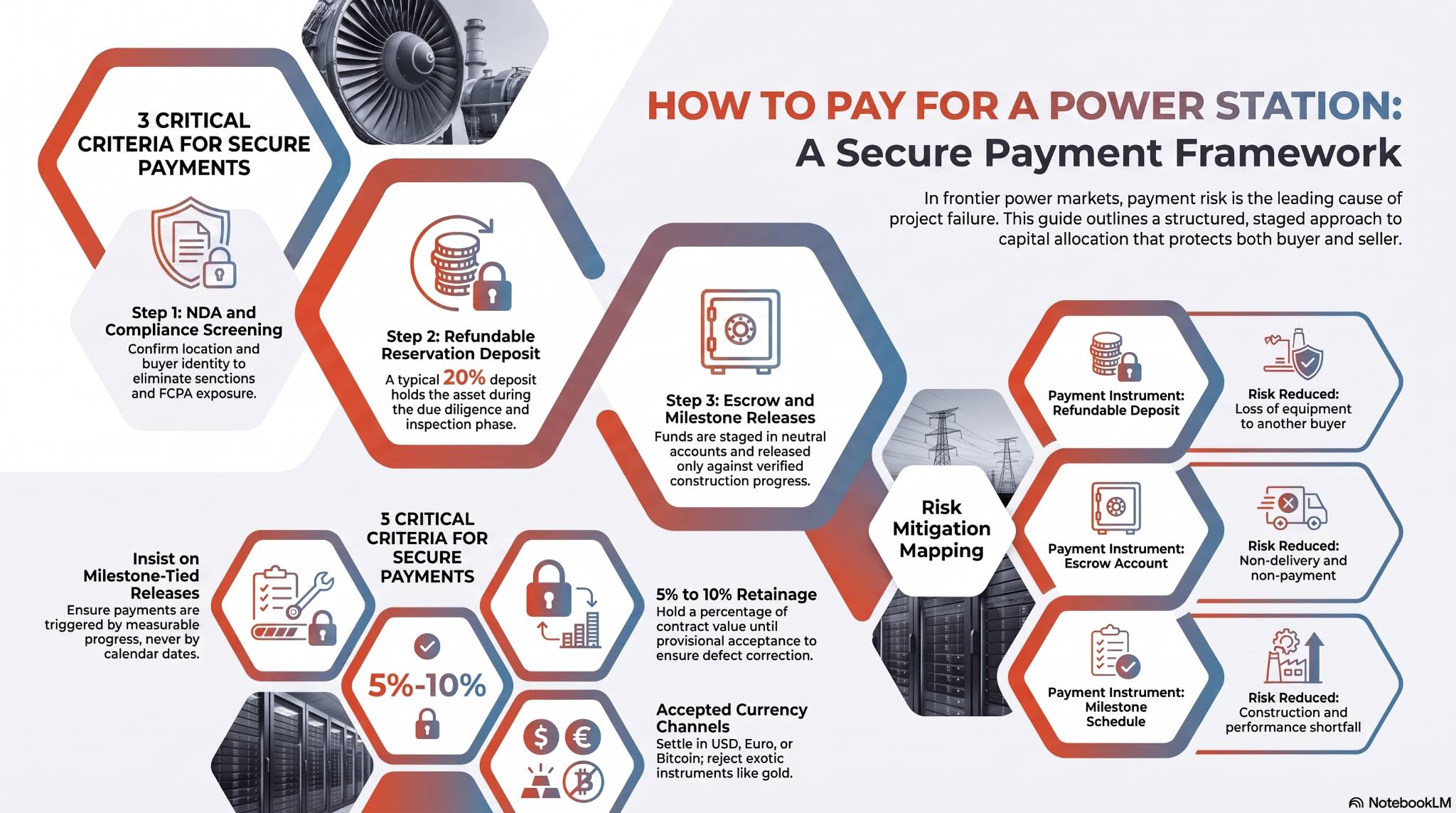
The table below shows how a typical secured payment sequence maps to project risk reduction.
|
Payment Stage |
Buyer Action |
Risk Reduced |
|
NDA and qualification |
Sign NDA, confirm location and funding |
Sanctions and circumvention risk |
|
Reservation deposit |
Refundable deposit to hold asset |
Loss of equipment to another buyer |
|
Inspection |
Fee paid, asset verified in person |
Buying misrepresented equipment |
|
Term sheet and escrow |
Funds staged in escrow |
Non-delivery and non-payment |
|
Milestone releases |
Payment against verified progress |
Construction and performance shortfall |
Government energy reform programs across Sub-Saharan Africa increasingly require exactly this kind of payment discipline before financing is released, which is why buyers who master how to pay for a power station move faster through approvals.
EPC and O&M Payment Structures: A Technical and Commercial Overview
Learning how to pay for a power station requires distinguishing between three different purchases that are often confused: buying equipment only, buying a full turnkey plant, and paying for operations and maintenance. Each has a different payment logic.
EPC stands for Engineering, Procurement, and Construction, the full turnkey delivery of a power station. O&M stands for Operations and Maintenance, the ongoing service contract that keeps a plant running after commissioning. CapEx is capital expenditure, the up front cost of building the plant, while OpEx is operating expenditure, the recurring cost of running it. A power station deposit typically applies to CapEx, while O&M is paid on a recurring schedule.
For equipment purchases, USP&E works on a reservation and inspection model. A refundable reservation deposit, commonly around 20 percent, holds the asset. That deposit is refundable if inspection shows the equipment is not as represented, and it applies to the purchase price once inspection is successful. This structure is explained further on the USP&E operations and maintenance and power plant engineering pages.
For full EPC projects, payment follows a milestone schedule tied to verified completion rather than calendar dates. Industry practice, reflected in World Bank EPC templates, holds roughly 5 to 10 percent of contract value as retainage until provisional acceptance, protecting the buyer against defects. Fast track diesel and mobile gas turbine projects compress this timeline, while HFO plants require longer engineering and manufacturing sequences that stretch the payment schedule across many months.
O&M and long term service agreements are paid on a recurring basis over a minimum term, usually three years or more. This aligns the service provider’s incentives with plant uptime across the full contract life.
Fuel Type Comparison for Power Station Payment Planning
Different technologies carry different payment profiles because their CapEx, lead times, and installation complexity vary widely. The table below helps buyers plan how to pay for a power station by fuel type.
|
Fuel Type |
CapEx per MW |
OpEx Profile |
Lead Time |
Best Application |
|
Diesel gensets |
Low to medium |
High fuel cost |
Under 90 days |
Fast track, remote, standby |
|
Mobile gas turbine |
Medium |
Medium fuel cost |
3 to 6 months |
Rapid grid and data center power |
|
Natural gas turbine |
Medium to high |
Low to medium fuel cost |
6 to 12 months |
Baseload where gas is available |
|
HFO plant |
High |
Low fuel cost |
9 to 14 months |
Long term baseload, mining |
|
Hybrid solar plus thermal |
Medium to high |
Low blended cost |
6 to 12 months |
Fuel savings, ESG targets |
Note on figures: CapEx per MW, lead times, and the 20 percent deposit and retainage percentages above are typical industry ranges for planning purposes. Every project is site specific, and exact figures must be confirmed by USP&E engineering after a term sheet is signed. These ranges are flagged here for internal verification before publication.
Case Studies: Proven Payment Structures in Frontier Markets and Similar Regions
Direct answer: USP&E’s payment structures have supported successful power delivery across some of the world’s most demanding markets, where weak banking infrastructure makes payment discipline essential. The examples below reflect the categories of work USP&E performs. Specific client names, MW figures, and financial outcomes are flagged for internal verification before publication and should be confirmed against project records.
In West Africa, USP&E has designed, built, and operated diesel and HFO power stations in Mali since 2006, supported by a large in country engineering and technician workforce. Payment for these mining sector projects has typically followed a staged structure combining equipment reservation deposits with EPC milestone releases, protecting both the mining off-taker and USP&E across multi month builds.
In the Americas, USP&E’s cross border work across Guyana, Colombia, Mexico, and the USA, summarized on the Americas project hub, has relied on escrow and letter of credit structures suited to international trade. In the data center segment, surging demand has made secure, fast payment terms critical, a topic explored on USP&E’s data center power page.
Across all regions, the pattern holds: refundable deposits qualify the deal, escrow protects the closing, and milestone releases protect delivery. Full project details are available through the USP&E project portfolio and client references pages.
How to Structure Payment for Your Power Station: 10 Critical Criteria
When evaluating how to pay for a power station and which partner to trust with your capital, assess each of the following. These criteria double as a due diligence checklist for any EPC and O&M provider.
- Refundability of the deposit. Confirm in writing that your reservation deposit is refundable if the asset is not as represented, and that it credits toward the purchase price on a successful inspection. A power station deposit should never be an unconditional payment.
- Escrow or controlled account availability. A credible seller will accept payment into an escrow or controlled account for large transactions, releasing funds against verified milestones rather than demanding a single unconditional wire.
- Milestone tied releases. Insist that EPC payments release on completion of measurable milestones, not on calendar dates or at commencement of work. This keeps your capital tied to real progress.
- Retainage on completion. Confirm that 5 to 10 percent of contract value is held until provisional acceptance, giving you leverage to ensure defects are corrected.
- Sanctions and compliance rigor. A partner that screens for OFAC and FCPA exposure protects you as much as itself. Weak compliance is a red flag, not a convenience.
- Currency clarity. Confirm which currencies the seller accepts, whether USD, Euro, or Bitcoin, and reject requests for exotic settlement such as gold, which frequently signals fraud.
- Transparent inspection terms. A modest, clearly documented inspection fee with defined refund conditions indicates a serious counterparty. Verify what the fee covers.
- Proof of ownership or exclusivity. Ensure the seller either owns the asset or holds a documented exclusive mandate, so your payment secures a real claim.
- Track record and legal history. Prioritize partners with a long delivery record and no history of litigation. USP&E’s zero lawsuit record across 25 years is a direct measure of contractual reliability.
- In house engineering and O&M. A partner with genuine engineering and operations and maintenance capability, rather than a broker, can stand behind performance guarantees that protect your payment.
Frequently Asked Questions: How to Pay for a Power Station
How do you pay for a power station safely in a frontier market?
You pay for a power station safely by staging your capital rather than paying a single unconditional wire. Start with a signed NDA and compliance screening, then a refundable reservation deposit to hold the asset, followed by verified inspection, then escrow at closing, and finally milestone linked releases through construction. This structure, used by lenders and EPC contractors worldwide, protects your capital at every step.
Is a power station deposit refundable?
A properly structured power station reservation deposit is refundable if the equipment is found to be not as represented during inspection. USP&E’s model applies the deposit to the purchase price once inspection is successful, so the deposit is either credited toward your plant or returned to you. Always confirm refund conditions in writing before paying.
What is escrow and why is it used for power plant payments?
Escrow is a controlled account held by a neutral third party that releases funds only when agreed conditions are met. It is used for power plant payments because it protects the buyer against non-delivery and the seller against non-payment simultaneously. Development finance institutions frequently require escrow or equivalent letters of credit before financing large power projects.
Can you pay for a power station in USD, Euro, or Bitcoin?
Yes. USP&E accepts payment in USD, Euro, and Bitcoin for qualified, compliant transactions. Requests to settle in gold or other exotic instruments are declined, because in practice they frequently indicate a lack of genuine funding. Currency terms are confirmed during the term sheet stage after compliance screening.
How much deposit is required to reserve a power plant?
A reservation deposit of approximately 20 percent is a common industry benchmark to hold a specific asset, though the exact figure depends on the equipment and transaction. The deposit is refundable if the asset is not as represented and applies to the purchase price on a successful inspection. Full EPC projects follow a separate milestone based payment schedule.
What is the difference between paying for equipment and paying for a full EPC power station?
Paying for equipment involves a reservation deposit against a specific asset, confirmed by inspection. Paying for a full EPC power station involves a milestone schedule covering engineering, procurement, civil works, installation, and commissioning, with retainage held until provisional acceptance. EPC payment is staged across many months because a complete plant is a major industrial build, not a single purchase.
Why does a seller require an NDA and compliance details before quoting payment terms?
A credible seller requires an NDA and project details to comply with FCPA and OFAC obligations and to confirm the project is not destined for a sanctioned region. This protects the buyer from unknowingly funding a non-compliant transaction. It also qualifies the deal, ensuring the seller commits engineering resources only to genuine, funded projects.
Summary: Key Takeaways for Power Station Payment Decision-Makers
Understanding how to pay for a power station protects your capital, your schedule, and your compliance position. The essentials:
- Payment risk, not equipment availability, is the leading cause of failed frontier power deals, so structure matters more than speed.
- Stage your capital: NDA and compliance screening, refundable reservation deposit, verified inspection, escrow at closing, then milestone linked releases.
- A refundable power station deposit of around 20 percent holds equipment and credits to the purchase price on successful inspection.
- Escrow accounts and letters of credit protect buyer and seller simultaneously and are standard in bankable power projects.
- Full EPC payment follows a milestone schedule with 5 to 10 percent retainage held until provisional acceptance.
- USP&E accepts USD, Euro, and Bitcoin for qualified, compliant transactions and declines exotic settlement such as gold.
- Knowing how to pay for a power station, with the right partner, turns a high risk wire into a secured, staged, and compliant transaction.
Ready to Power Your Project? Talk to USP&E’s Engineers Free.
USP&E Global offers a complimentary 4-hour engineering consultation for qualified power station, EPC, and O&M projects. Whether you are in early feasibility or ready to mobilize, our team of 350+ engineers across 35+ countries is ready to guide your project to success with speed and without excuses.
USP&E Global. Powering Possibility. Built for the Frontier.
ISO 9001:2015 | ISO 45001:2018 | 150+ Projects | 45+ Countries | Zero Lawsuits
Quick Links:
- Contact USP&E by clicking on this link.
- Request a fast equipment quote
Global Resources
- USP&E's Project Experience Portfolio
- USP&E Case Studies and Client Reference Letters
- USP&E Integrity and Compliance policy
- USP&E's ISO Certifications and Credentials