

How to Develop a Power Plant in Saudi Arabia: NEOM and Vision 2030 IPP Guide
Saudi Arabia is executing the most ambitious energy transformation programme in the modern Middle East. If you are asking how to develop a power plant in Saudi Arabia in 2025 and 2026, you are entering a market defined by extraordinary scale, accelerating private-sector opportunity, and a regulatory environment that is reforming faster than any comparable Gulf state. The Kingdom has committed to 50 percent renewables in its electricity mix by 2030 under Vision 2030, while simultaneously building NEOM, a 170-kilometre linear city in Tabuk Province that alone requires an estimated 4 gigawatts of new generation capacity. Behind those headline targets, Saudi Arabia is adding over 20,000 megawatts of new power capacity across gas, solar, wind, and hybrid projects between now and 2030, creating one of the largest concentrated IPP pipelines anywhere in the world.
This guide covers every stage of the power plant development process in Saudi Arabia: regulatory approval, the IPP licensing pathway through the Saudi Electricity Regulatory Authority (SERA), EPC contractor selection, fuel specification, grid interconnection with Saudi Electricity Company (SEC), project financing, and the specific timelines, costs, and technical requirements that separate successful developers from those who stall at the feasibility stage. USP&E Global has been active in the Middle East since 2002, with completed and live projects in Saudi Arabia, Qatar, UAE, Iraq, and Oman. This is not theoretical guidance. It is the operational reality of power project development in the Kingdom, delivered by engineers who have been there.
The Saudi Arabia Power Sector in 2025 and 2026: What the Data Shows
Saudi Arabia’s electricity demand is growing at approximately 4 to 5 percent per annum, driven by population growth, the industrialisation of the country’s non-oil economy, and the extraordinary energy consumption of flagship gigaprojects including NEOM, Diriyah Gate, and ROSHN. The Saudi Electricity Company (SEC) reported a peak demand of over 75,000 megawatts in summer 2023, and forecasts indicate that figure will exceed 90,000 megawatts before the end of the decade. Simultaneously, the Kingdom’s Vision 2030 renewable energy targets are pulling significant private capital into the sector through the National Renewable Energy Program (NREP), which the Saudi Power Procurement Company (SPPC) administers.
According to the International Energy Agency (IEA) and the International Renewable Energy Agency (IRENA), Saudi Arabia currently operates approximately 88,000 megawatts of installed capacity, with gas turbines and combined-cycle gas plants making up roughly 80 percent of that total. The pivot to renewables and the opening of the IPP market to international developers represents the single biggest commercial opportunity in the regional power sector today.
Table 1: Saudi Arabia Power Sector Key Metrics for IPP Developers (2025)
|
Power Sector Indicator |
Current Figure (2025) |
2030 Target / Projection |
|
Total Installed Capacity |
~88,000 MW |
~130,000 MW |
|
Gas Turbine Share of Capacity |
~80% |
~55% (post-renewable build-out) |
|
Renewable Energy Share |
~5% |
50% (Vision 2030 target) |
|
NREP Projects Awarded or in Procurement |
28+ projects |
70+ projects planned |
|
Peak Summer Demand |
~75,000 MW |
~90,000+ MW |
|
NEOM Power Requirement |
Phase 1: 1,200 MW |
Full build: 4,000+ MW |
|
IPP Market Opening |
2018 onward |
Fully competitive by 2026 |
Sources: IEA Saudi Arabia | IRENA Saudi Arabia | World Bank Energy Data
Key Drivers for Power Plant Development in Saudi Arabia: Why the 2025 to 2030 Window Is Critical
Developers who understand how to develop a power plant in Saudi Arabia during the 2025 to 2030 Vision 2030 delivery window will be positioning themselves in the most commercially active power market in the Gulf. Five structural drivers are accelerating this opportunity.
- Vision 2030 Diversification and the NREP: Saudi Arabia’s National Renewable Energy Program, managed by the Saudi Power Procurement Company (SPPC), is procuring utility-scale solar, wind, and hybrid projects at a pace not seen anywhere else in the Middle East. Over 70 projects are in the pipeline. Each requires EPC expertise, grid interconnection studies, and fuel or resource assessments that international developers must be prepared to deliver.
- NEOM and Gigaproject Power Demand: NEOM alone requires a dedicated power infrastructure backbone. The Neom Power and Water Company (ENOWA) is procuring generation capacity across hydrogen, solar, wind, and gas. Developers entering the NEOM supply chain must meet the Saudi Council of Engineers (SCE) registration requirements and demonstrate ISO-certified EPC delivery capability.
- Gas Turbine Peaking Capacity Needs: Saudi Arabia still requires significant dispatchable gas turbine capacity to backstop its renewable build-out. Aeroderivative turbines including the GE LM2500 and GE TM2500 are in active procurement for peaking and grid-support applications across the Kingdom.
- Industrial and Mining Sector Power Demand: Saudi Aramco, SABIC, and Ma’aden are all expanding industrial operations. Captive power stations of 50 to 500 megawatts are regularly tendered for industrial sites in Jubail, Yanbu, Ras Al Khair, and the Wa’ad Al Shamal industrial zone.
- Grid Modernisation and Private Sector Opening: The Saudi Electricity Regulatory Authority (SERA) has progressively liberalised the market since 2018. Third-party access to the national grid is now codified in the Electricity Law and its implementing regulations, giving IPP developers a clear legal framework for offtake under Power Purchase Agreements (PPAs) with SEC or SPPC.
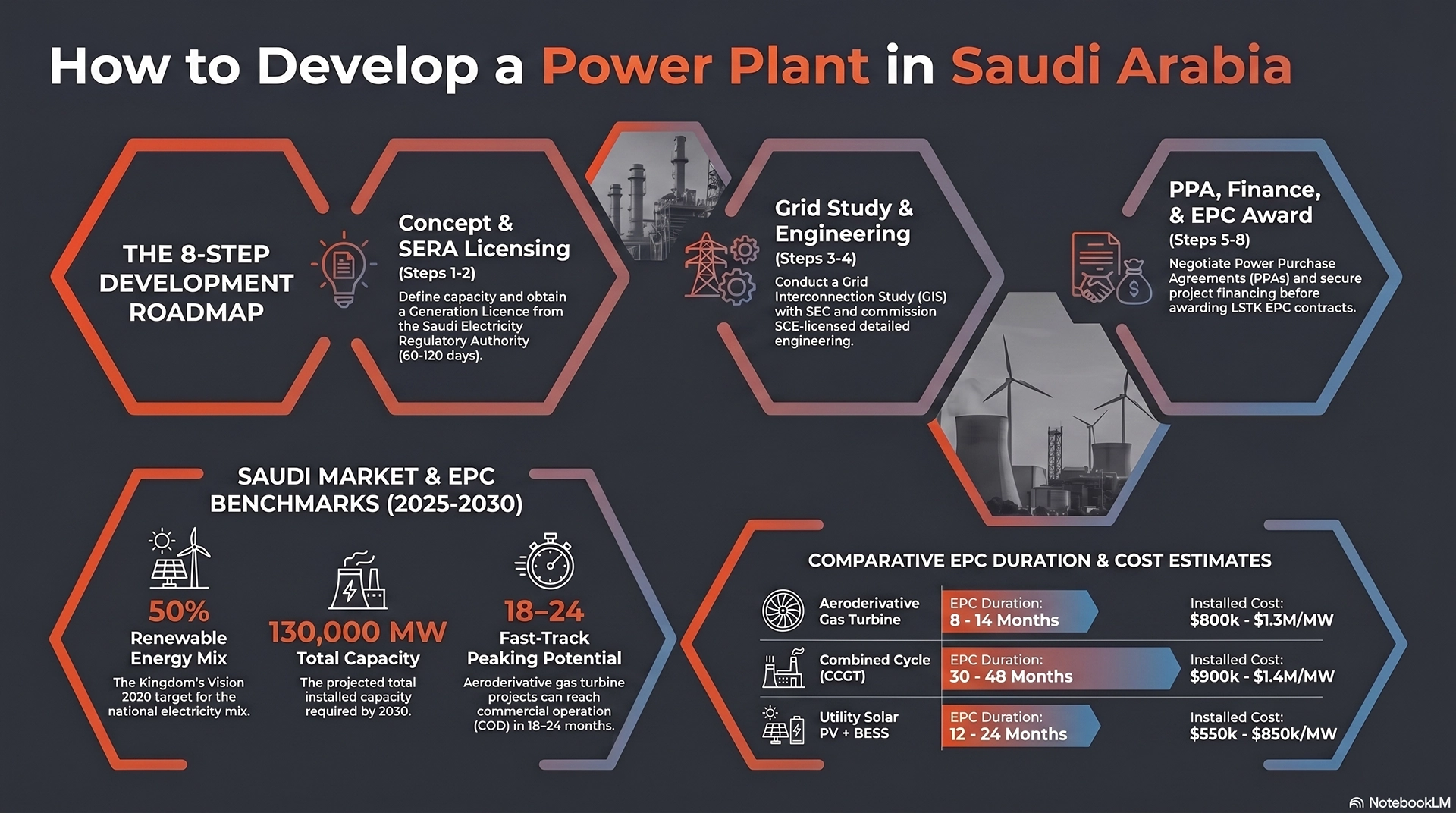
How to Develop a Power Plant in Saudi Arabia: The Regulatory and Licensing Pathway
Successfully developing a power plant in Saudi Arabia requires navigating a defined sequence of regulatory, commercial, and engineering milestones. The key authority is the Saudi Electricity Regulatory Authority (SERA), which issues generation licences, oversees PPAs, and enforces technical standards across the sector. The following eight steps represent the standard development pathway for an IPP or captive power station in the Kingdom.
- Project Concept and Pre-Feasibility: Define capacity (megawatts), fuel type (natural gas, solar, wind, hybrid), project location (Riyadh, Jeddah, Tabuk, Jubail, or other), offtake structure (merchant, captive, or PPA with SPPC/SEC), and investment structure. This stage typically requires 30 to 60 days and a budget of SAR 100,000 to SAR 400,000 for third-party advisors.
- SERA Generation Licence Application: Submit the licence application to SERA with company registration documents, a project information memorandum, technical specifications, and evidence of financial capability. SERA typically responds within 60 to 120 days. Provisional approval triggers the next development phases.
- Grid Interconnection Study (GIS): Engage SEC for a formal Grid Interconnection Study. This study confirms the point of common coupling (PCC), grid capacity, required transformation voltage (typically 110kV, 230kV, or 380kV), and interconnection timeline. GIS duration: 90 to 180 days. Cost: SAR 500,000 to SAR 2,000,000 depending on scale.
- Conceptual and Detailed Engineering: Commission a licensed engineering firm with Saudi Council of Engineers (SCE) registration to prepare conceptual designs, load flow studies (ETAP), P&IDs, site layout drawings, and environmental impact assessment (EIA) documentation for NCEC approval. USP&E Global provides full conceptual engineering from USD 150,000 to USD 350,000 for projects up to 200 megawatts.
- PPA Negotiation with SPPC or SEC: For grid-connected IPPs, negotiate a Power Purchase Agreement with SPPC (for competitive tender projects) or SEC (for bilateral projects). Key commercial terms include tariff structure, fuel pass-through provisions, capacity payments, availability guarantees (typically 95 percent or above), and liquidated damages provisions.
- Project Financing and Financial Close: Arrange equity and debt financing with international development finance institutions (IFC, IsDB, APICORP) or commercial lenders. Saudi Aramco Power Company (SAPCO), ACWA Power’s financing structures, and Saudi Arabia’s Public Investment Fund (PIF) are all active in co-investing in utility-scale projects. Financial close typically requires 6 to 18 months from PPA execution.
- EPC Contractor Procurement and Award: Issue an EPC tender to pre-qualified contractors. Evaluate on technical compliance, ISO certifications (ISO 9001:2015 and ISO 45001:2018 are standard requirements), track record in Saudi Arabia or comparable markets, financial standing, and price. EPC contracts in Saudi Arabia are typically LSTK (Lump Sum Turnkey) with performance bonds of 10 percent of contract value.
- Construction, Commissioning and Commercial Operation: Mobilise the EPC team, initiate civil works, deliver and install generation equipment, complete balance-of-plant connections, conduct pre-commissioning testing, and achieve commercial operation date (COD). COD triggers PPA payment commencement.
Power Plant EPC Delivery in Saudi Arabia: Technical Requirements and Timeline
EPC delivery in Saudi Arabia is governed by the Saudi Building Code (SBC), the Saudi Electricity Company Grid Code, and the technical standards issued by SERA. All engineering firms must hold Saudi Council of Engineers (SCE) registration, and contractors must hold a valid MOMRA (Ministry of Municipal and Rural Affairs) licence for civil works. Electrical contractors must hold a CITC-approved electrical contractor licence. For projects involving gas turbines, compliance with NFPA 70 (National Electrical Code) and ASME B31.3 for process piping is standard. USP&E Global’s in-house EPC capability at EPC Construction covers all phases from conceptual design through commissioning and O&M.
The following table presents typical EPC timelines and indicative cost ranges for power plant development in Saudi Arabia, organised by project scale. These figures reflect USP&E Global’s direct experience in Saudi Arabia and comparable Gulf markets and are provided as high-level guidance pending full site-specific engineering.
Table 2: EPC Timeline and Cost Guide for Power Plant Development in Saudi Arabia
|
Project Scale |
Technology |
EPC Duration (Months) |
Installed Cost (USD/MW) |
O&M Cost (USD/MW/Year) |
|
5 to 20 MW |
Diesel / Gas Reciprocating |
3 to 6 |
700,000 to 1,100,000 |
35,000 to 60,000 |
|
20 to 100 MW |
Aeroderivative Gas Turbine |
8 to 14 |
800,000 to 1,300,000 |
40,000 to 70,000 |
|
100 to 500 MW |
Heavy Frame Gas Turbine |
18 to 30 |
650,000 to 1,000,000 |
25,000 to 45,000 |
|
200 to 1,000 MW |
Combined Cycle Gas (CCGT) |
30 to 48 |
900,000 to 1,400,000 |
20,000 to 35,000 |
|
50 to 500 MW |
Utility Solar PV with BESS |
12 to 24 |
550,000 to 850,000 |
12,000 to 22,000 |
|
50 to 300 MW |
Hybrid Solar plus Gas Turbine |
18 to 30 |
750,000 to 1,100,000 |
30,000 to 55,000 |
Note: All costs are indicative USD figures based on Saudi Arabian market conditions as of 2025. Actual costs depend on site conditions, fuel supply infrastructure, grid distance, local content (IKTVA) requirements, and equipment specification. USP&E offers full detailed engineering services to generate bankable cost estimates. See USP&E Power Plant Engineering.
How USP&E Global Supports Power Plant Development in Saudi Arabia
USP&E Global is not a newcomer to the Kingdom. With live projects and commercial relationships across Saudi Arabia, Qatar, UAE, and Iraq, the company has been navigating Middle East power project development since 2002. For developers asking how to develop a power plant in Saudi Arabia, USP&E’s value proposition is structured around four interlocking capabilities: asset procurement, engineering and feasibility, full EPC delivery, and long-term O&M. Learn more at https://www.uspeglobal.com/pages/about-uspe.
- Asset Procurement: USP&E owns over 100 megawatts of gas turbines and engine-driven generating sets, holds exclusivity on over 500 megawatts, and maintains direct relationships with owners of a further 3,000 megawatts. For Saudi projects requiring fast-track peaking capacity, this inventory advantage is material. GE TM2500 aeroderivative gas turbines, available through USP&E at https://www.uspeglobal.com/pages/ge-tm2500s-by-usp-e, are particularly suited to Saudi Arabia’s fast-track peaking and industrial captive power requirements.
- Engineering and Feasibility: USP&E provides conceptual feasibility studies (30 to 60 days, from USD 30,000), detailed bankable feasibility studies (60 to 120 days, from USD 430,000), and full detailed design engineering. All engineering is ISO 9001:2015 certified and includes geotechnical survey inputs, ETAP load flow modelling, P&ID development, and grid interconnection study coordination.
- EPC Delivery: With over 150 completed projects in 35 countries, USP&E’s EPC track record covers gas turbine, HFO, diesel, solar, and hybrid power stations. The company holds ISO 9001:2015 and ISO 45001:2018 certifications. Zero lawsuits in 25 years of operation is a distinguishing fact in a market where EPC contract disputes are common.
- Operations and Maintenance: USP&E currently manages over 260 megawatts under O&M contracts across Africa and the Middle East. Availability guarantees of 95 percent or above, structured under Long Term Service Agreements (LTSAs), are standard. See the full O&M offering at https://uspeglobal.com/pages/operations-and-maintenance/.
USP&E’s SmartPower AI platform, detailed at SmartPower, provides real-time plant performance monitoring, predictive maintenance scheduling, and fuel optimisation analytics, directly addressing the IKTVA and Saudisation requirements for technology localisation in Saudi Arabia.
Frequently Asked Questions: How to Develop a Power Plant in Saudi Arabia
What is the first step to develop a power plant in Saudi Arabia as a foreign IPP developer?
The first formal step is obtaining a Generation Licence from the Saudi Electricity Regulatory Authority (SERA). Before submitting the licence application, developers must complete a pre-feasibility study, select a project site, confirm fuel supply access (natural gas pipeline or diesel logistics), and identify an offtake structure, either a PPA with SPPC/SEC or a captive arrangement with an industrial anchor. Most developers also pre-register with the Ministry of Investment (MISA) to establish their legal Saudi entity before initiating the SERA process.
How long does it take to develop a power plant in Saudi Arabia from concept to commercial operation?
Timeline depends on project scale and technology. A fast-track aeroderivative gas turbine project of 50 to 100 megawatts can reach commercial operation in 18 to 24 months from project concept if all regulatory approvals are secured in parallel with engineering and procurement. A utility-scale combined-cycle gas turbine (CCGT) or large-scale solar project of 300 to 1,000 megawatts typically requires 36 to 60 months from concept to COD, reflecting the complexity of grid interconnection studies, financing, and LSTK EPC delivery.
Do foreign companies need a local Saudi partner to develop a power plant in Saudi Arabia?
Under Vision 2030’s investment liberalisation programme and the MISA reforms introduced since 2018, foreign companies in many sectors can now own 100 percent of their Saudi entity without a mandatory local partner. However, the Saudi Council of Engineers (SCE) registration requirement for engineering firms, and MOMRA licensing for civil contractors, means that most international developers find strategic partnerships with Saudi entities commercially advantageous even where not legally mandated. For EPC delivery, IKTVA (In-Kingdom Total Value Add) requirements set minimum thresholds for local content in Aramco and Saudi Aramco-associated projects.
What fuel types are used in Saudi Arabia power plant development?
Saudi Arabia’s domestic gas tariffs are heavily subsidised, making pipeline natural gas the dominant fuel for both open-cycle and combined-cycle gas turbine power stations. Diesel is used for fast-track peaking and emergency generation but is commercially disadvantaged by the comparatively low gas tariff. Saudi Arabia’s Vision 2030 programme is introducing utility-scale solar photovoltaic, wind, and green hydrogen, with NEOM’s ENOWA entity at the forefront of hydrogen and renewable integration. For industrial captive power in remote areas, dual-fuel aeroderivative turbines capable of running on both natural gas and diesel are a common fast-track specification.
What does it cost to develop a power plant in Saudi Arabia for an industrial client?
Installed costs for gas turbine power stations in Saudi Arabia range from approximately USD 700,000 to USD 1,300,000 per installed megawatt for open-cycle aeroderivative and heavy-frame gas turbine projects, depending on scale, site conditions, grid distance, and scope of balance of plant. A 100-megawatt gas turbine station therefore requires a total installed capital investment of approximately USD 80 million to USD 130 million. Annual O&M costs under a Long Term Service Agreement typically run USD 40,000 to USD 70,000 per megawatt. These figures are indicative and require full site-specific engineering to confirm.
How does USP&E Global support power plant development in Saudi Arabia specifically?
USP&E Global supports Saudi Arabia power plant development at every stage: pre-feasibility studies, detailed engineering, gas turbine and engine asset procurement from owned inventory, full LSTK EPC delivery with ISO 9001:2015 and ISO 45001:2018 certification, and long-term O&M under performance-guaranteed service agreements. USP&E has been active across the Middle East since 2002, has live projects in Saudi Arabia and neighbouring Gulf states, and offers a complimentary 4-hour engineering consultation for qualified projects. Contact USP&E at https://www.uspeglobal.com/pages/contact-us.
What is SERA and how does it regulate IPPs in Saudi Arabia?
The Saudi Electricity Regulatory Authority (SERA) was established under the Electricity Law to license and regulate all electricity generation, transmission, distribution, and supply activities in Saudi Arabia. SERA issues generation licences to IPPs, approves PPA terms with SPPC and SEC, sets tariff structures, and enforces technical compliance standards. SERA’s regulatory framework has progressively opened the market to private and foreign developers since 2018, creating the legal certainty that underpins Vision 2030 IPP investment.
Summary: Key Takeaways for How to Develop a Power Plant in Saudi Arabia
Developers and investors evaluating how to develop a power plant in Saudi Arabia in 2025 and 2026 should note the following critical points before initiating a project.
- Saudi Arabia is the largest power market in the Gulf, with over 20,000 megawatts of new capacity required by 2030 across gas, solar, wind, and hybrid technologies. The opportunity for qualified IPP developers and EPC contractors is substantial and growing.
- The regulatory pathway for how to develop a power plant in Saudi Arabia is structured, legally defined, and consistently administered by SERA. Developers who engage with the process methodically and with a credentialed EPC partner significantly reduce schedule and cost risk.
- NEOM’s ENOWA and the Saudi Power Procurement Company (SPPC) are the two primary offtake counterparties for new IPP development. Both require ISO-certified EPC delivery and demonstrated project experience in comparable markets.
- Installed costs for gas turbine power stations in Saudi Arabia range from USD 700,000 to USD 1,300,000 per megawatt, and timelines range from 18 months for fast-track aeroderivative projects to 48 months or more for utility-scale CCGT or hybrid developments.
- USP&E Global brings 25 years of Middle East and frontier market power project experience, a 350-plus engineer team, owned and exclusive gas turbine inventory, and ISO-certified EPC and O&M delivery to Saudi Arabia project development. Zero lawsuits. 150-plus completed projects. 35-plus countries.
- The window for first-mover advantage in Vision 2030’s IPP programme is narrowing. Projects that reach financial close and EPC award by 2026 will be best positioned to capture the highest-value PPA terms and industrial offtake contracts before the market becomes more competitive.
Ready to Power Your Project? Talk to USP&E’s Engineers Free.
USP&E Global offers a complimentary 4-hour engineering consultation for qualified power station, EPC, and O&M projects in Saudi Arabia and across the Middle East. Whether you are in early feasibility or ready to mobilise, our team of 350+ engineers across 35+ countries is ready to guide your project to success with speed and without excuses.
USP&E Global — Powering Possibility. Built for the Frontier.
ISO 9001:2015 | ISO 45001:2018 | 150+ Projects | 35+ Countries | Zero Lawsuits
Quick Links:
- Contact USP&E by clicking on this link.
- Request a fast equipment quote
Global Resources
- USP&E's Project Experience Portfolio
- USP&E Case Studies and Client Reference Letters
- USP&E Integrity and Compliance policy
- USP&E's ISO Certifications and Credentials