

How Long Does It Take to Build a Power Plant? EPC Timelines by Fuel Type and MW Size
The question of how long to build a power plant is one of the most consequential decisions a mining company, utility developer, or independent power producer will face. Get the timeline wrong by even two months, and the consequences are measured in production halts, contract penalties, and communities left without power. Get it right, and your project reaches commissioning on schedule, within budget, and with full confidence from lenders, government counterparties, and end users alike.
The honest answer is that how long to build a power plant depends entirely on four variables: the fuel type selected, the size of the plant in megawatts, the completeness and quality of the engineering work preceding construction, and the experience of the EPC contractor managing procurement and mobilisation. A 5MW diesel genset installation in a frontier mining region can be operational in 60 to 90 days. A 100MW heavy fuel oil power station, even when much of the major equipment is already in stock, requires 12 to 18 months from deposit to commissioning. Understanding these distinctions is not optional. It is the foundation of every bankable EPC project timeline and every realistic power purchase agreement.
This guide covers the complete EPC construction timeline landscape, from fast-track diesel and mobile gas turbine deployments to full-scale HFO and combined cycle installations, with data tables, phase-by-phase breakdowns, and real-world context drawn from over 150 power station projects across 45+ countries.
The Energy Project Timeline Challenge: What the Data Shows
According to the International Energy Agency World Energy Outlook, approximately 775 million people globally still lack access to electricity, with the highest concentration across Sub-Saharan Africa, South and Southeast Asia, and parts of the Middle East. The World Bank Energy Data indicates that private sector investment in energy projects in developing markets exceeded USD 30 billion annually in recent years, yet project delays remain the single most cited obstacle to delivery.
The U.S. Energy Information Administration publishes construction cost and timeline data showing that median construction times for utility-scale power projects in the United States range from 12 months for simple-cycle gas turbines to over 60 months for coal and nuclear facilities. Frontier and emerging markets face additional delays of 20 to 40 percent over these benchmarks due to logistics complexity, import duty timelines, civil works permitting, and fuel supply chain development.
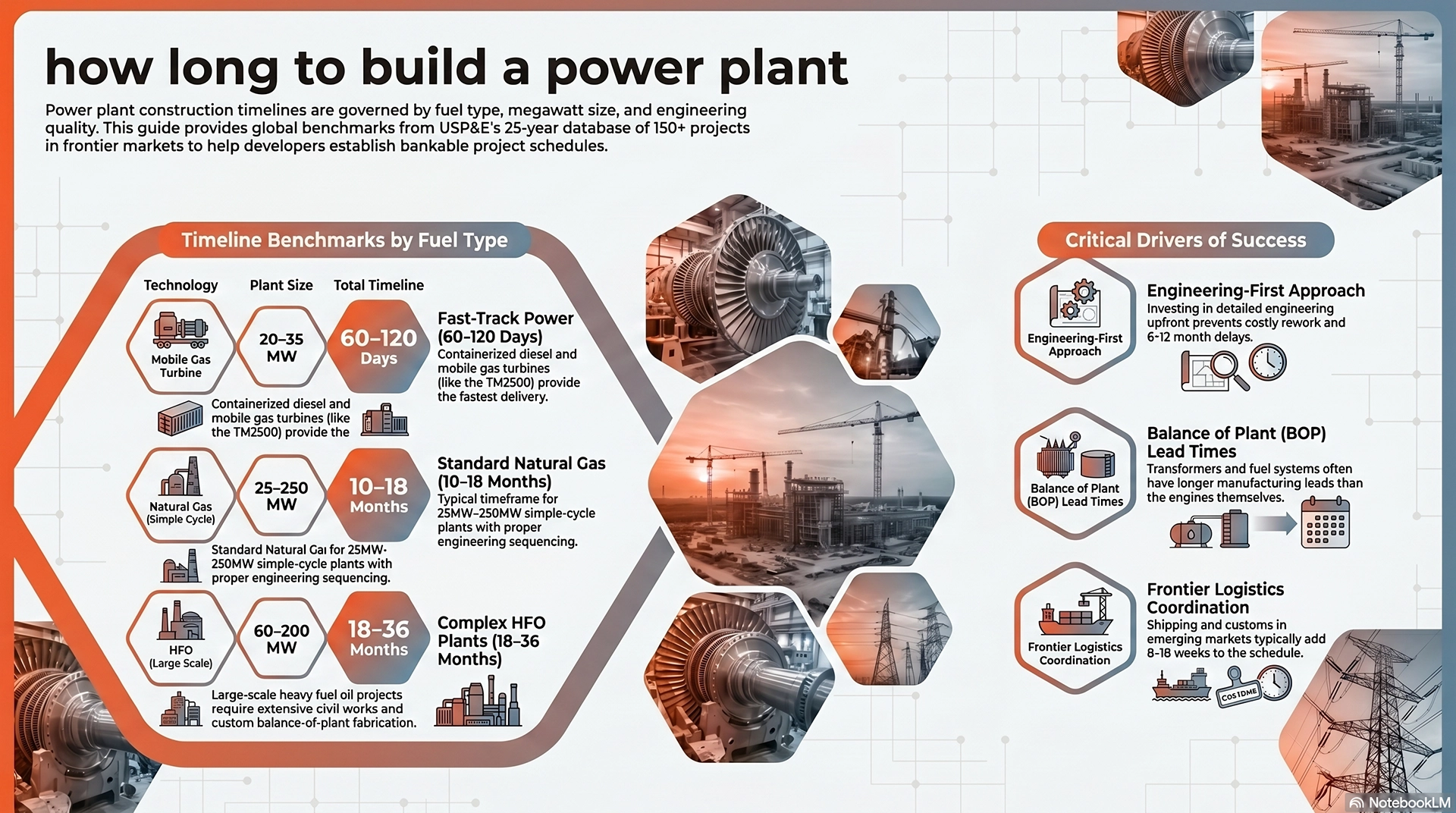
The table below provides a global benchmark of power plant construction timelines by fuel type and project size, based on USP&E’s 24+ years of EPC project delivery across Africa, the Middle East, Southeast Asia, and the Americas.
Table 1: Power Plant EPC Construction Timeline Benchmarks by Fuel Type and MW Size
|
Fuel Type |
Plant Size (MW) |
Engineering & Design |
Procurement & Mfg. |
Civil Works |
Install & Commission |
Total Timeline (Deposit to First Power) |
|
Diesel Genset (containerised) |
1 to 10 MW |
2 to 4 weeks |
4 to 8 weeks |
2 to 4 weeks |
2 to 4 weeks |
60 to 120 days |
|
Diesel Genset (open frame) |
10 to 30 MW |
4 to 8 weeks |
6 to 12 weeks |
4 to 8 weeks |
4 to 8 weeks |
4 to 7 months |
|
Mobile Gas Turbine (GE TM2500) |
20 to 35 MW |
3 to 6 weeks |
Unit in stock / 2 to 8 weeks shipping |
2 to 4 weeks |
3 to 6 weeks |
60 to 120 days |
|
Natural Gas Turbine (Simple Cycle) |
25 to 250 MW |
8 to 16 weeks |
16 to 40 weeks |
6 to 12 weeks |
8 to 16 weeks |
10 to 18 months |
|
HFO Reciprocating Engine Plant |
10 to 60 MW |
12 to 20 weeks |
20 to 30 weeks |
8 to 14 weeks |
16 to 36 weeks |
12 to 24 months |
|
HFO Plant (full BOP, large scale) |
60 to 200 MW |
16 to 24 weeks |
24 to 40 weeks |
12 to 20 weeks |
24 to 48 weeks |
18 to 36 months |
|
Hybrid Solar plus Diesel or Gas |
5 to 50 MW |
8 to 16 weeks |
12 to 24 weeks |
6 to 12 weeks |
8 to 16 weeks |
8 to 18 months |
Source: USP&E Global EPC Project Database, 2002 to 2025. Timelines represent realistic field conditions in frontier markets including Africa, the Middle East, and Southeast Asia. Western market installations may be 10 to 20 percent faster due to infrastructure availability.
Key Drivers of Power Plant Construction Timelines: Why Every Phase Matters
Understanding how long to build a power plant requires more than reading a timeline chart. It requires understanding the specific phase-level decisions that either compress or extend each stage. Below are the five most determinative factors, based on USP&E’s project delivery experience.
1. Engineering Quality Before Procurement Begins
The single largest source of project delay globally is premature procurement: ordering equipment before engineering is complete. When detailed engineering drawings, P&IDs, grid interconnection studies, and load analysis are not completed before any purchase orders are issued, scope changes ripple through every downstream package. An engineering phase that costs USD 150,000 to USD 400,000 upfront reliably saves USD 2 million to USD 10 million in rework, delays, and variation orders during construction. USP&E’s EPC projects begin with a mandatory conceptual engineering phase before any equipment deposit is placed.
2. Balance of Plant Manufacturing Lead Times
The prime mover (gas turbine, diesel engine, or HFO engine) is frequently the most visible item in a power station budget, but it is rarely the longest lead-time item. Transformers, medium-voltage switchgear, fuel oil treatment systems, radiators, exhaust systems, and control panels all require four to eight months for custom manufacturing once ordered. HFO fuel treatment systems in particular require 10,000 to 30,000 man-hours of class-4 pipe welding and fabrication. No EPC contractor in the world can compress these lead times without parallel engineering, which requires an investment in detailed design before procurement begins.
3. Civil Works and Site Preparation
Site preparation in frontier markets routinely takes two to four months longer than initial estimates due to soil conditions, import duty delays on civil equipment, lack of local skilled labour for reinforced concrete works, and permitting requirements from local authorities and environmental regulators. For example, geotechnical surveys in Mali, Liberia, or Mozambique require coordination with the respective national geological and mining authorities, adding four to eight weeks to site preparation timelines. Skipping geotechnical surveys to save time consistently results in foundation rework that adds six to 12 months to the project overall.
4. Shipping and Customs Clearance in Frontier Markets
Shipping a major power station component from Europe, North America, or East Asia to West Africa, Central Africa, or the Middle East typically requires six to 12 weeks at sea plus two to six weeks for customs clearance and inland transport. Countries including Sierra Leone (Port of Freetown), Liberia (Port of Monrovia), and Togo (Port of Lome) have improved customs infrastructure significantly, but heavy lifts and oversized loads require advance coordination with the port authority, the Ministry of Transport, and specialised heavy-lift logistics firms. USP&E coordinates all shipping and customs documentation internally through its global logistics team, which materially reduces clearance delays.
5. Commissioning and Grid Synchronisation
Commissioning of a power station is not a single event. It is a process that typically spans two to eight weeks and includes pre-commissioning checks, mechanical completion certification, load bank testing, fuel system commissioning, control system integration, protective relay setting, and grid synchronisation trials. Grid synchronisation for projects connecting to a national or regional grid requires coordination with the relevant grid operator or utility, such as the Liberia Electricity Corporation, the Societe Togolaise d’Electricite, or the Electricity Company of Ghana. This coordination must begin months before commissioning, not during it.
EPC Solutions and Timeline Profiles by Project Type: A Technical Overview
Fast-Track Power Plant Installation: Diesel and Mobile Gas Turbines (60 to 120 Days)
For projects with urgent power requirements, the GE TM2500 mobile gas turbine is the fastest large-scale power solution available globally. USP&E operates and maintains TM2500 units across multiple continents and can mobilise a 25MW to 35MW unit from stock within 30 to 60 days of deposit. The TM2500 is trailer-mounted, fuel-flexible between natural gas and diesel distillate, and operable on 50Hz or 60Hz. Civil works for a TM2500 installation are minimal, typically requiring only a reinforced concrete pad and site security infrastructure.
Containerised diesel genset stations in the 1MW to 15MW range represent the fastest deployable power solution for remote mining operations, military installations, and emergency grid support. USP&E has delivered containerised diesel installations in Mali, Burkina Faso, Sierra Leone, and South Africa within 60 to 90 days of contract signing, including shipping and customs clearance.
Standard Natural Gas Turbine EPC Projects (10 to 18 Months)
Natural gas turbine power plant EPC projects in the 25MW to 250MW range typically require 10 to 18 months from deposit to first power when engineering is properly sequenced ahead of procurement. This timeline assumes that natural gas supply infrastructure (pipeline or CNG/LNG delivery system) is either already in place or being developed in parallel by a separate contractor.
USP&E manages power plant engineering and EPC construction for natural gas turbine projects under a single contract, covering all phases from conceptual design through commissioning and handover. Having engineering, procurement, and construction under one roof eliminates interface risk between subcontractors and consistently reduces project timelines by 15 to 25 percent compared to split-contract approaches.
HFO Power Station Projects (12 to 24 Months Minimum)
Heavy fuel oil power stations are among the most technically complex industrial projects in the energy sector. An HFO plant in the 20MW to 100MW range involves not only the engine packages themselves, but a complete fuel oil treatment and storage system, a dedicated electrical switchroom, a high-voltage transformer and connection to the grid, a water cooling or air cooling radiator system, a black start generator, and comprehensive fuel reticulation pipework.
The table below shows the phase-by-phase breakdown of a representative 40MW HFO power station EPC project in West Africa, based on USP&E’s project execution history in Mali and Sierra Leone.
Table 2: 40MW HFO Power Plant EPC Phase Timeline (West Africa Representative Project)
|
Phase |
Activity |
Duration |
Key Dependencies |
Notes |
|
1 |
Conceptual and detailed engineering, P&ID development, grid interconnection study, geotechnical survey |
16 to 20 weeks |
Client site access, grid operator cooperation, soil data |
Largest single risk-reduction investment in the project |
|
2 |
Engine package procurement, transformer procurement, fuel treatment system fabrication, BOP manufacturing |
20 to 28 weeks |
Approved engineering drawings, purchase order issuance |
Run in parallel with Phase 1 where designs allow |
|
3 |
Civil works: concrete foundations, drainage, fuel bund construction, road and access |
10 to 16 weeks |
Geotechnical report complete, permits issued |
Delays here cascade into Phase 5 |
|
4 |
Shipping and customs clearance to West Africa port and inland delivery |
8 to 14 weeks |
Export documentation, port authority coordination |
Pre-clearing customs paperwork saves 2 to 4 weeks |
|
5 |
Mechanical erection, pipe fabrication and welding, cable installation, HV terminations |
16 to 28 weeks |
Civil works complete, all equipment on site |
10,000 to 30,000 man-hours class-4 welding |
|
6 |
Pre-commissioning, load bank testing, fuel commissioning, grid synchronisation |
6 to 10 weeks |
Electrical works complete, fuel supply confirmed |
Grid operator coordination must begin in Phase 1 |
|
TOTAL |
Deposit to First Power |
76 to 116 weeks |
18 to 28 months |
Assumes no force majeure, full client cooperation |
Note: Timeline assumes no force majeure events, full client cooperation on site access and permits, and engineering deposit received within five business days of contract signing.
Any vendor, broker, or contractor offering an HFO power station installation in under 12 months from deposit, without all equipment already fully containerised and balance of plant pre-fabricated, is not offering a realistic timeline. USP&E has delivered HFO projects faster than industry average, but only by investing heavily in parallel engineering, procurement, and fabrication from day one.
Case Studies: Proven Power Plant EPC Timelines in Frontier Markets
USP&E’s project portfolio and client references document over 150 projects across 45+ countries. The following represent typical timeline outcomes across different project types.
Mali: Syama Gold Mine — 30MW HFO Power Station
USP&E delivered a full-turnkey EPC and O&M contract for a 30MW HFO power station at the Syama Gold Mine in Mali, serving a major international gold mining client. Engineering, procurement, civil works, and commissioning were coordinated from USP&E’s Johannesburg and Bamako offices. The project was delivered on schedule, on budget, and within the contractual timeline for a project of this complexity in a landlocked frontier market. USP&E has maintained this plant under an O&M contract since commissioning.
Sierra Leone: Marampa Iron Ore Mine — 16MW HFO Power Station
USP&E delivered a 16MW HFO plant at the Marampa Iron Ore Mine in Sierra Leone, including full design, upgrade, commissioning, and ongoing O&M services. The project involved coordination with the Ministry of Energy and Water Resources of Sierra Leone and local port and customs authorities at the Port of Freetown. On-time delivery was achieved through disciplined parallel phasing of engineering and procurement.
Togo: West African Gas Turbine Installation — 50MW+
USP&E has been operating over 50MW of power generation in Togo since 2024, including natural gas turbine-driven generation serving utility clients and independent power producers under coordination with Togo’s Societe Togolaise d’Electricite. This project illustrates the efficiency advantage of a contractor with in-country presence and existing relationships with national utility operators.
How to Select the Right EPC Partner to Meet Your Power Plant Timeline: 10 Critical Criteria
Selecting the right EPC contractor is the single most consequential decision you will make in determining how long to build a power plant for your project. Evaluate every prospective partner against these ten criteria before awarding a contract.
- Engineering-first capability: Your EPC contractor must employ in-house licensed engineers capable of producing detailed P&IDs, grid interconnection studies, geotechnical assessments, and equipment specifications before any procurement begins. Contractors who rely entirely on subcontracted engineering firms have no real control over design timelines.
- Inventory ownership and access: Contractors who own equipment or hold exclusivity on specific units can mobilise faster and with greater price certainty than those who source from the open market at the time of contract. USP&E owns over 100MW of power station assets and holds exclusivity on over 500MW of additional inventory, which directly compresses procurement lead times.
- In-country logistics infrastructure: EPC contractors who have previously operated in the target country have pre-established relationships with port authorities, customs agencies, heavy transport firms, and civil construction subcontractors. These relationships routinely save four to eight weeks on shipping and customs phases.
- Parallel phasing capability: The best EPC contractors run engineering, procurement, and civil works in parallel, not sequentially. Sequential project management adds three to six months to every large-scale project. Confirm that your prospective contractor’s project schedule reflects overlap between phases.
- Compliance and sanctions screening: For projects in Africa, the Middle East, and Asia, your EPC partner must be OFAC and FCPA compliant and able to perform Know Your Counterparty (KYC) checks on all supply chain participants. Non-compliant contractors create legal liability for the project owner and can cause project suspension months into construction.
- O&M continuity from EPC phase: Contractors who deliver EPC and then hand over to a separate O&M operator create a knowledge gap that produces reliability problems in the first 12 to 24 months of operation. USP&E’s operations and maintenance team is the same team that built the plant, which produces measurably better uptime outcomes.
- ISO certification and quality management: Confirmed ISO 9001:2015 certification means your contractor operates under a documented and audited quality management system. ISO 45001:2018 covers health and safety management. Both are required for bankable project financing from institutions such as the International Finance Corporation and the African Development Bank.
- Reference projects in similar markets: Request references for projects completed in countries with similar logistical, regulatory, and climatic conditions to your target site. A contractor with 50 projects in Western Europe but zero in Sub-Saharan Africa is not an appropriate EPC partner for a frontier mining project in Zambia or Cameroon.
- Financial capacity to place procurement deposits: Large EPC projects require the contractor to place deposits on transformers, switchgear, and engine packages often six to twelve months before those items arrive on site. Contractors without the balance sheet to do this will create cash flow delays that push your commissioning date back by a full procurement cycle.
- Transparent feasibility and engineering pricing: Any EPC partner who refuses to provide a detailed engineering and feasibility study scope with fixed pricing is signalling an inability to deliver engineering on schedule. Budgets of USD 150,000 to USD 400,000 for conceptual engineering and USD 430,000 to USD 1,250,000 for bankable detailed engineering are the established market range for projects in the 10MW to 100MW range.
Frequently Asked Questions: How Long to Build a Power Plant
How long does it take to build a power plant from start to finish?
The full construction timeline for how long to build a power plant ranges from 60 days for a small containerised diesel installation to 36 months or more for a large-scale heavy fuel oil or combined cycle gas turbine facility. The timeline is primarily determined by fuel type, plant size, the completeness of engineering before procurement begins, and the logistical complexity of the project site. There is no universal answer, but every project timeline can be defined with accuracy once a conceptual engineering study is complete.
How long does it take to install a gas turbine power plant?
A simple-cycle natural gas turbine power plant in the 25MW to 100MW range typically requires 10 to 18 months from deposit to first power when engineering is sequenced correctly and equipment is procured from an inventory holder rather than ordered from an OEM manufacturing queue. The GE TM2500 mobile gas turbine, which USP&E operates and deploys globally, can be installed and commissioned in 60 to 120 days because it is trailer-mounted and requires minimal civil works. Fixed-frame gas turbine installations take longer due to civil foundation requirements and grid interconnection works.
How long does it take to build an HFO power plant?
An HFO power plant requires a minimum of 12 months from deposit to commissioning, and realistically 18 to 28 months for plants in the 40MW to 200MW range in frontier markets. This timeline is driven by the complexity of fuel oil treatment systems, the welding and fabrication requirements for HFO pipework, long lead-time balance of plant items, and customs and shipping timelines in regions such as West Africa and Southeast Asia. Any vendor claiming an HFO power station can be commissioned in under six months without pre-fabricated, fully containerised equipment and all balance of plant already complete is not presenting a credible timeline.
What is the fastest type of power plant to install?
The fastest power plants to install are containerised diesel generator stations and mobile gas turbines such as the GE TM2500. A containerised diesel installation in the 1MW to 15MW range can be operational in 60 to 90 days. A TM2500 deployment in the 25MW to 35MW range requires 60 to 120 days from mobilisation to first power. These fast-track solutions are particularly suited to emergency grid support, mining pre-production power needs, and temporary power during major power station outages.
How much does power plant engineering cost and how long does it take?
Conceptual engineering for a 10MW to 100MW power station typically takes 30 to 60 days and costs USD 30,000 to USD 250,000 depending on site complexity. Full bankable detailed engineering for a plant of the same size takes 60 to 120 days and costs USD 430,000 to USD 1,250,000 or more, depending on scope. These fees are not optional overhead. They are the critical investment that determines whether your project delivers on schedule and within budget. Skipping detailed engineering before procurement adds six to 18 months to total project delivery and typically increases total project cost by 15 to 25 percent.
What causes the most delays in power plant EPC projects?
The most common causes of delay in power plant EPC projects are: premature procurement before engineering is finalised, underestimating balance of plant manufacturing lead times, inadequate customs and shipping planning, delays in grid interconnection approval from the national utility or grid operator, and civil works complications arising from incomplete geotechnical surveys. Experienced EPC contractors mitigate all of these risks through parallel phasing, advance logistics coordination, and mandatory pre-construction engineering investment.
Does USP&E guarantee power plant construction timelines?
USP&E provides contractual delivery commitments on every EPC project, backed by the company’s 25-year track record of zero lawsuits and over 150 completed projects in 45+ countries. USP&E’s EPC and O&M approach is governed by ISO 9001:2015 quality management systems and ISO 45001:2018 health and safety management systems, both audited by independent third-party certification bodies. Timeline commitments are structured into project contracts with milestone-based payment terms and performance guarantees, giving project owners, lenders, and government counterparties full visibility and accountability throughout the construction phase.
Summary: Key Takeaways for Power Plant Construction Timeline Decision-Makers
- How long to build a power plant depends on fuel type, plant size, engineering quality, and EPC contractor capability. There is no single universal answer, but every project timeline can be accurately scoped once conceptual engineering is complete.
- Fast-track installations for diesel gensets and mobile gas turbines (GE TM2500) can deliver operational power in 60 to 120 days. These are the only realistic options for urgent emergency power requirements.
- Natural gas turbine simple-cycle plants in the 25MW to 250MW range require 10 to 18 months from deposit to commissioning when engineering is properly sequenced ahead of procurement.
- HFO power plants require a minimum of 12 months and realistically 18 to 28 months for frontier market projects. Any shorter claim should be treated as a commercial misrepresentation unless backed by documented evidence of fully pre-fabricated, containerised equipment and complete balance of plant already on site.
- Balance of plant manufacturing, not the prime mover, is typically the longest lead-time item in any power station project. Transformers, fuel treatment systems, and switchgear must be ordered immediately upon engineering completion to avoid adding months to the overall schedule.
- Investing USD 150,000 to USD 1,250,000 in detailed engineering before procurement consistently saves USD 2 million to USD 10 million in rework, delay costs, and variation orders during construction.
- How long to build a power plant in your specific market is best answered by an EPC contractor with in-country experience, in-house engineering, owned or exclusive inventory, and a documented project delivery record. These four factors are more predictive of on-time delivery than any other variable.
|
Ready to Power Your Project? Talk to USP&E’s Engineers Free. USP&E Global offers a complimentary 4-hour engineering consultation for qualified power station, EPC, and O&M projects. Whether you are in early feasibility or ready to mobilise, our full complement of mechanical, electrical, process control and implementation engineers across 45+ countries is ready to guide your project to success with speed and without excuses. USP&E Global — Powering Possibility. Built for the Frontier |
Quick Links:
- Contact USP&E by clicking on this link.
- Request a fast equipment quote
Global Resources
- USP&E's Project Experience Portfolio
- USP&E Case Studies and Client Reference Letters
- USP&E Integrity and Compliance policy
- USP&E's ISO Certifications and Credentials