

Gas Turbine Power for Syria’s Reconstruction: The Complete EPC and O&M Guide for Developers, Donors, and Utilities
Syria’s electricity grid has been among the most severely damaged energy systems in the world. Following more than a decade of conflict, the country entered a new political chapter in late 2024 with the fall of the Assad government, and international attention has since shifted rapidly toward reconstruction. The World Bank, the Gulf Cooperation Council, the United States, and the European Union have all signalled intent to fund and facilitate rebuilding efforts across housing, water, transport, and energy. Of all those sectors, power generation is the first bottleneck. Without electricity, no other reconstruction activity is possible.
Gas turbine power for Syria’s reconstruction is not a future topic. It is an active procurement challenge being evaluated by governments, NGOs, and private developers right now, in 2026. This guide is written for EPC developers, IPP investors, international donor agencies, utility procurement teams, and engineering firms who need to understand what is technically and commercially possible in Syria’s energy sector, what the realistic timelines and costs look like, which fuel types and turbine configurations are applicable, and what an experienced OFAC-compliant EPC and O&M partner can deliver on the ground.
The Energy Crisis in Syria: What the Data Shows
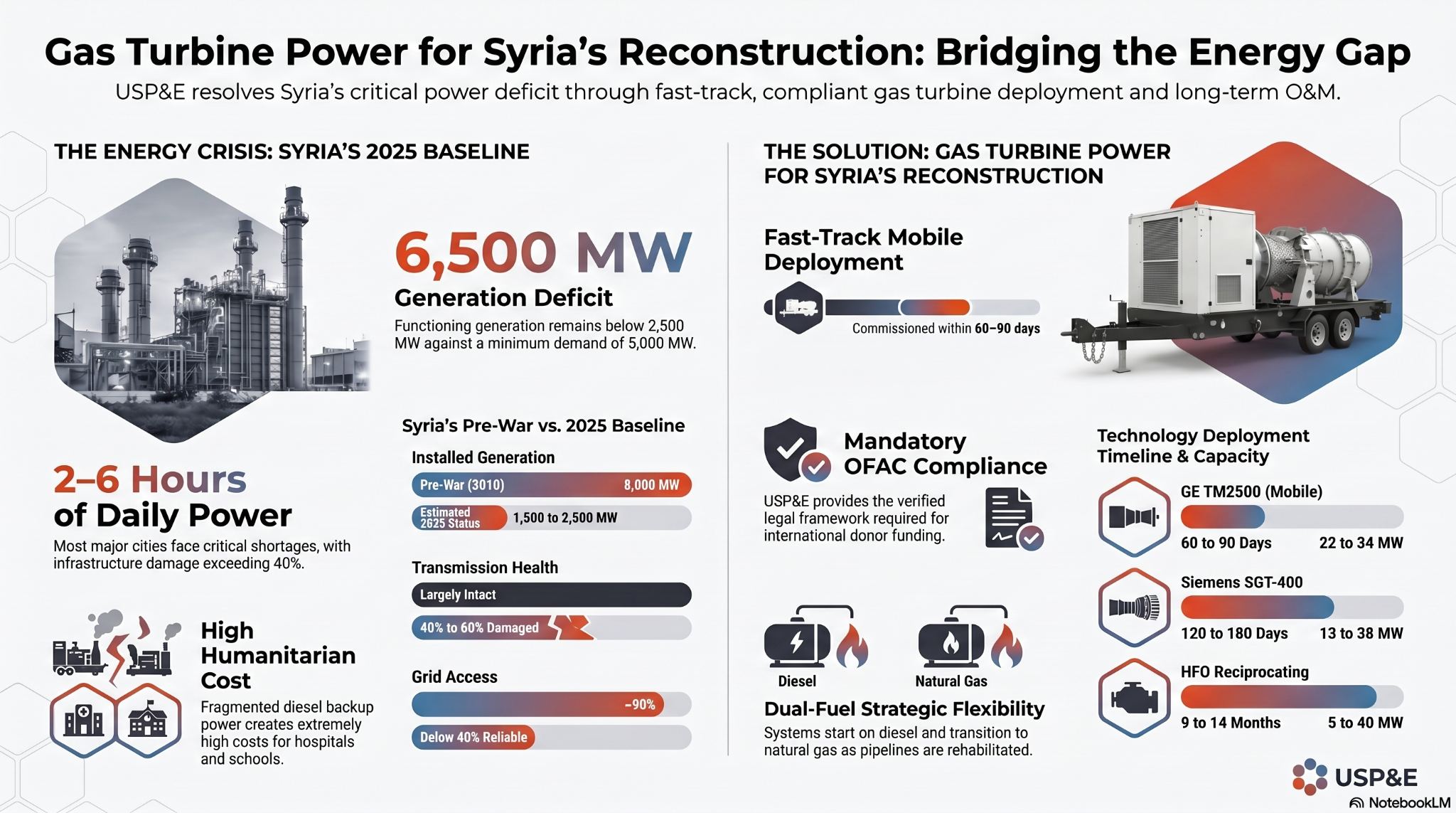
Before the conflict began in 2011, Syria had an installed generating capacity of approximately 8,000 MW and was capable of meeting domestic demand across most of its major population centres, including Damascus, Aleppo, Homs, Latakia, and Deir ez-Zor. By 2024, the World Bank estimated that Syria had lost between 50 and 60 percent of its pre-war generating capacity, with functioning generation believed to be between 1,500 and 2,500 MW against a population demand that, even at reduced economic activity levels, requires at minimum 4,000 to 5,000 MW for basic services.
The Syrian Ministry of Electricity has documented damage to transmission infrastructure, fuel supply chains, and generation facilities as the three compounding crises that prevent any single quick fix. Power cuts of 20 or more hours per day have been reported across Damascus and Aleppo as recently as 2025. Industrial production, water pumping, hospitals, and schools have all been operating on fragmented diesel generator backup power, at extremely high per-kWh cost.
Table 1: Syria Power Sector Status at the Start of the Reconstruction Era (2025 Baseline Estimates)
|
Indicator |
Pre-War (2010) |
Estimated 2025 Status |
Gap / Deficit |
|
Installed Generation Capacity |
8,000 MW |
1,500 to 2,500 MW |
5,500 to 6,500 MW deficit |
|
Average Daily Supply (hours) |
16 to 22 hours |
2 to 6 hours in most cities |
Critical shortage |
|
Transmission Infrastructure |
Largely intact |
40 to 60% damaged or destroyed |
Requires major capex |
|
Fuel Supply (natural gas) |
Domestic pipeline fed |
Severely disrupted |
Dual-fuel or liquid fuel priority |
|
Population with Grid Access |
Approx. 90% |
Below 40% reliable access |
Massive humanitarian gap |
Sources: World Bank Energy Data |
The International Energy Agency has identified Syria among the highest-priority post-conflict energy reconstruction cases globally, noting that the combination of pre-existing gas infrastructure, a technically educated workforce, and proximity to Gulf donor capital creates a viable reconstruction pathway if the right EPC and O&M frameworks are applied with speed and discipline.
Key Drivers of Gas Turbine Power for Syria’s Reconstruction: Why 2026 Is the Critical Window
Several converging forces are making gas turbine power for Syria’s reconstruction the most time-sensitive energy procurement opportunity in the Middle East right now.
- International Donor Capital Is Mobilising in 2026
The post-Assad transition government has been engaging Gulf states, the European Union, and multilateral development banks throughout 2025 and into 2026. Saudi Arabia, Qatar, and the UAE have all indicated reconstruction financing intent. The World Bank reopened its Syria engagement framework in 2025 for the first time in over a decade. This capital is actively seeking credible EPC partners who can operate in a post-conflict environment with demonstrated OFAC compliance, zero legal disputes, and a track record in adjacent frontier markets such as Iraq, Lebanon, and Yemen.
- Natural Gas Infrastructure Partially Survives
Syria’s pre-war gas pipeline network, which connected domestic fields in Deir ez-Zor and the northeast to power stations in Damascus and Homs, remains partially intact. Fast-track gas turbine installations that can connect to rehabilitated pipeline sections offer the fastest path to baseload power. Where pipeline gas is not yet available, aeroderivative gas turbines such as the GE TM2500 can operate on liquid fuel (diesel or naphtha) and transition to natural gas as infrastructure is restored, making them uniquely suited to Syria’s phased reconstruction context.
- Mining and Industrial Demand Is Recovering
Syria’s phosphate mining sector in the Palmyra and Khneifis regions is among the first industrial sectors targeted for revival by the transition government and Gulf investors. These remote mining operations require captive power generation that cannot wait for national grid reconstruction. Diesel genset and gas turbine-powered captive solutions for mining represent an early-entry commercial opportunity for EPC contractors already positioned in the market.
- OFAC Sanctions Relief Is Creating New Procurement Pathways
The United States Office of Foreign Assets Control (OFAC) has progressively issued general licences and specific authorisations to facilitate reconstruction activity in Syria since the political transition. As of 2025, reconstruction-focused energy infrastructure projects are eligible for OFAC authorisation on a case-by-case basis. EPC firms with established OFAC compliance programmes, proper KYC processes, and zero history of sanctions violations are the only credible partners for internationally funded Syrian reconstruction projects.
- Speed of Deployment Is a Humanitarian Requirement
The humanitarian cost of delayed power restoration in Syria is measured in lives. Hospitals running on fragmented diesel supply, water treatment plants that cannot operate, and the freeze of economic activity in major cities all create pressure for fast-track deployment. Mobile and containerised gas turbine solutions that can be mobilised within 60 to 120 days are the only technology that meaningfully addresses this timeline.
Table 2: Gas Turbine Technology Comparison for Syria Reconstruction Projects
|
Technology |
Capacity Range |
Fuel Flexibility |
Deployment Timeline |
Best Application in Syria |
|
GE TM2500 Aeroderivative |
22 to 34 MW per unit |
Dual fuel: diesel and gas |
60 to 90 days |
Rapid baseload, grid stabilisation |
|
GE LM2500 / LM6000 |
22 to 50 MW per unit |
Natural gas primary |
90 to 150 days |
Urban grid supply, pipeline zones |
|
Siemens SGT-400 / SGT-700 |
13 to 38 MW per unit |
Gas and liquid fuel |
120 to 180 days |
Industrial and utility baseload |
|
Caterpillar / Cummins Recip. |
1 to 10 MW per unit |
Diesel and natural gas |
30 to 60 days |
Remote industrial, mining, off-grid |
|
HFO Reciprocating (MAN, Wartsila) |
5 to 40 MW per unit |
Heavy fuel oil |
9 to 14 months |
Larger baseload, port-accessible sites |
EPC and O&M Solutions for Syria’s Reconstruction: A Technical and Commercial Overview
Delivering gas turbine power for Syria’s reconstruction requires an EPC partner with three specific capabilities that most firms cannot offer simultaneously: frontier market construction experience, OFAC-compliant procurement and compliance processes, and an in-house O&M capability to sustain operations after commissioning. These three requirements immediately narrow the field of credible partners.
Fast-Track Mobile and Containerised Solutions (30 to 120 Days)
For the most urgent humanitarian and transitional power needs, mobile gas turbines, containerised diesel generator sets, and pre-packaged power station modules represent the fastest path to generation. These solutions can be mobilised from existing inventory, shipped to the nearest port (typically Latakia or Tartus), and commissioned within 60 to 120 days for units in the 5 MW to 35 MW range. USP&E’s GE TM2500 mobile gas turbine programme is specifically designed for this deployment model, with units capable of operating on diesel before transitioning to natural gas as pipeline supply is restored.
Permanent Utility-Scale EPC Projects (6 to 24 Months)
For larger grid-scale power stations in the 50 MW to 300 MW range, full EPC projects require engineering and design (3 to 4 months), equipment procurement and shipping (3 to 6 months), civil works and balance of plant installation (4 to 8 months), and commissioning (1 to 2 months). These projects are appropriate for World Bank, GCC, or donor-funded programmes where a permanent generation asset is required as part of a national reconstruction plan. USP&E’s power plant engineering and EPC construction services cover the full scope from feasibility study through to commercial operations.
O&M: The Element Most Reconstruction Plans Miss
The history of post-conflict power reconstruction in Iraq, Libya, and Afghanistan is full of commissioned power stations that degraded rapidly due to the absence of a structured O&M programme. Syria’s reconstruction plan must include long-term O&M commitments from day one. USP&E’s operations and maintenance model, which currently manages over 260 MW across 13 live projects in 11 countries, provides availability guarantees, local technician training, predictive maintenance through the SmartPower AI platform, and LTSA structures that protect donor and investor capital over the full operational lifetime of the asset.
Fuel Type Comparison for Syria Reconstruction Power Projects
|
Fuel Type |
CapEx (per MW) |
OpEx (per MWh) |
Lead Time |
Best Application |
|
Diesel (fast-track gensets) |
USD 300,000 to 500,000 |
High: USD 0.20 to 0.35 |
30 to 60 days |
Emergency and transitional power |
|
Natural gas turbine (pipeline) |
USD 600,000 to 900,000 |
Low: USD 0.08 to 0.14 |
90 to 180 days |
Baseload where pipeline is available |
|
Dual-fuel (diesel to gas) |
USD 700,000 to 1,000,000 |
Medium transitioning to low |
60 to 120 days |
Phased reconstruction zones |
|
HFO reciprocating |
USD 500,000 to 800,000 |
Medium: USD 0.12 to 0.20 |
9 to 14 months |
Large baseload, port-accessible sites |
|
Solar-diesel hybrid |
USD 800,000 to 1,200,000 |
Very low blended |
6 to 12 months |
Remote industrial and camp power |
Note: All CapEx figures are indicative ranges. Full LSTK pricing including balance of plant, civil works, grid interconnection, and commissioning is project-specific and requires a feasibility study.
Compliance, OFAC, and Sanctions: What Every EPC Partner Must Get Right
Gas turbine power for Syria’s reconstruction cannot be delivered by a firm without robust OFAC and FCPA compliance infrastructure. This is not a bureaucratic formality. It is the single most important qualification criterion for any EPC contractor seeking to work in Syria with internationally funded programmes.
USP&E has operated as a fully OFAC-compliant and FCPA-compliant EPC and O&M company for over 25 years. Every transaction, every broker relationship, every equipment sale, and every project engagement is subject to USP&E’s mandatory KYC process, which includes NDA execution with all parties, passport and company registration verification, project location and end-buyer confirmation, proof of funding documentation, and a full OFAC screening against current sanctions lists before any technical or commercial information is shared.
USP&E has worked in post-conflict and conflict-adjacent markets including Iraq, Ukraine, Mali, Burkina Faso, and Yemen, always within the bounds of applicable international law. The company’s approach to Syria follows the same model: engagement is possible and appropriate where OFAC general licences or specific authorisations are in place, and where all parties to the transaction are fully identified and screened. USP&E does not and will not supply equipment or services to sanctioned individuals, entities, or destinations.
The USAID Power Africa programme and the World Bank Infrastructure Finance division both maintain updated guidance for contractors seeking to operate in OFAC-designated or formerly designated environments. Engagement with these bodies at the earliest stage of project development is strongly recommended.
Case Studies: Proven Performance in Post-Conflict and Frontier Markets
USP&E’s experience in conflict-adjacent and frontier markets provides direct proof of concept for gas turbine power for Syria’s reconstruction.
Iraq EPC and O&M:
USP&E has delivered EPC and O&M services in Iraq across multiple phases of the country’s post-conflict reconstruction, including gas turbine installations for industrial and utility clients. The logistical, security, and compliance complexity of operating in Iraq is directly analogous to what Syria will require. USP&E’s in-country mobilisation model, which involves advance team deployment, local procurement partnerships, and a dedicated compliance officer on every project, has been refined across multiple Iraq assignments.
Mali: 120 Engineers Operating in an Active Conflict Zone:
USP&E currently operates over 120 engineers and technicians in Mali, including in areas affected by regional insecurity, for clients including Barrick Gold and Resolute Mining. The ability to maintain 95 percent or higher uptime in a high-security, remote, fuel-challenged environment is precisely the operational DNA required for Syria’s reconstruction context.
Ukraine Grid Reconstruction:
USP&E has been active in Ukraine’s energy reconstruction since 2022, providing gas turbine and diesel power solutions for grid stabilisation in a live war environment. This represents USP&E’s most direct recent analogue to Syria: power delivery under active security constraints, with donor-funded procurement frameworks and strict compliance requirements.
Togo: Fast-Track Gas Turbine Commissioning:
USP&E commissioned over 50 MW of natural gas turbine power in Togo within a compressed timeline, working with West African Power Generation, demonstrating the company’s ability to move from contract signature to commercial operations faster than any competitor in its class.
Full project references and case studies are available at USP&E Client References and the USP&E Project Portfolio
How to Select the Right EPC Partner for Gas Turbine Power for Syria’s Reconstruction: 10 Critical Criteria
Procurement officers, donor programme managers, and project developers evaluating EPC partners for Syria reconstruction projects should apply the following criteria rigorously before shortlisting any firm.
- OFAC and FCPA Compliance Infrastructure. The partner must have a documented, auditable compliance programme covering KYC, sanctions screening, anti-bribery controls, and OFAC licence management. This is a threshold requirement, not a differentiator.
- Frontier Market Construction Track Record. Demonstrated ability to complete EPC projects in post-conflict, remote, or security-compromised environments. References from Iraq, Afghanistan, Libya, Yemen, or comparable markets are the relevant benchmark.
- In-House Engineering Capability. The EPC partner must employ engineers in-house, not just subcontract design work. In-house engineering at the scale of 350 or more engineers ensures design accountability and the ability to adapt rapidly to site conditions.
- Equipment Inventory Access. For fast-track projects, the partner must have direct access to owned or exclusively represented gas turbine and generator inventory. Brokers without equipment control cannot guarantee availability or delivery timelines.
- O&M Capability from Day One. The EPC firm must be capable of transitioning directly from construction to O&M, avoiding the gap period that has caused so many post-conflict power stations to fail.
- ISO Certification. ISO 9001:2015 for quality management and ISO 45001:2018 for health and safety are the minimum certification baseline for any EPC firm working on donor-funded infrastructure in Syria.
- Local and Regional Mobilisation Speed. The partner must demonstrate the ability to mobilise a team to site within weeks, not months, with an existing regional footprint in the Middle East or adjacent geographies.
- Financial Stability and Zero Legal History. The partner must show financial strength sufficient to hold equipment deposits, manage procurement on behalf of the project, and sustain multi-year O&M obligations. A zero-lawsuit track record over a multi-decade operating history is the clearest indicator of commercial integrity.
- Dual-Fuel and Transition-Ready Technology Selection. Given the uncertainty of Syria’s gas supply chain during reconstruction, the EPC partner must recommend and supply dual-fuel or liquid-fuel-first solutions that can transition to natural gas as pipeline infrastructure is restored.
- Transparent and Structured Procurement Process. Donor-funded projects require complete audit trails. The EPC partner’s procurement, NDA, and commercial processes must be structured, documented, and transparent from the first enquiry through to final payment.
Frequently Asked Questions: Gas Turbine Power for Syria’s Reconstruction
What is the fastest way to get power generation into Syria during reconstruction?
The fastest path to generation in Syria is through mobile or containerised gas turbine units and diesel generator sets, which can be mobilised and commissioned within 30 to 90 days from contract signature. The GE TM2500 aeroderivative gas turbine is a skid-mounted unit capable of generating 22 to 34 MW per unit, operating on diesel, and transitioning to natural gas when pipeline supply becomes available. For projects requiring power within 60 days, containerised diesel generator sets in the 1 MW to 10 MW range are the most practical immediate solution. Any EPC firm claiming permanent utility-scale installations within 90 days should be treated with extreme scepticism.
What fuel types are available for power generation in Syria right now?
Syria’s domestic natural gas pipeline system is partially functional in some regions but severely disrupted in others. The safest assumption for fast-track reconstruction projects is that liquid fuel (diesel or naphtha) will be the primary fuel for the first 12 to 24 months of operation, with a planned transition to natural gas as pipeline rehabilitation progresses. HFO-based power stations are technically viable for larger baseload requirements but require a 9 to 14-month delivery timeline even when equipment is already in stock, due to balance of plant requirements.
How long does a full EPC power station project take to complete in Syria?
A permanent utility-scale gas turbine power station of 50 MW to 150 MW requires 12 to 24 months from contract signature to commercial operations, depending on site conditions, fuel supply status, grid interconnection complexity, and the availability of pre-engineered equipment. Fast-track mobile solutions can compress this to 60 to 120 days for the initial generation output. Every site in Syria is unique, and a proper feasibility study is required before any EPC timeline can be confirmed.
Can a US-based or Western EPC company legally work in Syria right now?
Yes, under certain conditions. OFAC has issued general licences and specific authorisations covering reconstruction activity in Syria following the political transition, and these have progressively expanded through 2025 and 2026. However, compliance with OFAC, FCPA, and UN sanctions frameworks is mandatory, and the EPC partner must maintain full documentation of all parties, funding sources, and end-use destinations. EPC companies without a structured OFAC compliance programme cannot legally or safely operate in Syria under internationally funded programmes.
What does an EPC feasibility study for a Syria reconstruction power project cost?
A conceptual feasibility study for a Syria reconstruction power project, covering site assessment, technology selection, fuel analysis, CapEx and OpEx estimation, and a preliminary engineering report, typically costs between USD 30,000 and USD 250,000 depending on scope and complexity. A full bankable feasibility study with detailed engineering, grid interconnection study, and financial modelling costs between USD 430,000 and USD 1,250,000 and takes 60 to 120 days. This investment is essential before any serious EPC procurement begins.
What is the typical cost per MW for a gas turbine power plant in Syria?
The all-in installed cost for a gas turbine power station in Syria, including equipment, shipping, balance of plant, civil works, grid interconnection, and commissioning, typically ranges from USD 800,000 to USD 1,500,000 per MW depending on technology type, site remoteness, fuel infrastructure requirements, and security logistics. Equipment-only pricing is significantly lower, but equipment represents only 30 to 50 percent of the total installed cost. Any budget planning based on equipment price alone will result in significant underestimation.
What O&M support is available for power stations in Syria after they are commissioned?
Post-commissioning O&M is available from firms like USP&E, which offer long-term service agreements (LTSAs) covering preventive and corrective maintenance, spare parts supply, local technician training, remote monitoring through AI-driven platforms, and availability guarantees. O&M contracts for post-conflict environments typically include enhanced security protocols, regional logistics hubs, and force majeure provisions appropriate for the operating context. The absence of a structured O&M programme from day one is the single most common cause of post-conflict power station failure.
Summary: Key Takeaways for Gas Turbine Power for Syria’s Reconstruction Decision-Makers
- Gas turbine power for Syria’s reconstruction is an active 2026 procurement priority, with international donor capital mobilising and early-entry windows closing fast for credible EPC partners.
- Syria’s power generation deficit is estimated at 5,500 to 6,500 MW against current functional capacity of 1,500 to 2,500 MW, making it one of the largest post-conflict power reconstruction challenges in the world.
- Fast-track mobile and containerised gas turbine solutions can deliver generation within 60 to 120 days. Permanent utility-scale EPC projects require 12 to 24 months.
- Dual-fuel technology (diesel first, transitioning to natural gas) is the correct technical strategy for Syria’s current fuel supply uncertainty.
- OFAC compliance is a threshold requirement, not an option. Only EPC firms with documented compliance programmes, zero sanctions history, and established KYC processes should be considered.
- Full installed cost for gas turbine power for Syria’s reconstruction ranges from USD 800,000 to USD 1,500,000 per MW. Equipment-only pricing represents only a fraction of this total.
- O&M must be contracted from day one to protect the long-term value of reconstruction investments. Post-conflict power stations without structured O&M degrade rapidly.
- USP&E Global has operated in frontier markets including Iraq, Ukraine, Mali, and Togo with zero lawsuits in 25 years, ISO 9001:2015 and ISO 45001:2018 certification, and 350 engineers available for mobilisation.
Ready to Power Your Syria Reconstruction Project? Talk to USP&E’s Engineers Free.
USP&E Global offers a complimentary 4-hour engineering consultation for qualified power station, EPC, and O&M projects, including Syria reconstruction initiatives. Whether you are in early feasibility, responding to a donor-funded tender, or ready to mobilise, our team of 350 engineers across 35 countries is ready to guide your project with speed, compliance, and zero excuses.
USP&E Global — Powering Possibility. Built for the Frontier.
ISO 9001:2015 | ISO 45001:2018 | 150+ Projects | 35+ Countries | Zero Lawsuits
Quick Links:
- Contact USP&E by clicking on this link.
- Request a fast equipment quote
Global Resources
- USP&E's Project Experience Portfolio
- USP&E Case Studies and Client Reference Letters
- USP&E Integrity and Compliance policy
- USP&E's ISO Certifications and Credentials