

Fast Track Power Plant Installation: How to Deploy Emergency Power in Under 90 Days
When the power goes out at a mine site in Mali, a data center under construction in Texas, or a utility grid in Togo, the cost of inaction is measured in millions of dollars per day. Project developers, mine energy managers, and IPP procurement officers searching for fast track power plant installation solutions are not browsing out of curiosity. They are in a race against production loss, contract penalties, and competitive pressure. The question they are asking is urgent and specific: can an experienced EPC partner deploy reliable power generation in under 90 days, and if so, which technologies actually make that possible?
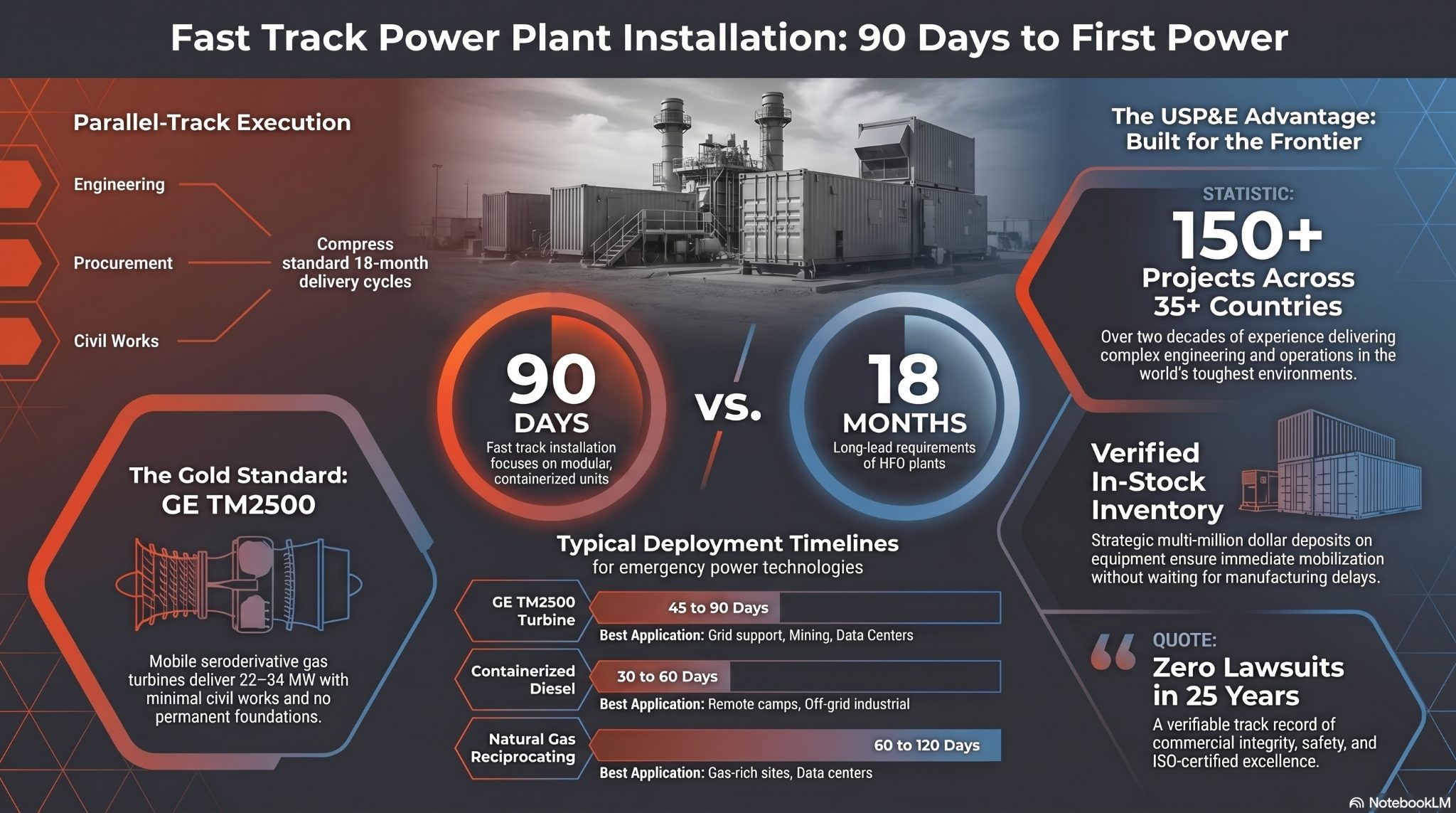
The answer is yes, but only when the right technology, the right inventory, and the right engineering team are already in position. Fast track power plant installation is not a promise that every EPC company can honour. It is a capability built over years of deploying emergency and rapid-response power across frontier markets, mining operations, utilities, and industrial facilities in over 35 countries. The discipline required to compress a standard 6-to-18-month EPC cycle into 45 to 90 days is the result of pre-engineered equipment, parallel-track project execution, in-stock inventory, and experienced boots on the ground.
This article gives procurement officers, energy managers, and project developers the complete technical and commercial picture of fast track power plant installation: which fuel types and turbine technologies are genuinely fast, what a compressed EPC schedule actually looks like phase by phase, where the real constraints lie, and how to select an EPC partner with the credentials to deliver. USP&E Global has completed over 150 power projects in more than 35 countries, with 350+ engineers across offices in the USA, UAE, South Africa, and Mali. This is not a promise. It is a track record.
The Global Emergency Power Gap: What the Data Shows
The International Energy Agency (IEA) estimates that over 750 million people globally still lack access to electricity, with the highest concentrations across sub-Saharan Africa and parts of South and Southeast Asia. See the IEA Africa Energy Outlook. But the emergency power gap is not only about grid access in developing markets. Even fully industrialised economies face sudden power shortfalls caused by extreme weather events, infrastructure failure, rapid load growth from AI data centers, and decommissioning of legacy generation assets ahead of replacement capacity coming online.
According to the World Bank Energy Data, power outages in developing economies cost industrial operations an average of 4 to 12 percent of annual turnover. For a 100 MW mine or a 50 MW data center, that figure translates to tens of millions of USD in production or revenue loss per year. The urgency of fast track power plant installation in these contexts is not abstract. It is an existential commercial priority.
The following table shows the scale of unmet emergency power demand across key USP&E target markets:
|
Region or Country |
Power Deficit Estimate |
Key Demand Driver |
Typical Emergency MW Requirement |
Fast-Track Technology Best Fit |
|
West Africa (Mali, Togo, Liberia) |
2,000 to 5,000 MW |
Grid instability, mining expansion |
10 to 150 MW per site |
GE TM2500, diesel gensets |
|
Middle East (Iraq, Saudi Arabia) |
5,000 to 15,000 MW |
Population growth, reconstruction |
50 to 500 MW per project |
Natural gas turbines, hybrid |
|
Southern Africa (SA, Mozambique, Zambia) |
3,000 to 8,000 MW |
Mining demand, Eskom load shedding |
10 to 200 MW per project |
Gas turbines, diesel, hybrid |
|
North America (USA, data centers) |
50,000+ MW by 2030 |
AI data center boom, gas turbine demand |
30 to 500 MW per campus |
GE TM2500, natural gas reciprocating |
|
Ukraine (reconstruction) |
10,000+ MW destroyed |
War damage, infrastructure rebuild |
25 to 300 MW per region |
Mobile gas turbines, diesel |
For reference data on global power sector deficits and reconstruction funding, see the African Development Bank Energy Sector and USAID Power Africa Program.
What Is Driving Demand for Fast Track Power Plant Installation Right Now
Five distinct market forces are compressing EPC timelines and driving unprecedented demand for fast track power plant installation across every continent:
- The AI Data Center Buildout. Hyperscalers and colocation providers in the United States, the Middle East, and Southeast Asia are scrambling for behind-the-meter gas turbine power to meet grid interconnection queues that stretch 5 to 10 years into the future. A single AI data center campus now consumes 100 to 500 MW of continuous power. The S. Energy Information Administration projects data center electricity demand to double by 2030. Behind-the-meter fast track power plant installation is the only viable near-term solution.
- Mining Expansion in Frontier Markets. Gold, copper, lithium, and critical mineral mining operations in Mali, Burkina Faso, the DRC, Zambia, Mozambique, and South Africa are advancing ahead of national grid capacity. Mining companies cannot wait 18 months for a standard HFO plant. Fast-deployable diesel gensets and mobile gas turbines are the only solution for first-power.
- Grid Infrastructure Reconstruction. Ukraine has lost over 10,000 MW of grid generation capacity to conflict damage since 2022. Syria is beginning the process of post-conflict energy reconstruction. Iraq continues to rebuild after decades of infrastructure degradation. In each of these environments, fast track power plant installation is the first step before permanent baseload capacity can be reestablished.
- Expiring Power Purchase Agreements and Utility Gaps. Independent Power Producers whose PPAs are expiring face a window between old and new contracts during which grid operators need bridge generation. Mobile and modular fast-track assets fill this gap without committing to long-lead permanent infrastructure.
- Extreme Weather and Climate Events. Hurricanes, floods, and wildfires are disabling power infrastructure in North America, the Caribbean, and Southeast Asia with increasing frequency. Emergency power installation timelines in these contexts are measured in days, not months.
Fast Track Power Plant Installation: A Technical and Commercial Overview
The single most important variable in fast track power plant installation is technology selection. Not all power generation technologies can be fast-tracked. The table below provides a clear comparison:
|
Power Technology |
Typical Fast-Track Timeline |
Standard EPC Timeline |
Minimum MW Range |
Best Fast-Track Application |
|
GE TM2500 Mobile Gas Turbine |
45 to 90 days |
90 to 120 days |
22 to 34 MW per unit |
Emergency grid support, mining, data centers |
|
Diesel Genset Package (containerized) |
30 to 60 days |
60 to 90 days |
1 to 30 MW |
Remote camps, off-grid industrial |
|
Natural Gas Reciprocating Engine |
60 to 120 days |
120 to 180 days |
5 to 50 MW |
Gas-rich upstream sites, data centers |
|
Hybrid Solar plus Diesel (pre-engineered) |
90 to 150 days |
180 to 270 days |
2 to 20 MW |
Mining, telecoms, remote infrastructure |
|
HFO Power Station |
Not possible in under 90 days |
9 to 18 months minimum |
10 to 300 MW |
Baseload utility and industrial IPP |
|
Large Frame Gas Turbine (GE, Siemens) |
Not possible in under 90 days |
12 to 30 months |
50 to 400 MW |
Utility-scale baseload |
The GE TM2500: The Gold Standard for Fast Track Power Plant Installation
The GE TM2500 mobile aeroderivative gas turbine is the most deployable large-scale power generation asset in the world for fast track applications. Each unit produces 22 to 34 MW of clean, reliable power from a single skid-mounted package that can be transported by air, sea, or road. USP&E Global holds an exclusive position on GE TM2500 units and has deployed them across Africa, the Middle East, and the Americas within 45 to 90 days of contract execution.
The TM2500 operates on natural gas, diesel, or dual-fuel configurations. It requires no permanent foundation. Civil works are minimal. Factory acceptance testing is performed before shipment. This combination of factors makes the TM2500 the only technology on the market capable of consistently delivering 22 MW or more of power to a frontier market site in under 90 days.
Containerized Diesel Gensets: The Fastest Option for Sub-10MW Applications
For projects requiring 1 to 15 MW in under 60 days, containerized diesel generator packages from Caterpillar, Cummins, or MTU represent the fastest available solution. USP&E maintains inventory of containerized diesel gensets at warehouses across multiple continents, allowing mobilization within 30 to 45 days in most cases. These units are self-contained, pre-wired, and plug-and-play at site with minimal civil preparation.
Why HFO Is Never a Fast Track Solution
Heavy fuel oil power stations are among the most misunderstood assets in the energy procurement market. Clients regularly request HFO fast track installations with 90-day timelines. This is not commercially or physically possible. An HFO plant requires site-specific engineering, custom balance of plant manufacturing, 10,000 to 30,000 man-hours of class four welding and pipefitting, civil foundation works, and a minimum of 6 to 9 months of procurement lead time for key components. No EPC company in the world can legitimately install a new HFO power station in under 6 months. If a vendor makes this claim, it is a red flag.
The Fast Track EPC Phase Breakdown: From NDA to First Power
Understanding the phase structure of a fast track power plant installation is essential for realistic project planning. The table below shows how a 45-to-90-day schedule is achieved through parallel-track execution rather than simply compressing individual phases:
|
# |
Phase |
Fast-Track Duration |
Standard Duration |
Key Fast-Track Enablers |
|
1 |
Engineering and Design |
2 to 4 weeks |
6 to 12 weeks |
Pre-engineered modular packages, existing site data, parallel procurement |
|
2 |
Procurement and Logistics |
Parallel with Phase 1 |
Sequential, 8 to 16 weeks |
In-stock inventory, pre-positioned equipment, strategic vendor relationships |
|
3 |
Site Preparation and Civil Works |
2 to 4 weeks |
4 to 10 weeks |
Minimal civil (containerized units), prepared pads, accessible sites |
|
4 |
Equipment Mobilization and Installation |
2 to 6 weeks |
6 to 16 weeks |
Air freight for critical spares, pre-wired skids, modular interconnection |
|
5 |
Commissioning and Handover |
1 to 3 weeks |
3 to 6 weeks |
Experienced commissioning team, pre-tested factory acceptance, parallel O&M mobilization |
The critical enabler of a true fast track schedule is parallel execution. While engineering is underway, procurement is happening simultaneously. While logistics are being arranged, civil preparation is proceeding at site. An EPC contractor without pre-existing inventory and pre-established vendor relationships cannot execute these phases in parallel, regardless of how aggressive their quoted timeline is.
Proven Fast Track Power Plant Installation Results in Frontier Markets
USP&E Global’s project portfolio includes multiple fast track power plant installation case studies across some of the world’s most challenging operating environments:
- West Africa, 22 to 112 MW Mining Power, Mali: USP&E delivered a first-power diesel generation package to a gold mine operated by Barrick Gold and Resolute Mining in Mali, with mobilization timelines that outpaced any alternative supplier in the market. USP&E now operates over 120 engineers and technicians permanently based in Mali, supporting multiple mine power contracts under long-term O&M agreements.
- Sub-Saharan Africa, Multi-Site Diesel Fast Track, Liberia and Sierra Leone: USP&E has designed, built, and commissioned HFO and diesel power stations in Liberia and Sierra Leone for mining clients including London Mining, Gerald Group, and SL Mining. In Sierra Leone, USP&E was engaged by the Ministry of Energy and Water Resources for multiple power infrastructure assessments.
- Togo, Natural Gas Turbine Fast Track, West Africa: USP&E is currently operating over 50 MW of natural gas turbine power in Togo for West African Power Generation, with 20 on-site employees supporting 24/7 O&M. This project commenced from contract execution to first power within a compressed timeline achievable only through pre-positioned equipment and pre-engineered scope.
- USA, Data Center Gas Turbine Power: USP&E is engaged in multiple fast track gas turbine power supply discussions for data center campuses across the United States requiring 60 Hz behind-the-meter generation. The GE TM2500 is the primary solution offered for these applications.
Review USP&E’s client case studies and references for detailed project outcomes across all regions and fuel types.
How to Select the Right EPC Partner for Fast Track Power Plant Installation
Selecting the wrong EPC partner for a fast track power plant installation is not just an inconvenience. It is a commercial catastrophe that can cost a project developer months of lost production and millions in wasted deposit. The following criteria should be applied rigorously:
- Verified in-stock inventory. Ask for a confirmed list of available assets with location, hours, and current status. An EPC claiming fast-track capability without physical inventory on hand cannot deliver on that promise.
- Proven in-country logistics. Fast track power plant installation in Mali is fundamentally different from fast track in Texas. The EPC partner must have established customs relationships, trusted freight forwarders, and on-the-ground knowledge of port and road access in the target country. USP&E maintains a global operations network across multiple continents precisely for this reason.
- Parallel-track project management. Confirm that the EPC can run engineering, procurement, and site preparation simultaneously. An organization without sufficient staffing or financial strength will sequence these phases, extending the timeline by months.
- Experienced commissioning team. A fast track schedule compressed at every earlier phase will fail at commissioning if the team lacks experience with the specific technology being deployed. Ask for references from commissioning projects on the same fuel type and turbine platform.
- ISO certification and compliance posture. Fast track does not mean cutting corners on safety or compliance. USP&E is certified to ISO 9001:2015 and ISO 45001:2018, with full OFAC and FCPA compliance. These credentials matter especially in frontier markets where regulatory scrutiny applies to international contractors.
- O&M capability at the same site. The fastest path to sustained power generation is engaging the same EPC for O&M from day one. An EPC that hands over a commissioned plant and departs creates a knowledge gap that causes reliability problems within weeks.
- Financial strength to hold inventory. Fast track is only possible when an EPC has already placed deposits and reserved equipment. An EPC that starts procurement after receiving your deposit is months behind before the project begins. USP&E places multi-million dollar deposits on strategic assets to hold them for clients, avoiding 12-to-24-month manufacturing delays.
- Zero-lawsuit track record. In 25 years of international EPC and O&M operations across 35+ countries, USP&E has never had a single lawsuit filed by a client or partner. This track record is independently verifiable and reflects a commercial culture built on delivering what is promised. See USP&E’s integrity and compliance commitment.
Frequently Asked Questions About Fast Track Power Plant Installation
Can a power plant really be installed in 90 days?
Yes, but only with specific technology. Mobile aeroderivative gas turbines such as the GE TM2500, pre-engineered containerized diesel genset packages, and modular natural gas reciprocating engine packages are the technologies capable of fast track power plant installation in 45 to 90 days. Standard HFO, large frame gas turbines, and new-build combined cycle plants cannot be commissioned in under 9 to 18 months. The 90-day threshold is achievable only when the EPC partner has equipment physically in stock, a parallel-track project execution model, and experienced teams already in-country or capable of rapid mobilization.
What is the fastest way to deploy emergency power for a mine or data center?
The fastest deployable power solution for a mine or data center in the 10 to 100 MW range is the GE TM2500 mobile gas turbine. Each unit produces 22 to 34 MW of power from a single skid-mounted package requiring minimal civil works and no permanent foundation. USP&E holds exclusive access to TM2500 units and has deployed them to frontier markets in sub-Saharan Africa, the Middle East, and the Americas. For requirements under 10 MW, containerized diesel gensets from Caterpillar or Cummins can be mobilized in as little as 30 days.
How long does a fast track power plant feasibility study take?
A fast track conceptual feasibility study for an emergency power project typically takes 30 to 60 days and includes a site visit, geotechnical assessment (high level), load study, fuel specification review, and preliminary CapEx and OpEx modeling. For projects requiring a bankable feasibility study, the timeline extends to 60 to 120 days. USP&E’s engineering team can initiate this process immediately upon receipt of a deposit and signed term sheet. See the complete guide to power plant feasibility study costs and timelines in the USP&E article library.
Why can’t an HFO power plant be installed in 90 days?
HFO power stations require custom engineering for every site, site-specific balance of plant design, 6 to 9 months of procurement lead time for specialized components, 2 to 3 months of civil foundation and structural works, and 10,000 to 30,000 man-hours of class four welding and mechanical installation. Even when HFO engine packages are available in stock, the surrounding plant infrastructure cannot be manufactured, shipped, and installed in under 6 months. Any vendor claiming to deliver a complete HFO power station in under 6 months is either misrepresenting the scope or is not describing a fully compliant, grid-ready installation.
What does fast track power plant installation cost per MW?
Fast track power plant installation commands a premium over standard EPC timelines due to air freight costs, premium vendor pricing for rapid delivery, and the additional engineering and logistics resources required to compress the schedule. As a general benchmark, fast track diesel and gas turbine installations in frontier markets range from USD 800,000 to USD 1,500,000 per installed MW, depending on the technology, site accessibility, balance of plant scope, and fuel system requirements. This figure is a starting range for conceptual budgeting only. Accurate pricing requires a site visit and engineering scope definition.
How do I know if my project qualifies for a 90-day fast track schedule?
A project qualifies for a genuine 90-day fast track power plant installation schedule when it meets three conditions. First, the technology required must be one of the fast-deployable platforms described in this article. Second, the site must be accessible by road or sea within a reasonable logistics window. Third, the client must be able to execute commercial documentation, pay a deposit, and mobilize site preparation within the first two weeks of contract execution. Projects requiring extended regulatory approvals, custom engineering, or complex grid interconnection studies will not achieve 90-day commissioning regardless of the EPC team involved.
Key Takeaways for Fast Track Power Plant Installation Decision-Makers
Summary: What You Need to Know Before Engaging an EPC for Fast Track Deployment
- Fast track power plant installation is technology-specific. Only mobile gas turbines, containerized diesel gensets, and modular natural gas packages can be commissioned in 45 to 90 days. HFO and large frame gas turbines cannot.
- The GE TM2500 is the premier fast track power plant installation solution for projects requiring 22 to 100+ MW in frontier markets, mining operations, and data center campuses globally.
- Parallel-track execution is the critical differentiator. An EPC without in-stock inventory and pre-established vendor relationships will add months to any quoted timeline, regardless of their claimed capability.
- HFO is never fast track. Any vendor claiming an HFO plant can be commissioned in under 6 months is not describing a complete, grid-ready power station.
- O&M readiness is as important as fast track EPC capability. The EPC partner selected for fast track power plant installation should have the operational team ready to manage the asset from day one of commissioning.
- Credentials matter in frontier markets. ISO 9001:2015, ISO 45001:2018, OFAC compliance, FCPA compliance, and a 25-year zero-lawsuit track record are the baseline standard for a trusted fast track EPC partner.
- USP&E Global has completed over 150 fast track and standard EPC power projects in more than 35 countries, with 350+ engineers positioned across Africa, the Middle East, and the Americas.
Ready to Power Your Project? Talk to USP&E’s Engineers Free.
USP&E Global offers a complimentary 4-hour engineering consultation for qualified fast track power plant installation, EPC, and O&M projects. Whether you are evaluating a TM2500 deployment for a mine in West Africa or a behind-the-meter data center solution in the USA, our team of 350+ engineers across 35+ countries is ready to guide your project to first power with speed and without excuses.
USP&E Global — Powering Possibility. Built for the Frontier. | ISO 9001:2015 | ISO 45001:2018 | 150+ Projects | 35+ Countries | Zero Lawsuits
Quick Links:
- Contact USP&E by clicking on this link.
- Request a fast equipment quote
Global Resources
- USP&E's Project Experience Portfolio
- USP&E Case Studies and Client Reference Letters
- USP&E Integrity and Compliance policy
- USP&E's ISO Certifications and Credentials