

DRC Power Plant EPC: Industrial Power for the World’s Mineral Heartland
The Democratic Republic of Congo holds the largest cobalt reserves on earth and ranks among the top global copper producers, yet its national grid reaches only a fraction of its population and almost none of its remote mining concessions. For an operator standing at a copper or cobalt site in Katanga, the question is not whether power matters. The question is how to secure reliable, fuel efficient generation when the public utility cannot deliver it. A well structured DRC power plant EPC strategy turns that constraint into a controllable, financeable part of the project rather than a recurring crisis. This guide explains what the data shows, why the timing is critical, and how an experienced engineering and construction partner moves a Congolese industrial power project from concept to commissioning. USP&E Global has operated in the DRC since 2017 and has built and run power stations across the most demanding markets in Africa. We act as the guide here. Your project is the priority.
The Energy Challenge in the DRC: What the Data Shows
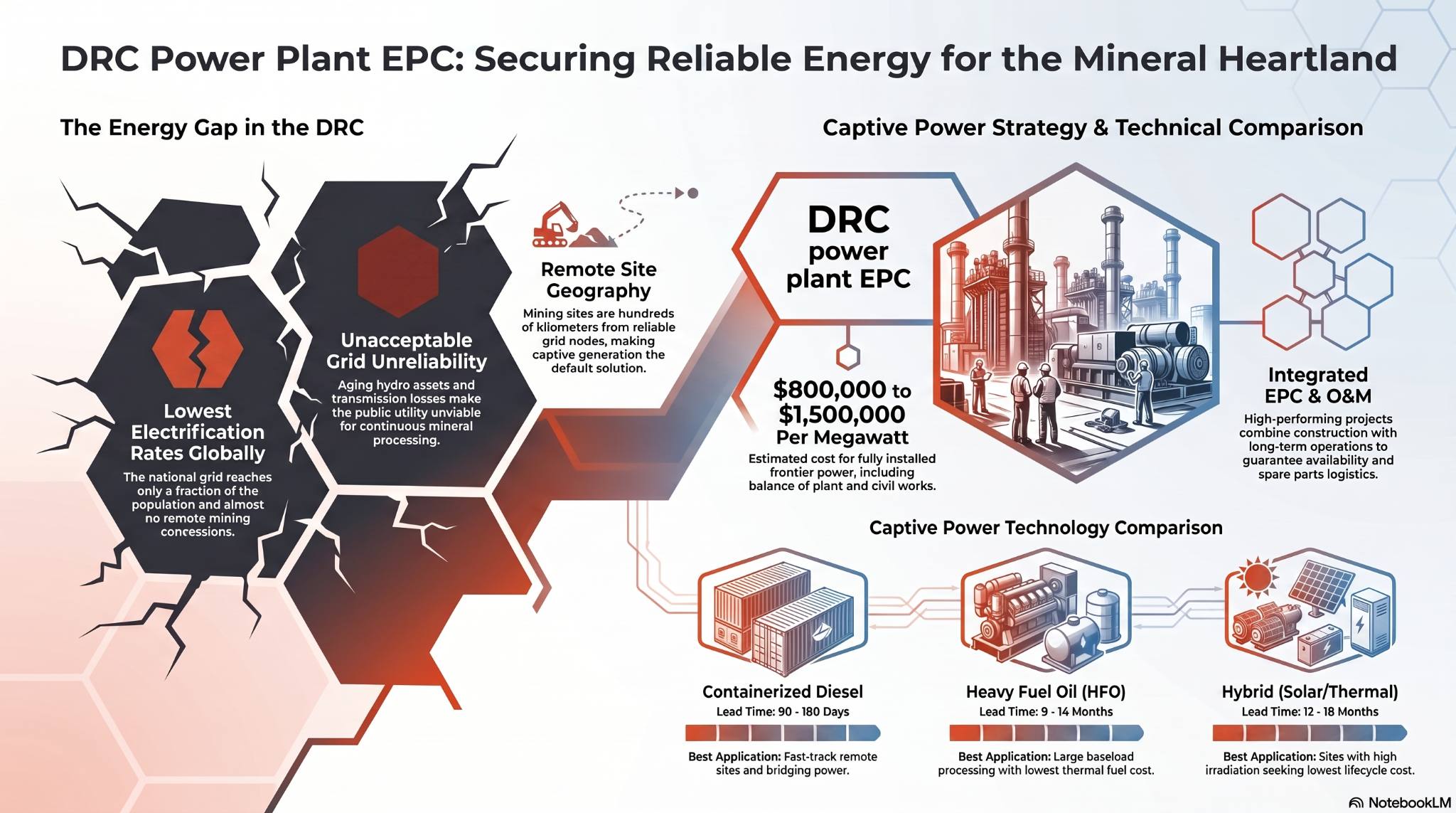
The DRC has one of the lowest electrification rates of any large economy in the world, and the gap between installed grid capacity and industrial demand continues to widen as mining investment accelerates. The national utility, SNEL, struggles with aging hydro assets, transmission losses, and load shedding that make grid supply unreliable for any operation requiring continuous power. For copper and cobalt processing, where an unplanned outage can solidify material in a furnace or halt an entire concentrator line, that unreliability is commercially unacceptable.
The table below summarizes the electricity access picture against industrial demand in the Congolese mineral belt.
|
DRC Power Indicator |
Reported Position |
Implication for Mining Operators |
|
National electrification rate |
Among the lowest of large African economies |
Grid supply rarely reaches remote concessions |
|
Primary grid generation |
Heavily hydro dependent, drought exposed |
Seasonal output variability and load shedding |
|
Katanga copper and cobalt belt |
Hundreds of kilometres from reliable grid nodes |
Captive generation is the default solution |
|
Industrial demand growth |
Driven by copper, cobalt, and processing expansion |
New baseload capacity needed annually |
Authoritative third party data confirms the scale of the deficit. The World Bank energy and mining data portal tracks the DRC’s electrification trajectory, the International Energy Agency Africa Energy Outlook documents the Sub-Saharan supply gap, and the African Development Bank energy program details the financing frameworks supporting Central African generation projects. These sources consistently place the DRC among the countries where captive industrial power is not a luxury but a precondition for production.
Key Drivers of DRC Power Plant EPC in Central Africa: Why Now Is the Critical Window
Several forces are converging to make this the decisive period for industrial power development in the DRC. Understanding these drivers helps a mine energy manager or IPP developer justify the capital decision internally.
- Copper and cobalt demand. The global energy transition depends on Congolese cobalt for batteries and Congolese copper for electrification and data centre buildout. Expanding extraction and on site processing both require large, dependable power blocks that the grid cannot supply.
- Grid unreliability. SNEL’s hydro dominated system is exposed to drought and chronic underinvestment. Operators cannot tie production guarantees to a grid that load sheds without warning.
- Remote site geography. Concessions in Katanga and across the wider mineral belt sit far from stable transmission. Captive generation, often diesel or heavy fuel oil, is frequently the only practical option.
- Processing migration. As more value added processing moves in country, the power intensity per tonne rises sharply, pushing demand toward configurations measured in tens of megawatts per site.
The cost of inaction is measurable. The table below compares typical captive generation options against grid dependence for a Congolese processing operation.
|
Power Strategy |
Relative CapEx |
Reliability Profile |
Best Application |
|
Grid only dependence |
Lowest upfront |
Poor, load shedding exposed |
Not viable for continuous processing |
|
Diesel captive plant |
Moderate |
High, fast to deploy |
Fast track and remote sites |
|
HFO captive plant |
Higher upfront |
High, lowest fuel cost |
Large baseload, coastal supplied fuel |
|
Hybrid solar and thermal |
Higher upfront |
High, lowest lifecycle fuel |
Sites with strong solar resource |
The financing environment also rewards action now. Development finance institutions increasingly require certified operations and maintenance coverage and verified compliance as conditions of support, which favours operators who engage a qualified EPC construction partner early rather than improvising.
EPC and O&M Solutions for the DRC: A Technical and Commercial Overview
Designing a DRC power plant EPC scope begins with the fuel question, because fuel availability and logistics dominate both cost and schedule in Central Africa. Diesel gensets offer the fastest path to power and suit remote sites and bridging requirements. Heavy fuel oil plants deliver the lowest fuel cost per unit for large baseload duty but require longer build timelines and substantial balance of plant. Natural gas is rarely available at Congolese mine sites today, so most captive solutions are diesel, HFO, or increasingly hybrid systems that pair solar generation with thermal backup to cut fuel burn.
Fast track and standard EPC timelines differ sharply by technology, and being honest about this protects the client from fraud. The table below sets realistic expectations.
|
Plant Type |
Realistic Time to Commissioning |
Notes |
|
Containerized diesel (in inventory) |
90 to 180 days |
Fastest deployable captive option |
|
Natural gas turbine (where gas exists) |
6 to 12 months |
Requires fuel infrastructure |
|
HFO reciprocating plant |
9 to 14 months |
Never genuinely fast track |
|
Hybrid solar plus thermal |
12 to 18 months |
Highest lifecycle fuel saving |
Operations and maintenance in the DRC carries region specific demands. Fuel quality varies and must be tested and managed. Ambient conditions, dust, and humidity affect filtration and cooling. Remote logistics mean spare parts must be pre positioned, because airfreighting a combustor part into Central Africa during an outage is both slow and extremely costly. Local content requirements and workforce development are increasingly written into mining and utility agreements. A credible operations and maintenance model addresses all of these through resident teams and availability guarantees rather than reactive call outs.
On cost, honest ranges matter more than precise quotes. Fully installed frontier market power typically falls between 800,000 and 1,500,000 US dollars per megawatt once balance of plant, civil works, fuel infrastructure, and grid or distribution interconnection are included. Remote Congolese sites sit toward the upper end because of trucking distances, hardened civils, and security provisioning. Operating cost is dominated by fuel, which is why hybrid and HFO configurations attract operators chasing the lowest lifecycle cost. USP&E’s power plant engineering team prices each component against the specific site rather than offering a misleading single number.
Fuel Type Comparison for DRC Power Projects
|
Fuel Type |
CapEx |
OpEx |
Lead Time |
Best Application |
|
Diesel |
Moderate |
High fuel cost |
90 to 180 days |
Fast track, remote, bridging power |
|
Heavy fuel oil |
Higher |
Lowest thermal fuel cost |
9 to 14 months |
Large baseload processing |
|
Hybrid solar and thermal |
Higher |
Lowest lifecycle |
12 to 18 months |
High irradiation mine sites |
|
Natural gas |
Site dependent |
Moderate |
6 to 12 months |
Only where pipeline or LNG exists |
Case Studies: Proven DRC Power Plant EPC Results in the Mineral Belt and Similar Markets
The most credible evidence of capability is delivered performance in comparable conditions. USP&E has operated in the DRC since 2017, with engineering and field resources positioned in neighbouring South Africa and across the West African mining belt that shares the DRC’s logistics and fuel realities.
In Mali, USP&E designed, built, and now operates captive power for major gold producers, sustaining availability above 97 percent across multiple years in an environment defined by remoteness, heat, and security risk. The same operating discipline applies directly to Katanga copper and cobalt sites. In Sierra Leone, USP&E delivered a heavy fuel oil plant for a major mining client ahead of schedule, demonstrating the balance of plant and civil execution that an HFO DRC project demands. In Togo, USP&E delivered a 50 megawatt natural gas turbine station for a national utility under a full EPC scope and a multi year operations and maintenance contract, evidence of utility grade execution where the grid had failed.
These outcomes are documented in USP&E’s project experience and client references. The common thread is that each project sits in a market where most contractors will not operate, which is exactly where Congolese operators need a partner.
How to Select the Right EPC Partner for DRC Power Plant EPC: 10 Critical Criteria
Choosing a partner for a Congolese industrial power project is a risk management decision. The following criteria help a procurement officer or mine energy manager evaluate candidates objectively.
- Frontier track record. Look for documented projects in the DRC or comparable Central and West African markets, not just experience in stable economies.
- Compliance posture. Confirm full adherence to United States Foreign Corrupt Practices Act standards and Office of Foreign Assets Control sanctions screening. International financiers require this as a baseline.
- Verify ISO 9001 quality and ISO 45001 safety certification, which serious lenders and regulators treat as minimum qualification.
- Fuel honesty. A trustworthy partner will tell you that HFO is never genuinely fast track. Reject anyone promising HFO commissioning in under nine months.
- Integrated EPC and O&M. A partner who builds and then operates the plant owns the outcome, rather than building and walking away.
- Equipment access. Owned and exclusive inventory shortens lead times dramatically compared with waiting on new manufacturing.
- Logistics capability. Central African sites demand proven inland transport, customs, and spares pre positioning.
- Availability guarantees. Insist on contractual availability commitments with liquidated damages, not vague uptime promises.
- Local content. A credible partner builds local workforce capacity, which matters for both compliance and long term cost.
- Financial strength. The partner must be able to mobilise capital, equipment, and engineering teams quickly without subcontracting the core scope.
Evaluated against these criteria, the field of genuinely qualified DRC power plant EPC and hybrid power systems contractors narrows considerably.
Frequently Asked Questions: DRC Power Plant EPC in the Mineral Belt
What does a DRC power plant EPC project cost?
Fully installed power in the DRC typically ranges from 800,000 to 1,500,000 US dollars per megawatt once balance of plant, civil works, fuel infrastructure, and interconnection are included. Remote Katanga sites sit toward the upper end because of trucking distances and hardened civil works. A firm number requires a signed agreement, the project location, the fuel specification, and proof of funding before engineering begins.
How long does it take to build a captive power plant in the DRC?
Containerized diesel plants from existing inventory can be commissioned in roughly 90 to 180 days. Heavy fuel oil plants realistically require 9 to 14 months because of balance of plant manufacturing, civil curing, and class four welding. Any vendor promising HFO power in under nine months is misrepresenting the process.
What fuel is best for a remote mining power plant in the DRC?
Diesel offers the fastest deployment for remote and bridging needs. Heavy fuel oil delivers the lowest thermal fuel cost for large baseload processing. Hybrid solar and thermal systems deliver the lowest lifecycle fuel cost where the solar resource is strong. Natural gas is rarely available at Congolese mine sites today.
Can an EPC contractor operate safely in the DRC?
Yes, provided the contractor has genuine frontier experience, security hardened site design, resident or rapidly deployable teams, and full compliance systems. USP&E has operated in the DRC since 2017 and maintains a zero lawsuit record across 25 years and 35 plus countries.
Why not just rely on the SNEL grid?
The national grid is hydro dependent, drought exposed, and prone to load shedding, which makes it unsuitable for continuous copper and cobalt processing. Captive generation gives the operator control over reliability, which is why it is the default for serious Congolese mining operations.
Does USP&E provide long term operations and maintenance in the DRC?
Yes. USP&E offers operations and maintenance under long term service agreements that include availability guarantees, spare parts pre positioning, and resident teams, which is essential where emergency airfreight of parts is slow and costly.
Summary: Key Takeaways for DRC Power Plant EPC Decision-Makers
- The DRC holds world leading cobalt and copper resources but cannot supply reliable grid power to remote mining sites, making captive generation essential.
- A sound DRC power plant EPC strategy selects fuel by site logistics: diesel for speed, HFO for baseload fuel cost, hybrid for lowest lifecycle cost.
- Honest timelines matter. Diesel can deliver in 90 to 180 days, while HFO realistically needs 9 to 14 months and is never genuinely fast track.
- Fully installed frontier power typically costs 800,000 to 1,500,000 US dollars per megawatt, with remote Congolese sites at the upper end.
- The right partner combines frontier track record, compliance, certification, integrated EPC and O&M, and availability guarantees.
- USP&E has operated in the DRC since 2017 and brings 150 plus projects, 350 plus engineers, and a zero lawsuit record to Congolese industrial power.
Ready to Power Your Project? Talk to USP&E’s Engineers Free.
USP&E Global offers a complimentary 4-hour engineering consultation for qualified power station, EPC, and O&M projects. Whether you are in early feasibility or ready to mobilize, our team of 350+ engineers across 35+ countries is ready to guide your project to success with speed and without excuses.
USP&E Global. Powering Possibility. Built for the Frontier.
ISO 9001:2015 | ISO 45001:2018 | 150+ Projects | 35+ Countries | Zero Lawsuits
Explore USP&E Global Further
Quick Links:
- Contact USP&E by clicking on this link.
- Request a fast equipment quote
Global Resources
- USP&E's Project Experience Portfolio
- USP&E Case Studies and Client Reference Letters
- USP&E Integrity and Compliance policy
- USP&E's ISO Certifications and Credentials