

Black Start Power Plant: How Generators Restart a Dead Grid
When a power grid suffers a total collapse, a blackout that takes every generating unit offline, restoring it is not as simple as flipping a switch. Most power stations need electricity from the grid to start, which is impossible when the grid is dead. The solution is a black start power plant: a generating unit that can start from a completely de energised state, without any external power, and then energise the network so that other stations can come back online. For a utility, an industrial site with critical loads, or an operator in a market prone to grid failure, black start capability is the difference between a rapid recovery and a prolonged, costly outage. This guide explains what the data shows, how black start works, which technologies provide it, and how an experienced engineering partner delivers it. USP&E Global engineers generation and grid systems across more than 35 countries, and we act as the guide while your project remains the priority.
The Black Start Power Plant Challenge: What the Data Shows
A black start power plant is a generating unit capable of starting itself without any external electricity supply, then progressively energising transmission lines and helping other power stations restart in a controlled sequence. This matters because most large thermal plants rely on grid power for their own auxiliaries, pumps, fans, and controls, so in a total blackout they cannot self start. Without a black start resource, a grid can remain dark far longer than the original fault would suggest.
The table below summarizes which technologies can provide black start capability.
| Technology | Black Start Suitability | Why |
| Diesel and gas reciprocating engines | Strong | Self contained start, fast ramp |
| Aeroderivative gas turbines | Strong | Fast start, low auxiliary need |
| Battery energy storage | Strong | Instant, grid forming capable |
| Large frame and steam plants | Weak | Depend on external power to start |
Authoritative references frame the importance. The United States Energy Information Administration documents grid reliability and restoration, the International Energy Agency tracks grid resilience as renewables and outages reshape power systems, and the World Bank energy and mining data portal covers the weak grid conditions where blackouts are most common. These sources confirm that black start power plant capability is a critical and growing element of grid resilience.
Key Drivers of Black Start Power Plant Capability: Why It Matters Now
Several forces are raising the importance of black start capability across utility and industrial systems. Each one strengthens the case for engineering it into a project.
- Grid fragility. In many frontier and conflict affected markets, total or partial grid collapse is a recurring reality, making rapid restoration capability essential.
- Renewable penetration. As conventional thermal plants that traditionally provided black start are displaced by intermittent renewables, the system needs new, dedicated black start resources.
- Critical load protection. Industrial sites, mines, and data centres with critical processes cannot tolerate prolonged outages and benefit from local black start capability.
- Reconstruction and resilience. In post conflict and disaster recovery, the ability to energise a dead grid from scratch is the foundation of restoring all other services.
The choice of black start resource depends on the role it must play. The table below compares the options.
| Black Start Resource | Strength | Best Application |
| Diesel or gas engine | Fast, self contained start | Local and distributed restoration |
| Aeroderivative gas turbine | Fast start, larger blocks | Utility scale restoration anchor |
| Battery storage | Instant, grid forming | Fast initial energisation |
| Hybrid storage plus engine | Combines instant and sustained | Resilient integrated systems |
A qualified power plant engineering partner designs the black start capability and the protection and control systems that make controlled restoration possible.
EPC and O&M Solutions for a Black Start Power Plant: A Technical and Commercial Overview
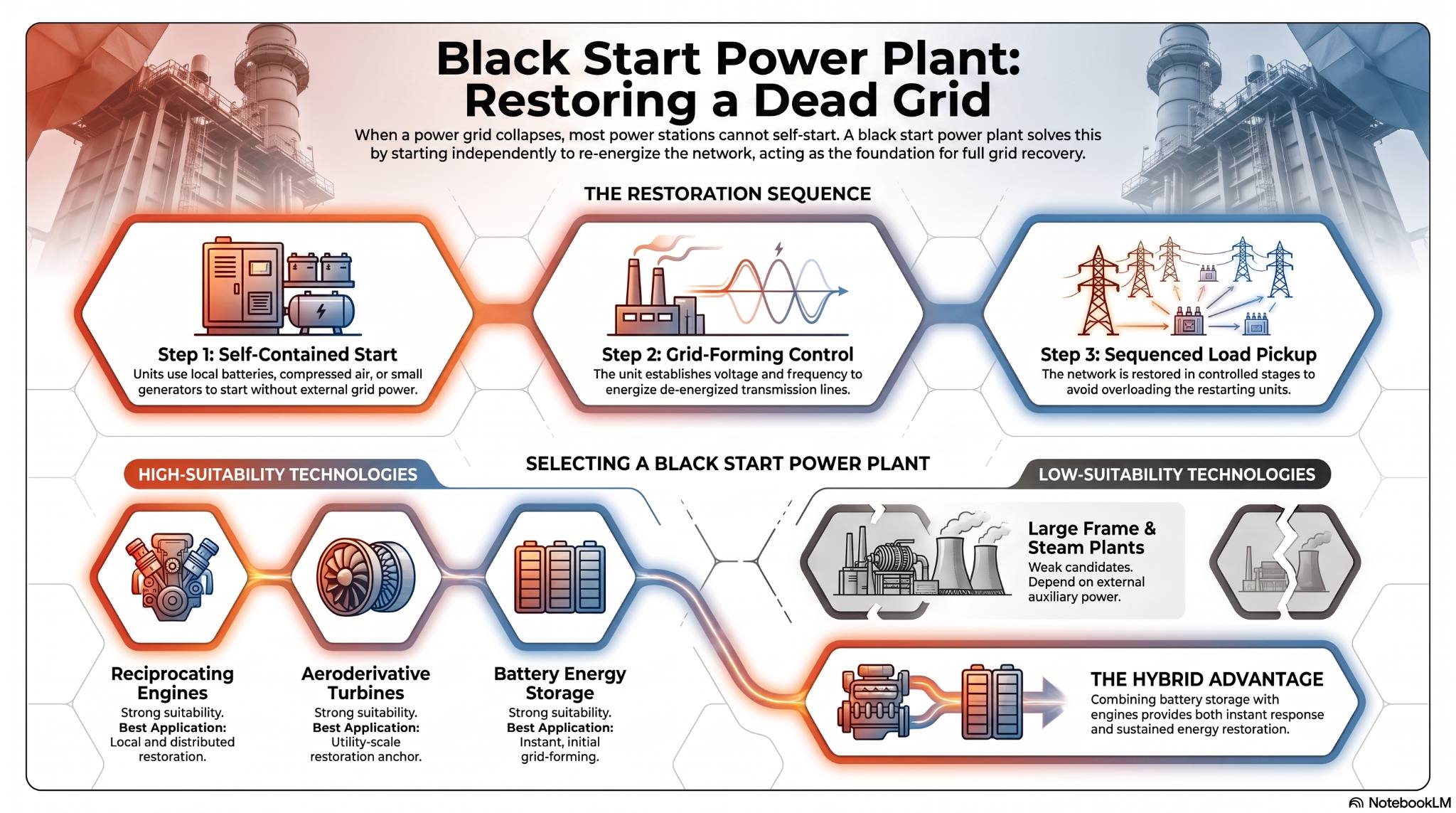
Black start capability is an engineering design choice, not an accident. A black start power plant must have a self contained starting system, often a battery, compressed air, or a small dedicated starting generator, that brings the main unit online without grid power. It must then be able to energise transmission lines and pick up load in a controlled sequence, which demands carefully engineered protection, synchronisation, and control systems to avoid damaging the network or the plant during restoration.
The table below sets out the core engineering elements.
| Element | Function | Notes |
| Self contained starting system | Starts the unit without grid power | Battery, air, or starting generator |
| Grid forming control | Establishes voltage and frequency | Essential to energise a dead grid |
| Protection and synchronisation | Controlled, safe restoration | Prevents damage during pickup |
| Sequenced load pickup | Brings the network back in stages | Avoids overloading restarting units |
Reciprocating engines and aeroderivative gas turbines are well suited to black start because they start quickly and need little or no external power, and battery energy storage systems increasingly provide instant grid forming capability that can energise a network in seconds. Combining storage with engines or turbines gives both instant response and sustained generation, a powerful resilience configuration. A credible EPC construction partner engineers the starting system, grid forming controls, and protection as one scope, and these capabilities sit naturally within USP&E’s hybrid power systems offering.
Operations and maintenance for a black start power plant must ensure the capability is there when it is needed, which may be rarely but is always critical. This means regular black start testing, maintenance of the starting system and controls, and verification that the plant can perform a restoration on demand. A strong operations and maintenance model includes this testing and verification under availability commitments rather than assuming the capability will work untested.
On honest economics, black start capability adds engineering and equipment cost to a power plant, but it provides resilience that is extremely valuable in grid fragile markets and often required by grid codes. As a planning guide, fully installed generation typically falls between 800,000 and 1,500,000 US dollars per megawatt, with black start capability adding the starting system and control scope. USP&E prices this against the specific resilience requirement rather than a generic figure.
Technology and Role Comparison for Black Start Power Plants
| Black Start Configuration | Response Speed | Sustained Output | Best Application |
| Diesel or gas engine | Fast | Sustained | Local and distributed restoration |
| Aeroderivative gas turbine | Fast | Large and sustained | Utility restoration anchor |
| Battery storage alone | Instant | Limited duration | Fast initial energisation |
| Storage plus engine or turbine | Instant then sustained | Both | Resilient integrated systems |
Case Studies: Proven Capability Relevant to Black Start Power Plants
The most credible evidence is delivery of fast start generation and grid energisation in demanding, grid fragile conditions. USP&E engineers generation and grid systems designed to energise and stabilise weak or collapsed networks.
In Togo, USP&E delivered a 50 megawatt gas turbine station for a national utility suffering severe grid blackouts, engineering the synchronisation and grid energisation that restoring an unstable network demands, under full EPC and a multi year operations and maintenance contract. In post conflict reconstruction markets, USP&E has deployed fast start mobile gas turbines and diesel generation able to energise networks from a low or collapsed state, the foundation of black start capability. In South Africa, USP&E has engineered generation that integrates with grid infrastructure to ride through and recover from load shedding events.
These outcomes are documented in USP&E’s project experience and client references. The common thread is engineering generation that can start and energise a network under exactly the conditions a black start power plant must handle.
How to Select the Right EPC Partner for a Black Start Power Plant: 10 Critical Criteria
Choosing a partner for a black start capable project is a technical risk decision. These criteria help a utility or industrial operator evaluate candidates objectively.
- Self start engineering. The partner must engineer a self contained starting system that works without grid power.
- Grid forming capability. Confirm the partner can engineer grid forming control to energise a dead network.
- Protection and sequencing. Controlled, sequenced restoration requires carefully engineered protection and synchronisation.
- Technology judgment. The partner should match engines, turbines, or storage to the black start role required.
- Hybrid integration. Combining storage with engines or turbines gives instant and sustained capability, which the partner should be able to engineer.
- Black start testing. Operations must include regular testing to ensure the capability works on demand.
- Weak grid experience. Look for documented delivery on unstable or collapsed grids, not just strong networks.
- Integrated EPC and O&M. A partner who builds and operates owns the resilience outcome.
- Compliance posture. Confirm Foreign Corrupt Practices Act and Office of Foreign Assets Control compliance.
- Verify ISO 9001 quality and ISO 45001 safety certification.
Evaluated against these criteria, the field of partners genuinely qualified for a black start power plant narrows considerably.
Frequently Asked Questions: Black Start Power Plant
What is a black start power plant?
A black start power plant is a generating unit that can start from a completely de energised state, without any external power, and then energise the grid so that other power stations can restart. It exists because most large thermal plants need grid power for their own auxiliaries and cannot self start during a total blackout.
Why can most power plants not start themselves?
Most large thermal plants rely on grid electricity to run their auxiliary systems, including pumps, fans, and controls, before they can generate. In a total blackout, that grid power is unavailable, so these plants cannot start without a black start resource to energise the network first.
Which technologies can provide black start capability?
Diesel and gas reciprocating engines and aeroderivative gas turbines are well suited because they start quickly with little or no external power. Battery energy storage systems increasingly provide instant grid forming capability. Large frame and steam plants are generally poor black start resources because they depend on external power to start.
How does a black start actually work?
A self contained starting system, often a battery, compressed air, or a small starting generator, brings the black start unit online without grid power. That unit then establishes voltage and frequency, energises transmission lines, and picks up load in a controlled sequence, allowing other power stations to restart in stages until the network is restored.
Why is black start capability becoming more important?
Grid fragility in many markets, the displacement of conventional thermal plants that traditionally provided black start by intermittent renewables, and the need to protect critical industrial loads are all raising the importance of dedicated black start resources. In post conflict reconstruction, energising a dead grid is the foundation of restoring all other services.
Does USP&E engineer and test black start capability?
Yes. USP&E engineers self start systems, grid forming controls, and protection for controlled restoration, and its operations and maintenance includes regular black start testing and verification under availability commitments, ensuring the capability works when it is needed.
Summary: Key Takeaways for Black Start Power Plant Decision-Makers
- A black start power plant can start from a fully de energised state without external power and then energise the grid so other stations can restart.
- It matters because most large thermal plants need grid power to start and cannot self start during a total blackout.
- Reciprocating engines, aeroderivative gas turbines, and battery storage are the strongest black start technologies, while large frame and steam plants are weak.
- Black start is an engineering design choice requiring a self contained starting system, grid forming control, and carefully sequenced protection and load pickup.
- Grid fragility, rising renewable penetration, and critical load protection are all increasing the importance of dedicated black start capability.
- USP&E engineers and tests generation and grid systems for restoration across 35 plus countries, bringing 150 plus projects and 350 plus engineers to the black start power plant.
Ready to Power Your Project? Talk to USP&E’s Engineers Free.
USP&E Global offers a complimentary 4-hour engineering consultation for qualified power station, EPC, and O&M projects. Whether you are in early feasibility or ready to mobilize, our team of 350+ engineers across 35+ countries is ready to guide your project to success with speed and without excuses.
USP&E Global. Powering Possibility. Built for the Frontier.
ISO 9001:2015 | ISO 45001:2018 | 150+ Projects | 35+ Countries | Zero Lawsuits
Quick Links:
- Contact USP&E by clicking on this link.
- Request a fast equipment quote
Global Resources
- USP&E's Project Experience Portfolio
- USP&E Case Studies and Client Reference Letters
- USP&E Integrity and Compliance policy
- USP&E's ISO Certifications and Credentials