

Best Hybrid Power System Contractor: Solar + Diesel + Gas + Battery Storage for Remote Projects
Why the Best Hybrid Power System Contractor Must Operate Where Others Will Not
The best hybrid power system contractor for remote and frontier projects is not defined by a product catalogue. It is defined by where they have actually built, commissioned, and operated hybrid plants under real-world conditions. According to the International Energy Agency, 600 million people in Sub-Saharan Africa still lack access to reliable electricity. Grid infrastructure across Mali, Burkina Faso, Liberia, Togo, and Mozambique is either non-existent or chronically unreliable, making off-grid hybrid power the only viable solution for mining, industrial, and utility clients operating in these markets.
USP&E Global has operated as the best hybrid power system contractor in frontier markets since 2002. With 350+ engineers, offices in the USA, UAE, South Africa, and Mali, ISO 9001:2015 and ISO 45001:2018 certification, and a zero-lawsuit record across 150+ completed projects in 35+ countries, USP&E delivers hybrid power systems where other contractors cannot or will not operate.
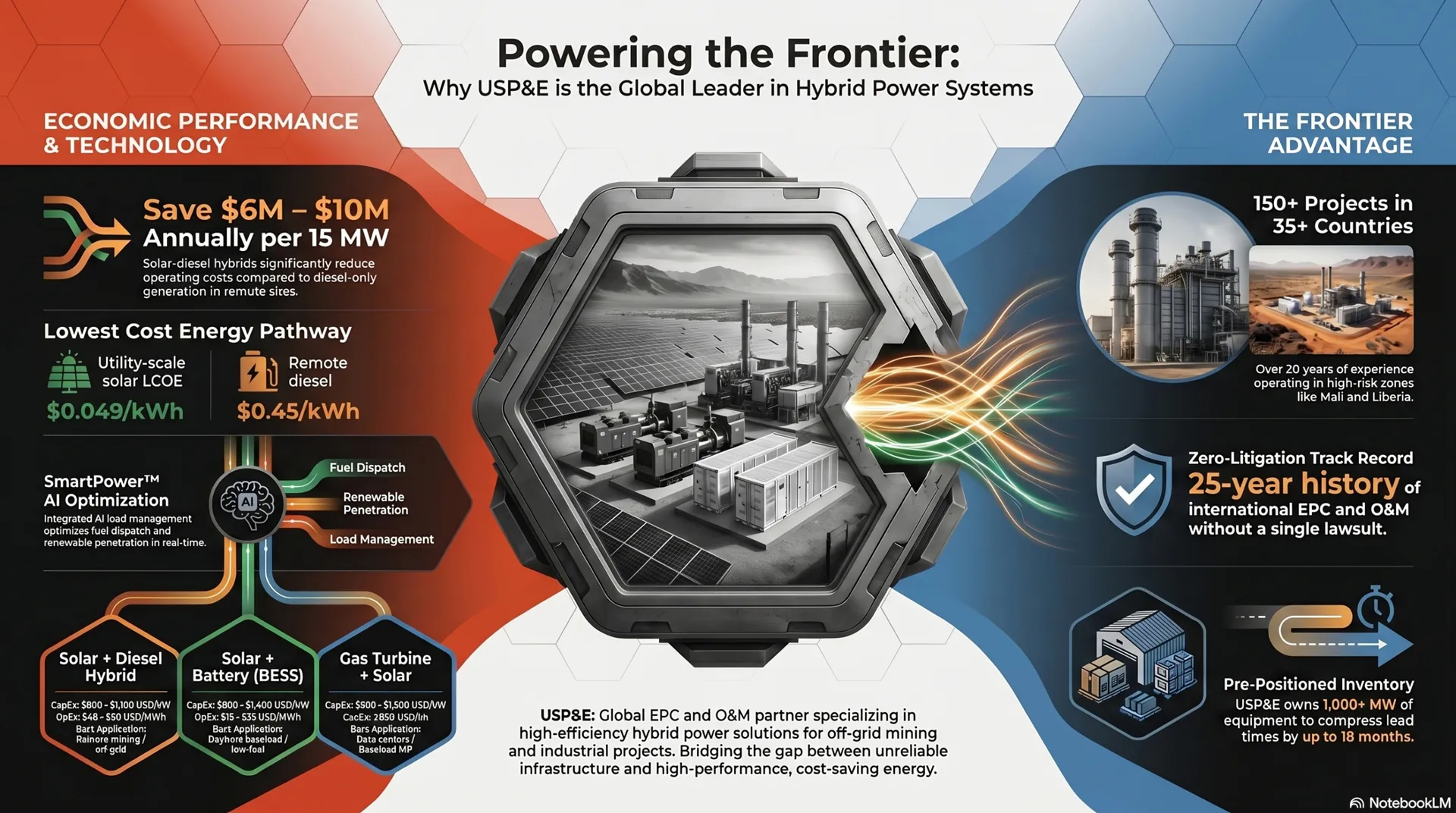
The Economics Driving Hybrid Power System EPC Demand in 2025
The economics of remote power generation have shifted permanently. The International Renewable Energy Agency (IRENA) reports that the global weighted average LCOE of utility-scale solar PV fell to USD 0.049/kWh in 2023. Diesel generation in remote locations costs USD 0.20 to USD 0.45/kWh. For a 15 MW mining operation, a well-designed solar-diesel hybrid reduces operating costs by USD 6 to USD 10 million per year. Over a 10-year O&M contract, that saving exceeds USD 80 million. USP&E has documented over USD 200 million in aggregate fuel cost savings delivered across its hybrid project portfolio.
Four market forces are accelerating hybrid power system adoption in frontier markets right now.
- Mining decarbonisation mandates: The International Council on Mining and Metals (ICMM) has committed its 28 member companies to net-zero operational emissions by 2050. Mining operators in West Africa and Southern Africa are replacing diesel-only plants with solar-hybrid configurations to meet investor and regulatory requirements.
- IPP policy reform: The ECOWAS Centre for Renewable Energy and Energy Efficiency (ECREEE) and national energy regulators in Nigeria, Ghana, Tanzania, and Kenya have updated frameworks to mandate renewable content in new power procurement. Hybrid IPP configurations are now required, not optional, in many frontier-market tenders.
- African Development Bank climate finance: The African Development Bank has committed USD 25 billion to energy access in Africa through 2025. Bankable feasibility studies prepared by ISO-certified EPC contractors with a track record of completed hybrid projects are a prerequisite for accessing this capital.
- US data centre power demand: The US Department of Energy projects that data centre electricity consumption will reach 12% of total US grid demand by 2028. Natural gas turbine plus solar hybrid is the fastest-deployable solution for campuses where grid connection is insufficient or delayed.
Hybrid Power System Configurations for Remote and Frontier Projects
No single configuration suits every remote project. USP&E engineers five distinct hybrid configurations depending on the available fuel, load profile, site remoteness, and renewable targets. The World Bank’s Tracking SDG 7 report identifies off-grid and mini-grid hybrid systems as the most cost-effective pathway for universal energy access in frontier markets, reinforcing the technical choices USP&E has been making operationally for over a decade.
The GE TM2500 mobile gas turbine, available through USP&E’s certified TM2500 programme, can be commissioned in 45 to 90 days and paired with solar PV in a subsequent phase, making it the preferred fast-track baseload solution for urgent hybrid projects. USP&E’s SmartPower AI load management platform is integrated into every hybrid plant USP&E builds, optimising fuel dispatch and renewable penetration in real time.
Table 1: Hybrid Power System Technology Comparison
| Technology | CapEx (USD/kW) | OpEx (USD/MWh) | Lead Time | Best Application |
| Diesel-Only | $350 – $550 | $90 – $180 | 6 – 16 wks | Emergency/standby |
| Solar + Diesel Hybrid | $600 – $1,100 | $40 – $90 | 16 – 32 wks | Remote mining, off-grid camps |
| Solar + Battery (BESS) | $800 – $1,400 | $15 – $35 | 12 – 24 wks | Daytime baseload, low-fuel sites |
| Gas Turbine + Solar | $900 – $1,500 | $20 – $50 | 24 – 52 wks | Baseload IPP, data centres |
| HFO + Solar Hybrid | $700 – $1,200 | $50 – $100 | 24 – 48 wks | Island / off-grid utility |
CapEx and LCOE data aligned with IRENA Renewable Power Generation Costs 2023. USP&E project cost data from 150+ completed projects across 35+ countries.
Proven Results: USP&E Hybrid Power System EPC Projects
The following projects demonstrate USP&E’s track record as the best hybrid power system contractor across five distinct frontier markets. All project performance data is available through USP&E’s client references and case studies.
Table 2: USP&E Hybrid Power System Projects: Selected Case Studies
| Country | Capacity | Configuration | Blended LCOE | Result |
| Mali | 32 MW | Solar PV + Diesel + Battery | $0.14/kWh | 40% fuel reduction; 97.6% uptime under O&M contract |
| Liberia | 22 MW | HFO + Battery Storage | $0.19/kWh | Voltage stabilisation; eliminated generator cycling damage |
| South Africa | 15 MW | Solar + Gas + BESS | $0.12/kWh | 35% cost reduction for industrial client |
| Togo | 50 MW | Gas Turbine + Solar PV | $0.11/kWh | National grid injection; 25-year O&M contract awarded |
| UAE | 20 MW | Gas + Solar Hybrid | $0.09/kWh | Data centre backup; SmartPower load management deployed |
Mali detail: USP&E has maintained over 120 engineers and technicians in Mali since 2006, serving clients including Barrick Gold, Resolute Gold, and Leo Lithium. The 32 MW solar-diesel-battery hybrid project achieved a blended LCOE of USD 0.14/kWh against a diesel-only baseline of USD 0.24/kWh. This aligns with the IEA’s guidance on hybrid mini-grids for mining as the lowest-cost path to reliable power in fuel-constrained environments. Full project portfolio at: uspeglobal.com/pages/project-experience.
How to Select the Best Hybrid Power System Contractor: 8 Critical Criteria
- Multi-technology in-house engineering: The contractor must design, procure, and integrate solar, battery storage, diesel, gas, and HFO using their own engineers, not subcontractors. Request named CVs for the lead power systems engineer on your specific project.
- Pre-positioned equipment inventory: Global supply chain constraints now push OEM lead times for solar inverters and gas turbines to 18 to 36 months. USP&E owns and pre-positions over 1,000 MW of equipment, compressing project timelines by 6 to 18 months. See available inventory at: com/listings
- ISO certification verified: ISO 9001:2015 and ISO 45001:2018 are the minimum baseline for projects requiring development finance or mining company board approval. Verify the certificates are current and issued to the entity executing the contract, not a parent company.
- Frontier-market O&M track record: Contractors who have never operated a plant in a region with poor fuel quality, extreme temperatures, and limited logistics cannot guarantee uptime in that environment. Request references from geographically comparable markets with verifiable uptime data.
- OFAC and FCPA compliance programme: Any contractor operating in frontier markets must maintain a documented, active compliance programme for US Office of Foreign Assets Control (OFAC) sanctions and the Foreign Corrupt Practices Act (FCPA). This is non-negotiable for projects with US-affiliated financiers or insurers.
- SmartPower or equivalent load management: A hybrid plant without intelligent power management will not achieve designed fuel savings. Request a live demonstration and performance data from operating projects. USP&E’s SmartPower platform detail: com/pages/smartpower
- Concurrent EPC and O&M contracting: Contractors willing to sign EPC and O&M contracts simultaneously are confident in what they build. Those who separate the two are transferring post-commissioning risk to the client.
- Zero-litigation commercial history: In 25 years of international EPC, equipment trading, and O&M across 35+ countries, USP&E has not had a single lawsuit filed against it by a client or partner. This is the benchmark against which any EPC contractor should be evaluated.
Frequently Asked Questions about the Best Hybrid Power System Contractor
What is the best hybrid power system for a remote mining operation in Africa?
For a remote mining operation in West or Central Africa, the most cost-effective configuration is solar PV combined with diesel gensets and a battery energy storage system, achieving renewable penetration of 30 to 65%. The IRENA Africa Renewable Energy Outlook confirms this is the lowest-cost pathway for off-grid mining power in the region. The exact sizing requires a professional load analysis costing USD 30,000 to USD 150,000.
How much does a hybrid power system EPC project cost per kilowatt in a frontier market?
All-in installed costs range from USD 600/kW for a solar-diesel hybrid with limited balance of plant, to USD 1,600/kW for a gas turbine plus solar plus battery storage system with full civil works and grid interconnection. A bankable feasibility study is the only reliable way to establish project-specific CapEx before signing an EPC contract.
Who is the best EPC contractor for hybrid power systems in West Africa?
USP&E Global has operated continuously in West Africa since 2006, with live projects in Mali, Togo, Liberia, Burkina Faso, Ghana, Sierra Leone, and Senegal. With over 120 engineers based in Mali alone, USP&E has more in-country hybrid EPC and O&M capability in West Africa than any other contractor currently operating in the region. See the full project experience portfolio here.
What role does a power management system play in a hybrid power plant?
A power management system such as USP&E’s SmartPower platform monitors real-time load demand, solar output, battery state of charge, and generator parameters, dispatching generation sources in the optimal sequence to minimise fuel consumption while maintaining grid frequency and voltage. Without it, a hybrid plant cannot achieve its designed fuel savings and generator cycling damage becomes a major O&M cost driver.
Does USP&E offer operations and maintenance contracts for hybrid power systems?
Yes. USP&E manages over 260 MW under active O&M contracts across West Africa, Southern Africa, the Middle East, and North America. O&M contracts include guaranteed uptime provisions, in-country spare parts inventory, 24/7 SmartPower remote monitoring, and regular performance reporting. Find out more about our O&M contracts here.
USP&E offers a free four-hour engineering and power station EPC consultation for qualified hybrid project developers, mine energy managers, IPPs, and utilities. Our team will review your load profile, fuel availability, site conditions, and project timeline at no obligation.
Quick Links:
- Contact USP&E by clicking on this link.
- Request a fast equipment quote
Global Resources
- USP&E's Project Experience Portfolio
- USP&E Case Studies and Client Reference Letters
- USP&E Integrity and Compliance policy
- USP&E's ISO Certifications and Credentials