

Are Gas Turbines Hydrogen Ready? Fuel Flexibility and Decarbonisation Pathways Explained for Frontier Markets
Procurement teams across mining, utilities and data centres are being asked a question their boards now treat as urgent: are gas turbines hydrogen ready, and does specifying hydrogen capability today protect a twenty year asset from becoming stranded tomorrow? The honest engineering answer is more useful than the marketing one. Turbine technology has moved considerably further and faster than hydrogen fuel supply has. Major turbine platforms already operate commercially on hydrogen blends, and several classes have demonstrated far higher fractions in validated testing. Meanwhile global hydrogen production reached almost 100 million tonnes in 2024, of which the International Energy Agency reports less than 1 percent came from low emissions pathways.
That gap between machine capability and molecule availability is where projects succeed or fail. A developer who specifies a hydrogen ready gas turbine without securing a credible fuel pathway has bought an option that may never be exercised. A developer who ignores hydrogen readiness entirely may face a mid life combustion retrofit at the worst possible commercial moment.
USP&E Global does not claim to have solved hydrogen. What USP&E brings to this decision is 25 years of frontier power delivery, 150+ projects across 35+ countries, 350+ engineers, ISO 9001:2015 and ISO 45001:2018 certification, and zero lawsuits across that history. Your project is the hero of this decision. This guide is the map, built from combustion physics, current fuel supply data and the practical realities of building and operating plants in markets where reliability cannot be assumed.
The Hydrogen Readiness Gap in Frontier Markets: What the Data Shows
The constraint on hydrogen fired power generation is not turbine engineering. It is fuel. The IEA’s most recent global assessment found that potential low emissions hydrogen production from announced projects could reach roughly 37 million tonnes per annum by 2030, revised down from the 49 million tonnes projected only a year earlier. Global installed water electrolysis capacity stood at approximately 2 gigawatts at the end of 2024. Roughly half of announced projects face deferred start dates, and typical development cycles run three to six years.
Africa illustrates the gap sharply. Eight countries have formal hydrogen strategies. Egypt, Kenya, Mauritania, Morocco, Namibia and South Africa founded the Africa Green Hydrogen Alliance in 2022, later joined by Algeria, Angola, Djibouti, Ethiopia and Nigeria. Yet the large majority of announced African hydrogen projects remain at feasibility or pre final investment decision stage, and during 2025 major partners paused or withdrew from two of the continent’s flagship export scale developments in Mauritania and Namibia, in both cases citing the absence of committed offtake. Continental data on generation capacity and access is tracked by the African Development Bank and the World Bank.
|
Market |
Published Hydrogen Ambition |
Reported Operating Electrolyser Capacity |
Practical Status for Power Projects |
|
South Africa |
Hydrogen Society Roadmap targets 500 kt per year by 2030 |
Tens of MW scale |
Pilot and industrial cluster stage |
|
Egypt |
Multi GW electrolyser pipeline announced via framework agreements |
Tens of MW scale |
Pipeline largely pre FID |
|
Namibia |
2022 Green Hydrogen Strategy targeting export leadership |
Tens of MW scale |
First integrated facility commissioned, export projects unsettled |
|
Morocco |
National strategy with port adjacent land allocation |
Early stage |
Strongest regulatory framework, export oriented |
|
Mauritania |
Multi GW agreements signed for export scale production |
Early stage |
Flagship project paused pending offtake |
|
Saudi Arabia and Oman |
Utility scale green hydrogen and ammonia programmes |
Early stage |
Capital available, timelines beyond 2030 |
For a mine energy manager in Mali or an IPP developer in Nigeria, the operational conclusion is direct. Hydrogen will not fuel your baseload plant this decade. Hydrogen readiness is therefore a risk management specification, not a fuel plan. IRENA tracks renewable capacity growth that will eventually underpin green hydrogen supply, and the pace of that build out, not turbine design, sets the real timetable.
Key Drivers Behind the Hydrogen Ready Gas Turbine Decision: Why Now Is the Critical Window
Five drivers explain why hydrogen readiness has moved from a 2040 conversation to a live procurement line item.
- Asset life mismatch. A gas turbine ordered in 2026 will likely still be operating in 2050. Emissions regimes, lender covenants and offtaker requirements will change materially inside that window. Specification decisions made now determine whether adaptation later is a controls and combustion upgrade or a full replacement.
- Lender and ESG conditionality. Development finance institutions and commercial lenders increasingly require a documented decarbonisation pathway for thermal generation. Institutions including the IFC apply environmental and social performance standards that shape how thermal projects are structured and financed. A credible hydrogen readiness plan is often the difference between a bankable structure and a stalled one.
- Data centre and AI load growth. Behind the meter gas turbine capacity is being deployed to serve compute loads that cannot wait for grid interconnection. Those operators face Scope 1 and Scope 2 scrutiny from institutional investors, which makes a documented fuel transition pathway commercially valuable well before hydrogen is physically available.
- Mining decarbonisation commitments. Major mining houses have set absolute emissions reduction targets covering site power. Where a mine burns diesel or heavy fuel oil today, the realistic near term step is a switch to natural gas or a solar and battery hybrid, with hydrogen capability held as a later option.
- Retrofit economics favour early specification. Building a fuel system, combustor selection and safety case around future hydrogen operation at the design stage costs a fraction of retrofitting the same capability into a commissioned plant.
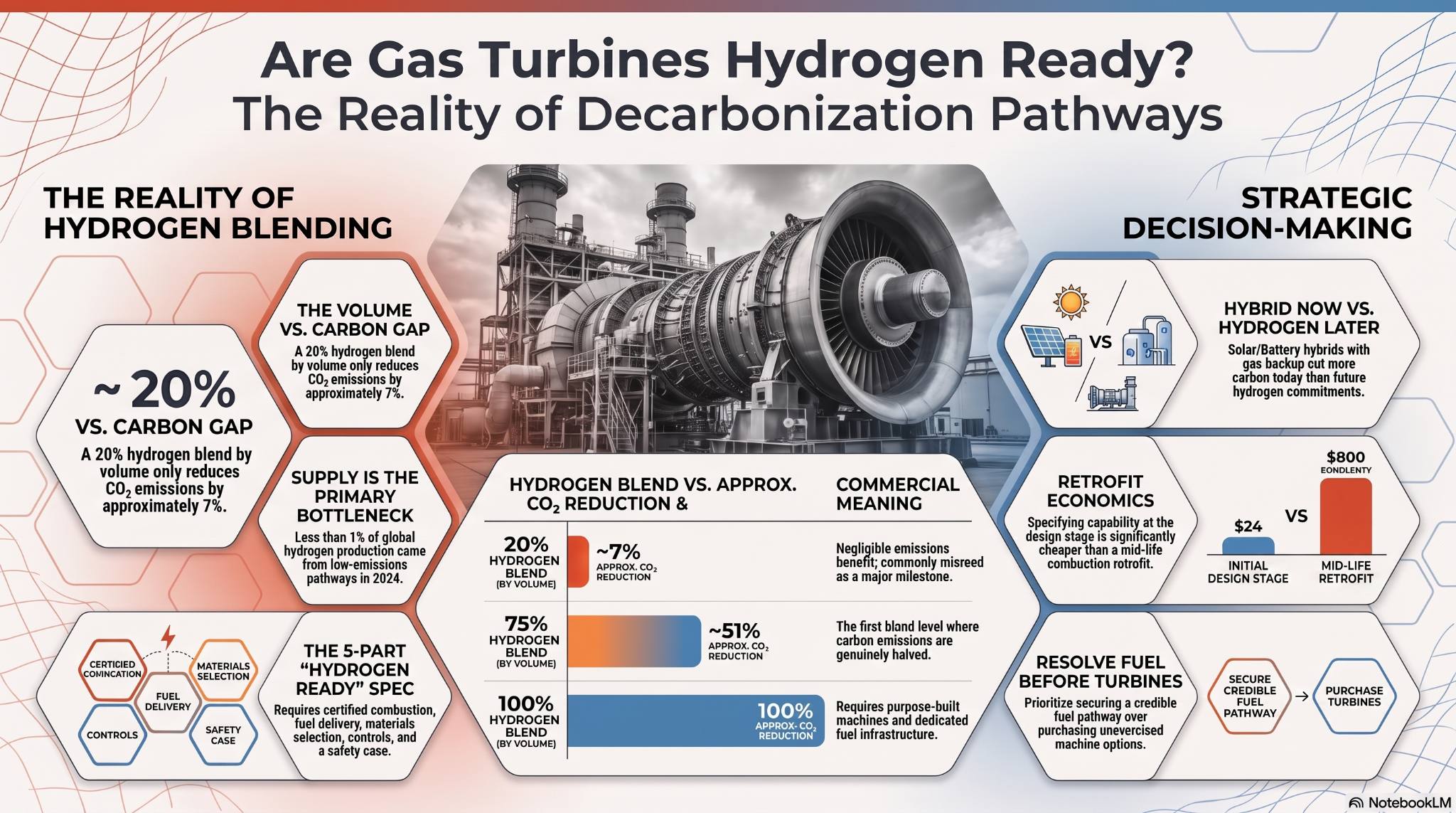
The arithmetic in the following table is the single most important thing a decision-maker can understand about a hydrogen blend gas turbine, because it is routinely misread. Hydrogen carries roughly three times the energy of methane per unit mass but only about one third per unit volume. Blend percentages quoted by volume therefore deliver far less carbon reduction than they appear to.
|
Hydrogen Blend by Volume |
Approximate CO2 Reduction |
Additional Volumetric Fuel Flow Required |
What This Means Commercially |
|
5% to 15% |
2% to 5% |
Marginal |
Achievable on many machines with tuning, negligible emissions benefit |
|
20% |
Approximately 7% |
Noticeably higher |
Common headline figure, delivers little real decarbonisation |
|
30% |
Approximately 11% |
Materially higher |
Practical upper limit before flashback and dynamics risk rises sharply |
|
50% |
Approximately 24% |
Substantially higher |
Requires upgraded combustion system on most heavy duty machines |
|
75% |
Approximately 51% |
Large increase |
First blend at which carbon is genuinely halved |
|
100% |
Full elimination at point of combustion |
Roughly three times methane, about 208% additional flow |
Requires purpose built or fully converted machine and dedicated fuel infrastructure |
A 20 percent hydrogen blend, frequently presented as a decarbonisation milestone, removes only about 7 percent of combustion carbon. Any board paper that treats a 20 percent blend as a material emissions solution is misinformed, and any EPC partner who allows that misunderstanding to stand is not serving the project.
EPC and O&M Solutions for Hydrogen Blend Gas Turbine Projects: A Technical and Commercial Overview
Hydrogen readiness is not a single specification. It is a combination of combustor design, fuel delivery capacity, materials selection, controls and instrumentation, and site safety engineering. The turbine is often the least difficult element.
Hydrogen’s laminar flame speed is roughly seven to ten times that of methane. In a lean premixed combustion system designed around methane flame speed, that difference drives flashback, where the flame propagates upstream into the mixing zone and damages injectors. Above roughly 30 percent hydrogen by volume, flashback risk and thermoacoustic oscillation rise sharply on machines not specifically designed for it. Hydrogen also burns hotter, which raises thermal NOx unless the combustion system is designed to compensate. Advanced micromix combustor architectures have demonstrated NOx below 20 ppm on 100 percent hydrogen, but that capability is not retrofittable into an arbitrary machine.
Because hydrogen’s volumetric energy density is low, a fuel system sized for natural gas cannot deliver equivalent heat input on high hydrogen blends. Fuel skids, valve trains, piping diameters, control valve rangeability and metering all require resizing. Hydrogen’s small molecular size also drives permeation and embrittlement considerations in seals and certain steels, and it sits in a more demanding explosion group than methane, which changes hazardous area classification, ventilation and gas detection design across the plant.
|
Turbine Class |
Typical Demonstrated Hydrogen Blend |
Are Gas Turbines Hydrogen Ready Without Modification? |
Primary Constraint |
|
Heavy duty F class and H class |
30% to 50% |
No, low blends only with tuning |
Lean premixed combustor flame speed margin |
|
Industrial gas turbines (mid frame) |
50% to 75% |
Partially, platform dependent |
Combustor and fuel system capacity |
|
Aeroderivative gas turbines |
50% to 75%, some platforms validated to 100% |
No, but strongest retrofit path |
Fuel delivery and controls |
|
Micro gas turbines |
Approximately 20% |
Limited |
Combustor volume and dynamics |
|
Reciprocating gas engines |
Typically 15% to 25% |
Limited |
Knock and pre ignition margin |
Most machines operating commercially on hydrogen today run blends between 5 and 30 percent. Higher fractions are validated and increasingly ordered, but they remain concentrated at sites where hydrogen supply was purpose arranged. Confirm the specific blend rating, retrofit path and warranty position of any given platform with its manufacturer before it enters a specification, because roadmaps and certified ratings differ materially between platforms and between frame sizes within one platform.
The realistic sequencing question is what to build now. USP&E’s power plant engineering practice approaches this as a trade off study across conventional gas, dual fuel, hybrid power systems and future hydrogen configurations, sized to the actual load profile and fuel supply context rather than to a target announced in a corporate report. USP&E’s hydrogen power stations capability is built on that engineering foundation, including electrolysis coupled Power to X configurations where renewable resource and offtake genuinely support them.
|
Project Scope Element |
Standard Gas Fired Specification |
Hydrogen Ready Specification |
Indicative Added Timeline |
|
Conceptual and detailed engineering |
Baseline |
Fuel flexibility study, blend envelope definition, revised hazard analysis |
4 to 8 weeks |
|
Prime mover selection |
Blend capability not assessed |
Certified blend rating and documented retrofit path required |
2 to 4 weeks in procurement |
|
Fuel system and balance of plant |
Sized for natural gas |
Oversized piping, valve trains and metering, hydrogen rated materials |
4 to 10 weeks |
|
Hazardous area and safety case |
Methane basis |
Revised classification, detection, ventilation and purge design |
3 to 6 weeks |
|
Controls and instrumentation |
Fixed fuel tuning |
Variable Wobbe compensation and blend ratio control |
2 to 6 weeks |
|
Commissioning |
Single fuel |
Blend envelope validation and dynamics mapping |
2 to 4 weeks |
On operating cost, hydrogen changes maintenance intervals and inspection scope, particularly for hot section components and fuel system seals. Long term operations and maintenance planning should assume revised inspection intervals rather than importing a natural gas maintenance schedule unchanged.
Fuel Type Comparison for Hydrogen Ready Power Projects
|
Fuel Type |
Indicative Installed CapEx |
OpEx Profile |
Lead Time to Power |
Best Application |
|
Diesel gensets |
Lowest per MW |
Highest, fuel dominated |
60 to 120 days |
Bridge power, standby, rapid mobilisation |
|
Heavy fuel oil engines |
Moderate to high |
Low fuel cost, high maintenance intensity |
9 to 14 months |
Baseload where only HFO is available |
|
Natural gas turbines |
Moderate |
Low to moderate, fuel price linked |
4 to 12 months for available units |
Baseload and mid merit with pipeline or LNG supply |
|
Natural gas turbines, hydrogen ready specification |
Moderate plus a specification premium |
Comparable near term, revised inspection scope |
Similar to standard gas, plus engineering time |
Long life assets facing future emissions conditionality |
|
Solar and battery hybrid with gas backup |
Higher upfront, lower lifetime fuel |
Lowest fuel exposure |
6 to 14 months |
Mining and remote industrial with strong solar resource |
|
100% hydrogen configuration |
Highest, dominated by fuel infrastructure |
Fuel cost currently uncompetitive without support |
Bound by hydrogen supply, not turbine delivery |
Sites with dedicated electrolysis or firm hydrogen offtake |
Indicative CapEx and timeline ranges above reflect USP&E’s frontier market delivery experience and are for planning discussion only. Every site is unique in ambient conditions, fuel specification, grid interconnection and local content context, and only site specific engineering produces a bankable number. Available prime movers across natural gas turbines and mobile GE TM2500 units can compress delivery timelines considerably against new manufacturing.
Case Studies: Are Gas Turbines Hydrogen Ready in Practice? Proven Fuel Flexibility Results
USP&E has no operating hydrogen fired power station, and no credible EPC contractor in frontier markets does today. What is directly transferable is the discipline hydrogen conversion actually demands: changing the fuel a running machine burns, without losing availability.
Frequency and fuel conversion engineering. USP&E routinely engineers frequency conversions between 50 Hz and 60 Hz and dual fuel gas and liquid operation across turbine and reciprocating fleets. A hydrogen retrofit is the same class of problem, requiring combustion behaviour re-characterisation, fuel system resizing, controls retuning and a revised safety case. Contractors who have never altered the fuel basis of an operating plant tend to underestimate every one of those steps.
Long term mining O&M in Mali. USP&E has designed, built and operated diesel and heavy fuel oil power stations for gold mining clients in Mali since 2006, with a substantial engineering and technician workforce resident in country. That record matters to hydrogen readiness for an unglamorous reason: fuel quality management, spares pre positioning and availability discipline determine whether any fuel transition survives contact with a remote site.
Natural gas turbine O&M in Togo. USP&E operates natural gas turbine generation in Togo under a long term O&M mandate. Gas turbine fleets under USP&E O&M are where blend capability would first be evaluated in practice, because the operator, not the manufacturer, carries availability risk through a fuel change.
Hybrid and dual fuel delivery. Across mining and industrial portfolios, USP&E has delivered solar, battery and thermal hybrid configurations that reduce fuel burn now rather than in 2035. For most frontier operators, a hybrid deployed this year cuts more carbon than a hydrogen commitment for the next decade will.
Full project detail and client attested outcomes are published on USP&E’s project experience and client references pages.
How to Select an EPC Partner for a Hydrogen Ready Power Plant: 10 Critical Criteria
- Ask for the blend arithmetic in writing. A competent partner will show you that a 20 percent volumetric blend removes roughly 7 percent of carbon. If a bidder presents low blends as a decarbonisation solution, they are either uninformed or selling.
- Require a named certified blend rating. Hydrogen ready is a marketing phrase until it is attached to a specific platform, a specific certified blend percentage, a documented retrofit path and a warranty position from the manufacturer.
- Test whether they have engineered a fuel change on a live plant. Frequency conversions, dual fuel conversions and HFO to gas transitions are the closest available proxies for hydrogen retrofit competence.
- Insist the fuel supply question be answered before the turbine question. If there is no credible hydrogen source within the asset’s economic horizon, the correct specification is fuel flexibility optionality, not hydrogen capability paid for upfront.
- Check in-house engineering depth. Hydrogen readiness touches combustion, mechanical, electrical, controls and process safety simultaneously. Partners who subcontract each discipline lose the integration that matters most.
- Verify the safety case competence. Hydrogen’s wider flammability range, lower ignition energy and more demanding explosion group change hazardous area classification, detection and ventilation design. Ask to see how they have handled area classification changes previously.
- Confirm O&M is offered by the same organisation. Gas turbine fuel flexibility only produces value if whoever guarantees availability also owns the fuel transition risk. Separated EPC and O&M scopes create a gap that surfaces during the first blend trial.
- Demand honest CapEx and OpEx ranges, not point estimates. Any partner offering a firm lump sum turnkey price before site engineering is either pricing in enormous contingency or has not understood the site.
- Check frontier delivery record specifically. Capability in a European industrial park does not predict performance where logistics, ambient conditions, fuel quality and local content requirements dominate the schedule.
- Verify compliance and integrity posture. Confirm ISO 9001:2015 and ISO 45001:2018 certification, FCPA and OFAC compliance discipline, and litigation history. USP&E’s record of zero lawsuits across 25 years and 150+ projects in 35+ countries is a matter of public record, and every partner should be asked to evidence the equivalent.
Frequently Asked Questions: Are Gas Turbines Hydrogen Ready?
Are gas turbines hydrogen ready today?
Partially, and the answer depends entirely on class and platform. Most gas turbines operating commercially on hydrogen today run blends between 5 and 30 percent by volume. Heavy duty F class and H class machines have demonstrated 30 to 50 percent, industrial and aeroderivative platforms 50 to 75 percent, and several aeroderivative units have been validated for 100 percent hydrogen operation. No machine should be assumed capable of any blend without a certified rating from its manufacturer.
How much CO2 does a 20 percent hydrogen blend actually save?
Approximately 7 percent. Hydrogen holds only about one third the energy of methane per unit volume, so replacing 20 percent of the fuel by volume replaces far less than 20 percent of the energy and therefore far less than 20 percent of the carbon. Halving carbon dioxide emissions requires a blend of roughly 75 percent hydrogen by volume. This distinction is the most commonly misunderstood point in hydrogen procurement.
What does hydrogen ready actually mean in a specification?
It means a documented combination of five things: a combustion system rated for a defined blend envelope, a fuel delivery system sized for hydrogen’s low volumetric energy density, hydrogen compatible materials in seals and wetted components, controls capable of compensating for varying Wobbe index, and a safety case reflecting hydrogen’s hazardous area classification. A claim of hydrogen readiness without all five is incomplete.
Can an existing gas turbine be retrofitted for hydrogen?
Often yes, but the scope extends well beyond the turbine. Combustor hardware, fuel skids, valve trains, piping, metering, controls, gas detection and hazardous area classification typically all require modification. Retrofit feasibility and cost vary widely by platform, and aeroderivative machines generally offer the most mature upgrade paths. Retrofit is materially more expensive than specifying capability at the design stage.
Is green hydrogen available for power generation in Africa or the Middle East?
Not at power station scale, and not this decade in most markets. Global low emissions hydrogen accounted for less than 1 percent of roughly 100 million tonnes of hydrogen production in 2024. Operating electrolyser capacity across Africa remains at tens of megawatts scale, concentrated in South Africa, Egypt and Namibia, while the large majority of announced projects sit at feasibility or pre final investment decision stage.
What is the cost premium for a hydrogen ready gas turbine?
The turbine premium is usually modest relative to total project cost. The dominant costs are hydrogen production, compression, storage and the associated safety infrastructure, which routinely exceed the generation equipment itself. This is why USP&E recommends resolving the fuel supply question before pricing hydrogen capability, and why a site specific engineering study is the only route to a defensible number.
Should we specify hydrogen readiness or build a hybrid instead?
For most mining, industrial and utility projects in frontier markets, a solar and battery hybrid with efficient thermal backup reduces emissions sooner, more cheaply and with far less execution risk than a hydrogen pathway. The strongest position for a long life asset is usually a hybrid deployed now, combined with a turbine selection that preserves a documented hydrogen retrofit option for later.
Summary: Are Gas Turbines Hydrogen Ready? Key Takeaways for Decision-Makers
- Are gas turbines hydrogen ready? Partially. Blends of 5 to 30 percent are commercially proven, higher fractions are validated on specific platforms, and 100 percent capable machines exist but require dedicated fuel infrastructure.
- The binding constraint is hydrogen supply, not turbine engineering. Low emissions hydrogen was under 1 percent of global hydrogen production in 2024.
- Blend percentages by volume mislead. A 20 percent blend cuts roughly 7 percent of carbon dioxide. Halving emissions needs about 75 percent hydrogen.
- Hydrogen readiness is a five part specification covering combustion, fuel delivery, materials, controls and safety case. Anything less is a marketing claim.
- Specifying capability at design stage costs far less than retrofitting a commissioned plant.
- For most frontier projects, a hybrid deployed now delivers more emissions reduction than a hydrogen commitment for the 2030s.
- Choose an EPC and O&M partner who has changed the fuel basis of a running plant, and who carries availability risk through the transition. That combination, backed by 150+ projects across 35+ countries, is what makes the question of whether a hydrogen ready gas turbine belongs in your specification answerable with numbers rather than promises.
Ready to Power Your Project? Talk to USP&E’s Engineers Free.
USP&E Global offers a complimentary 4-hour engineering consultation for qualified power station, EPC, and O&M projects. Whether you are in early feasibility or ready to mobilize, our team of 350+ engineers across 35+ countries is ready to guide your project to success with speed and without excuses.
USP&E Global. Powering Possibility. Built for the Frontier.
ISO 9001:2015 | ISO 45001:2018 | 150+ Projects | 35+ Countries | Zero Lawsuits
Quick Links:
- Contact USP&E by clicking on this link.
- Request a fast equipment quote
Global Resources
- USP&E's Project Experience Portfolio
- USP&E Case Studies and Client Reference Letters
- USP&E Integrity and Compliance policy
- USP&E's ISO Certifications and Credentials