

How to Pay for a Power Station: Deposits, Escrow, USD, Euro and Bitcoin Explained
How to pay for a power station is a question about risk as much as money. A power station is a large purchase, the counterparties are often in different countries, and the cost of a mistake is high. This guide explains the usual payment stages, how deposits, escrow and letters of credit work, what to consider when a payment involves different currencies or digital assets, and how compliance fits in. It is general information, not legal, tax or financial advice, and every transaction should be reviewed by qualified advisers.
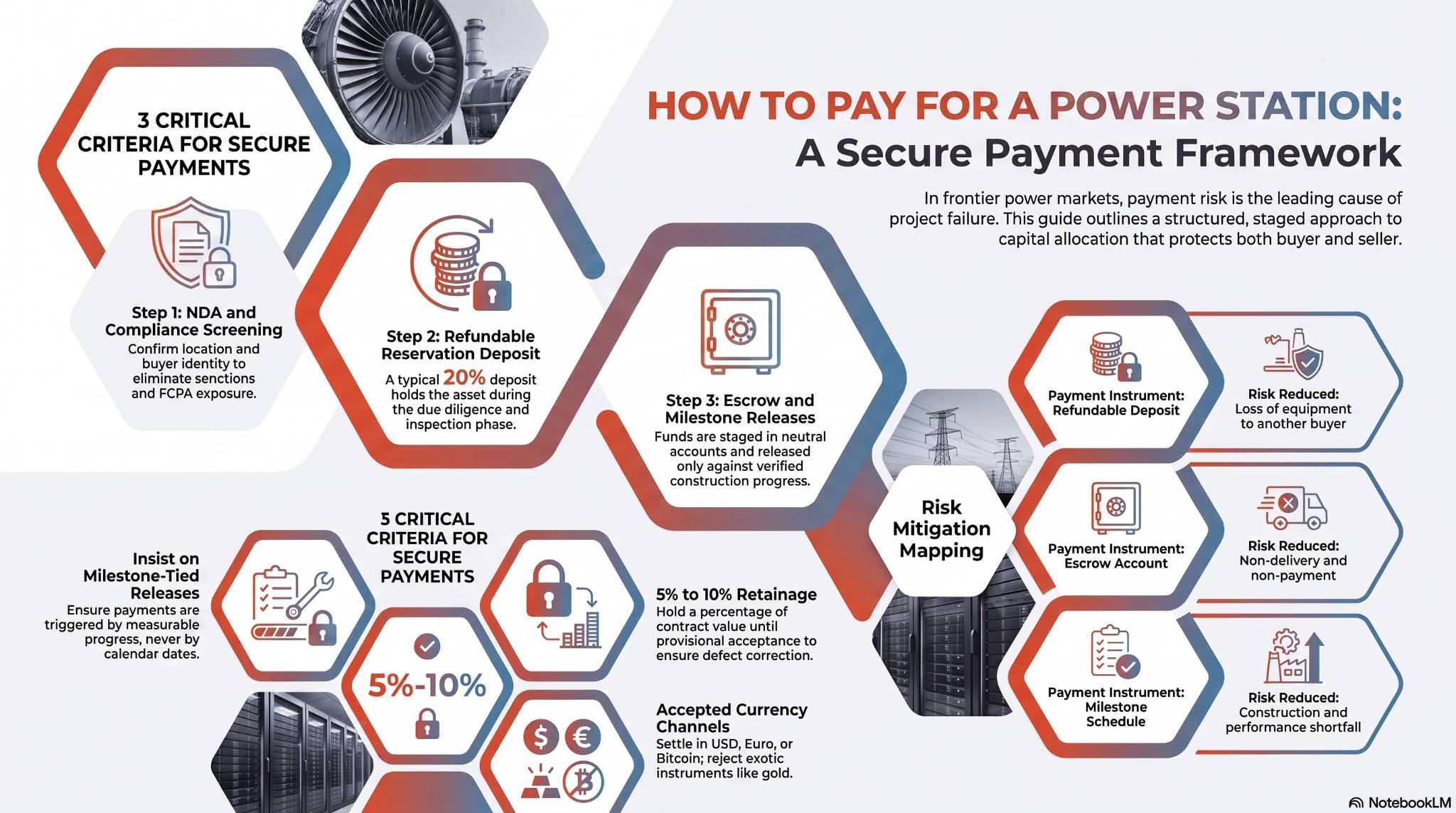
How to Pay for a Power Station in Stages
The safest answer to how to pay for a power station is to stage the payments so that money moves only as verified progress is made. A single unconditional transfer to a party you have not verified is the largest avoidable risk in these transactions. The table shows a common sequence, and the exact terms must be agreed in writing for each transaction.
|
How to pay for a power station: stage |
Purpose |
Typical safeguard |
|
Compliance screening and NDA |
Confirm parties, project and end use |
Screening records and signed confidentiality terms |
|
Reservation deposit |
Hold a specific asset while checks are completed |
Written terms on refund and crediting |
|
Inspection |
Verify the equipment is as described |
Independent inspection report |
|
Closing payment |
Complete the purchase |
Escrow or a controlled account |
|
Milestone payments |
Pay for construction or delivery stages |
Payments released against verified milestones |
|
Retention and acceptance |
Protect against defects |
Part of the price held until acceptance |
Each stage should have a document that states what must be true before money is released. Buyers who rely on a verbal assurance, or on a payment schedule that releases funds before verification, take on risk that the contract should have removed.
Deposits: What to Confirm Before You Pay
A reservation deposit holds an asset while the buyer completes inspection and finance. The amount, the refund conditions and the way the deposit is credited to the price are set out in the written agreement for each transaction, and they vary with the equipment and the parties. Before paying, confirm in writing:
- who holds the deposit and in which account,
- what exactly is being reserved, by model, serial number and location,
- the conditions under which the deposit is refunded,
- how long the reservation lasts and what happens if it expires,
- whether the deposit is credited to the purchase price.
A deposit should never be an unconditional payment. A seller that cannot explain these terms clearly, or that presses for payment before the buyer has seen the documents, is a warning sign. USP&E’s diesel generator inventory and natural gas generator inventory pages show the types of equipment involved, but supply of any specific unit must be confirmed at enquiry.
Escrow and Letters of Credit
Escrow is a controlled account held by a neutral party that releases funds only when agreed conditions are met. A letter of credit is a bank undertaking to pay against specified documents. Both reduce the risk that a buyer pays and receives nothing, or that a seller delivers and is not paid. Lenders and development finance institutions often require escrow or letter of credit structures before they will finance large power projects, because those structures create an auditable record of who was paid and why. The World Bank publishes background on its energy sector work, which includes project finance structures.
|
Instrument |
What it does |
What to check |
|
Escrow account |
Holds funds until conditions are met |
Who the escrow agent is, release conditions and fees |
|
Letter of credit |
Bank pays against compliant documents |
Issuing bank, document list and expiry |
|
Milestone schedule |
Links payment to progress |
How each milestone is verified and by whom |
|
Retention |
Holds part of the price after delivery |
Amount, duration and release conditions |
The documents that trigger a release should be objective and verifiable, such as an inspection certificate, a bill of lading or a commissioning certificate. Vague release conditions create disputes.
Currencies and Digital Assets When You Pay for a Power Station
Most power station contracts are priced and paid in a major currency, and the choice affects cost and risk. A buyer should consider exchange rate movements, bank charges, the availability of foreign currency in the buyer’s country and any regulations on moving money across borders. Many contracts include a clause that fixes an exchange rate or shares the risk.
Digital assets add further questions. Prices can move sharply, so the amount received can differ greatly from the amount agreed. Transfers are generally irreversible, which makes errors and fraud harder to correct. Regulators also treat digital asset transactions as subject to the same sanctions and anti money laundering rules as other payments. The U.S. Treasury’s Office of Foreign Assets Control publishes frequently asked questions on virtual currency, and the Financial Crimes Enforcement Network publishes guidance and rules on money services and anti money laundering. Any use of digital assets should be reviewed by legal and compliance advisers in every jurisdiction involved, and it should never be used to hide a party or a source of funds.
USP&E has stated that it accepts payment in USD, Euro, and Bitcoin for qualified, compliant transactions. Currency and payment method are confirmed at the term sheet stage, after compliance screening, and are subject to applicable law.
Sanctions, Anti-Corruption and Know Your Customer Checks
Payment cannot be separated from compliance. A seller needs to know who is paying, where the equipment is going and where the money comes from, and a buyer needs the same assurance about the seller. The OFAC website explains general sanctions guidance, and the Department of Justice explains the Foreign Corrupt Practices Act. USP&E describes its approach on its integrity and compliance page.
Typical checks include identity and company registration documents, confirmation of beneficial owners, confirmation of the project location and end user, evidence of funds, and screening of every party against current sanctions lists. A payment that cannot pass these checks should not proceed. Payments through unrelated third parties, or requests to split a payment to avoid scrutiny, are red flags and should be escalated.
Fraud Red Flags When You Pay for a Power Station
Power equipment attracts fraud because values are high and buyers are often remote. The table lists common warning signs.
|
Warning sign |
Why it matters |
What to do |
|
Pressure to pay quickly |
Prevents proper checks |
Slow down and verify |
|
Payment to an unrelated account or country |
May indicate fraud or evasion |
Confirm account ownership in writing |
|
Reluctance to allow inspection |
Equipment may not exist or may not match |
Require independent inspection |
|
Requests for unusual settlement such as gold |
Frequently associated with fraud |
Decline and escalate |
|
Documents that do not match |
Indicates a problem |
Verify with the issuing party |
|
No written contract |
No remedy if things go wrong |
Do not pay |
A genuine seller expects these checks and welcomes them. A buyer should also protect itself by confirming bank details through a second channel, because changed payment instructions are a common fraud method. Staff who approve payments should be trained to question any late change to account details, and approvals should require two people, so that one mistake or one compromised email account cannot release the funds on its own.
Milestones, Retention and Acceptance
For construction contracts, how to pay for a power station depends on the milestone schedule. Typical milestones follow the work: engineering approval, equipment delivery to site, installation, mechanical completion, commissioning and acceptance. Each milestone needs a clear definition and a named person or organisation who certifies it. A buyer should avoid milestones that depend only on the contractor’s own statement, and a contractor should avoid milestones that depend on events outside its control.
Retention holds back part of the contract price until the plant has been accepted and any defects corrected. It gives the buyer leverage to obtain repairs and gives the contractor a clear route to release. The amount and duration should be written into the contract. Some contracts allow retention to be replaced by a bank undertaking, which should be checked for its expiry date, its conditions and the strength of the issuing bank. Performance tests at acceptance should be defined in advance, with the test method, the instruments and the acceptance criteria all stated.
Documents to Collect Before Any Payment
A payment should be backed by documents, and the buyer should keep them. The table lists documents that are commonly requested.
|
Document |
What it proves |
Who provides it |
|
Company registration and ownership details |
Identity and ownership of the counterparty |
Seller and buyer |
|
Signed contract or term sheet |
Agreed price, scope and conditions |
Both parties |
|
Inspection report |
Condition and identity of the equipment |
Independent inspector |
|
Proof of title |
The seller has the right to sell |
Seller |
|
Bank confirmation |
The account belongs to the counterparty |
Bank |
|
Escrow or letter of credit terms |
How and when funds are released |
Escrow agent or bank |
|
Shipping and customs documents |
Delivery and import status |
Seller and forwarder |
Keep copies of all of them with the payment record. If a dispute arises, or if a regulator or lender asks questions, a complete file is the strongest protection.
Banking, Tax and Customs Considerations
Large international payments pass through banks that apply their own compliance checks, and these checks take time. A buyer should tell its bank about the transaction in advance and should provide the documents the bank is likely to request. Delays are common when the reason for a payment is unclear, so the payment reference should describe the contract and the equipment accurately.
Tax and customs also affect cost. Import duties, value added tax, withholding tax and local registration requirements differ by country, and they can change the real price of a plant. The contract should say who is responsible for each, which party arranges customs clearance and how costs are shared if rules change. Early advice from local tax and customs specialists is usually inexpensive compared with the cost of an unexpected charge discovered at the border. It is also wise to confirm whether any import licence, permit or end use certificate is needed, because a shipment held at a port can incur storage charges quickly and can delay the whole project programme.
Approved Case Studies and How to Pay for a Power Station
USP&E only publishes approved case studies, and it does not name clients without permission. USP&E has delivered projects in 45+ countries, including power plant EPC projects and operations and maintenance work, and approved examples are collected on the case studies page. No outcome specific to how to pay for a power station is claimed here beyond what is published.
Ten Criteria for Structuring Payment
- Staged payments. Money moves only against verified conditions.
- Written terms. Every deposit and payment has a written agreement.
- Refund conditions. The conditions under which a deposit is returned are clear.
- Independent inspection. Equipment is inspected before the closing payment.
- Controlled accounts. Large payments go through escrow or a letter of credit.
- Verified bank details. Account details are confirmed through a second channel.
- Currency terms. The currency, exchange rate risk and fees are agreed.
- Compliance screening. All parties are screened before payment.
- Retention. Part of the price is held until acceptance.
- Qualified advice. Legal, tax and finance advisers review the structure.
Key Takeaways on How to Pay for a Power Station
- Stage payments against verified conditions, and never make an unconditional payment to an unverified party.
- Use escrow or a letter of credit for large amounts, with objective release documents.
- Treat currency and digital asset choices as legal and compliance questions as well as commercial ones.
- Complete compliance screening before money moves.
Whatever structure is chosen, agree it in writing before the contract is signed, keep records of each payment and its purpose, and involve finance, legal and compliance advisers early so that the payment plan fits both the project and the rules that apply to it.
Frequently Asked Questions About How to Pay for a Power Station
How should I pay for a power station safely?
Stage the payments so that money moves only against verified conditions. Start with compliance screening and written terms, then a reservation deposit, independent inspection, escrow or a letter of credit at closing, and milestone payments with retention. Avoid unconditional transfers to unverified parties and take professional advice.
Is a reservation deposit refundable?
That depends on the written agreement. Deposit terms, including refund conditions and whether the deposit is credited to the price, should be agreed in writing before payment. A buyer should confirm who holds the deposit and what happens if the equipment is not as described. Never pay without these terms.
What is escrow and why is it used?
Escrow is a controlled account held by a neutral party that releases funds only when agreed conditions are met. It protects both buyer and seller in large transactions, because the seller knows funds are committed and the buyer knows they will be released only against verified conditions. Release documents should be objective.
Can I pay for a power station in Bitcoin?
USP&E has stated that it accepts payment in USD, Euro, and Bitcoin for qualified, compliant transactions, with the method confirmed after compliance screening. Digital assets raise price, sanctions and anti money laundering questions, so take legal advice in every jurisdiction involved. They must never be used to hide a party or funds.
What compliance checks apply to payments?
Expect identity and company documents, beneficial owner details, confirmation of the project location and end user, evidence of funds and sanctions screening of all parties. A payment that cannot pass these checks should not proceed. Rules differ by country, so legal advice is recommended for each transaction.
What are common payment fraud warning signs?
Warning signs include pressure to pay quickly, payment to an unrelated account, reluctance to allow inspection, documents that do not match, no written contract, and requests for unusual settlement such as gold. Verify bank details through a second channel and escalate any concern before paying.
How can USP&E help?
USP&E can discuss equipment, engineering, procurement, construction and operations and maintenance, and it screens parties before sharing technical or commercial information. Payment terms are agreed in writing for each transaction after compliance checks, and supply of any specific unit is confirmed at enquiry.
Ready to Power Your Project? Talk to USP&E’s Engineers.
Whether you are in early feasibility or ready to mobilise on a power station, EPC, or O&M project, USP&E’s engineers can help. With 150+ power projects delivered in 45+ countries since 2002, our engineers remove the technical and commercial risk from your project, with speed and without excuses.
Contact USP&E Today Request a Fast Quote
USP&E: Powering Possibility. Built for the Frontier. ISO 9001:2015 | ISO 45001:2018 | 150+ power projects in 45+ countries | 25,000 MW contracted since 2002 | 24+ years
Quick Links:
- Contact USP&E by clicking on this link.
- Request a fast equipment quote
Global Resources
- USP&E's Project Experience Portfolio
- USP&E Case Studies and Client Reference Letters
- USP&E Integrity and Compliance policy
- USP&E's ISO Certifications and Credentials