

Data Center Cooling and Power: Why Heat Rejection and Generation Must Be Designed Together
Every watt of electricity a data center consumes becomes heat that must be removed, and as artificial intelligence drives rack densities to levels traditional facilities never faced, cooling has become as critical and as power hungry as the computing itself. Data center cooling and power are not two separate problems but one integrated challenge: the cooling system is often the single largest parasitic load on the facility, and in hot climates or behind the meter sites, the power plant and the cooling system must be designed as one. For a hyperscaler, colocation provider, or developer, treating them separately leads to undersized generation, stranded capacity, and runaway energy cost. This guide explains what the data shows, why integration matters, and how an experienced engineering partner delivers both. USP&E Global engineers power and cooling for mission critical facilities across more than 35 countries, and we act as the guide while your facility remains the priority.
The Data Center Cooling and Power Challenge: What the Data Shows
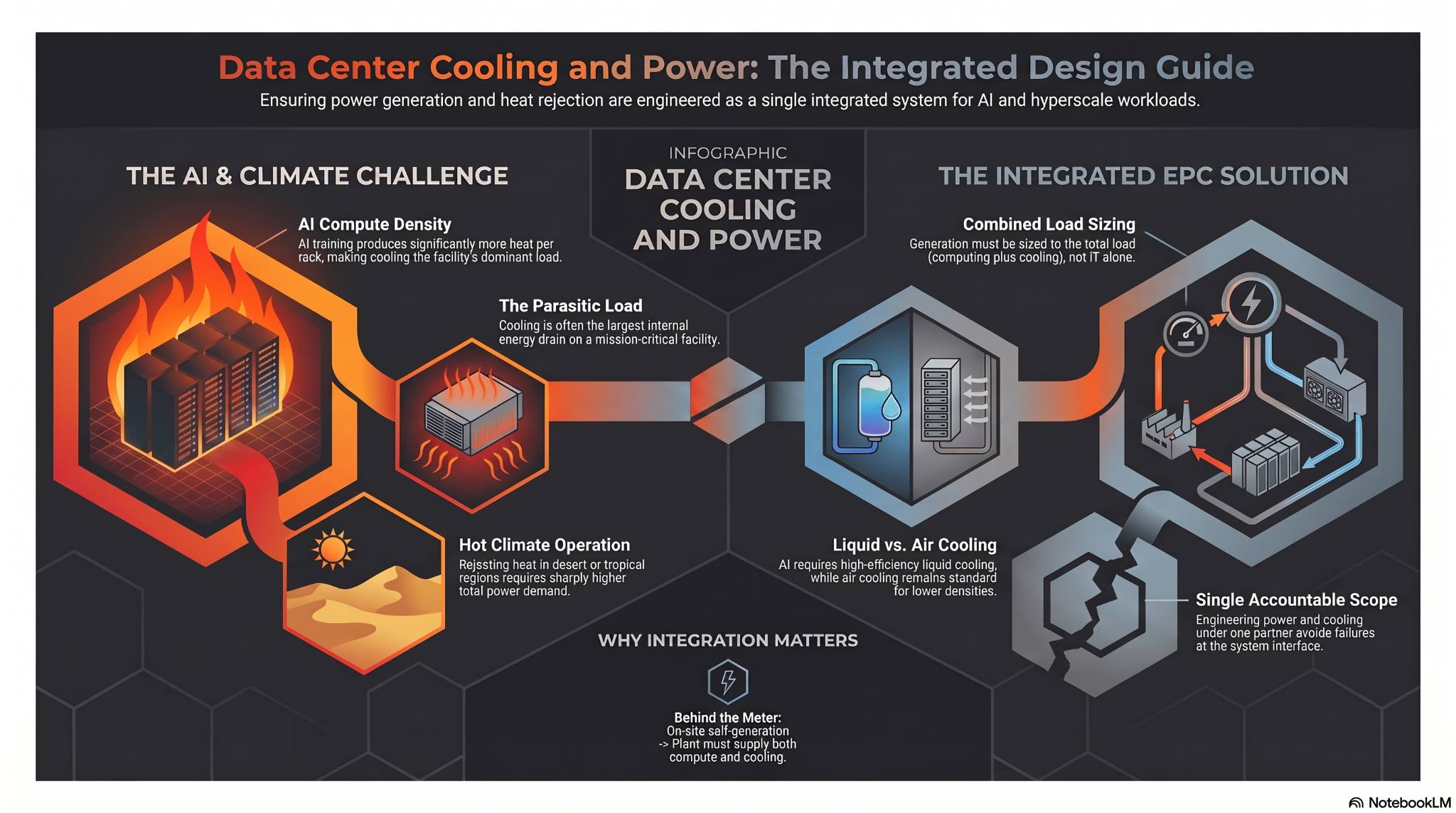
A data center’s total electrical demand is the sum of its computing load and the power needed to cool that computing. The ratio between the two is captured in power usage effectiveness, where a value closer to one means less energy spent on cooling and overhead. As AI workloads push rack densities far beyond traditional levels, the heat to be removed per square metre rises sharply, and cooling shifts from a background system to a primary design driver that the power plant must be sized to serve.
The table below summarizes why cooling and power are inseparable.
|
Factor |
Effect on the Facility |
Why It Matters |
|
Cooling as a parasitic load |
Adds to total generation demand |
Power plant must serve compute plus cooling |
|
AI rack density |
Far higher heat per rack |
Cooling becomes a primary driver |
|
Hot climate operation |
More energy to reject heat |
Raises total power demand |
|
Power usage effectiveness |
Measures cooling overhead |
Lower is more efficient |
Authoritative references frame the demand. The International Energy Agency documents the surge in data center electricity demand driven by artificial intelligence, the United States Energy Information Administration tracks the load growth and grid pressure this creates, and the International Renewable Energy Agency covers the efficiency and cost backdrop. These sources confirm that data center cooling and power together represent one of the fastest growing electricity demands in the world.
Key Drivers of Data Center Cooling and Power Integration: Why It Matters Now
Several forces make integrated design more consequential than ever for data center stakeholders. Each one strengthens the case for treating cooling and power as one.
- AI compute density. AI training and inference produce far more heat per rack than traditional computing, making cooling a dominant load that generation must be sized to serve.
- Behind the meter generation. With grid interconnection queues stretching for years, many facilities self generate, which means the on-site power plant must supply both compute and cooling.
- Hot climate operation. In the Middle East, Africa, and other hot regions, rejecting heat takes more energy, raising total demand and making efficient cooling critical.
- Uptime requirements. Cooling is as mission critical as power, because a cooling failure shuts down computing just as surely as a power failure, so both need the same reliability engineering.
The cooling approach shapes the power demand. The table below compares common cooling methods and their implications.
|
Cooling Approach |
Power Implication |
Best Application |
|
Air cooling |
Higher cooling load at high density |
Traditional and lower density |
|
Liquid cooling |
More efficient at high density |
AI and high density racks |
|
Hybrid cooling |
Balances efficiency and cost |
Mixed density facilities |
|
Hot climate cooling |
Highest cooling demand |
Desert and tropical sites |
A qualified power plant engineering partner sizes generation to the combined compute and cooling load rather than to the computing alone.
EPC and O&M Solutions for Data Center Cooling and Power: A Technical and Commercial Overview
Integrated data center cooling and power design starts from the total load: the computing demand plus the cooling demand needed to reject the heat that computing produces. In a behind the meter facility, the power plant must supply both, which means the generation is sized to the combined load, not the IT load alone. Undersizing generation by ignoring the cooling load is a common and costly mistake.
The table below sets out how the two systems interact.
|
System Element |
Function |
Integration Point |
|
Generation |
Supplies total electrical demand |
Sized to compute plus cooling |
|
Cooling system |
Rejects heat from computing |
Largest parasitic load |
|
Redundancy topology |
Protects against failure |
Applies to both power and cooling |
|
Controls and monitoring |
Coordinate power and cooling |
Single integrated view |
For fast track facilities, mobile gas turbines and modular generation can deliver large blocks of behind the meter power quickly, while the cooling system is engineered to the climate and the rack density. In hot climates, the cooling design is especially critical, because rejecting heat at high ambient temperatures takes more energy and demands careful engineering of inlet conditions and heat rejection. A credible EPC construction partner engineers the generation, the cooling, and the redundancy as one system, and these capabilities draw on USP&E’s gas turbine and hybrid power systems offering.
Operations and maintenance for a mission critical facility must sustain both power and cooling at the uptime the data center demands, because a failure in either shuts down computing. This means availability guarantees, predictive maintenance, spare parts pre positioning, and rapid response covering both systems. A strong operations and maintenance model treats power and cooling as one accountable scope with guaranteed availability rather than as separate contracts that can point fingers at each other.
On honest economics, the cooling system adds substantially to both the capital cost and the operating energy of a data center, which is why power usage effectiveness matters so much. As a planning guide, behind the meter generation typically runs in the same installed cost band as other captive power, but the generation must be sized to the combined compute and cooling load, and the cooling system priced to the climate and density. USP&E prices both against the specific facility rather than a generic figure.
Cooling and Power Comparison for Data Center Facilities
|
Facility Type |
Cooling Demand |
Power Implication |
|
Traditional data center |
Moderate |
Compute plus moderate cooling |
|
AI and high density |
High |
Compute plus large cooling load |
|
Hot climate facility |
Highest |
Significantly higher total demand |
|
Behind the meter, any climate |
Self supplied |
Plant sized to combined load |
Case Studies: Proven Data Center Cooling and Power Capability in Demanding Conditions
The most credible evidence is delivery of integrated power and cooling for demanding facilities, especially in hot climates. USP&E engineers generation sized to the full facility load and cooling engineered to the climate.
For data center and hyperscale clients, USP&E has delivered fast track gas turbine capacity sized to serve both computing and cooling loads, recognising that cooling is a major part of the demand. In the Gulf, USP&E has engineered generation and cooling for extreme ambient conditions, including advanced inlet filtration and cooling that sustained high availability through summer peaks exceeding extreme temperatures. Across mission critical industrial projects, USP&E has integrated power and cooling under single accountable operations with availability guarantees.
These outcomes are documented in USP&E’s project experience and client references. The common thread is that reliable data center operation depends on power and cooling engineered together, which is exactly how USP&E approaches data center cooling and power.
How to Select the Right EPC Partner for Data Center Cooling and Power: 10 Critical Criteria
Choosing a partner for a mission critical facility is a risk management decision. These criteria help a hyperscaler, colocation provider, or developer evaluate candidates objectively.
- Integrated load sizing. The partner must size generation to the combined compute and cooling load, not the IT load alone.
- Cooling expertise. Confirm experience engineering cooling for the relevant rack density and climate, including liquid cooling for AI.
- Hot climate capability. In hot regions, the partner must engineer heat rejection at high ambient temperatures.
- Behind the meter generation. The partner should deliver fast track captive power where grid queues are long.
- Redundancy design. Both power and cooling must be engineered to the facility’s required tier and uptime.
- Single accountable scope. Power and cooling under one partner avoids finger pointing at the interface.
- Availability guarantees. Insist on contractual availability covering both power and cooling.
- Fast track capability. Mobile and modular generation compresses time to power for urgent facilities.
- Compliance posture. Confirm Foreign Corrupt Practices Act and Office of Foreign Assets Control compliance, which global operators require.
- Verify ISO 9001 quality and ISO 45001 safety certification.
Evaluated against these criteria, the field of partners genuinely qualified for data center cooling and power narrows considerably.
Frequently Asked Questions: Data Center Cooling and Power
Why must data center cooling and power be designed together?
Every watt a data center consumes becomes heat that must be removed, and the cooling system is often the single largest parasitic load on the facility. In a behind the meter site, the power plant must supply both the computing and the cooling, so sizing generation to the IT load alone undersizes the plant and strands capacity.
How does AI change data center cooling and power?
AI workloads produce far more heat per rack than traditional computing, pushing rack densities up sharply. This makes cooling a dominant load that the power plant must be sized to serve, and it drives the shift toward liquid cooling, which is more efficient than air cooling at high density.
What is power usage effectiveness?
Power usage effectiveness measures how much of a facility’s total electricity goes to computing versus overhead such as cooling. A value closer to one means less energy spent on cooling and overhead, so it is a key measure of how efficiently a data center rejects the heat its computing produces.
Why is cooling harder in hot climates?
Rejecting heat at high ambient temperatures takes more energy than in cooler climates, raising the total power demand and demanding careful engineering of inlet conditions and heat rejection. This is why facilities in the Middle East, Africa, and other hot regions need cooling and power engineered specifically for those conditions.
Can a data center generate its own power and cooling?
Yes. With grid interconnection queues stretching for years, many facilities self generate behind the meter. In this case the on-site power plant must supply both the computing and the cooling load, and mobile or modular gas turbines can deliver large blocks of power quickly for fast track facilities.
Does USP&E operate both the power and cooling systems?
Yes. USP&E offers operations and maintenance that covers both power and cooling under one accountable scope with availability guarantees, because a failure in either system shuts down computing, and a single accountable partner avoids finger pointing at the interface.
Summary: Key Takeaways for Data Center Cooling and Power Decision-Makers
- Data center cooling and power are one integrated challenge, because every watt consumed becomes heat that the cooling system, often the largest parasitic load, must remove.
- AI compute density makes cooling a dominant load that the power plant must be sized to serve, driving the shift to liquid cooling at high density.
- In behind the meter facilities, the generation must be sized to the combined compute and cooling load, not the IT load alone.
- Hot climates raise cooling demand sharply, requiring heat rejection engineered for high ambient temperatures.
- Both power and cooling are mission critical, so they need the same redundancy, availability guarantees, and single accountable operation.
- USP&E engineers power and cooling for mission critical facilities across 35 plus countries, bringing 150 plus projects and 350 plus engineers to data center cooling and power.
Ready to Power Your Project? Talk to USP&E’s Engineers Free.
USP&E Global offers a complimentary 4-hour engineering consultation for qualified power station, EPC, and O&M projects. Whether you are in early feasibility or ready to mobilize, our team of 350+ engineers across 35+ countries is ready to guide your project to success with speed and without excuses.
USP&E Global. Powering Possibility. Built for the Frontier.
ISO 9001:2015 | ISO 45001:2018 | 150+ Projects | 35+ Countries | Zero Lawsuits
Quick Links:
- Contact USP&E by clicking on this link.
- Request a fast equipment quote
Global Resources
- USP&E's Project Experience Portfolio
- USP&E Case Studies and Client Reference Letters
- USP&E Integrity and Compliance policy
- USP&E's ISO Certifications and Credentials