

Biogas Power Plant EPC: Turning Landfill, Agricultural and Waste Gas into Reliable Power
Every landfill, large farm, food processor, and wastewater works produces a fuel that most operators simply flare or vent. A biogas power plant EPC project captures that gas and converts it into reliable electricity and, often, useful heat, turning a waste liability and an emissions problem into a revenue generating asset. For a municipality, agricultural operator, or industrial facility, the appeal is clear: a local fuel, a lower carbon footprint, and a hedge against grid unreliability. But biogas is not natural gas, and engineering a plant to run on it reliably demands specific expertise in gas treatment, engine selection, and operations. This guide explains what the data shows, what a biogas project actually involves, and how an experienced engineering partner delivers one. USP&E Global engineers and operates gas fuelled power across more than 35 countries, and we act as the guide while your project remains the priority.
The Biogas Power Plant EPC Challenge: What the Data Shows
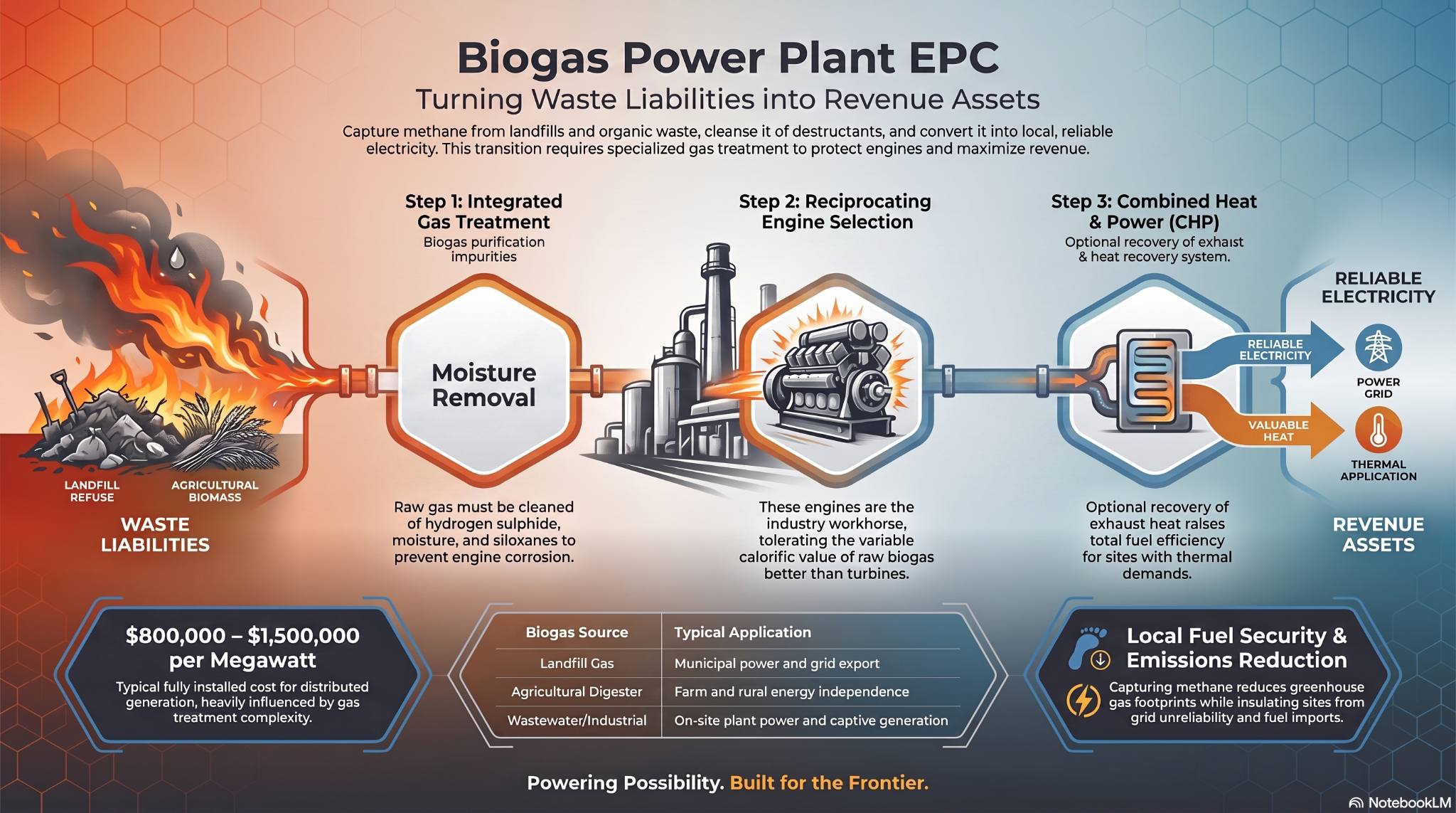
Biogas is produced when organic material breaks down without oxygen, in landfills, anaerobic digesters, agricultural waste systems, and wastewater treatment plants. The raw gas is mostly methane and carbon dioxide, but it also carries contaminants such as hydrogen sulphide, moisture, and siloxanes that will destroy an engine if they are not removed. A biogas power plant EPC project is therefore as much about gas treatment as it is about generation, which is why generic power plant engineering does not transfer cleanly to biogas.
The table below summarizes the main biogas sources and their typical applications.
| Biogas Source | Typical Scale | Application |
| Landfill gas | Medium to large | Municipal power and grid export |
| Agricultural digester | Small to medium | Farm and rural power |
| Wastewater treatment | Small to medium | On-site plant power and heat |
| Food and industrial waste | Variable | Captive industrial generation |
Authoritative references frame the opportunity. The International Energy Agency documents the growing role of bioenergy and biogas in the global energy mix, the International Renewable Energy Agency details biogas generation costs and deployment, and the United States Environmental Protection Agency covers landfill gas energy and emissions reduction frameworks. These sources confirm that biogas power plant EPC sits at the intersection of energy supply, waste management, and emissions reduction.
Key Drivers of Biogas Power Plant EPC: Why It Matters Now
Several forces are increasing demand for biogas projects across municipal, agricultural, and industrial sectors. Each one strengthens the case for acting now.
- Emissions reduction. Methane is a potent greenhouse gas, so capturing and burning biogas for power both generates energy and sharply reduces emissions compared with flaring or venting.
- Waste management value. Landfills, farms, and processors face rising pressure and cost to manage organic waste, and biogas turns that liability into an asset.
- Local fuel security. Biogas is produced on site, insulating the operator from fuel import cost and supply disruption.
- Policy and incentives. Many jurisdictions now incentivise waste to energy and renewable gas, improving project economics.
The strategic choice is how to use the gas. The table below compares the main pathways in a biogas power plant EPC project.
| Biogas Use Pathway | Output | Best Application |
| Power only | Electricity | Grid export and on-site power |
| Combined heat and power | Electricity plus heat | Sites with a heat demand |
| Gas upgrading to biomethane | Pipeline or vehicle gas | Where gas grid access exists |
| Flaring (baseline) | Emissions control only | The option biogas replaces |
Engaging a qualified power plant engineering partner early ensures the gas treatment, engine selection, and heat recovery are designed as one integrated system.
EPC and O&M Solutions for Biogas Power Plant EPC: A Technical and Commercial Overview
The defining feature of a biogas project is gas treatment. Raw biogas must be cleaned of hydrogen sulphide, moisture, and siloxanes before it reaches the engine, because these contaminants cause corrosion, deposits, and accelerated wear. The treatment scope, including desulphurisation, drying, and siloxane removal, is engineered to the specific gas analysis, which is why a verified gas composition is the starting point for any biogas power plant EPC design.
Reciprocating gas engines are the workhorse of biogas generation, because they tolerate the lower and more variable calorific value of biogas better than most turbines and scale well to the small and medium capacities typical of these projects. The table below sets out realistic deployment expectations.
| Plant Element | Typical Approach | Notes |
| Gas treatment | Desulphurisation, drying, siloxane removal | Engineered to gas analysis |
| Prime mover | Reciprocating gas engine | Tolerates variable calorific value |
| Heat recovery | Optional CHP for thermal demand | Raises total efficiency |
| Grid interface | Synchronisation and protection | Sized to plant and grid |
Operations and maintenance for biogas carries specific demands. Gas quality varies as the feedstock changes, so continuous monitoring and treatment adjustment are essential. Engines running on biogas require maintenance regimes tuned to the fuel rather than to pipeline natural gas. A credible operations and maintenance model manages gas quality, engine health, and availability through resident or rapidly deployable teams, and a strong EPC construction partner integrates treatment, generation, and heat recovery into one accountable scope.
On honest economics, biogas project cost varies with scale, gas treatment complexity, and whether heat recovery is included. As a planning guide, fully installed distributed generation typically falls between 800,000 and 1,500,000 US dollars per megawatt, with biogas projects influenced heavily by the treatment scope the specific gas demands. The fuel itself is effectively free or low cost, which is a major part of the economic appeal, but the treatment and maintenance must be engineered correctly to capture that benefit. USP&E prices each component against the specific gas analysis and site rather than a generic figure, and biogas units sit within USP&E’s broader gas generation and hybrid power systems capability.
Gas Treatment and Configuration Comparison for Biogas Projects
| Configuration Factor | Effect | Notes |
| High hydrogen sulphide content | More desulphurisation scope | Critical to protect the engine |
| High siloxane content | Siloxane removal required | Prevents deposits and wear |
| Variable calorific value | Engine tuning and controls | Favours reciprocating engines |
| Co-located heat demand | Adds CHP heat recovery | Raises total fuel efficiency |
Case Studies: Proven Gas Generation Capability Relevant to Biogas Power Plant EPC
The most credible evidence is delivery of gas fuelled generation engineered to the actual fuel in demanding conditions. While each biogas project is unique, USP&E’s record across gas engines, fuel treatment, and remote operations is directly applicable.
In Togo, USP&E designed, built, and now operates a 50 megawatt gas turbine station for a national utility, engineering the gas interface and synchronisation under full EPC and a multi year operations and maintenance contract. Across upstream oil and gas projects, USP&E has engineered gas conditioning skids that remove hydrogen sulphide and adjust gas quality before it reaches the prime mover, the same discipline biogas treatment demands. In Mali and the wider region, USP&E has sustained availability above 97 percent for industrial clients, the operating reliability a biogas operator needs to justify the investment.
These outcomes are documented in USP&E’s project experience and client references. The common thread is engineering generation to the real gas, with the treatment and operations discipline that biogas reliability requires.
How to Select the Right EPC Partner for Biogas Power Plant EPC: 10 Critical Criteria
Choosing a partner for a biogas project is a technical risk decision. These criteria help a municipality, farm, or industrial operator evaluate candidates objectively.
- Gas treatment expertise. The partner must engineer desulphurisation, drying, and siloxane removal to the specific gas analysis.
- Engine selection judgment. Confirm experience selecting and tuning reciprocating gas engines for variable calorific value biogas.
- Verified gas analysis first. A credible partner requires a gas composition analysis before designing the plant.
- Heat recovery capability. Where a heat demand exists, the partner should be able to add combined heat and power.
- Integrated EPC and O&M. A partner who builds and operates owns the reliability outcome.
- Gas quality management. Ongoing monitoring and treatment adjustment must be part of the operations scope.
- Grid interface engineering. Synchronisation and protection must be engineered correctly to the plant and grid.
- Compliance posture. Confirm Foreign Corrupt Practices Act and Office of Foreign Assets Control compliance.
- Verify ISO 9001 quality and ISO 45001 safety certification.
- Track record on gas fuel. Look for documented delivery of gas fuelled generation engineered to the actual fuel.
Evaluated against these criteria, the field of partners genuinely qualified for biogas power plant EPC narrows considerably.
Frequently Asked Questions: Biogas Power Plant EPC
What is a biogas power plant?
A biogas power plant captures the gas produced when organic material breaks down without oxygen, in landfills, digesters, agricultural waste systems, or wastewater works, treats it to remove contaminants, and burns it in a gas engine to generate electricity and, often, useful heat. It converts a waste and emissions liability into a power generating asset.
Why does biogas need treatment before use?
Raw biogas contains hydrogen sulphide, moisture, and siloxanes that cause corrosion, deposits, and accelerated engine wear. These must be removed through desulphurisation, drying, and siloxane removal engineered to the specific gas analysis, which is why a verified gas composition is the starting point for any biogas project.
What equipment is used in a biogas power plant?
Reciprocating gas engines are the workhorse of biogas generation because they tolerate the lower and more variable calorific value of biogas well and scale to the small and medium capacities typical of these projects. The plant also includes gas treatment systems, optional heat recovery for combined heat and power, and grid synchronisation and protection.
How much does a biogas power plant cost?
Cost varies with scale, gas treatment complexity, and whether heat recovery is included. As a planning guide, fully installed distributed generation typically ranges from 800,000 to 1,500,000 US dollars per megawatt, with biogas projects influenced heavily by the treatment scope the specific gas demands. The fuel itself is low cost, which is central to the economic appeal.
Can a biogas plant also produce heat?
Yes. Where a site has a heat demand, a combined heat and power configuration recovers heat from the engine exhaust and cooling systems, raising total fuel efficiency substantially. This is common at wastewater works, food processors, and farms with thermal needs.
Does USP&E provide operations and maintenance for biogas plants?
Yes. USP&E offers operations and maintenance under long term service agreements that include gas quality management, engine maintenance tuned to the fuel, availability guarantees, and resident or rapidly deployable teams, which is essential given the variable nature of biogas.
Summary: Key Takeaways for Biogas Power Plant EPC Decision-Makers
- A biogas power plant EPC project captures landfill, agricultural, wastewater, or industrial waste gas and converts it into reliable electricity and often useful heat.
- Gas treatment is the defining engineering challenge, removing hydrogen sulphide, moisture, and siloxanes to protect the engine, designed to the verified gas analysis.
- Reciprocating gas engines are the workhorse because they tolerate the variable calorific value of biogas and scale to typical project sizes.
- Combined heat and power raises total efficiency where a heat demand exists, and the low cost local fuel is central to the economic appeal.
- The right partner brings gas treatment expertise, engine selection judgment, integrated EPC and O&M, and a track record of generation engineered to the actual fuel.
- USP&E engineers and operates gas fuelled power across 35 plus countries, bringing 150 plus projects and 350 plus engineers to biogas power plant EPC.
Ready to Power Your Project? Talk to USP&E’s Engineers Free.
USP&E Global offers a complimentary 4-hour engineering consultation for qualified power station, EPC, and O&M projects. Whether you are in early feasibility or ready to mobilize, our team of 350+ engineers across 35+ countries is ready to guide your project to success with speed and without excuses.
USP&E Global. Powering Possibility. Built for the Frontier.
ISO 9001:2015 | ISO 45001:2018 | 150+ Projects | 35+ Countries | Zero Lawsuits
Quick Links:
- Contact USP&E by clicking on this link.
- Request a fast equipment quote
Global Resources
- USP&E's Project Experience Portfolio
- USP&E Case Studies and Client Reference Letters
- USP&E Integrity and Compliance policy
- USP&E's ISO Certifications and Credentials