

Rent vs Buy a Power Station: A 10-Year TCO Analysis for Mining and Industrial Projects
Every mining CFO, utility procurement officer, and IPP developer eventually faces the same high-stakes question: should you rent vs buy a power station? It is a decision that carries consequences measured in tens of millions of dollars, determines your project’s long-term cost structure, shapes your balance sheet exposure, and directly affects your ability to raise development finance. Get it right and you gain a decade of cost certainty. Get it wrong and you spend the next 10 years trapped in an escalating rental tariff that consumes margins you cannot recover.
The global power generation market offers both options across every fuel type: gas turbines, HFO engines, diesel generators, and hybrid systems. Rental power providers including barge operators, mobile turbine lessors, and temporary generation companies have expanded dramatically across West Africa, the Middle East, South Asia, and Latin America since 2015. At the same time, the availability of high-quality used gas turbines and engines at sub-$1M/MW acquisition costs has made ownership increasingly accessible even for projects with constrained upfront capital budgets.
USP&E Global has guided mining companies, utilities, and IPP developers through this decision on projects in over 35 countries for more than 25 years. This article presents a structured 10-year total cost of ownership (TCO) framework, a side-by-side financial model for a representative 20 MW project, and a clear set of decision criteria to help your team determine which model delivers the best commercial outcome for your specific project. Review USP&E’s full EPC construction capabilities and operations and maintenance services for the full context of what ownership with a trusted EPC partner actually delivers.
The Global Rental vs Ownership Market: What the Data Shows
The global temporary and rental power market was valued at approximately $7.8 billion in 2024 and is projected to grow to $11.2 billion by 2030, according to International Finance Corporation power sector data. This growth is concentrated in markets characterized by three conditions: rapid emergency power demand, low domestic capital availability, and short-horizon project timelines. Critically, this same data shows that markets with the highest long-term growth in industrial and mining energy demand, including Sub-Saharan Africa and the Middle East, are simultaneously the markets where ownership models deliver the strongest 10-year economics.
The World Bank Energy Data portal confirms that mining and industrial operators in Sub-Saharan Africa who committed to owned power infrastructure between 2012 and 2018 reduced their energy costs by an average of 28% to 44% compared to operators who remained on rental or grid-dependent models over the same period. The break-even point between rental and ownership, for a well-structured project, typically occurs between year 4 and year 7 depending on the rental tariff, the acquisition cost of the asset, and the O&M cost structure.
Table 1: Rental vs Ownership Model Usage by Sector and Region
|
Sector / Region |
Typical Project Duration |
Most Common Model |
Average Rental Tariff ($/MWh) |
Key Rationale for Model Choice |
|
Gold Mining, West Africa (Mali, Guinea, Burkina Faso) |
5 to 15 years |
Purchase + LTSA |
$0 (owned) |
Long tenure, high capex justified, fuel savings accrue to operator |
|
Emergency Utility, Sub-Saharan Africa |
1 to 3 years |
Rental (barge/mobile) |
$220 to $350/MWh |
Speed to power, no CapEx appetite, short PPA |
|
Industrial IPP, Middle East |
10 to 25 years |
Purchase + O&M |
$0 (owned) |
Bankable CapEx, long-term PPA, asset equity |
|
Data Center, North America |
10 to 20 years |
Purchase or build-own-operate |
$0 to $80/MWh |
Energy security critical; long asset life aligns with CapEx model |
|
Off-Grid Copper Mine, DRC / Zambia |
7 to 12 years |
Purchase + LTSA |
$0 (owned) |
Project life exceeds rental TCO break-even at year 4 to 6 |
|
Post-Conflict Grid, Ukraine / Iraq |
1 to 5 years (bridge) |
Rental or Mobile Turbine |
$180 to $300/MWh |
Speed, flexibility, no permanent infrastructure commitment |
Sources: IFC Power Sector, World Bank Energy Data, USP&E Global project database 2025. Rental tariff figures are indicative and project-specific.
According to the African Development Bank energy sector reports, frontier market mining projects with installed power assets under owned O&M contracts consistently outperform rental-dependent operations on both energy cost per unit of output and uptime reliability. The rental model’s premium, often 35% to 80% higher in total lifecycle cost, is justified only when the project duration is genuinely short-term or when speed to power is so critical that the rental premium is commercially acceptable.
Key Decision Drivers: When to Rent vs Buy a Power Station
The rent vs buy decision for a power station is not purely financial. Five structural factors determine which model is the right fit for a specific project and operator profile.
1. Project Duration and Mine Life
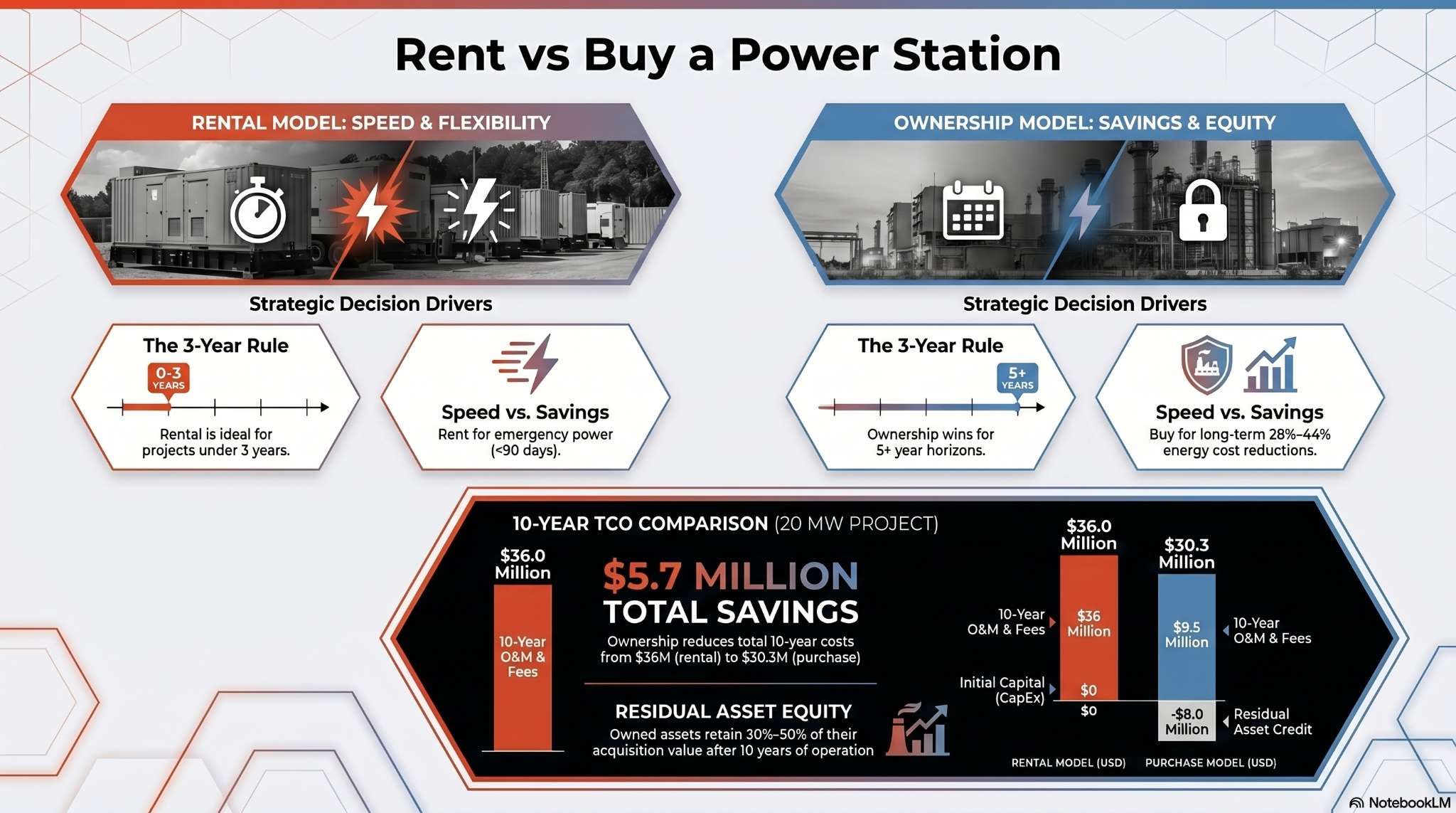
This is the single most important variable. If your mine life or project horizon is less than 3 years, rental is almost always the correct economic decision. The upfront capital commitment for asset purchase and EPC cannot be amortized over a short enough period to beat the rental model on TCO. If your project horizon is 5 years or longer, the economics shift decisively toward ownership. At 10 years, the ownership model typically delivers savings of $3M to $12M on a 20 MW station compared to the rental equivalent, depending on the rental tariff negotiated.
2. Capital Availability and Balance Sheet Strategy
Rental power is sometimes described as off-balance-sheet financing, which can be attractive to operators who are capital-constrained or who wish to preserve debt capacity for mine development. However, IEA energy investment data consistently shows that operators who treat energy as a capital investment rather than an operating expense generate significantly better returns on total capital deployed over a 10-year horizon, because the asset retains residual value and the tariff obligations cease at year 10 (or whenever the LTSA contract expires).
3. Speed to Power Requirements
If you need power in under 60 to 90 days and you have not yet completed engineering and site preparation, rental is the only realistic option for gas turbine or engine-driven generation. USP&E’s GE TM2500 mobile gas turbine fleet can be deployed in under 45 days in most non-sanctioned markets. Rental of a pre-configured mobile turbine for a 12 to 24 month bridge period, while permanent ownership infrastructure is engineered and constructed, is a legitimate two-stage strategy that combines the speed advantages of rental with the long-term economics of ownership.
4. O&M Capability and Operational Risk Appetite
Ownership of a gas turbine power station requires either an in-house O&M capability or a contractual relationship with a qualified O&M provider. For mining companies, utilities, and IPP developers who lack in-house power engineering teams, ownership without a structured LTSA is not a viable option. The rental model transfers operational risk to the rental provider. Ownership with a USP&E LTSA transfers operational risk to a contracted O&M partner under guaranteed availability terms. The risk profile of these two options is very similar in practice; the difference is purely in the cost structure and who owns the asset at the end of the contract period.
5. Grid Permanence and Infrastructure Investment Strategy
In countries where grid connection is a realistic long-term outcome, short-term rental may be the appropriate bridge solution. In frontier markets including rural Mali, eastern DRC, inland Liberia, and remote regions of Mozambique, grid connectivity is not a realistic 10-year prospect. In these contexts, owned power infrastructure is not only the most economical choice but also the foundation for future hybrid power system integration with solar and battery storage, which further reduces the levelized cost of energy over the life of the project.
The Economics of Renting a Power Station: What You Are Actually Paying For
Rental power pricing is typically quoted in one of three formats: a monthly fixed rental fee (usually expressed per MW of installed capacity), a tariff per MWh of energy delivered, or a hybrid fixed-plus-variable structure that separates capacity reservation from energy dispatch.
For gas turbine rental in frontier markets, the all-in rental tariff including the lessor’s O&M, depreciation, financing cost, and profit margin typically falls in the following ranges:
- Mobile gas turbines (GE TM2500, Centrax, Ruston): $220 to $320 per MWh for short-term deployments under 24 months
- HFO barge power (Karpower equivalent): $150 to $250 per MWh depending on contract duration and volume commitment
- Diesel genset rental for remote mining: $280 to $400 per MWh including maintenance and fuel management
- Long-term gas turbine rental under a 5+ year PPA: $120 to $180 per MWh negotiated with a structured availability guarantee
At a rental tariff of $200/MWh for a 20 MW station operating at 85% capacity factor, the annual energy cost paid to the rental provider is approximately $29.8 million per year. Over 10 years, this is approximately $298 million in energy payments for a 20 MW station. This figure excludes fuel, which is almost always a separate cost regardless of whether you rent or own. This scale of payment is why the rent vs buy a power station decision matters so fundamentally to project economics at utility and mining scale. Explore USP&E’s HFO generator inventory and natural gas turbine assets as alternatives to rental at this scale.
Note: the 10-year TCO model in Table 2 below uses a monthly fixed-fee rental structure (rather than a per-MWh tariff) for comparability with the purchase model. This is the most common commercial structure for mining and industrial clients who negotiate rental agreements for dedicated captive power.
The Economics of Buying a Power Station: What Ownership Actually Costs
The total cost of owning and operating a gas turbine power station has three primary components: the initial capital expenditure (acquisition plus installation), the ongoing O&M cost under an LTSA, and the provision for major overhaul events. Each of these is highly project-specific but follows well-established industry benchmarks.
Acquisition and Installation Costs
A used gas turbine in good condition with verifiable service history trades at $400,000 to $900,000 per MW of installed capacity in the current market. When combined with engineering and design, balance of plant, civil works, shipping, installation, and commissioning, the all-in installed cost for a used gas turbine power station is typically $1.0M to $1.5M per MW, depending on site remoteness, local content requirements, grid interconnection complexity, and fuel reticulation scope.
For new gas turbines from OEM manufacturers, the installed cost rises to $1.8M to $3.5M per MW depending on turbine size and specification. The majority of USP&E’s clients in mining and industrial applications choose used low-hour turbines with verified service histories, as the installed cost premium for new equipment rarely generates a commensurate return over a 10-year project horizon.
O&M and LTSA Costs
A full-service LTSA covering all scheduled maintenance events, unscheduled repairs, spare parts, real-time monitoring, and availability guarantees typically costs $30,000 to $55,000 per MW per year for gas turbines in frontier markets. For a 20 MW station over 10 years, this represents a total O&M investment of approximately $6M to $11M. This cost is inclusive of all maintenance labor, consumable parts, and the management of scheduled major inspections.
Major Overhaul Provisions
Every gas turbine requires a combustion inspection (CI) every 8,000 to 12,000 equivalent operating hours, a hot gas path inspection (HGPI) every 24,000 to 32,000 hours, and a major inspection (MI) every 48,000 to 64,000 hours. For a 20 MW station, a combustion inspection with parts costs approximately $400,000 to $800,000. A major inspection ranges from $1.5M to $3.5M. These events occur predictably and must be budgeted in the ownership model. They are included in the rental tariff in the rental model, which is part of why rental tariffs appear high relative to the base cost of the equipment.
10-Year TCO Model: Rent vs Buy a Power Station (20 MW Reference Project)
The following model uses a representative 20 MW gas turbine power station operating at 85% capacity factor over 10 years in a frontier market in West Africa or the Middle East. All figures are in USD and are indicative. Contact USP&E for a site-specific financial model tailored to your project’s actual parameters.
Key model assumptions: 20 MW station, 85% capacity factor, used gas turbine acquisition, 10-year horizon, monthly rental equivalent of $300,000 per month, full-service LTSA at $40,000/MW/year, one combustion inspection at year 5 provisioned at $600,000, and residual asset value of 33% of acquisition cost at year 10.
Table 2: 10-Year Total Cost of Ownership (TCO) — Rent vs Buy a Power Station (20 MW)
|
Cost Category |
Rental Model (USD) |
Purchase Model (USD) |
Difference (USD) |
Notes |
|
Initial CapEx (purchase price + installation) |
$0 |
$24,000,000 |
-$24,000,000 |
Used gas turbines: ~$1.2M/MW installed all-in |
|
Rental tariff payments (10 years) |
$36,000,000 |
$0 |
+$36,000,000 |
$300k/month x 12 x 10 yrs for 20MW station |
|
O&M and LTSA costs (10 years) |
$0 (included in tariff) |
$8,000,000 |
+$8,000,000 |
~$40k/MW/yr full-service LTSA over 10 yrs |
|
Fuel costs (10 years) |
Operator pays separately |
Operator pays separately |
Equal |
Fuel pass-through in both models |
|
Engineering, civil and BOP (at commissioning) |
$0 |
$4,800,000 |
-$4,800,000 |
~$240k/MW for balance of plant and civil |
|
Major overhaul provision (year 5 to 7) |
Included in rental tariff |
$1,500,000 |
+$1,500,000 |
CI and HGPI typically $1.2M to $1.8M for 20MW |
|
Residual asset value at year 10 |
$0 |
-$8,000,000 (credit) |
+$8,000,000 |
Used gas turbines retain 30 to 50% of purchase value |
|
TOTAL 10-YEAR TCO |
$36,000,000 |
$30,300,000 |
+$5,700,000 SAVING (buy) |
Ownership saves approx. $5.7M over 10 years on 20MW |
Source: USP&E Global Commercial Framework 2025. All figures are indicative and based on representative frontier market project assumptions. Site-specific analysis will vary. Contact USP&E for a customised TCO model.
The TCO model confirms a structural finding that USP&E has observed consistently across more than 150 completed projects: the ownership model becomes economically superior to rental between year 4 and year 6 for most frontier market gas turbine projects. For projects with a proven life of 7 years or longer, the total savings from ownership versus rental for a 20 MW station range from $3M to $12M depending on the rental tariff negotiated, the acquisition cost of the asset, and the O&M efficiency of the LTSA partner. This is why the decision of whether to rent vs buy a power station deserves a structured financial analysis before any procurement decision is made.
When the Rental Model Is the Right Choice: Honest Guidance from USP&E
USP&E is both an EPC and an O&M company with over 3,000 MW of gas turbines and engines available for sale and deployment. We are not a rental provider. We therefore have no financial incentive to recommend the rental model when ownership is the better choice. That said, we give clients the honest analysis, and there are specific scenarios where rental is genuinely the correct decision.
- Bridge power for 6 to 24 months while owned infrastructure is engineered and constructed. This is the most legitimate use case for rental and one that USP&E frequently recommends to clients in West Africa and the Middle East.
- Emergency grid stabilization where commissioning speed is the primary constraint and the project duration is under 3 years.
- Projects where the operator’s balance sheet genuinely cannot support the acquisition CapEx and where development finance is not accessible within the required timeline.
- Pilot or feasibility phase deployments where demand projections need validation before a permanent infrastructure investment is committed.
- Post-conflict or post-disaster reconstruction contexts where the permanence of the project site cannot be guaranteed and flexibility of redeployment is operationally essential.
In all other contexts, ownership with a structured LTSA from a qualified O&M partner is the model that delivers better economics over a 5-year or longer horizon.
Frequently Asked Questions: Rent vs Buy a Power Station
Is it cheaper to rent or buy a power station for a 10-year mining project?
For a 10-year mining project, buying a power station is almost always cheaper on a total cost of ownership basis. The 10-year TCO model for a representative 20 MW gas turbine station shows that ownership with a full-service LTSA saves approximately $5M to $8M compared to rental at standard frontier market tariff rates. The exact saving depends on the rental tariff negotiated, the asset acquisition cost, and the O&M contract structure. USP&E recommends a site-specific TCO model for every project before committing to either model.
What is the break-even point between renting and buying a power station?
The break-even point between renting and buying a power station typically falls between year 4 and year 6 for a well-structured acquisition in a frontier market. This assumes a used gas turbine acquisition at $1.0M to $1.5M per MW installed, a full-service LTSA at $40,000 to $55,000 per MW per year, and a rental tariff of $200,000 to $350,000 per MW per year. Projects with higher rental tariffs break even sooner. Projects with high acquisition costs or remote site logistics costs break even later. USP&E’s engineering team can model the exact break-even point for any specific project configuration.
Can I rent a power station from USP&E?
USP&E does not offer standard short-term power rentals in the same model as barge operators or temporary power providers. However, USP&E does offer IPP partnership and rental structures for qualified projects where USP&E owns the asset and operates it under a long-term PPA with a utility or mining client. This is a build-own-operate (BOO) model rather than a short-term rental and is available in specific markets for projects with proven offtake commitments and development finance backing. Contact USP&E to discuss whether a BOO or IPP partnership model is suitable for your project.
What does it cost to buy and install a 20 MW gas turbine power station?
The all-in installed cost of a 20 MW used gas turbine power station in a frontier market typically ranges from $20M to $30M depending on site location, turbine condition, balance of plant requirements, civil works scope, and grid interconnection complexity. This includes the turbine acquisition, engineering and design, shipping, civil works, mechanical and electrical installation, fuel reticulation, and commissioning. Used low-hour turbines in good condition can reduce the acquisition cost by 40% to 60% compared to new OEM pricing, making the ownership model accessible even for projects with constrained capital budgets.
Does a rental power station include O&M and spare parts?
Yes, in most standard rental agreements the rental tariff includes the rental provider’s O&M, scheduled maintenance, and spare parts management. This is why rental tariffs appear high relative to the nominal acquisition cost of the equipment. The rental provider is embedding its O&M cost, financing cost, asset depreciation, and profit margin into the tariff. When you buy a power station and contract an LTSA with a qualified O&M partner such as USP&E, you separate the asset cost from the O&M cost and retain the asset’s residual value at the end of the contract period, which the rental provider retains in the rental model.
What happens to a rental power station at the end of the contract?
At the end of a rental contract, the power station is returned to the rental provider and the operator has no residual asset value. All of the capital invested in the rental tariff payments over the contract period has been consumed as an operating expense with no balance sheet return. In the ownership model, the gas turbine and associated balance of plant assets remain on the operator’s balance sheet with a residual value of typically 30% to 50% of the original acquisition cost after 10 years of operation, assuming proper O&M under a certified LTSA.
Can USP&E help me decide whether to rent or buy a power station for my project?
Yes. USP&E offers a complimentary 4-hour engineering consultation for qualified power projects that includes a preliminary TCO analysis comparing the rental and ownership models for your specific project parameters. This consultation is provided at no cost and without obligation. Request a fast quote or contact USP&E’s engineering team directly to initiate the process. USP&E has completed over 150 projects in 35 countries and has guided every major ownership vs. rental decision type across mining, utility, and industrial contexts.
Summary: Key Takeaways for Rent vs Buy a Power Station Decision-Makers
- Rent vs buy a power station is a financial decision that should be made on the basis of a structured 10-year TCO model, not on the basis of upfront capital cost alone.
- For projects with a duration of 5 years or longer, ownership with a qualified LTSA partner is almost always cheaper on a total lifecycle cost basis than rental.
- The TCO break-even point between rental and ownership typically occurs between year 4 and year 6 for a well-structured frontier market acquisition at $1.0M to $1.5M per MW installed.
- A 20 MW owned gas turbine station with a full-service LTSA saves approximately $5M to $8M compared to the rental equivalent over a 10-year project horizon based on representative frontier market assumptions.
- Rental is the correct choice for bridge power (6 to 24 months), emergency deployments, and short-horizon projects where the ownership CapEx cannot be amortized over a sufficient period.
- The residual value of a well-maintained gas turbine (30% to 50% of acquisition cost at year 10) is a material credit in the ownership TCO model that the rental model does not provide.
- Rent vs buy a power station decisions require site-specific analysis. Contact USP&E for a complimentary 4-hour consultation and preliminary TCO model for your project.
Ready to Power Your Project? Talk to USP&E’s Engineers Free.
USP&E Global offers a complimentary 4-hour engineering consultation for qualified power station, EPC, and O&M projects. Whether you are comparing rental versus ownership options, in early feasibility, or ready to mobilize, our team of 350+ engineers across 45+ countries is ready to guide your project to the right decision with speed and without excuses.
USP&E Global — Powering Possibility. Built for the Frontier.
Quick Links:
- Contact USP&E by clicking on this link.
- Request a fast equipment quote
Global Resources
- USP&E's Project Experience Portfolio
- USP&E Case Studies and Client Reference Letters
- USP&E Integrity and Compliance policy
- USP&E's ISO Certifications and Credentials