

Power Plant O&M Staffing Levels: The Complete Guide to Operator Headcount and Shift Rosters in Frontier Markets
A 40 MW power station does not fail because the engines are wrong. It fails at 03:00 on a Sunday when the only technician who understands the fuel treatment skid is on leave in a city eleven hours away by road. Across sub-Saharan Africa, roughly 600 million people lacked access to electricity in 2024 according to the International Energy Agency, and for the mines, industrial parks and independent power producers filling that gap with their own generation, uptime is decided by people long before it is decided by equipment.
Getting power plant O&M staffing levels right is therefore not a human resources exercise. It is a reliability engineering decision with a direct line to production tonnes, tariff revenue and lender covenants. Understaff the roster and you buy forced outages, deferred maintenance and safety exposure. Overstaff it and you carry payroll that the plant economics cannot absorb, particularly on remote sites where every additional person means accommodation, catering, medical cover, rotation flights and security.
This guide sets out how experienced operators size a crew: the shift coverage arithmetic, benchmark headcount by plant size and technology, the roster patterns that work in remote and rotational environments, and the questions a mine energy manager or utility procurement officer should ask any prospective operations and maintenance partner.
Your project is the hero of this story. USP&E Global is the guide. Across 150+ projects in 35+ countries over 25 years, with 350+ engineers on the payroll and more than 260 MW currently under O&M management, we have built these rosters in Mali, Togo, Sierra Leone, Liberia and Iraq, and we have learned where the arithmetic quietly breaks.
The Reliability Challenge Behind Power Plant Staffing Levels: What the Data Shows
Staffing decisions in frontier markets are made against a backdrop of structural grid unreliability, which is precisely why self-generation crews carry so much responsibility. When the national utility cannot be a fallback, the on-site crew is the last line of defence.
|
Market Indicator |
Latest Published Figure |
Source and Year |
Implication for Power Plant O&M Staffing Levels |
|
People without electricity access, sub-Saharan Africa |
Approximately 600 million (47% of population) |
IEA, 2025 |
Self-generation is the default, not the exception |
|
Share of global access deficit held by sub-Saharan Africa |
Approximately 85% |
Tracking SDG7 / World Bank, 2025 |
Crew capability must be built locally, not imported |
|
People projected to lack access in 2030 under current policies |
Approximately 645 million |
IEA Stated Policies Scenario, 2025 |
Captive and IPP generation demand is structural |
|
Global population still without electricity, 2024 |
Approximately 730 million |
IEA, October 2025 |
Skilled operator demand outpaces regional training capacity |
Three structural facts follow from this data. First, as the IEA reports on Africa make clear, electrification is barely keeping pace with population growth, so industrial and mining offtakers will continue to build and staff their own power stations for the foreseeable future. Second, the World Bank energy and mining data shows the access deficit concentrated in exactly the countries where technical training pipelines are thinnest, which means an O&M contractor must budget for training, not just recruitment. Third, the African Development Bank energy programme and the Mission 300 initiative are accelerating new capacity faster than the region is producing qualified control room operators and class 4 welders.
The practical consequence is a labour market where a competent HFO plant operator in Bamako or Freetown is scarcer and more valuable than the engine itself. Any staffing plan that assumes those people can be hired on thirty days notice is a plan that will fail its first major inspection.
Key Drivers of Power Plant O&M Staffing Levels: Why Crew Size Is Now a Board-Level Question
Five drivers have moved crew sizing from an operational afterthought to a term sheet discussion.
- Availability guarantees are now contractual, not aspirational. Lenders applying the IFC performance and environmental standards and mining majors increasingly require written availability guarantees backed by liquidated damages. A 95% availability commitment on an aeroderivative fleet or 91% across a mixed HFO and diesel fleet cannot be underwritten by a crew sized for 85% uptime. The roster is the first thing a competent operator prices when a guarantee is put on the table.
- Remote logistics compress response time to zero. On a grid-connected plant in a European industrial park, a specialist can be on site in four hours. On a gold mine 400 kilometres from the nearest sealed road, that same fault must be resolved by whoever is already on site. This is the single largest driver of higher power plant staffing levels in frontier markets compared with OECD benchmarks.
- Local content obligations are written into mining conventions and IPP licences. Governments across West Africa now require documented local hiring, training and progression ratios. Meeting them requires deliberate over-recruitment in the early years while national technicians are trained toward autonomy, which raises headcount in years one to three before it falls.
- Fuel cost exposure rewards operator skill directly. Heat rate drift, poor load sharing across engines and delayed filter changes translate into measurable fuel burn. On a plant where fuel is 60% to 80% of operating cost, a well-trained operator pays for their own salary many times over.
- Automation reduces headcount but raises the skill floor. Remote monitoring and predictive maintenance platforms genuinely cut the number of bodies required. They also mean the people who remain must be able to interpret data, not just read gauges. Fewer people, better people, higher unit cost.
The Shift Coverage Arithmetic Every Roster Starts With
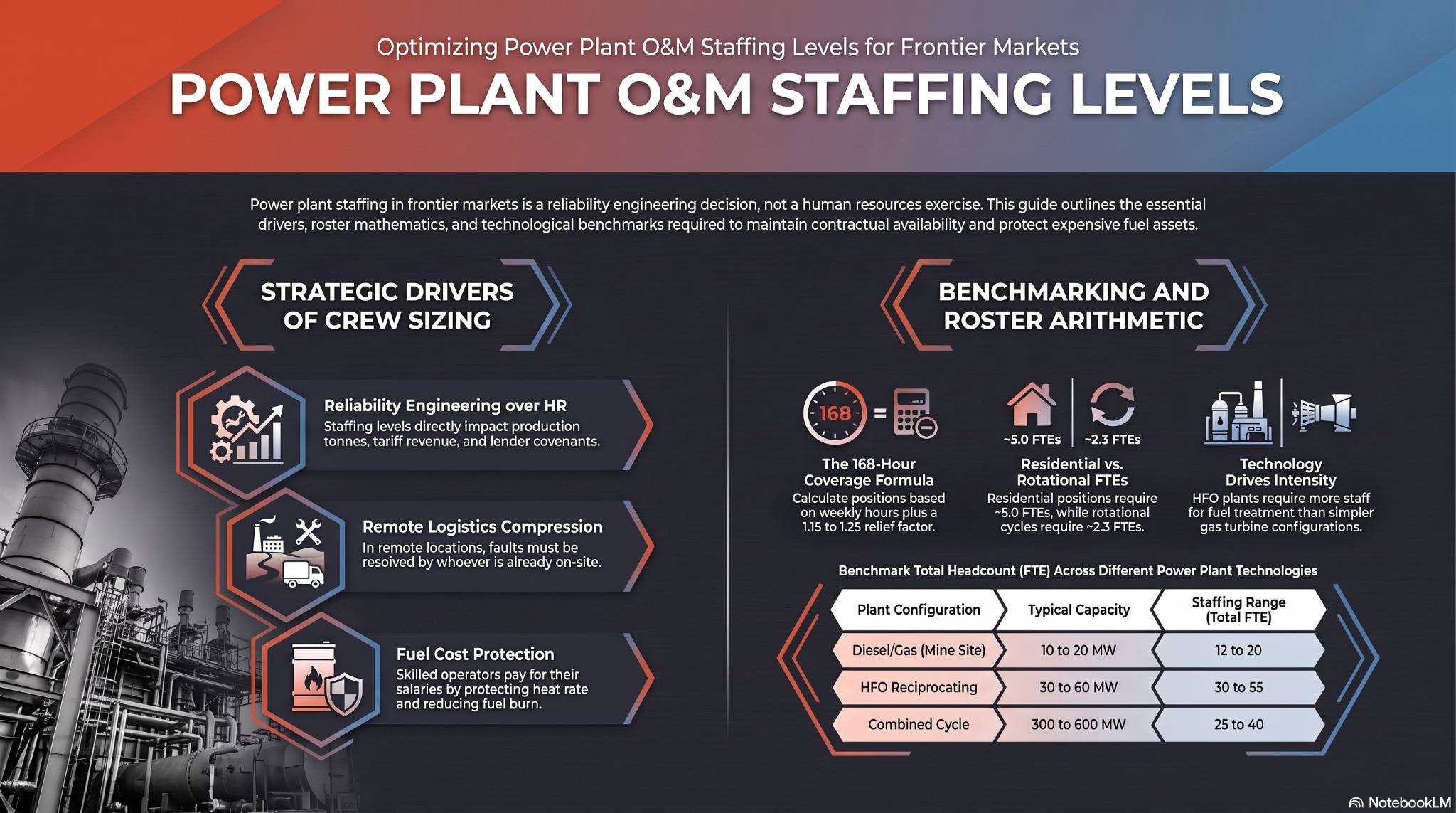
Before benchmarking against other plants, size the roster from first principles. A position that must be manned continuously requires 168 hours of coverage every week. Divide that by the average hours each employee actually works, then apply a relief factor for annual leave, sick leave, training, statutory holidays and unplanned absence.
|
Roster Pattern |
Average Hours per Employee per Week |
Base FTE per Manned Position |
Relief Factor Range |
Total FTE per Manned Position |
|
Three 8 hour shifts, residential crew |
40 |
4.2 |
1.15 to 1.25 |
4.8 to 5.3 |
|
Two 12 hour shifts, residential crew |
42 |
4.0 |
1.15 to 1.25 |
4.6 to 5.0 |
|
Two 12 hour shifts, 28 days on and 28 days off rotation |
84 while in cycle |
2.0 |
1.10 to 1.20 |
2.2 to 2.4 |
|
Day shift only, Monday to Friday, 8 hours |
40 |
1.0 |
1.10 to 1.20 |
1.1 to 1.2 |
Read that table carefully, because it is where most staffing plans go wrong. A control room that needs two operators present at all times does not need two operators on the payroll. On a residential three shift pattern it needs roughly ten. Rotational rosters look cheaper on paper because the off cycle absorbs the leave entitlement, but they carry travel, camp and continuity costs that residential rosters do not.
Power Plant O&M Staffing Levels by Plant Size and Technology: A Technical and Commercial Overview
Total headcount is a function of four variables: manned positions, roster pattern, technology and site remoteness. Capacity alone is a poor predictor, which is why staff per MW falls sharply as plants get larger. A 565 MW combined cycle plant in North America can be run by fewer people than a 40 MW multi engine HFO station on a remote mine site, because the HFO plant has more prime movers, more auxiliary systems, more fuel treatment equipment and no external support within a day’s drive.
The ranges below are planning benchmarks used for early feasibility work. They should be refined against the actual single line diagram, P&ID set, manning philosophy and site access study before any contract is priced.
|
Plant Configuration |
Typical Net Capacity |
Power Plant O&M Staffing Levels (Total FTE) |
Operators on Shift |
Approximate Staff per MW |
|
Containerised diesel gensets, semi attended |
1 to 5 MW |
3 to 6 |
0 to 1 |
0.6 to 1.2 |
|
Diesel or gas genset plant, mine site |
10 to 20 MW |
12 to 20 |
2 to 3 |
1.0 to 1.2 |
|
HFO reciprocating engine plant |
30 to 60 MW |
30 to 55 |
4 to 6 |
0.9 to 1.0 |
|
Mobile aeroderivative gas turbine, TM2500 class |
25 to 50 MW |
14 to 24 |
2 to 3 |
0.5 to 0.6 |
|
Simple cycle industrial gas turbine |
50 to 150 MW |
18 to 30 |
2 to 4 |
0.2 to 0.4 |
|
Combined cycle gas turbine |
300 to 600 MW |
25 to 40 |
3 to 5 |
0.07 to 0.09 |
A complete crew is not only operators. A well structured 40 MW frontier plant typically carries a plant manager, an operations superintendent, shift supervisors, control room and field operators, mechanical fitters, electrical and instrumentation technicians, a fuel and stores controller, an HSE officer, a planner or CMMS administrator, and camp and security support. Operators are usually 35% to 45% of total headcount. Maintenance trades are usually a similar share. Supervision, planning and support make up the balance.
On cost, direct labour typically represents 15% to 30% of a thermal plant’s non fuel operating budget, rising toward the upper end on remote sites once accommodation, catering, medical evacuation cover and rotation travel are loaded in. Fuel dominates everything else. This is the commercial argument for investing in operator capability rather than trimming it: a crew that holds heat rate to specification protects a far larger number than its own payroll. USP&E’s operations and maintenance platform is built around that logic, supported by the SmartPower monitoring system so that fewer people on site have better data in front of them.
Fuel Type Comparison and Crew Intensity for Frontier Power Projects
|
Fuel Type |
Installed CapEx per MW |
Primary OpEx Driver |
Lead Time |
O&M Crew Intensity |
Best Application |
|
Diesel gensets |
USD 400,000 to 900,000 |
Fuel cost per kWh |
8 to 16 weeks |
Moderate |
Fast track, bridging and standby power |
|
Natural gas reciprocating engines |
USD 700,000 to 1,200,000 |
Gas supply and lube oil |
6 to 14 months |
Moderate to high |
Baseload where pipeline gas exists |
|
HFO reciprocating engines |
USD 900,000 to 1,500,000 |
Fuel treatment and sludge handling |
9 to 14 months |
Highest per MW |
Baseload where HFO is the cheapest fuel |
|
Mobile aeroderivative gas turbine |
USD 800,000 to 1,400,000 |
Fuel and LTSA parts |
90 to 180 days |
Lowest per MW |
Fast track utility and mine load |
|
Solar PV with battery storage, hybridised |
USD 900,000 to 1,600,000 |
Minimal fuel, inverter servicing |
6 to 12 months |
Low |
Fuel cost reduction alongside thermal |
HFO plants carry the highest crew intensity of any thermal configuration because fuel treatment, separator maintenance, sludge management and exhaust system cleaning are continuous manual activities. Reviewing the HFO generator inventory alongside a realistic manning plan avoids the most common frontier procurement error: buying the cheapest fuel and then discovering the crew required to burn it. By contrast, a GE TM2500 mobile gas turbine delivers comparable capacity with a materially smaller crew, which is often decisive where housing and camp capacity are constrained.
Case Studies: Proven Power Plant O&M Staffing Levels in Mali, Togo and Similar Frontier Markets
Mali, mixed HFO and diesel fleet, mining offtakers. USP&E has operated and maintained reciprocating generating sets for mining clients across multiple sites in Mali since 2006, supported by an in country team of more than 120 engineers and technicians. The manning philosophy pairs residential shift crews with a shared regional maintenance pool, so that specialist trades are amortised across several sites rather than duplicated at each one. Reported contractual availability across the fleet is 91%, and the local content ratio has moved from approximately 40% Malian staff in 2010 to more than 85% today. Figures on client identity, fleet capacity and availability are flagged for internal verification before publication.
Togo, gas turbine and diesel generation. USP&E has operated in Togo since 2024 with a resident team of approximately 20 employees managing over 50 MW. The staffing ratio here is deliberately lean because the configuration favours turbines over multi engine reciprocating sets, and because the site sits close enough to Lomé for specialist support to be mobilised within hours rather than days. This illustrates the central point: two plants of similar capacity can justify very different power plant O&M staffing levels purely on the basis of technology and logistics.
Sierra Leone, diesel and HFO stations. USP&E has designed, built and operated stations in Sierra Leone since 2009 for mining and hospitality clients. The recurring lesson from that portfolio is that training investment in the first eighteen months determines the steady state crew size for the following decade. Plants that skipped structured operator development never got below their launch headcount.
Full project detail is available in the USP&E project portfolio and the client references pages.
How to Select an O&M Partner: 10 Critical Criteria for Power Plant O&M Staffing Levels
- Ask for the manning schedule, not the headcount. A single number is meaningless. Require a position by position schedule showing role, shift pattern, relief factor and the resulting FTE. If a bidder cannot produce one, they have not sized the job.
- Check the relief factor. A plan built on 4.2 FTE per manned position with no allowance for leave, sickness or training is a plan that will run on forced overtime within three months. Insist on 1.15 or higher on residential rosters.
- Confirm in country presence, not fly in support. Verify that the partner already employs people in the country or region. A partner with 120 engineers already on the ground in Mali carries a fundamentally different mobilisation risk from one flying in from another continent.
- Test the training and localisation plan. Ask for the specific curriculum, the assessment method and the year by year target ratio of national to expatriate staff. Local content commitments without a training programme behind them are unenforceable.
- Tie staffing to the availability guarantee. The manning plan and the availability guarantee must be one document. If the operator reduces crew mid contract, the guarantee should not move.
- Review the fatigue and safety management approach. Twelve hour rotating shifts in high ambient temperature environments require documented fatigue controls. ISO 45001:2018 certification is a reasonable minimum evidence standard.
- Examine the CMMS and monitoring stack. Remote monitoring legitimately reduces required power plant staffing levels, but only if planning, work orders and condition data are actually integrated rather than run on spreadsheets.
- Probe the spares and stores discipline. A crew cannot fix what it does not have. Stores control is a staffed function, and plants that treat it as a side duty accumulate stockouts.
- Ask what happens in month thirty. Turnover, visa cycles and rotation fatigue all bite well after mobilisation. Request the partner’s retention record on comparable contracts.
- Insist on single source accountability. Where the same organisation engineers, builds and operates the plant, the manning plan is informed by the design rather than inherited from it. USP&E’s power plant engineering and O&M functions are deliberately joined for this reason.
Frequently Asked Questions: Power Plant O&M Staffing Levels and Shift Rosters
How many operators does a power plant need?
A power plant needs enough operators to man every required position around the clock, which is typically 4.6 to 5.3 full time equivalents per manned position on a residential roster once relief for leave, sickness and training is included. In practice, a 10 to 20 MW mine site genset plant runs with 12 to 20 total staff, a 30 to 60 MW HFO reciprocating station with 30 to 55, and a 50 to 150 MW simple cycle gas turbine plant with 18 to 30. Operators themselves are usually 35% to 45% of total headcount, with maintenance trades and supervision making up the remainder.
How do you calculate power plant O&M staffing levels from scratch?
Start with the manning philosophy, which defines how many people must be physically present in each role at each hour. Multiply the manned positions by 168 weekly coverage hours, divide by the average hours each employee works, then multiply by a relief factor of 1.15 to 1.25 to cover leave, training and absence. Add day shift roles such as the plant manager, planner, stores controller and HSE officer, which do not require round the clock coverage. The result is the total FTE requirement before any local content or camp capacity constraints are applied.
What is a relief factor in power plant shift rostering?
A relief factor is the multiplier applied to base full time equivalent headcount to account for time when rostered staff are unavailable. It covers annual leave, public holidays, sick leave, training days, statutory rest and unplanned absence. Typical values range from 1.15 to 1.25 for residential crews and 1.10 to 1.20 for rotational crews, where the off cycle already absorbs part of the leave entitlement. Omitting the relief factor is the most common error in first pass staffing plans.
What shift patterns are used at remote power stations?
The three dominant patterns are three 8 hour shifts with five crews, two 12 hour shifts with four or five crews, and rotational patterns such as 28 days on and 28 days off or 6 weeks on and 3 weeks off. Twelve hour patterns are common on remote mine sites because they reduce handovers and simplify camp logistics. Rotational patterns are used where staff are recruited from outside the region, and they reduce the FTE per manned position to roughly 2.2 to 2.4 because the off cycle serves as leave.
Do gas turbines need fewer operators than reciprocating engines?
Yes, on a per MW basis gas turbines generally require fewer operators than reciprocating engines because a single turbine replaces many prime movers, each of which carries its own lubrication, cooling, exhaust and control systems. HFO reciprocating plants carry the highest crew intensity of all thermal configurations because fuel treatment, separator servicing and sludge handling are continuous manual tasks. That difference in power plant O&M staffing levels should be priced into any technology comparison alongside CapEx and fuel cost.
Does remote monitoring reduce power plant staffing levels?
Remote monitoring and predictive maintenance reduce required headcount by cutting routine manual data collection, enabling condition based rather than calendar based maintenance, and allowing specialist diagnostic support to be centralised across several sites. What it does not do is remove the need for physically present operators and trades who can isolate equipment, execute work and respond to alarms. The realistic effect is a smaller but more highly skilled crew, and a shift in cost from headcount to capability.
Who pays for the O&M crew under a typical power plant O&M contract?
Under a full operations and maintenance contract the O&M provider recruits, employs, trains and pays the crew, and recovers those costs through a fixed monthly operating fee, with variable costs such as fuel usually passed through separately. Under a long term service agreement the owner often retains the operations staff while the provider supplies maintenance labour and parts. Clarify at term sheet stage whether operations staffing sits inside or outside the scope, because it materially changes the fee and the accountability for availability.
Summary: Key Takeaways on Power Plant O&M Staffing Levels for Decision-Makers
- Power plant O&M staffing levels are driven by manned positions, roster pattern, technology and site remoteness, not by installed capacity alone.
- One continuously manned position requires 4.6 to 5.3 FTE on a residential roster, or 2.2 to 2.4 FTE on a 28 days on and 28 days off rotation.
- Benchmark total headcount runs from 12 to 20 staff on a 10 to 20 MW mine site plant, to 30 to 55 on a 30 to 60 MW HFO station, to 25 to 40 on a 300 to 600 MW combined cycle plant.
- HFO reciprocating plants carry the highest crew intensity per MW; aeroderivative gas turbines carry the lowest.
- Direct labour is typically 15% to 30% of non fuel operating cost, and rises on remote sites once camp, catering, medical and rotation travel are included.
- Availability guarantees, local content obligations and lender conditions have made the manning schedule a contractual document, not an internal one.
- Remote monitoring reduces crew size but raises the required skill level, so budget for training rather than assuming recruitment.
Getting power plant O&M staffing levels right is the difference between a plant that meets its availability guarantee and one that quietly erodes production every month. USP&E Global has built and run these crews across 35+ countries for 25 years, with 350+ engineers, 150+ projects delivered, ISO 9001:2015 and ISO 45001:2018 certification, and zero lawsuits. Your project is the hero. We are the guide who has already made the mistakes so that you do not have to.
Ready to Power Your Project? Talk to USP&E’s Engineers Free.
USP&E Global offers a complimentary 4-hour engineering consultation for qualified power station, EPC, and O&M projects. Whether you are in early feasibility or ready to mobilize, our team of 350+ engineers across 35+ countries is ready to guide your project to success with speed and without excuses.
USP&E Global. Powering Possibility. Built for the Frontier.
ISO 9001:2015 | ISO 45001:2018 | 150+ Projects | 45+ Countries | Zero Lawsuits
Quick Links:
- Contact USP&E by clicking on this link.
- Request a fast equipment quote
Global Resources
- USP&E's Project Experience Portfolio
- USP&E Case Studies and Client Reference Letters
- USP&E Integrity and Compliance policy
- USP&E's ISO Certifications and Credentials