

How to Get an IPP License in West Africa: A Country-by-Country Regulatory Guide for Independent Power Producers
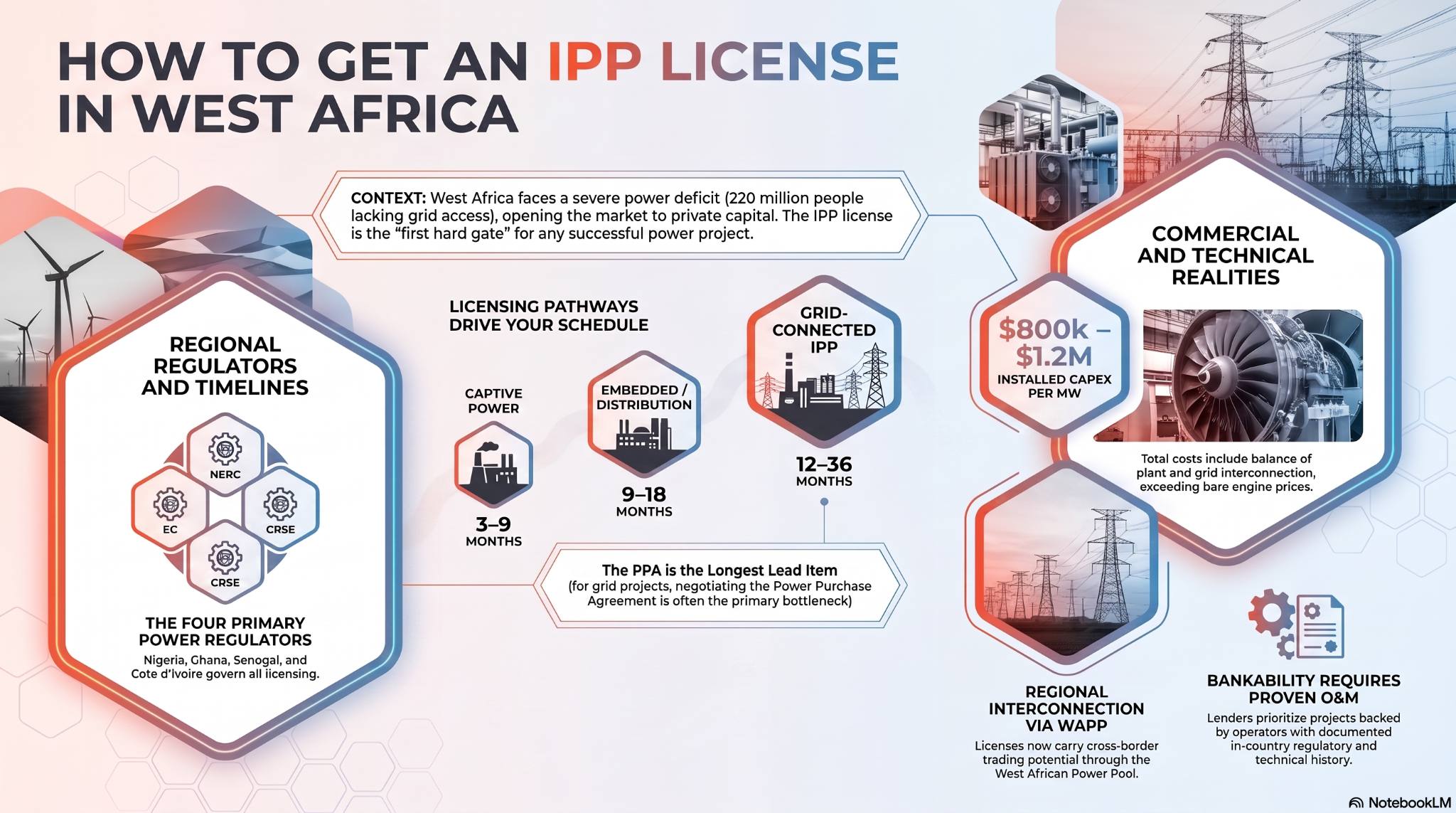
Across West Africa, more than 220 million people still live without reliable grid electricity, and the region loses an estimated 35 to 40 percent of the power it generates to ageing transmission and distribution infrastructure, according to the ECOWAS Commission. That gap is the single largest commercial opportunity in the region’s energy sector, and it is the reason governments from Lagos to Dakar have opened generation to private capital. Understanding how to get an IPP license in West Africa is the first hard gate every independent power producer must clear before a single turbine is ordered or a power purchase agreement is signed.
This guide maps the licensing pathway country by country, names the regulators and the laws they enforce, and sets out realistic approval timelines so your project is built on a compliant foundation from day one. An IPP, or independent power producer, is a privately owned company that generates electricity for sale to a utility, a large industrial off-taker, or the grid, under a long-term contract. Your project is the hero of this story. USP&E Global, with 150+ projects delivered across 35+ countries over 25 years of operation, is the experienced guide that helps you navigate the regulatory maze without costly missteps. The licensing process is where most projects stall, and it is where the right technical and commercial partner earns its place.
The Energy Challenge in West Africa: What the Data Shows
West Africa’s power deficit is severe, persistent, and unevenly distributed. Nigeria alone, the region’s largest economy, delivers only a fraction of the generation its population requires, and grid reliability across the fifteen ECOWAS member states remains among the lowest in the world. The International Energy Agency reports that the pace of new electricity connections across sub-Saharan Africa has slowed rather than accelerated, with fewer than 19 million people gaining access in 2024, below the rate achieved in 2019. Independent power producers are increasingly the mechanism by which governments close this gap, because public utilities lack the balance-sheet capacity to fund new capacity alone.
The table below summarizes the licensing landscape across the region’s four largest IPP markets. These figures shape the difficulty and the timeline of the approval you will pursue.
|
Country |
Primary Electricity Regulator |
Governing Law |
Typical License Term |
Single Buyer / Grid Off-taker |
|
Nigeria |
Nigerian Electricity Regulatory Commission (NERC) |
Electricity Act 2023 |
Up to 15 years, renewable |
NBET / bilateral and eligible customers |
|
Ghana |
Energy Commission |
Energy Commission Act 1997 (Act 541) |
Definite period, renewable |
ECG / bulk customers via PURC tariffs |
|
Senegal |
Commission de Regulation du Secteur de l’Energie (CRSE) |
Electricity Code (Law 98-29, reformed 2021) |
Set by concession terms |
Senelec (single buyer) |
|
Cote d’Ivoire |
Autorite Nationale de Regulation du secteur de l’Electricite (ANARE-CI) |
Electricity Code 2014 |
Set by convention |
CI-Energies (single buyer) |
Regional coordination adds a second layer. The West African Power Pool, created under ECOWAS, now interconnects nine mainland countries and is extending toward the remaining member states, which means a generation license granted in one country increasingly carries cross-border trading implications. The ECOWAS Regional Electricity Regulatory Authority (ERERA) governs that regional market. For developers, this is good news: a well-structured IPP can, over time, sell into a market far larger than any single national grid. The World Bank tracks the access and investment data that lenders rely on when they underwrite these projects, and those datasets should inform your feasibility case.
Key Drivers of How to Get an IPP License in West Africa: Why Now Is the Critical Window
The regulatory environment has shifted decisively in favor of private generation over the past five years. Understanding how to get an IPP license in West Africa is urgent precisely because the policy window is open now and competition for the best off-take contracts is intensifying. Five drivers define this moment.
- Utility reform and unbundling. Nigeria’s Electricity Act 2023 replaced the older sector-reform statute and devolved licensing powers, allowing state governments to regulate intrastate generation while NERC retains national oversight. Senegal’s 2021 reform is transforming Senelec into a holding company with separated generation, transmission, and distribution arms. These reforms create clearer entry points for IPPs.
- Mining and industrial demand. Gold, lithium, and bauxite operations across Mali, Burkina Faso, Guinea, and Ghana require firm, uninterrupted power that public grids cannot supply. Captive and embedded IPP projects serving a single industrial off-taker often face a lighter licensing burden than grid-connected plants.
- Data center and digital infrastructure growth. Coastal hubs in Nigeria, Ghana, and Senegal are attracting data center investment that demands 99.9 percent-plus availability, a standard that makes independent generation with guaranteed uptime commercially essential.
- Regional renewable targets. ECOWAS aims to raise the renewable share of the regional electricity mix to 48 percent by 2030, including large hydropower, per the ECOWAS Renewable Energy Policy. This target is opening dedicated licensing and procurement tracks for solar, wind, and hybrid IPPs.
- Population and GDP growth. West Africa’s population and economies continue to expand faster than grid capacity, guaranteeing structural demand for new generation for decades.
The commercial stakes vary sharply by licensing route. The table below compares the three most common IPP structures a developer will choose between.
|
IPP Project Structure |
Licensing Complexity |
Typical Approval Time |
Best Application |
|
Grid-connected IPP with PPA |
High: full generation license plus grid connection and PPA |
12 to 36 months |
Utility-scale sale to national grid |
|
Embedded / distribution-connected |
Medium: generation license plus distribution connection agreement |
9 to 18 months |
Supply to a defined network area or cluster |
|
Captive power (self-consumption) |
Lower: permit rather than full license in most markets |
3 to 9 months |
Mining, industrial, and data center self-supply |
EPC and O&M Solutions for West African IPP Projects: A Technical and Commercial Overview
Securing the license is one milestone; building a plant that meets the license conditions and the PPA availability guarantees is another. West African IPP projects sit in demanding physical conditions: high ambient temperatures that derate turbines, variable fuel quality, remote sites with long logistics chains, and local-content requirements that shape procurement. A generation license typically obliges the holder to construct, own, operate, and maintain the plant to defined technical standards, so the engineering choices you make at feasibility stage determine whether you can honor the license for its full term.
EPC, or engineering, procurement, and construction, is the turnkey delivery of the plant. O&M, or operations and maintenance, is the long-term running of it. In West Africa the two are inseparable in practice, because a lender financing your PPA will want a credible operator standing behind the availability guarantee. USP&E delivers both, drawing on power plant engineering and operations and maintenance teams that have run plants in Mali, Togo, Sierra Leone, and across the region.
Configuration depends on fuel availability and off-take profile. Diesel gensets and mobile gas turbines mobilize fastest and suit early-stage or bridging power. Natural gas turbines, where a gas supply agreement exists, offer the lowest running cost at scale. HFO plants deliver low fuel cost but require long lead times and cannot be fast-tracked, a reality worth stating plainly to any board expecting a 90-day HFO commissioning. Hybrid systems that pair thermal generation with solar and storage are increasingly favored under ECOWAS renewable targets, and USP&E’s hybrid power systems practice is built for exactly this transition.
Fast-track and standard timelines differ materially, and licensing conditions often reference the commissioning schedule, so the table below is directly relevant to your license application.
|
Delivery Path |
Engineering and Procurement |
Construction and Commissioning |
Total to Power |
|
Mobile gas turbine (fast-track) |
4 to 8 weeks |
8 to 16 weeks |
Under 6 months |
|
Diesel genset plant |
6 to 10 weeks |
10 to 20 weeks |
4 to 8 months |
|
HFO power station |
12 to 16 weeks |
8 to 14 months |
9 to 18 months |
|
Natural gas turbine (permanent) |
12 to 20 weeks |
10 to 18 months |
12 to 30 months |
On cost, honest ranges matter more than headline numbers. Installed CapEx for thermal IPP plants in the region commonly runs between 800,000 and 1,200,000 US dollars per MW once balance of plant, grid interconnection, fuel reticulation, and civil works are included, well above the bare engine or turbine price. OpEx is dominated by fuel and by the O&M contract that underwrites your availability guarantee.
Fuel Type Comparison for West Africa Power Projects
|
Fuel Type |
CapEx |
OpEx |
Lead Time |
Best Application |
|
Natural gas |
Medium to high |
Low |
Long |
Grid-scale baseload where gas supply exists |
|
HFO (heavy fuel oil) |
High |
Low to medium |
Long (9 to 18 months) |
Baseload where gas is unavailable |
|
Diesel |
Low |
High |
Short |
Bridging, peaking, remote sites |
|
Solar hybrid |
Medium |
Very low |
Medium |
Daytime load, mining, ECOWAS renewable targets |
Case Studies: Proven Results for Independent Power Producers in West Africa and Similar Markets
USP&E’s track record across the region gives license applicants a credible operating partner to name in their submissions, which lenders and regulators both value. The examples below reflect the kind of outcomes documented in the USP&E project portfolio and experience. Specific client names, MW figures, and performance percentages are flagged for internal verification before publication.
In Mali, USP&E has designed, built, and operated diesel and HFO power stations serving major mining clients since 2006, with a large engineering and technician workforce based in-country. Mining IPPs of this type typically run under captive or embedded structures, which shortens the licensing path while still requiring rigorous fuel supply and environmental documentation. [Verify: named mining clients and installed MW.]
In Togo, USP&E has operated natural gas turbine-driven generation since 2024, contributing to grid supply through a regional off-take arrangement. Grid-connected projects like this require the full generation license and a negotiated PPA, and the operating history strengthens any future license renewal. [Verify: MW under operation and off-taker name.]
In Sierra Leone, USP&E delivered diesel and HFO power stations for mining and hospitality clients dating back over a decade, demonstrating the remote-logistics and fuel-handling capability that West African IPP sites demand. These references are drawn from the client references record. [Verify: client names and outcome metrics.]
The common thread is that a documented operating history in the specific country materially improves both the speed of licensing and the bankability of the PPA. Regulators grant licenses to applicants who can prove they will honor the conditions, and lenders finance projects backed by operators who have done it before.
How to Select the Right EPC Partner for Your IPP License in West Africa: 10 Critical Criteria
Choosing the partner who will help you secure and then deliver on your license is the highest-leverage decision a developer makes. Evaluate every candidate against these criteria.
- In-country regulatory experience. The partner should have navigated the specific national regulator, whether NERC, the Ghana Energy Commission, CRSE, or ANARE-CI, not merely worked in the region generally. Regulatory nuance is local.
- Integrated EPC and O&M capability. A partner who both builds and operates can stand behind the availability guarantees your PPA and license require, which single-scope contractors cannot.
- Bankability and lender familiarity. The partner’s name and track record should reassure the development finance institutions and commercial banks that fund IPP projects, shortening due diligence.
- Fuel-agnostic engineering. The right partner designs to the fuel realistically available at your site rather than pushing a single technology, and is candid about lead times, especially for HFO.
- Local content and workforce depth. Many West African licenses carry local-participation conditions. A partner with existing in-country engineers and technicians helps you meet them.
- Compliance and ethics record. Independent power producers operating with international lenders must satisfy anti-corruption and sanctions rules. Confirm the partner’s FCPA and OFAC compliance posture before you engage.
- Proven remote logistics. West African sites are often far from ports. The partner should demonstrate real capability moving heavy plant to difficult locations.
- Transparent, honest timelines. Beware anyone promising HFO commissioning in 90 days. Credible partners give you ranges grounded in engineering reality.
- Financial stability and litigation history. A partner with 25 years of operation and zero lawsuits signals the reliability that a decades-long PPA demands.
- ISO 9001:2015 quality management and ISO 45001:2018 occupational health and safety certification are baseline expectations for any serious IPP partner.
USP&E meets these criteria as an integrated EPC and O&M provider, and developers can review the full capability on the EPC construction and about USP&E pages.
Frequently Asked Questions: How to Get an IPP License in West Africa
What is the first step to get an IPP license in West Africa?
The first step is identifying the correct national regulator and confirming which license type your project needs. In Nigeria that is NERC under the Electricity Act 2023; in Ghana the Energy Commission under Act 541; in Senegal the CRSE; and in Cote d’Ivoire ANARE-CI. Before applying, most regulators require you to register the project, prove site control, and demonstrate technical and financial capacity. Engaging an experienced EPC and O&M partner at this stage prevents the documentation gaps that cause most early rejections.
How long does it take to get an IPP license in West Africa?
Timelines vary by country and by project structure. A captive or self-consumption permit for an industrial or mining site can be approved in roughly 3 to 9 months, while a full grid-connected generation license with a negotiated power purchase agreement commonly takes 12 to 36 months. The PPA negotiation, not the license itself, is often the longest single step. Building a realistic timeline into your feasibility study is essential.
Do I need a power purchase agreement to get an IPP license?
For grid-connected projects, yes, in practice. Most West African regulators treat the license and the PPA as linked, and in several markets, including Ghana, obtaining the generation license is a condition precedent to the PPA taking effect. The single buyer is usually the state utility, such as Senelec in Senegal or CI-Energies in Cote d’Ivoire. Captive projects that consume all their own power generally do not require a PPA.
What is the minimum plant size that requires an IPP license?
Thresholds differ by country. In Nigeria, a generation undertaking exceeding 1 MW at a site generally requires a NERC license or permit, while very small installations may be exempt. Other markets set their own thresholds, and captive plants above defined limits still require a permit even when no electricity is sold to third parties. Always confirm the current threshold with the specific national regulator.
Can one IPP license let me sell power across West African borders?
Not directly, but the regional market is moving that way. The West African Power Pool now interconnects nine mainland countries, and cross-border trade is regulated at the regional level by ERERA under ECOWAS. A national license is the foundation, and regional trading arrangements are layered on top through the pool. This is why a well-structured independent power producer can eventually access demand far beyond a single national grid.
How much does it cost to develop an IPP project in West Africa?
Installed CapEx for thermal IPP plants commonly runs between 800,000 and 1,200,000 US dollars per MW once balance of plant, grid interconnection, fuel systems, and civil works are included. The bare turbine or engine price is only a fraction of this. Development costs, including feasibility studies, licensing, and PPA negotiation, are additional and should be budgeted from the outset. A conceptual feasibility and engineering study is the disciplined way to establish these numbers before committing capital.
What compliance rules apply to independent power producers in West Africa?
IPPs working with international lenders and equipment suppliers must satisfy anti-corruption and sanctions requirements, including the US Foreign Corrupt Practices Act and OFAC sanctions rules where a US-linked party is involved. National licensing also carries local-content, environmental, and technical-standard conditions. Choosing a partner with a clean compliance record and clear FCPA and OFAC posture protects the whole project from regulatory and financing risk.
Summary: Key Takeaways for How to Get an IPP License in West Africa Decision-Makers
- Knowing how to get an IPP license in West Africa starts with identifying the correct national regulator: NERC in Nigeria, the Energy Commission in Ghana, CRSE in Senegal, and ANARE-CI in Cote d’Ivoire.
- License type drives timeline: captive permits take 3 to 9 months, while grid-connected generation licenses with a PPA take 12 to 36 months.
- For grid-connected projects the license and the power purchase agreement are linked, and the PPA is usually the longest step.
- Regional interconnection through the West African Power Pool and ERERA is expanding the market a licensed independent power producer can reach.
- Installed CapEx typically runs 800,000 to 1,200,000 US dollars per MW; the engine or turbine price alone is misleading.
- The right EPC and O&M partner, with in-country experience, integrated delivery, and a clean compliance and litigation record, is the difference between a license granted and a project stalled.
- USP&E Global brings 150+ projects across 35+ countries, 350+ engineers, ISO 9001:2015 and ISO 45001:2018 certification, and 25 years with zero lawsuits to guide independent power producers through licensing and delivery.
Ready to Power Your Project? Talk to USP&E’s Engineers Free.
USP&E Global offers a complimentary 4-hour engineering consultation for qualified power station, EPC, and O&M projects. Whether you are in early feasibility or ready to mobilize, our team of 350+ engineers across 35+ countries is ready to guide your project to success with speed and without excuses.
USP&E Global, Powering Possibility. Built for the Frontier.
ISO 9001:2015 | ISO 45001:2018 | 150+ Projects | 35+ Countries | Zero Lawsuits
Quick Links:
- Contact USP&E by clicking on this link.
- Request a fast equipment quote
Global Resources
- USP&E's Project Experience Portfolio
- USP&E Case Studies and Client Reference Letters
- USP&E Integrity and Compliance policy
- USP&E's ISO Certifications and Credentials